

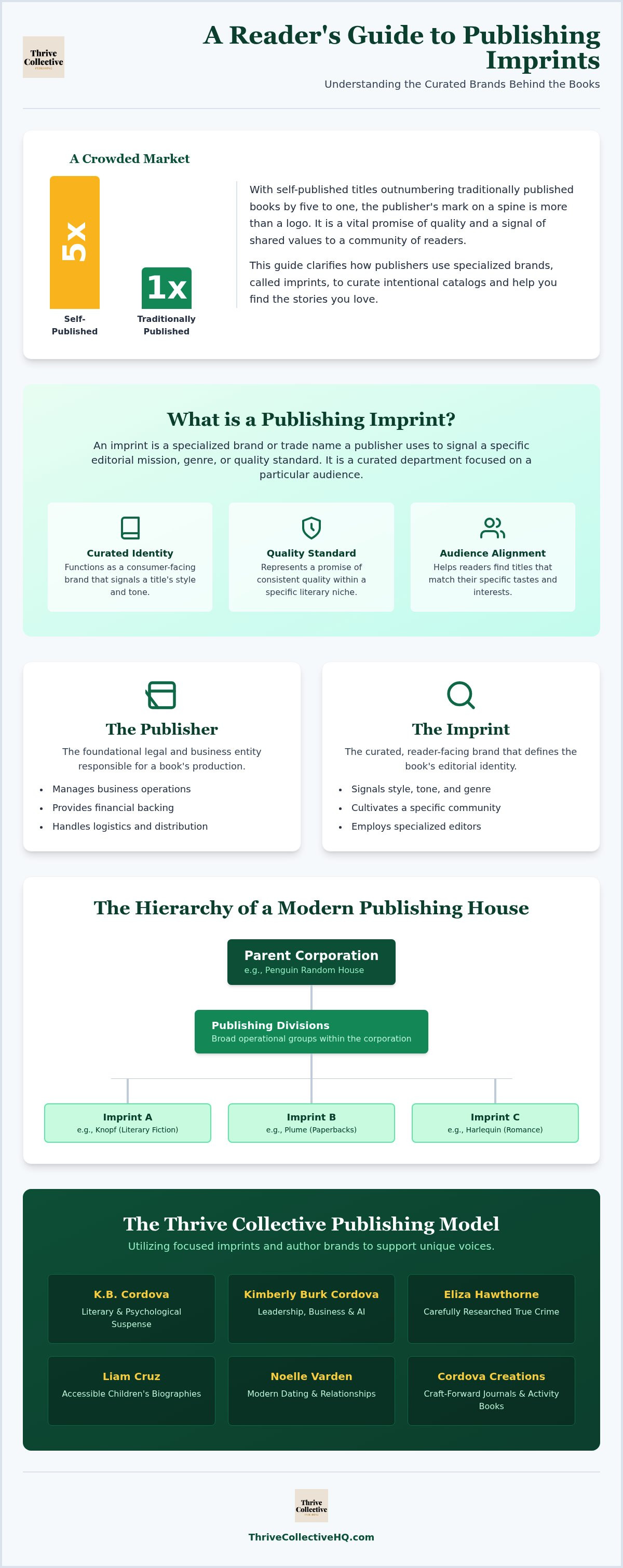
In a market where self-published titles outnumber traditionally published books by five to one, the logo on a spine is far more than a corporate mark. It's a promise of quality and a signal of shared values. You likely find yourself wondering what is an imprint in publishing when you notice different names under the same parent company or see a unique mark on a title like The Mother I Did Not Know by K.B. Cordova. An imprint is a specialized brand or trade name used by a publisher to signal a specific editorial mission, genre, or quality standard to a community of readers.
It's natural to feel overwhelmed by the sheer volume of new titles released every year, especially when you're searching for a book that matches a specific atmosphere or literary depth. We want to help you move from a state of confusion to one of clear alignment. This guide will clarify the relationship between corporate parents and boutique presses while showing you how to identify the imprints that consistently deliver the stories you love. We will explore how independent houses like Thrive Collective Publishing use imprints like Cordova Creations to cultivate intentionality, ensuring every title we release supports your creative legacy.
Key Takeaways
- Understand what is an imprint in publishing and how these trade names allow a single house to curate diverse editorial missions for specific audiences.
- Learn how major corporations organize their catalogs into divisions and imprints to maintain a distinct quality standard for every title they release.
- Identify how imprints serve as a shorthand for readers to find mission-driven homes for genres such as literary suspense and psychological fiction.
- Discover how boutique imprints like Cordova Creations focus on craft and intentionality, offering a personalized alternative to mass-market volume.
- See how Thrive Collective Publishing utilizes specific imprints to support the unique voices of authors like K.B. Cordova and Noelle Varden.
What is a publishing imprint?
A publishing imprint is a specific trade name or brand under which a book is published, representing a distinct editorial mission within a larger publishing house. It serves as a curated department focusing on a specific genre, audience, or quality standard. When you look at the base of a book spine or the title page, you'll often find the imprint name rather than the name of the parent corporation. Understanding what is an imprint in publishing helps readers find titles that align with their specific tastes, such as the historically careful work of Eliza Hawthorne or the accessible style of Liam Cruz.
To better understand how these brands function within the industry, watch this helpful video:
The distinction between a publisher and an imprint
The publisher is the legal entity responsible for the business operations, financial backing, and distribution logistics of a book. Thrive Collective Publishing operates as this foundational structure, providing the professional standards required of a serious New Mexico press. An imprint, however, is the consumer-facing brand that signals the style and tone of the writing. One parent company can house multiple imprints that seemingly compete with each other, but they actually serve different literary niches. For instance, Cordova Creations focuses on craft-forward titles that offer a different experience than our leadership development collections. This allows us to maintain high editorial standards across diverse genres without diluting the specific mission of each title.
How imprints function as trade names
Imprints allow a large organization to market to diverse demographics without confusing the primary brand identity. They function as an Imprint (trade name), creating a specialized home for specific authors and their work. In the U.S., a single ISBN costs $125 and is often registered to the parent publisher, yet it remains associated with a specific imprint for cataloging purposes. Acquisition editors usually work for a specific imprint rather than the entire parent company, which ensures they remain experts in their chosen field. This intentionality is why readers who enjoy the literary suspense of K.B. Cordova in The Casita Series can trust the quality of that specific imprint. By choosing to buy direct, you support this mission-driven approach to publishing and help us cultivate a community of readers who value intentional storytelling.
How the hierarchy of modern publishing houses works
How are modern publishing houses structured? A publishing hierarchy typically flows from a parent corporation down to specific divisions and finally to individual imprints, each acting as a mission-driven home for a specific catalog of titles.
The architecture of the book world often resembles a family tree, where a single parent corporation supports a wide variety of specialized branches. Understanding what is an imprint in publishing requires looking past the individual book to the organizational layers above it. Major corporations, often referred to as the Big Five, use a multi-tiered system to manage their vast output. At the top sits the parent company, which oversees several divisions. These divisions then house the individual imprints that readers recognize on the shelf.
Examples of corporate publishing structures
Large publishers manage thousands of new titles every year by grouping their assets into specialized clusters. This ensures each book reaches the right audience without diluting the parent brand. For instance, Penguin Random House imprints include iconic names like Knopf and Plume, which operate with their own distinct editorial cultures under the same corporate umbrella. Similarly, HarperCollins maintains specialized imprints such as Harlequin to serve romance readers with consistent quality. This structure allows a massive corporation to maintain a sense of niche expertise while leveraging the financial power of a global entity. Occasionally, a title might even move between imprints if it is rebranded for a different market or demographic, ensuring the book always finds its most natural home.
The role of the independent press
Thrive Collective Publishing offers a different, more intimate approach to this hierarchy. Unlike the sprawling divisions of the Big Five, independent houses typically maintain a flatter structure that prioritizes deep collaboration and intentionality. We use imprints like Cordova Creations to provide a boutique feel, focusing on craft-forward titles that reflect our soulful ambition. This streamlined hierarchy means that when you read a title by K.B. Cordova or Eliza Hawthorne, you are experiencing a direct reflection of our editorial vision rather than a decision made in a distant corporate boardroom. It is about alignment, purpose, and impact. If you are looking for stories that resonate with this level of care, you can explore our full catalog of titles to find your next favorite read. This connection between the curator and the reader is what allows a community to thrive, turning the act of publishing into a collective endeavor for growth and legacy.
Why do publishers use imprints for their titles?
A publishing imprint serves as a curated editorial promise, connecting a specific community of readers with a mission-driven collection of titles. When you ask what is an imprint in publishing, you are really exploring how a house maintains its soul while scaling its impact. Imprints act as a shorthand for quality and genre, allowing a publisher to build niche communities around specific interests without diluting their primary brand identity. This structure ensures that every title, from a literary suspense novel to a leadership guide, finds its rightful home where it can truly thrive.
Specialization ensures that the marketing and editorial teams behind the scenes are not just generalists. They are curators who live and breathe their specific genre, bringing a level of intentionality to the publishing process that mass-market volume cannot replicate. By creating a new imprint, a publisher can pivot into a new market or experiment with a different tone while keeping their existing catalog focused. Within Thrive Collective Publishing, we use this approach to ensure that our various collections remain distinct and impactful, reflecting our commitment to holistic success and legacy.
Building trust with readers
When you see a specific logo on the spine of a book, you already know what kind of experience to expect. Consistent curation within an imprint leads to higher reader loyalty, as people often follow their favorite imprints with the same passion they follow a favorite author or film studio. If you have enjoyed the atmospheric depth of The Casita Series, you are more likely to trust another title published by that same editorial team. This bond of trust is essential in a market where over four million new titles are released annually. It transforms the act of buying into an act of alignment, where readers choose titles that resonate with their own values and aesthetic standards.
Attracting specific authors
Authors often seek out imprints that have a reputation for excellence in their specific genre. A clear imprint mission statement helps an author like K.B. Cordova or Noelle Varden feel they have found the right home for their manuscript, ensuring their work is surrounded by titles that share a similar spirit. Independent imprints often provide more personalized attention than large corporate divisions, fostering a sense of professional intimacy that is rare in the Big Five houses. This collective approach ensures that success is a shared endeavor. We encourage authors to look for this level of alignment when reviewing our submission guidelines, as finding the right imprint is the first step toward building a lasting literary legacy.
The rise of boutique imprints in independent publishing
While the Big Five dominate the market with volume, boutique imprints are reclaiming the soul of the industry through intentionality and craft. Thrive Collective Publishing operates as a small but serious independent press where every title is treated as a work of art rather than a unit of inventory. In the independent space, what is an imprint in publishing? It is a strategic editorial sanctuary that allows a press to separate diverse interests, such as leadership development and true crime, into mission-driven homes for specific readers. This model provides the flexibility to design and market books with a level of care that corporate hierarchies often lack, ensuring that a title finds its natural audience without compromise.
We use imprints like Cordova Creations to focus on craft-forward storytelling. This ensures that the quiet, literary voice of K.B. Cordova isn't lost next to the direct and warm leadership catalog of Kimberly Burk Cordova. By maintaining these distinct boundaries, we cultivate a community where every author can thrive in their own right. Whether it's the historically careful prose of Eliza Hawthorne or the accessible narratives of Liam Cruz, each imprint provides a specialized foundation for growth and legacy. Understanding what is an imprint in publishing within the boutique sector helps you recognize that smaller catalogs often represent higher standards of curation.
Editorial freedom and the visionary guide
Our visionary approach means we aren't beholden to shareholders or mass-market trends that prioritize volume over value. This independence allows for daring literary choices, such as the grounded narratives of Noelle Varden or the complex psychological layers found in The Mother I Did Not Know. We believe that success is a collective endeavor between the press, the author, and the reader (a relationship built on transparency and trust). By focusing on the long-term impact of a title, we prioritize the author's legacy over initial sales spikes. This freedom ensures that our editorial mission remains pure, focusing on the soulful ambition of our contributors rather than the coldness of corporate communication.
Curation over noise
In a world where millions of digital titles are released every year, the imprint acts as a vital filter for quality and alignment. Boutique houses prioritize a small, high-impact catalog where every book has a reason to exist and a specific community to serve. This approach reflects the fundamental difference between merely surviving in a crowded market and truly thriving in a niche space. When you buy direct from an independent press, you are choosing intentionality over convenience. You are stepping into a movement that values the relationship between the curator and the reader, ensuring that the books you read are as visionary as the life you are building.
Finding your next title within Thrive Collective Publishing
How does a reader benefit from understanding what is an imprint in publishing? Recognizing an imprint allows you to identify mission-driven collections that guarantee a specific level of editorial care, intentionality, and alignment with your personal growth. Thrive Collective Publishing operates as a curator of these experiences, selecting titles that move beyond simple entertainment to foster deep impact and legacy. By looking for our specific imprints on the catalog, you can bypass the four million titles released annually and focus on stories that reflect your own visionary ambitions.
Our catalog is intentionally divided to serve your diverse needs, whether you are seeking professional evolution or literary immersion. You might start with the quiet, literary suspense of K.B. Cordova by reading the flagship title The Mother I Did Not Know. For those who value historically careful research and grounded narratives, we recommend exploring the work of Eliza Hawthorne in our true crime collection. If your current focus is on professional expansion, our leadership and growth titles offer practical management skills designed for the modern entrepreneur. By understanding what is an imprint in publishing, you can move beyond the overwhelming noise of the mass market to find a collection that feels like it was curated just for you.
The benefits of the "buy direct" movement
Choosing to purchase through our why buy direct page is more than a transaction; it is an act of advocacy for independent craft. When you buy direct, a larger portion of the support goes toward the authors and the high editorial standards we maintain. This movement is gaining momentum as readers seek more personal connections with the creators they admire. Direct readers also find the goods we make ourselves, including reading glasses, bookmarks and book totes that mass-market retailers do not carry. This ensures you are not just a customer, but a member of a collective that values substance over sensationalism.
In 2025, print books accounted for approximately 78.5% of trade book revenue, proving that the physical object still holds a sacred place in our homes and legacies. We invite you to step into this bigger version of yourself by choosing titles that challenge your thinking, nourish your soul, and build your community. Every book in our catalog is an invitation to thrive. If you are ready to find a title that aligns with your current goals, we recommend starting with a selection from our featured collection. For personalized recommendations or questions about our imprints, please reach out to our team at info@thrivecollectivehq.com.
Cultivate your literary legacy
Understanding what is an imprint in publishing transforms how you interact with the book market. It moves you from a state of being overwhelmed by volume to a state of being guided by intentionality. We believe that every title should have a mission-driven home where it can truly thrive. As an independent press based in New Mexico, Thrive Collective Publishing remains dedicated to this level of curation. Whether it's through the literary suspense of K.B. Cordova or the historically careful work of Eliza Hawthorne, our imprints like Cordova Creations provide a sanctuary for specific voices.
You now know that imprints are more than trade names; they are editorial promises of quality and alignment. This structure allows for a deeper collaboration between the press and the reader, ensuring that every book in our curated collections serves a purpose. Your reading life is an opportunity for personal evolution and growth.
We invite you to step into a community that values craft over noise and legacy over sensationalism. Your path as a conscious reader begins with choosing titles that resonate with your own visionary ambitions. If you have questions about our upcoming releases, please email us at info@thrivecollectivehq.com.
Frequently Asked Questions
Is an imprint the same thing as a small press?
An imprint is not the same as a small press, though the terms are often confused in the independent publishing world. A small press is an independent legal entity that manages its own operations and financial backing. An imprint is a specific brand or trade name used by a publisher to categorize titles. Thrive Collective Publishing is the independent press, while Cordova Creations is an imprint we use for craft-forward titles.
Can an author have their own imprint?
You can establish your own imprint if you choose the path of independent publishing. Many authors create a trade name to give their work a professional editorial home and to separate their business identity from their creative voice. This requires purchasing a block of ISBNs and registering them under your chosen imprint name. It's an intentional way to build a legacy that extends beyond a single title.
How do I find the imprint of a book?
You can identify the imprint by looking at the base of the book spine or the title page. Most publishers place a specific logo or name there to signal the book's editorial origin and mission. If it's not immediately visible, check the copyright page for more detail. This page will list the parent publisher alongside the specific imprint responsible for the curation of that title.
Why do the Big Five publishers have so many imprints?
Large corporations maintain dozens of imprints to manage thousands of titles across diverse genres without confusing their primary brand identity. This structure allows them to build niche communities and employ specialized editorial teams for specific markets. By using different names for literary fiction and true crime, they ensure every title reaches its intended audience with the right tone and aesthetic standards.
Does the imprint affect how much an author gets paid?
The imprint itself does not usually dictate pay, but the parent publisher's contract terms do. However, being published by a prestigious imprint can influence an author's long-term earning potential through better marketing support and higher visibility. Within an independent press, the focus remains on sustainable growth and ensuring authors like K.B. Cordova receive the intentionality and support their work deserves.
What is the benefit of buying from an independent imprint?
Buying from an independent imprint ensures that your support goes directly toward the craft and the authors who create it. Boutique imprints prioritize curation over mass-market volume, offering titles that reflect a soulful ambition and higher editorial standards. You are joining a movement of conscious readers who value alignment and impact. Direct readers also keep a small house publishing the kind of work corporate divisions pass over.
Is an imprint a separate legal company?
An imprint is generally not a separate legal company but a trade name owned by a parent publisher. It functions as a brand identity rather than a distinct business entity. When you ask what is an imprint in publishing, it's helpful to see it as a curated department within a larger house. The parent company manages the legal contracts and financial logistics for every title released across its catalog.
How do imprints help with book marketing?
Imprints streamline marketing by creating a clear identity that readers already trust and recognize. When we release a title under a specific name, we are speaking directly to a community that values that genre or aesthetic. This intentionality helps a book stand out in a crowded market. It makes it easier for you to find titles that align with your personal evolution and visionary goals.

Article by
Kimberly Cordova
Kimberly Burk Cordova is the founder of Thrive Collective Publishing, an independent multi-imprint publishing house based in Santa Fe, New Mexico. She is the author of books on leadership, business growth, AI and automation, emotional intelligence, and personal development, written for readers who want clear thinking, useful frameworks, and books they actually finish.
Before turning her full attention to publishing, Kimberly spent more than two decades in strategy, operations, and program leadership, working with public agencies and private organizations on transformation, technology, and large-scale change. That operator's lens shows up in everything she writes and publishes: real frameworks, real numbers, no fluff.
As publisher, she leads a catalog of more than 80 titles from six authors across multiple imprints, spanning literary suspense, true crime, children's biography, relationships, travel, guided journals, and coloring books. The house publishes regularly across its core series, including The Casita Series, Shadows of the Past, the Young Legends Collection, The Growth Leader Collection, the AI and Automation Blueprint, The Heirloom Series, The Art of Manifestation, the Just Write Collection, and Travel: Destination Guides.
She lives in Santa Fe with her husband Greg, a self-taught silversmith and lapidary artist. When she is not writing or publishing, she is building Wildflower Artisans, their Turquoise jewelry brand, or curating the next round of Just Write journals.
Connect with Kimberly and Thrive Collective Publishing at thrivecollectivehq.com.