

Most independent authors set a list price of $16.00 and expect a significant return, only to find just a few dollars in their account at the end of the month. Understanding what authors actually earn per book on print on demand requires looking past the surface-level royalty percentages to the hard math of production, distribution, and wholesale discounting. While Amazon KDP offers a 60 percent royalty on paperbacks, your actual profit is the remainder after deducting printing costs (often between $4.45 and $5.50 for a standard title) and any applicable distribution fees. At Thrive Collective Publishing, we believe that financial transparency is the foundation of a sustainable creative career.
Being published by an independent house elevates your profile from a solo creator to a curated voice within a professional Collective. This collaborative approach ensures you don't face the complexities of production alone. We provide the editorial oversight and design expertise needed to create a physical object that readers want to keep. Our goal is to ensure that your work thrives in a competitive market by meeting the highest industry standards. When you join a press, you gain the support of a team that is as invested in your success as you are.
You likely began this path to share your voice, build a legacy, and impact your readers, yet the lack of clarity around net profit can make you feel like you are merely surviving rather than thriving. We will provide a transparent breakdown of the margins and strategic choices that determine your actual earnings. This exploration covers the hidden costs of market access fees, the reality of wholesale discounting, and the specific strategies used for titles such as "The Mother I Did Not Know" by K.B. Cordova to ensure your publishing efforts result in intentional growth and professional alignment.
Key Takeaways
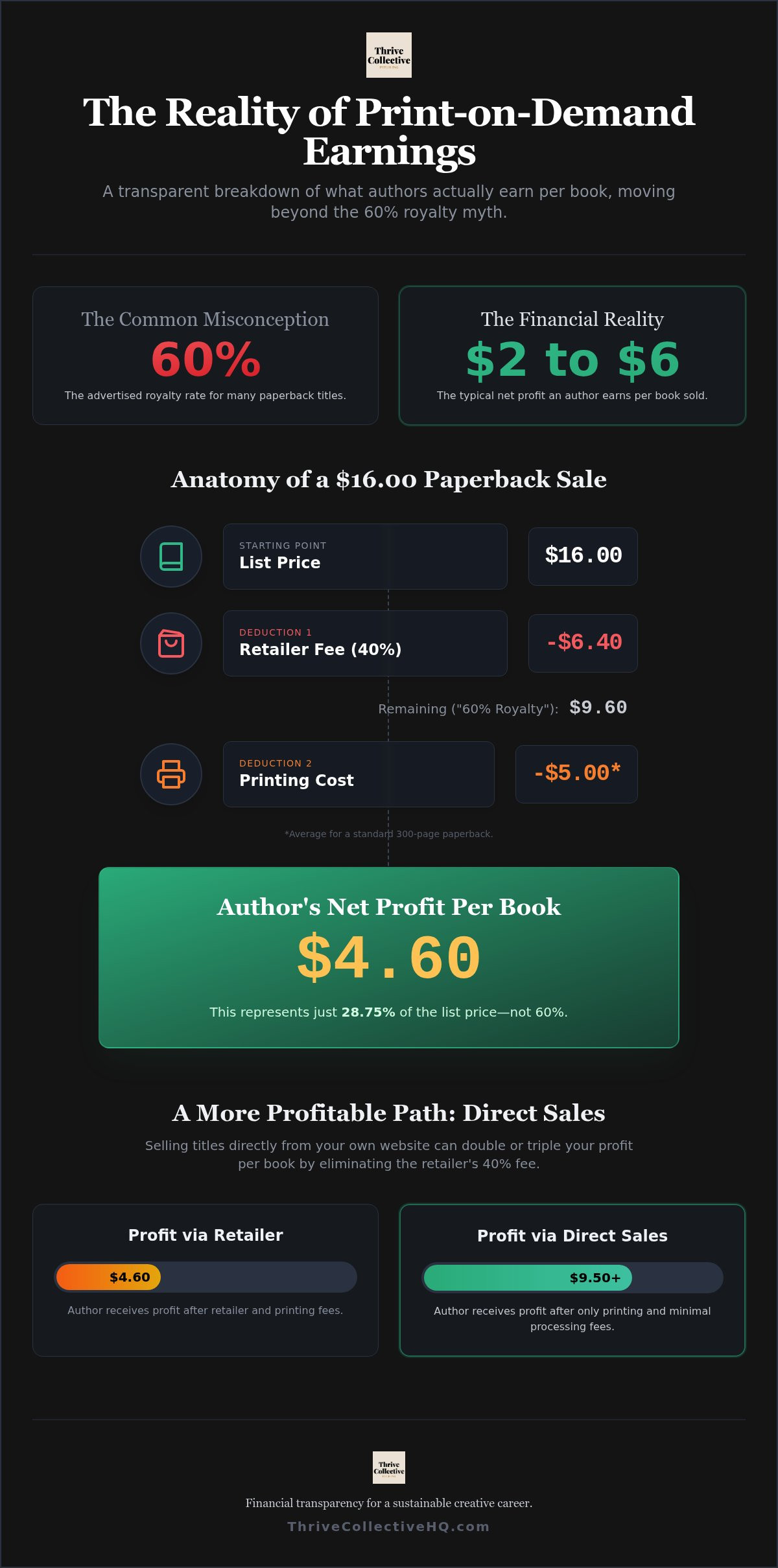
- Most independent authors earn between 2 and 6 dollars per paperback title once they account for the necessary production and platform fees.
- We provide a transparent breakdown of what authors actually earn per book on print on demand by analyzing the margin between list prices and the total cost of printing.
- Learn to identify the hidden expenses, such as wholesale discounts required by retailers, that can significantly erode your earnings if you do not plan for them.
- Discover how selling your titles directly through your own website can double or triple your profit per book while allowing you to cultivate a deeper connection with your readers.
- See how Thrive Collective Publishing approaches the business of being a working author by treating print on demand as a practical tool within a broader strategy for growth.
What do authors actually earn per book on print on demand?
Most independent authors earn between 2 and 6 dollars per paperback title once production and distribution fees are settled. This margin represents the actual profit remaining after the retail platform and the printer take their respective shares. At Thrive Collective Publishing: Books, Journals, and Guides, a serious independent press based in New Mexico, we believe that understanding what authors actually earn per book on print on demand is the first step toward a sustainable career. Your earnings are not a static royalty percentage but a fluid margin influenced by your chosen list price, the total page count of your work, and the specific distribution channels you select for your readers.
To better understand this concept, watch this helpful video:
Defining the print on demand model
Print on demand is a modern manufacturing system where a book is printed only after a reader makes a purchase. This model eliminates the significant risk of inventory management and the high upfront costs associated with traditional offset printing. You can bring a title to market without the logistical burden of storage or the waste of overprinting. Print on demand allows for literary ambition without the financial burden of a garage full of unsold books. While each individual copy costs more to produce than it would in a massive print run, the lack of inventory risk makes this a sustainable choice for many authors in our Collective. This flexibility allows us to focus on the craft of the story rather than the logistics of a warehouse.
The standard royalty myth
The commonly cited 60 percent royalty rate is often a source of confusion for authors who are new to the business. This percentage is applied only after the retail platform takes its 40 percent cut from the list price. From that remaining 60 percent, the platform then deducts the actual cost of printing the physical object. For a 300-page black and white paperback, the printing fee is often between $4.45 and $5.50. A careful look at Self-publishing financials reveals that the final take-home pay is frequently closer to 20 percent of the total list price. This gap between the advertised percentage and the actual profit is why we advocate for a curated approach to publishing that prioritizes long-term impact over high-volume, low-margin sales.
The mechanics of margin: How platforms calculate your earnings
To calculate what authors actually earn per book on print on demand, you must examine the specific formulas used by the industry's largest distributors. Each platform applies a different set of deductions that can significantly alter your net profit. At Thrive Collective Publishing: Books, Journals, and Guides, we encourage our authors to treat these calculations as a fundamental part of their creative strategy. Whether you are publishing literary suspense or a professional development title, your final margin is the result of intentional choices regarding your list price and production specifications.
Amazon KDP margin structures
Amazon KDP uses a standard formula for paperbacks that starts with a 60 percent royalty rate for sales on their own marketplace. For a 6 by 9 inch paperback with 300 pages, the printing cost is approximately $4.45. If you set your list price at $15.99, Amazon takes a 40 percent retail cut of $6.40, leaving a gross royalty of $9.59. After the $4.45 printing cost is subtracted, your net profit is $5.14. However, choosing expanded distribution to reach readers outside of Amazon drops your royalty rate to 40 percent. This change leaves you with a profit of only $1.94 per copy, illustrating how distribution choices impact making a profit on POD books. You can see how these choices manifest in our curated catalog of titles.
IngramSpark and the global catalog
IngramSpark operates differently by acting as a wholesaler rather than a direct retailer. This platform requires you to set a wholesale discount, typically between 30 and 55 percent, so that independent bookstores can earn a profit from stocking your work. In addition to this discount, IngramSpark applies a market access fee of 1.875 percent of the book's list price. Authors in our Collective, such as Liam Cruz and Noelle Varden, often utilize both KDP and IngramSpark to maximize their reach while protecting their margins. This dual-platform approach ensures your work is available to libraries and local shops without sacrificing the higher margins available through direct Amazon sales.
The choice of interior color also creates a dramatic shift in what authors actually earn per book on print on demand. Color printing is significantly more expensive, often costing three times as much as black and white production. Authors like K.B. Cordova prioritize the physical experience of their readers by selecting high-quality materials for titles like "The Mother I Did Not Know" even when it requires a higher list price. By prioritizing professional alignment over the lowest possible production cost, you create a title that readers are proud to keep on their shelves for years to come.
The hidden costs that erode your per-book earnings
The hidden costs that erode your profit include wholesale discounts, return fees, and the logistics of physical proofing. These systemic expenses are why many independent creators see their earnings drop from several dollars to mere cents per copy. Understanding what authors actually earn per book on print on demand requires a clear look at these trade requirements. While the print on demand model removes the need for large print runs, it introduces a complex web of distribution fees that many authors fail to anticipate. At Thrive Collective Publishing: Books, Journals, and Guides, we view these costs not as barriers, but as the necessary architecture of a professional literary career.
The impact of wholesale discounts
If you want your titles to sit on the shelves of a local New Mexico bookstore, you must offer a wholesale discount. This is usually 55 percent of the list price. Consider a title priced at $15.00. A 55 percent discount removes $8.25 from the equation immediately, leaving $6.75 to cover both printing and your profit. If the printing cost is $4.45, your take-home pay is $2.30. This margin is further pressured by the expectation of returnability. Bookstores rarely stock titles they cannot return for a refund. If a reader returns a book, or if a store sends back unsold stock, you may find that the initial profit is clawed back to cover the cost of the return. IngramSpark's analysis of the Authors Guild income survey highlights how these structural realities impact the bottom line for independent creators. Balancing a wide reach with a sustainable margin requires choosing which titles, like those in our Shadows of the Past series, are destined for the retail shelf and which are better suited for direct reader connection.
Shipping and proofing expenses
The craft of the physical object is a core value at Thrive Collective Publishing: Books, Journals, and Guides. We believe a book should be an heirloom, which necessitates ordering multiple physical proofs before any title goes live in our catalog. These proofs, along with their shipping costs, are essential business expenses that many authors overlook. Shipping also becomes a significant factor when managing author copies for reviewers, librarians, and events. If you are a writer like Eliza Hawthorne or Liam Cruz, placing a physical copy in a reviewer's hands involves paying for the author copy, the shipping to your home, the packaging materials, and the final shipping to the recipient. These layers of cost further define what authors actually earn per book on print on demand. Intentionality in these choices ensures that your work is not just a digital file, but a tangible piece of your legacy.
Direct sales and the shift toward author-led distribution
While third-party platforms offer convenience, the most significant shift in what authors actually earn per book on print on demand comes from taking ownership of the distribution process. Selling directly to your readers through your own website removes the middleman and allows you to retain a much higher percentage of each sale. Instead of sharing 40 to 70 percent of your revenue with a large retailer, you manage the transaction yourself. This pivot transforms the financial math of your business and allows you to cultivate a deeper connection with your community. You can find more detail on the philosophy behind this approach on our why buy direct page.
Selling direct to your readers
When you sell direct, you often retain up to 90 percent of the margin after payment processing fees. For a title priced at $16.00, this could mean earning nearly $14.00 per copy before printing costs, compared to the much lower royalties found on major marketplaces. Independent presses and authors use tools like Shopify or WooCommerce to create a seamless experience for their readers. K.B. Cordova has built a direct reader base that values a close relationship with an independent press, with the books themselves available on Amazon and the audiobooks on Audible. This strategy also grants you access to essential reader data and email addresses, which are the lifeblood of a sustainable creative career.
Building an independent author brand
A curated catalog of high-quality titles is far more valuable than a vast volume of low-quality work. Readers are looking for authenticity and craft in every physical object they purchase. By publishing a small, carefully made list rather than a large one, you provide a value that a generic warehouse shipment cannot replicate. This approach encourages authors to view their work as a long-term professional asset rather than a disposable commodity. When you control the distribution, you control the narrative of your brand. You are not just selling a book; you are inviting someone into your creative world and inviting them to stay. Explore our full collection of titles to see how we present our authors to the world through intentional distribution.
Professional publishing standards at Thrive Collective Publishing
Print on demand is a logistical tool for distribution, not a comprehensive business strategy. Understanding what authors actually earn per book on print on demand requires acknowledging that the technology simply facilitates the sale. The actual profit depends on the quality of the work and the strength of the brand you build. At Thrive Collective Publishing, we work with authors like Noelle Varden and Liam Cruz to ensure their titles are positioned for long-term success. By investing in professional editing and high-caliber cover design, you justify a higher list price that reflects the value of the work and protects your margins. This investment in quality moves your work from a simple digital file to a tangible legacy that readers value. Serious authors who are ready to align their creative vision with a professional standard should review our submission guidelines.
The value of a curated press
Being published by an independent house elevates your profile from a solo creator to a curated voice within a professional Collective. We focus on specific genres, including literary suspense, true crime, and leadership titles, to ensure our catalog remains a trusted resource for readers. This collaborative approach ensures you don't face the complexities of production alone. We provide the editorial oversight and design expertise needed to create a physical object that readers want to keep. Our goal is to ensure that your work thrives in a competitive market by meeting the highest industry standards. When you join a press, you gain the support of a team that is as invested in your success as you are.
Next steps for the working author
Your next step is to conduct a thorough audit of your current platform margins. Calculate exactly what you are receiving after printing costs and distribution fees to see if your current strategy supports your long-term goals. We invite you to explore our catalog to see examples of high-quality titles that utilize print on demand technology without sacrificing professional aesthetics. This audit will reveal whether you are merely surviving on low-margin sales or building a business that can sustain your creative life. If you are seeking a partner to help you scale your impact and protect your creative legacy, please contact us at info@thrivecollectivehq.com for professional inquiries. We are here to support your evolution as a working author.
Building a sustainable literary legacy
Thrive Collective Publishing remains dedicated to high-quality print and digital production, specializing in literary suspense and professional development. We believe that no one succeeds in a vacuum, and our independent press network, including imprints like Cordova Creations, is here to support authors who prioritize craft and alignment. You are invited to explore our professional submission guidelines to see if your title is a fit for our curated catalog. Your legacy is built on the intentionality you bring to your business today. We believe in your potential to reach readers with grace and impact.
Frequently Asked Questions
How much does Amazon KDP take from every book sale?
Amazon KDP takes 40 percent of the list price for paperbacks sold directly on their marketplace, plus the actual cost of printing. If you choose expanded distribution to reach other retailers, the platform takes 60 percent of the list price. For a standard title published by Thrive Collective Publishing, the remaining gross royalty must then cover the printing fees, which usually range from 4.45 to 5.50 dollars for a typical paperback.
Can I change my book price after it is published to increase my earnings?
You can adjust your list price at any time through your platform dashboard to reflect current market conditions. Increasing the price can improve what authors actually earn per book on print on demand, though you should monitor how this affects your total sales volume. Many authors in our Collective audit their pricing annually to ensure their margins remain in alignment with rising paper and production costs across the industry.
Is IngramSpark better than KDP for author profit?
KDP usually offers a higher per-copy profit for sales occurring on Amazon because they don't require the same wholesale discounting as a distributor. IngramSpark is superior for reaching independent bookstores and libraries, but their 1.875 percent market access fee and required wholesale discounts often result in lower net earnings per unit. Most serious authors use both platforms to balance high-margin direct sales with wide global availability.
What is a wholesale discount and do I have to offer one?
A wholesale discount is the percentage of the list price that a retailer keeps as their profit when they sell your book. While you don't need to offer this for direct Amazon sales, distributors like IngramSpark require a discount between 30 and 55 percent to make your work available to physical bookstores. Without a competitive discount, retailers won't stock your titles because they cannot make a profit on the transaction.
How do book returns affect my print on demand royalties?
Returns can lead to a negative balance in your author account if you have selected the returnable option through your distributor. When a bookstore returns unsold stock, the platform deducts the original wholesale price from your earnings and may charge a small processing fee. Authors like Noelle Varden carefully evaluate whether the prestige of bookstore placement justifies the financial risk of these potential clawbacks to their monthly royalties.
What is the average profit for a 15 dollar paperback?
The average profit for a 15 dollar black and white paperback is typically between 4 and 5 dollars when sold directly on Amazon. This calculation accounts for the 6 dollar platform fee and roughly 4.45 dollars in printing costs. If that same title is sold through expanded distribution, your profit may drop to less than 2 dollars per copy once the additional middleman fees and wholesale discounts are applied.
Do I earn more on ebooks than on print on demand titles?
Ebooks generally provide higher profit margins because they eliminate the costs of physical printing and shipping. On major platforms, you earn a 70 percent royalty for digital titles priced between 2.99 and 9.99 dollars. While digital sales are efficient for cash flow, physical books like "The Mother I Did Not Know" by K.B. Cordova remain essential for readers who value the craft and permanence of a printed object.
How can I sell my books directly to readers to make more money?
You can sell directly by using an e-commerce tool like Shopify to process transactions on your own website. This approach allows you to retain up to 90 percent of the list price after payment processing fees are settled. Direct sales significantly increase what authors actually earn per book on print on demand while allowing you to build a direct email list and own the long-term relationship with your readers.

Article by
Kimberly Cordova
Kimberly Burk Cordova is the founder of Thrive Collective Publishing, an independent multi-imprint publishing house based in Santa Fe, New Mexico. She is the author of books on leadership, business growth, AI and automation, emotional intelligence, and personal development, written for readers who want clear thinking, useful frameworks, and books they actually finish.
Before turning her full attention to publishing, Kimberly spent more than two decades in strategy, operations, and program leadership, working with public agencies and private organizations on transformation, technology, and large-scale change. That operator's lens shows up in everything she writes and publishes: real frameworks, real numbers, no fluff.
As publisher, she leads a catalog of more than 80 titles from six authors across multiple imprints, spanning literary suspense, true crime, children's biography, relationships, travel, guided journals, and coloring books. The house publishes regularly across its core series, including The Casita Series, Shadows of the Past, the Young Legends Collection, The Growth Leader Collection, the AI and Automation Blueprint, The Heirloom Series, The Art of Manifestation, the Just Write Collection, and Travel: Destination Guides.
She lives in Santa Fe with her husband Greg, a self-taught silversmith and lapidary artist. When she is not writing or publishing, she is building Wildflower Artisans, their Turquoise jewelry brand, or curating the next round of Just Write journals.
Connect with Kimberly and Thrive Collective Publishing at thrivecollectivehq.com.