

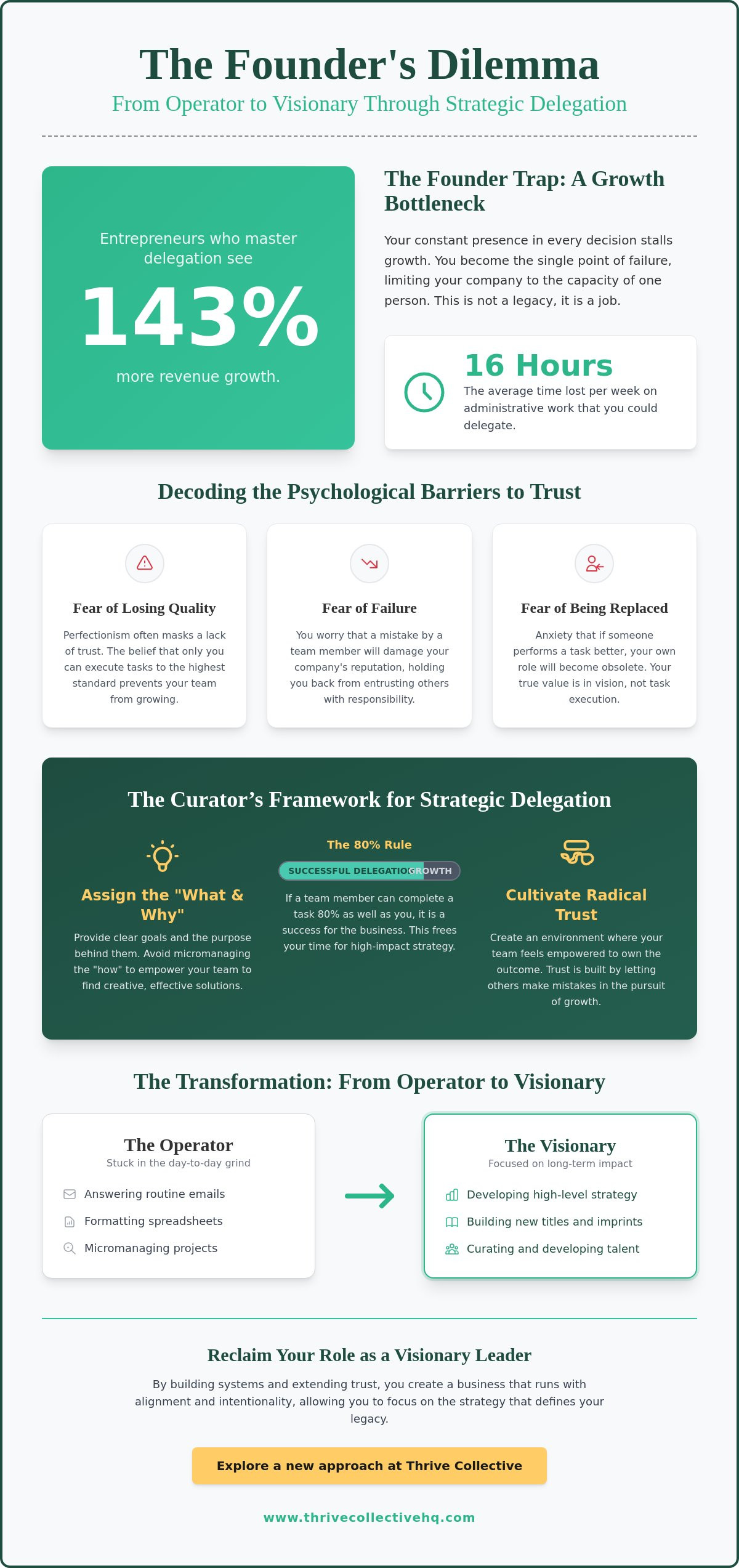
Entrepreneurs who master delegation see 143 percent more revenue growth than those who try to carry the weight of every task alone. Developing delegation skills for entrepreneurs is not just about clearing your inbox, it is about reclaiming your role as a visionary. You likely feel that no one can execute your vision with the same precision you do, leading to an average of 16 hours of administrative work every week that drains your creative energy. It is an exhausting cycle that keeps you in a state of survival rather than allowing your business to thrive.
Trust is a muscle, and for many founders, it has atrophied from years of solo effort. When you consider passing a task to someone else, three primary fears often arise: the fear of failure, the fear of being replaced, and the fear of losing quality. These aren't just business concerns; they are deeply personal anxieties that can stall your evolution. You might worry that a mistake will damage your reputation or that if a team member performs a task better than you, your own role becomes obsolete. In reality, your value isn't in the execution of tasks but in the intentionality of your vision. Developing delegation skills for entrepreneurs requires you to acknowledge these fears so they no longer dictate your schedule.
We believe that your impact is limited only by the systems you build and the trust you extend to your team. You will learn why the most successful leaders stop doing everything themselves and how to cultivate a collective that takes ownership of your mission. This article explores the shift from operator to leader, providing a path toward a business that runs with alignment and intentionality while you focus on the high level strategy that defines your legacy.
Key Takeaways
- Identify the "Founder Trap" where your constant presence in every decision stalls growth and creates a bottleneck for your collective.
- Overcome the psychological fears of losing quality or being replaced by recognizing how perfectionism often masks a lack of trust.
- Strengthen your delegation skills for entrepreneurs by assigning the "what and why" of a project rather than micromanaging the "how."
- Apply a practical 14 day time audit to categorize your daily actions and isolate the tasks that only you can perform.
- Reclaim your space as a visionary leader who prioritizes high level strategy and the long term impact of your titles.
The Myth of the Indispensable Founder
The "Founder Trap" is a quiet constraint. It happens when you become the primary bottleneck for every operation in your business, a position that prevents the collective from moving forward with intentionality. You might believe that staying involved in every minor decision ensures the highest quality for your readers, but this mindset actually limits your company to the capacity of a single person. It is a job, not a legacy. According to a foundational definition of delegation, true leadership requires the assignment of authority to others to achieve results. When your mind is occupied with the minutiae of daily operations, you lose the mental bandwidth needed for high level creativity. This cognitive load acts as a ceiling on your potential and the growth of your titles.
To better understand this concept, watch this helpful video:
The High Cost of Being a Solo Genius
Consider the math of your own workday. If you spend 15 hours every week on tasks that could be handled by a $20 per hour assistant, you are effectively paying yourself that low rate for nearly two full workdays. This is the high cost of the solo genius. While you are busy formatting spreadsheets or answering routine emails, you are losing the visionary time required to scale your catalog or develop new imprints like those found in our just-write-collection. This pattern leads to chronic overworking and eventually burnout, which trickles down to your team and dampens the collective energy of your culture. When a founder is exhausted, the business loses its heartbeat.
Reframing Delegation as Leadership Growth
Refining your delegation skills for entrepreneurs is not about losing control; it's about gaining impact. A leader who cannot step away from the daily grind is a liability to their company. If your business cannot function without your constant presence, you haven't built an organization, you've built a job for yourself. Your team cannot grow if they are never given the chance to lead. When you entrust a team member with a project, you provide them with the space to develop their own ownership. This transition from operator to visionary is the only way to move from simply surviving to truly thriving. By building these delegation skills for entrepreneurs, you move from a state of constant reaction to a state of proactive alignment. It is the difference between being a manager of tasks and a curator of talent.
Decoding the Psychological Barriers to Trust
Trust is a muscle, and for many founders, it has atrophied from years of solo effort. When you consider passing a task to someone else, three primary fears often arise: the fear of failure, the fear of being replaced, and the fear of losing quality. These aren't just business concerns; they are deeply personal anxieties that can stall your evolution. You might worry that a mistake will damage your reputation or that if a team member performs a task better than you, your own role becomes obsolete. In reality, your value isn't in the execution of tasks but in the intentionality of your vision. Developing delegation skills for entrepreneurs requires you to acknowledge these fears so they no longer dictate your schedule.
The Perfectionism Trap and Its Consequences
Perfectionism is often a mask for a lack of trust in your hiring process or your team’s potential. Requiring 100 percent perfection from day one is an impossible standard that prevents your collective from learning. If you insist on reviewing every comma in a manuscript or every pixel on a book cover, you are practicing stifling micromanagement. Consider the 80 percent rule: if a team member can complete a task 80 percent as well as you can, it is a success for the business. This margin allows for individual growth and protects your time for high level strategy. In small teams, micromanagement kills creativity, as employees become afraid to suggest new ideas for fear of being corrected. They stop taking ownership and start waiting for instructions, which turns your business back into a bottleneck.
Cultivating a Culture of Radical Trust
Radical trust is the willingness to let others make mistakes in the pursuit of growth. It is not about abdication, but about creating an environment where your team feels empowered to own the outcome. Trust is essential. This begins with clear communication of your expectations and alignment with your personal values. When your team understands the "why" behind your catalog, they can make decisions that reflect your mission without constant check-ins. You can find more on this in our leadership core values guide, which helps you bridge the gap between your vision and your team's execution. As you cultivate this trust, you may want to explore our leadership development books for entrepreneurs to deepen your understanding of collective success. Trusting your team is the only way to ensure your business thrives beyond your own physical capacity.
Beyond Task-Passing: Building a Culture of Ownership
Handing off a list of tasks is not the same as leading a team. To truly scale, you must move from task delegation, which requires you to provide constant instructions, to responsibility delegation, where your team owns the final outcome. When you refine your delegation skills for entrepreneurs, you stop worrying about the specific steps and start focusing on the results. Many founders fail because they attempt to delegate the "how" of a project. By dictating every movement, you remain the primary operator and keep the cognitive load on your own shoulders. Instead, delegate the "what and why" to allow your collective to find the most efficient path forward.
Standard operating procedures (SOPs) are often viewed as restrictive, but in a healthy organization, they are tools for empowerment. They provide a clear baseline that ensures your titles maintain a consistent quality without requiring your daily intervention. We find that a strong feedback loop is essential for this structure to hold. Encourage your team members to propose solutions when they encounter a hurdle rather than simply reporting the problem. This shift in communication transforms your staff from passive executors into active problem solvers who are invested in the success of your catalog.
Delegating Outcomes Instead of Instructions
The difference between instructions and outcomes is profound. For example, instead of asking a team member to create a single social media post, ask them to take responsibility for a 10 percent increase in audience engagement growth over the next month. This outcome-based approach frees up your mental space entirely. You are no longer managing a checklist; you are monitoring a metric. Setting clear success markers from the start ensures that everyone is in alignment, allowing you to focus on high level visionary work while your team manages the details of execution.
The Role of Intentionality in Team Structure
Building a team requires the same curator’s voice you use when selecting new imprints for your series. It is a process of intentional selection and pruning. We recommend using guided journals for personal growth to help your team members reflect on their own leadership and ownership within the collective. This practice encourages self-awareness and helps individuals identify where they can take more responsibility. If a team member fails to meet expectations, address it as a failure of system or alignment rather than a personal shortcoming. Clear, calm communication ensures that every challenge becomes an opportunity for personal and professional evolution.
The Curator’s Framework for Strategic Delegation
Strategic delegation is an editorial act. Just as we curate the titles in our catalog, you must curate the tasks that occupy your day. This requires a transition from reactive doing to intentional selection. By applying a structured framework, you can refine your delegation skills for entrepreneurs and ensure that your energy is directed toward high impact growth. We recommend starting with a low stakes approach, delegating recurring administrative duties first to build a foundation of trust before moving toward more complex operational responsibilities. This ensures that your collective grows in alignment with your long term vision.
Step 1: The Two-Week Time Audit
Clarity begins with data. For the next 14 days, track your activities in 30 minute increments. Label every entry as administrative, operational, or visionary. Administrative tasks are the routine functions like scheduling or basic data entry. Operational tasks involve the daily running of your imprints. Visionary tasks are the high level strategy and creative planning that only you can provide. A simple audit often reveals that founders spend over 16 hours every week on administrative work that could be handled by a virtual assistant. Reclaiming those 16 hours allows you to return to the heart of your mission and focus on the legacy you are building.
Step 2: Identifying Your Zone of Genius
Your Zone of Genius is the intersection of your highest skill and your deepest passion. It is where you provide the most value to your collective. The hardest part of this process is delegating tasks that you actually enjoy but that aren't visionary in nature. You might love designing social media graphics, but if that time prevents you from identifying new market opportunities for your series, it is a distraction. We often find that how to get out of the habit of procrastination is actually a lesson in task alignment. When you are stuck in the wrong tasks, your momentum stalls. By matching resources to the specific strengths of your team, you create a review cycle that focuses on high level results rather than daily interference.
Once you have identified the tasks to offload, you must match them to the right resources. This might mean hiring a specialist for your technical needs or a generalist for administrative support. Average hourly rates for virtual assistants in the United States sit at approximately $24.40, which is a manageable investment to regain your strategic focus. Once the tasks are assigned, establish a review cycle that occurs on a recurring schedule. This allows you to maintain high level oversight without interrupting the daily flow of your team. To support this transition, explore our leadership development books for entrepreneurs which offer deeper frameworks for visionary growth.
Transitioning from Operator to Visionary Leader
Moving beyond the daily operations is a profound evolution of your identity. A visionary leader is not just a manager of tasks; they are the architect of culture, the navigator of future opportunities, and the guardian of the collective mission. When you successfully apply delegation skills for entrepreneurs, you trade the noise of activity for the clarity of impact. Your new role is to set the long term strategy that guides your imprints and to identify the shifts in the industry that will define your legacy. It is the final shift from working in the business to working on the business, allowing your vision to breathe and expand.
Filling the Space with Strategic Intent
When you first step back from the daily grind, you may encounter an unsettling silence. This "void" is where many founders stumble, often relapsing into old habits or micromanagement because they feel unproductive without a full inbox. You must fill this space with intentionality. Instead of spending 16 hours a week on administrative tasks that could be handled by a virtual assistant, you might spend that time studying emerging reader trends or building high level partnerships with other imprints. Reading leadership development books for entrepreneurs provides the intellectual fuel needed to stay in a growth mindset. This practice ensures that your mental energy is spent on the visionary horizon rather than the operational floor.
The Legacy of the Collective
A true leader is one whose vision survives their absence. If your business relies solely on your presence to survive, it hasn't yet reached the state of thriving. By refining your delegation skills for entrepreneurs, you build a collective that takes genuine ownership of your mission. This is the core of the thrive versus survive dichotomy. Longevity is found in a team that understands your values and can execute your vision with autonomy and grace. We invite you to evaluate your current catalog of responsibilities today. Identify one task to release, one trust to extend, and one step toward the visionary role you were meant to hold. Your legacy is not found in what you do, but in what you empower others to achieve.
Reclaiming Your Visionary Role
You have seen that the path to a lasting legacy requires a fundamental shift in how you view your own time. By refining your delegation skills for entrepreneurs, you move away from the exhausting cycle of daily operations and step into the quiet authority of a curator. You stop managing tasks and start cultivating a collective that shares your intentionality. This evolution isn't just about efficiency; it's about creating a business that reflects your highest purpose without requiring your constant presence. We believe that your impact is defined by the space you create for others to lead.
We are proud to support this transition through our carefully curated catalog of titles, designed for the serious independent leader who values impact over hype. Our site is operated by Cordova Consulting LLC in New Mexico, where we prioritize editorial quality in every series we publish. Master the art of the visionary role by exploring our leadership development books for entrepreneurs. You have the potential to build something that thrives long after you step away from the operational floor. Trust in the systems you have built and the team you have chosen to carry your vision forward.
Frequently Asked Questions
What are the first delegation skills an entrepreneur should learn?
The first delegation skills for entrepreneurs involve mastering the time audit and the art of the clear objective. You must identify tasks that drain your energy, such as routine administrative work, and learn to communicate the "why" of a project rather than just the "how." By focusing on the outcome, you allow your collective to take ownership while you maintain the high level strategy for your catalog.
How do I know if I am micromanaging my team or just providing oversight?
Oversight focuses on whether the final title meets the success metrics you established at the start. Micromanagement occurs when you dictate every specific step or require approval for minor decisions that don't impact the visionary goal. If you find yourself spending more time reviewing a task than it would have taken to do it yourself, you are likely stifling your team's growth and personal evolution.
Can I delegate delegation skills to a project manager or COO?
You can certainly delegate the daily management of workflows to a project manager once you have set the intentionality and culture of the business. A project manager can oversee the execution of your series, but the visionary responsibility for the long term legacy must remain with you. This structure allows you to focus on high level strategy while your collective handles the operational details.
What if I cannot afford to hire a full-time employee for delegation?
You don't need a full-time hire to begin refining your delegation skills for entrepreneurs. Many leaders start by engaging virtual assistants or freelancers for specific imprints or tasks. In the United States, the average hourly rate for a virtual assistant is approximately $24.40, which allows for a scalable approach to building your team. This allows you to reclaim hours for visionary work without the overhead of a full-time salary.
How do I maintain my brand voice when someone else is writing for me?
Maintaining your brand voice requires a clear style guide and a strong curator’s voice during the review process. Provide your team with concrete examples of your preferred tone and vocabulary patterns, such as our focus on alignment and intentionality. Use a feedback loop to refine their work over time until they can produce titles that resonate with your readers as if you had written them yourself.
What should I do if a delegated task is done incorrectly?
If a task falls short of your expectations, treat it as an opportunity to review your systems and communication. Check whether the standard operating procedure was clear and if the team member had the necessary resources to succeed. Calmly address the gap between the outcome and the vision, then update your instructions to ensure the collective learns from the experience and moves forward with greater alignment.
How often should a visionary leader check in on delegated responsibilities?
The frequency of check-ins depends on the complexity of the task and the maturity of the team member’s skills. For new responsibilities, a brief daily or bi-weekly touchpoint ensures alignment. As trust grows, you should move toward weekly or monthly high level reviews. This rhythm protects your mental space while ensuring that your catalog of titles continues to meet the standards of your mission.
Is it possible to delegate too much as a small business owner?
You can only delegate too much if you offload the visionary core that gives your business its heartbeat. While you can delegate operations, marketing, and administration, you cannot delegate the final responsibility for the strategy and culture of your collective. A leader who is entirely disconnected from their business loses the intentionality required to ensure their titles truly thrive in the market.

Article by
Kimberly Cordova
Kimberly Burk Cordova is the founder of Thrive Collective Publishing, an independent multi-imprint publishing house based in Santa Fe, New Mexico. She is the author of books on leadership, business growth, AI and automation, emotional intelligence, and personal development, written for readers who want clear thinking, useful frameworks, and books they actually finish.
Before turning her full attention to publishing, Kimberly spent more than two decades in strategy, operations, and program leadership, working with public agencies and private organizations on transformation, technology, and large-scale change. That operator's lens shows up in everything she writes and publishes: real frameworks, real numbers, no fluff.
As publisher, she leads a catalog of more than 80 titles from six authors across multiple imprints, spanning literary suspense, true crime, children's biography, relationships, travel, guided journals, and coloring books. The house publishes regularly across its core series, including The Casita Series, Shadows of the Past, the Young Legends Collection, The Growth Leader Collection, the AI and Automation Blueprint, The Heirloom Series, The Art of Manifestation, the Just Write Collection, and Travel: Destination Guides.
She lives in Santa Fe with her husband Greg, a self-taught silversmith and lapidary artist. When she is not writing or publishing, she is building Wildflower Artisans, their Turquoise jewelry brand, or curating the next round of Just Write journals.
Connect with Kimberly and Thrive Collective Publishing at thrivecollectivehq.com.