

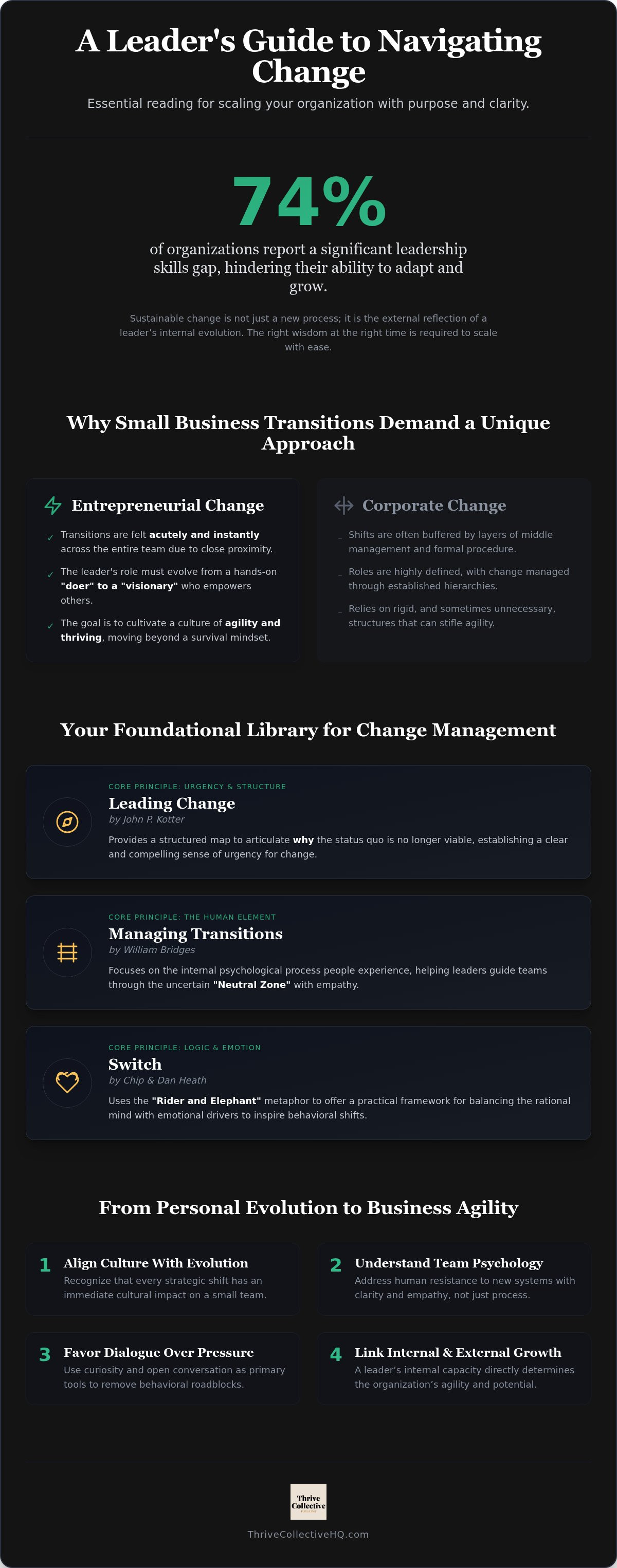
Recent data indicates that 74 percent of organizations face a significant leadership skills gap, a number that continues to widen as the expectations for visionary leaders shift toward more human-centered approaches. You likely feel this gap personally when your small team resists a new process or when the rapid growth of your business outpaces your formal management training. At Thrive Collective Publishing, we believe that sustainable organizational change is the external reflection of a leader’s internal evolution and intentionality.
We understand that scaling with ease requires more than just grit; it requires the right wisdom at the right time. This article provides a curated selection of essential books on change management for leaders, offering you a clear reading list of pivotal titles designed to help you lead through evolution with grace. We will explore foundational classics like John P. Kotter’s 8-step process alongside modern 2026 releases, such as Dr. Elena Martinez’s work on leadership in a disrupted world, to ensure your business scaling remains in perfect alignment with your personal growth.
Key Takeaways
- Understand why transitions feel more acute within small teams and how to align your culture with rapid business evolution.
- Identify which foundational books on change management for leaders provide the psychological frameworks necessary for letting go of old processes with clarity.
- Learn to remove behavioral roadblocks by applying modern strategies that favor curiosity and dialogue over traditional pressure.
- Explore the link between a leader’s internal capacity and business agility through titles like The Emotional Intelligence Advantage by Liam Cruz.
- Discover how to curate a living catalog of resources that supports sustainable scaling and reflects your unique visionary perspective.
Why do small business leaders need specific books on change management?
Small business leaders require specialized resources because entrepreneurial change management is the specific practice of aligning team culture with rapid business evolution. Unlike large corporations where shifts are buffered by layers of middle management, small teams experience transitions more acutely due to closer personal proximity. When you lead a team of five or fifteen, every shift in strategy or software is felt instantly. There is no anonymity. This is why you must curate your library to include titles that balance tactical execution with human-centered empathy. Intentionality in choosing specific books on change management for leaders prevents the adoption of rigid, unnecessary corporate structures that can stifle the very agility that makes your business special.
The difference between corporate and entrepreneurial transitions
Resource constraints in a growing business require change models that are efficient and easily communicated to everyone at once. As a founder, you face the unique challenge of transitioning from a "doer" who handles every task to a "visionary leader" who empowers others to carry the torch. Entrepreneurial change management serves as a tool for sustainable scaling by ensuring the team evolves at the same pace as the revenue. You can find a deeper history of these models in foundational titles for understanding organizational transitions, though applying them to a small shop requires a lighter, more personal touch.
Moving from a state of survival to a state of thriving
Change is often viewed as a threat rather than an opportunity for alignment, particularly when a team is stuck in a survival mindset. At Thrive Collective Publishing, we focus on scaling with ease and purpose, encouraging leaders to move away from reactive patterns toward a culture of agility. The books you choose should help your team see evolution as a path to collective success. By focusing on the intentionality behind each shift, you cultivate a community that embraces growth rather than one that merely follows a checklist. Our leadership and growth collection is designed specifically to help you bridge this gap between personal evolution and business scaling.
A leader’s catalog should be a living resource. It should evolve as the business grows, moving from basic operational guides to sophisticated books on change management for leaders that address the nuances of team psychology. By choosing titles published by independent presses like Thrive Collective Publishing, you gain access to unique, visionary perspectives that often get lost in the noise of traditional corporate publishing. This intentional curation ensures that your business remains a reflection of your values even as it expands.
Foundational titles for understanding organizational transitions
Building a library of books on change management for leaders is about more than collecting information; it's about establishing the vocabulary necessary for you to discuss growth with your community. Without a shared language, transitions feel chaotic and disjointed. John P. Kotter’s Leading Change remains a primary text for this reason, specifically for its emphasis on establishing a sense of urgency. It helps you articulate why the status quo is no longer an option for a business aiming to thrive. By providing a structured map for multi-year shifts, Kotter ensures that your vision doesn't get lost in the day-to-day operations of scaling.
The psychology of team transitions
While Kotter provides the map, William Bridges focuses on the travelers. In Managing Transitions, he argues that transition is the internal process people go through as they internalize change. Understanding the "Neutral Zone" is vital for leaders who feel their team is stalling. This is the uncomfortable space between the old way of doing things and the new reality. Recognizing this stage allows you to lead with empathy rather than frustration. Many readers find that identifying this human resistance to new systems is the first step toward overcoming it and reaching a place of alignment.
Frameworks for behavioral shifts
Frameworks for behavioral shifts often require a balance of logic and emotion. Switch by Chip and Dan Heath provides a practical framework for directing what they call the "Rider" (the rational mind) and the "Elephant" (the emotional side). They use the metaphor of the path to show how small environment changes lead to big results. By shaping the path, you make the desired behavior the default choice for your team, reducing the friction that often accompanies evolution.
Kotter’s eight steps offer a high-level map for more complex organizational shifts. For those who prefer a broad overview before diving into specific methodologies, HBR’s 10 Must Reads on Change Management serves as a thoughtfully curated starting point. It gathers the most influential thoughts from various experts into one volume, allowing you to see which approaches resonate with your specific leadership style. As you begin to build your personal curated catalog of titles, these foundational works will ensure you are scaling with intentionality and clarity. Selecting the right books on change management for leaders is an investment in your team's future and your own legacy as a visionary guide.
Modern strategies for cultural and behavioral shifts
Traditional management often relies on the idea that more force yields better results. This approach is exhausting. Modern books on change management for leaders suggest a more elegant path: subtraction over addition. Instead of layering new mandates onto an already overwhelmed team, visionary leaders look for ways to simplify and align. This shift reflects a move away from top-down mandates toward a collaborative evolution where every team member feels invested in the business legacy. By focusing on intentionality, you can scale your impact without sacrificing the soulful ambition that started your venture.
Removing the barriers to team alignment
In his work The Catalyst, Jonah Berger suggests that you should act as a catalyst by identifying and lowering the hurdles to change. This approach reduces the friction and resentment often found in growing small businesses. When you remove a barrier, the movement happens naturally. Lowering friction is more effective than increasing pressure because it invites your team into the process rather than forcing them through it. This method respects the autonomy of your community and ensures that growth feels like a shared achievement rather than a corporate requirement.
Scaling often creates friction in communication. Crucial Conversations serves as an essential companion for leaders handling the interpersonal tension that change inevitably creates. It provides the tools necessary to handle high-stakes dialogues with grace and clarity. When you can speak your truth while maintaining a space of safety, you prevent the misunderstandings that often stall progress. This title is a staple for any leader who wants to maintain deep support for their team during periods of rapid evolution.
Trust as the foundation of agility
Trust is the primary currency of any leader managing hard problems. In Move Fast and Fix Things, Frances Frei and Anne Morriss argue that speed should never come at the expense of trust. Cultural shifts succeed only when the team believes the leader has their best interests in mind. This belief creates the psychological safety required for true innovation and agility. For those looking to deepen their understanding of this dynamic, our Leadership and Growth collection offers several titles on building trust and leading with purpose.
Thrive Collective Publishing believes that success is a collective endeavor. We curate our catalog to include books on change management for leaders that prioritize heart-centered leadership and professional intimacy. By choosing resources that focus on trust and barrier removal, you ensure that your business scaling remains in alignment with your personal growth. These modern strategies don't just help you survive a transition; they empower your entire organization to thrive in a state of continuous, intentional evolution.
The link between personal evolution and business agility
Thrive Collective Publishing operates on a core belief: a business cannot grow beyond the internal capacity of its leader. While structural changes are necessary for any expanding organization, the emotional agility of the individual at the helm determines the ultimate success of the transition. We curate specific titles that bridge this gap, moving beyond dry spreadsheets to address the soulful ambition required for true impact. When you invest in books on change management for leaders that prioritize your own growth, you create the necessary space for your business to scale with ease and intentionality.
Managing the self during team shifts is often the most challenging part of leadership. The Emotional Intelligence Advantage by Liam Cruz is a pivotal title for this work, providing a framework for understanding your own emotional triggers as you encounter resistance from your community. Similarly, Mind Games Exposed explores the internal narratives and limiting beliefs that often prevent leaders from embracing new directions. These are not just business guides; they are tools for personal evolution that ensure your external business scaling remains in perfect alignment with your internal values.
Cultivating the growth leader mindset
You must first manage your own internal resistance before you can hope to address the fears of your team. The Growth Leader Collection offers resources specifically designed for this quiet, internal work. Liam Cruz emphasizes that empathy is a strategic advantage when managing complex cultural changes. By cultivating a mindset of curiosity rather than defense, you can see the transition from your team's perspective and lead them toward a state of thriving. This personal intentionality is what eventually creates a lasting organizational legacy.
Using journals to document organizational evolution
Reflective writing is a cornerstone of professional growth and a vital tool for any visionary guide. Guided journals from the Just Write Collection help you process transitions with clarity and purpose. By documenting the shifts in your business, you can identify recurring patterns in team behavior and your own reactions to stress. Cordova Creations offers inviting, craft-forward tools for this type of reflection, making the practice of journaling feel like a restorative ritual rather than a chore. Documenting your evolution allows you to lead with a sense of history and foresight.
A leader’s catalog should be a living resource that supports both the business and the person behind it. As you move from the survival mindset of early growth into a more sophisticated stage of scaling, your library must reflect that shift. We invite you to browse our catalog of leadership titles to find the specific resources that will support your next stage of evolution. Choosing the right books on change management for leaders is an act of commitment to your team, your business, and your own continued growth as a conscious leader.
Curating a library that supports sustainable scaling
Discussion is often the bridge between reading and doing. We invite you to consider joining our book clubs to discuss these titles with other entrepreneurs who are walking a similar path. Sharing insights within a collective environment helps solidify the frameworks you encounter. It transforms a solitary act into a community endeavor, ensuring that no leader has to manage transitions in a vacuum.
Why buying direct matters for the literary community
Purchasing from our catalog supports authors directly and ensures the continued health of the independent literary community. When you buy from Thrive Collective Publishing, you're making a conscious choice to bypass corporate distributors in favor of a more personal connection. Review our Why Buy Direct page to understand the impact this has on independent publishing. Accepted authors like Kimberly Burk Cordova and K.B. Cordova provide grounded insights for modern readers, and their work is made possible by this direct support. This model allows us to maintain high editorial standards while focusing on the visionary perspectives that traditional presses often overlook.
Next steps for your leadership development
To begin your study, choose one foundational title and one modern strategy title from our collection. This balanced approach allows you to understand the historical bedrock of change theory while staying current with contemporary cultural shifts. Set a professional development goal to implement one specific framework from these books on change management for leaders each quarter. You might also invite your team to read a reader’s companion or companion guide together to foster a collective understanding.
Sustainable scaling is a practice of continuous alignment. By curating a thoughtful library, you're investing in your own capacity to lead with heart and authority. We recommend starting with The Emotional Intelligence Advantage by Liam Cruz for an immediate impact on your team dynamics. For more information on our upcoming releases or to share your thoughts on a recent read, please email info@thrivecollectivehq.com.
Step into your role as a visionary guide
Sustainable organizational change is never just a structural shift; it's the external reflection of your own internal evolution. By balancing foundational theories with modern behavioral strategies, you ensure that your business scaling remains in perfect alignment with your core values. We believe that a leader’s library should be a living resource, one that grows alongside your team and your soulful ambition. Intentional curation of books on change management for leaders prevents the adoption of rigid corporate structures and instead fosters a culture where every individual can thrive.
Thrive Collective Publishing is an independent New Mexico press dedicated to providing unique, visionary perspectives. Our titles are published by working authors and entrepreneurs who have walked the path of growth themselves. When you choose to buy direct, you provide essential support for the literary community and gain access to grounded insights from authors like Kimberly Burk Cordova and Liam Cruz. Explore our curated Leadership and Growth collection to find your next essential title. You have the potential to lead with heart and authority; it's time to build the library that supports your legacy.
Frequently Asked Questions
What is the best book for change management for new leaders?
Switch by Chip and Dan Heath is widely considered the best starting point for those new to leadership because it simplifies the complex psychology of behavior change. It introduces the Rider, the Elephant, and the Path as a framework for understanding how to influence both the rational and emotional sides of a team. This title is particularly useful for leaders who lack formal management training but need to implement shifts with clarity and empathy.
How do leaders manage change effectively in small teams?
Managing change in small teams requires high-level transparency and a focus on personal proximity. Because every team member is deeply impacted by shifts in strategy, you must prioritize two-way communication and lower the barriers to alignment. Using specific books on change management for leaders that focus on agility rather than bureaucracy helps maintain the speed of a small business while ensuring everyone feels heard and valued.
Are there change management books specifically for entrepreneurs?
Yes, many resources are written by working authors who understand the unique constraints of scaling a business with limited resources. These titles often focus on the "Visionary Guide" perspective, helping founders move from doing every task to leading a team with intentionality. Our catalog at Thrive Collective Publishing includes titles that address the intersection of business scaling and personal growth, ensuring you don't lose the heart of your business as you grow.
What are the 8 steps of change management according to John Kotter?
John Kotter’s influential model begins with establishing a sense of urgency and creating a guiding coalition to lead the effort. The process continues through developing a strategy, communicating the vision, and empowering broad-based action. To anchor the change in the culture, leaders must generate short-term wins and consolidate gains to produce more change. This framework provides a high-level map for leaders who need a structured, multi-year approach to organizational evolution.
Can reading books on emotional intelligence help with change management?
Reading titles on emotional intelligence is essential because organizational change is ultimately a human experience. The Emotional Intelligence Advantage by Liam Cruz is a pivotal resource for managing your own internal narratives and triggers during team shifts. When you understand the underlying fears and motivations of your community, you can lead with empathy and intentionality, which significantly reduces the friction often caused by rapid growth.
How do I create a book club at work to discuss change management?
You can start by choosing one foundational title and inviting your team to a monthly discussion centered on practical application. Use a reader’s companion or companion guide to provide structure and ensure the conversation stays focused on how the concepts apply to your specific business. This collective approach fosters a shared vocabulary and ensures that growth is viewed as a common goal rather than a top-down mandate.
What is the difference between organizational change and personal evolution?
Organizational change refers to the structural and strategic shifts within a business, while personal evolution is the internal growth a leader undergoes to meet those new demands. At Thrive Collective Publishing, we believe a business cannot grow beyond the capacity of its leader. Using guided journals from the Just Write Collection allows you to document this evolution, ensuring your leadership style remains in alignment with your business goals.
Where can I find leadership development books from an independent press?
You can browse the full Thrive Collective Publishing catalog at /collections/books, where every title lists the formats it is available in. Our books are sold in paperback, hardcover and Kindle on Amazon, and the audiobook editions are on Audible. We publish books on change management for leaders by authors like Kimberly Burk Cordova and K.B. Cordova, selected by a small New Mexico press rather than a corporate acquisitions committee, which is how careful, useful titles that larger houses pass over still reach readers.

Article by
Kimberly Cordova
Kimberly Burk Cordova is the founder of Thrive Collective Publishing, an independent multi-imprint publishing house based in Santa Fe, New Mexico. She is the author of books on leadership, business growth, AI and automation, emotional intelligence, and personal development, written for readers who want clear thinking, useful frameworks, and books they actually finish.
Before turning her full attention to publishing, Kimberly spent more than two decades in strategy, operations, and program leadership, working with public agencies and private organizations on transformation, technology, and large-scale change. That operator's lens shows up in everything she writes and publishes: real frameworks, real numbers, no fluff.
As publisher, she leads a catalog of more than 80 titles from six authors across multiple imprints, spanning literary suspense, true crime, children's biography, relationships, travel, guided journals, and coloring books. The house publishes regularly across its core series, including The Casita Series, Shadows of the Past, the Young Legends Collection, The Growth Leader Collection, the AI and Automation Blueprint, The Heirloom Series, The Art of Manifestation, the Just Write Collection, and Travel: Destination Guides.
She lives in Santa Fe with her husband Greg, a self-taught silversmith and lapidary artist. When she is not writing or publishing, she is building Wildflower Artisans, their Turquoise jewelry brand, or curating the next round of Just Write journals.
Connect with Kimberly and Thrive Collective Publishing at thrivecollectivehq.com.