

What if the most valuable asset you leave behind isn't found in a bank account, but in the quiet ink of your own story? Understanding why you should start a family history journal is the first step in moving from a fear of fading memories to a state of true connection. A journal transforms scattered anecdotes into a structured legacy of wisdom, ensuring your family's character is never lost to time. It is natural to feel a sense of urgency as the past begins to soften at the edges, or to feel paralyzed by the technical weight of genealogy charts.
You want to preserve your history, but the path from a box of photos to a narrative often feels steep. This practice serves as a bridge between generations, offering a way to record the intentionality behind your life's work. We will examine how to begin this process with ease, creating a tangible heirloom that provides personal peace and a visionary guide for those who follow your path. By the end, you will have a clear framework to turn your heritage into a living catalog of impact.
Key Takeaways
- Learn how a legacy record shifts the focus from dry genealogy dates to the personal values and intentionality that define your life.
- Explore the documented link between family narratives and increased resilience, providing a sense of alignment for both the reader and their descendants.
- Understand why you should start a family history journal as a way to organize scattered memories into a structured vessel of lived wisdom.
- Compare the benefits of prompted imprints versus blank notebooks to establish a sustainable writing rhythm that suits your current season.
- Discover how specific titles within The Heirloom Series offer the necessary structure to move from dreaming of a legacy to creating a finished catalog of wisdom.
Defining the Family History Journal as a Vessel for Wisdom
At Thrive Collective Publishing: Books, Journals, and Guides, we believe a family history journal is far more than a simple notebook. It is a curated record of the values, stories, and life lessons that define your unique lineage. While a standard record might list where a person was born, this journal captures the spirit of how they lived and the intentionality behind their choices. We view this practice as an intentional act of leadership for your family collective, creating a bridge between the hard won lessons of your past and the evolving needs of those who will follow you. This perspective clarifies why you should start a family history journal today.
To better understand the foundations of this practice, watch this helpful video:
Understanding why you should start a family history journal begins with recognizing it as a vessel for wisdom rather than just a storage unit for data. It is a way to ensure your personal evolution serves as a visionary guide for the next generation.
The Difference Between Genealogy and Legacy
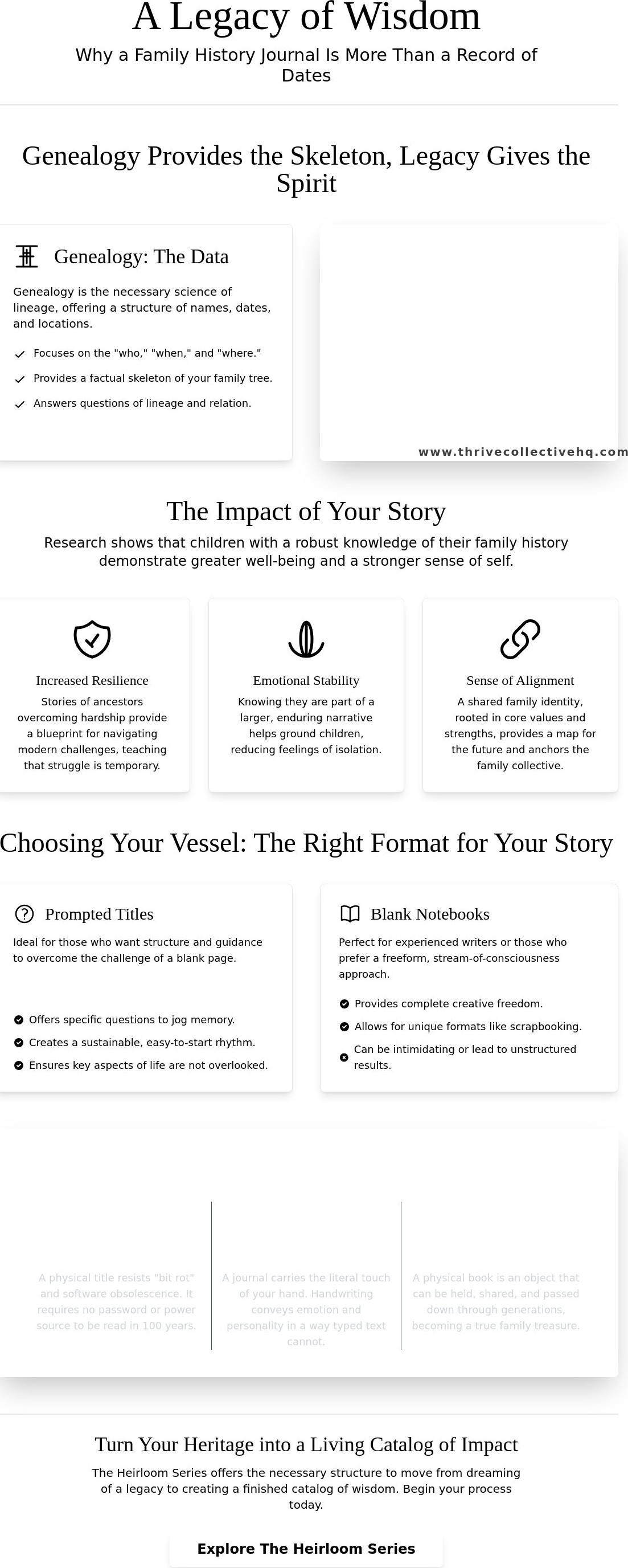
Genealogy provides the necessary structure of your family tree, offering a skeleton of names, dates, and locations. Genealogy is the science of lineage, but legacy is the art of character. A list of birth dates from the 1800s rarely inspires a teenager, but a story about a great grandfather starting a business with five dollars often does. By prioritizing the "why" and "how" of your life, you make your history accessible to younger readers. This approach focuses on the spirit of the family narrative, ensuring that your descendants don't just know who you were, but what you stood for during your time on earth.
Why Paper Remains the Superior Medium for Legacy
We live in an era of digital convenience, yet the physical page remains the most resilient medium for your stories. Digital files are susceptible to "bit rot" and the inevitable obsolescence of software platforms over the decades. A physical journal from our journals and keepsakes catalog carries the literal touch of your hand, providing a tactile connection that a screen cannot replicate. Handwriting conveys emotion and personality through the slant of a letter or the pressure of a pen. These physical titles become tangible heirlooms that can be held, passed down, and preserved without the need for a password or a power source. They represent a commitment to permanence in a world that often feels temporary.
The Psychological and Social Benefits of Recording Your Story
Recording your story is an act of profound psychological stewardship. While the previous section explored the journal as a vessel for wisdom, we must also look at the impact this practice has on the human spirit. Understanding why you should start a family history journal often begins with the realization that your narrative is a foundation for your children's mental health. Research indicates that children who possess a robust knowledge of their family history demonstrate significantly higher levels of resilience and emotional stability. They don't just see themselves as isolated individuals; they see themselves as part of a larger, enduring narrative that has survived the test of time.
This practice anchors the family collective. It provides a map for the future. It fosters a sense of alignment that transcends the daily noise of modern life.
Building Resilience Through Ancestral Narrative
When you document how your ancestors navigated hardship, you provide a blueprint for modern challenges. This concept, often called the "Intergenerational Self," suggests that our sense of well-being is tied to the stories of those who came before us. Knowing that a grandmother survived a period of economic scarcity or that a father rebuilt a career after a setback gives the next generation perspective. It teaches them that struggle is temporary and that triumph is a recurring theme in their DNA. This shared identity ensures that even during periods of rapid change, your descendants remain grounded in their core values and recurring family strengths.
The Gift of Being Known
There is a universal human desire to be truly understood and remembered by those we love. A journal serves as your voice across time, allowing you to speak directly to daughters or grandchildren you may never meet. It bridges the gap between generations, turning a distant name into a living, breathing presence. This process of reflection also offers you personal closure, helping you identify the specific milestones that have defined your own growth. Exploring these connections can be a deeply healing experience for the author and the reader alike. For those looking to understand the complexities of maternal legacy, The Mother I Did Not Know serves as a poignant example of how recording these stories can transform our understanding of the women who shaped us. By choosing to write, you ensure that your impact is felt long after the ink has dried.
Choosing Your Format: Prompted Titles vs. Blank Notebooks
Deciding how to record your history is as significant as the stories themselves. If you are wondering why you should start a family history journal, consider the medium as the first step in your legacy process. The format you choose should align with your current life season and your natural writing rhythm. Prompted journals serve as a visionary guide, removing the friction of the blank page by providing specific, intentional questions. These titles are ideal for readers who want a structured path to follow, ensuring that no essential life stage or emotional milestone is overlooked. Within our journals and keepsakes catalog, The Heirloom Series is specifically designed to facilitate this type of deep, rhythmic reflection.
The Benefits of Guided Prompts
Prompts act as a quiet mentor. They lead you toward memories that might otherwise remain dormant, such as the specific sensory details of a childhood home or the internal shifts experienced during a first leadership role. By offering a balanced record, these guided titles help you avoid the paralysis that often comes with a vast, unorganized past. You don't have to decide what matters most on day one; the prompt does that work for you. This structured approach is particularly helpful for those who feel overwhelmed by the sheer volume of their lived experience. It turns a daunting project into a series of small, manageable conversations with your future descendants, ensuring your wisdom is shared with clarity and purpose.
When to Choose a Blank Journal
For the writer who prefers a stream-of-consciousness style, a blank notebook offers total creative freedom. This format is best if you already have a specific narrative in mind or if you want to include sketches, original photographs, and physical ephemera like historical letters or pressed flowers. While this path requires more discipline and a self-imposed structure, it allows for a highly personalized expression of your family's spirit. When choosing this route, we recommend prioritizing titles with archival-quality paper to prevent the yellowing or degradation of the family record over several decades. Understanding why you should start a family history journal includes recognizing that the physical quality of the book is what allows it to survive as a tangible heirloom. Whether you choose the guidance of a series or the freedom of a blank page, the goal remains the same: to move from a state of dreaming to a state of doing.
Five Steps to Beginning Your Family History Habit
Establishing a new practice requires a shift from abstract intention to concrete action. When you consider why you should start a family history journal, the goal is to create a sustainable rhythm rather than a one-time sprint. We recommend these five steps to ground your legacy work in the present, moving from a state of dreaming into a state of consistent doing.
- Select a Resonant Title: Choose a journal from our catalog that aligns with your current life season, whether that focus is on leadership, motherhood, or ancestral roots.
- Commit to a Low-Pressure Schedule: Aim for one story or one prompt per week. Consistency is more valuable than volume when building a long term record.
- Use Dates as Anchors: Incorporate existing genealogy data by using specific years or locations to ground your personal anecdotes in historical reality.
- Focus on the Sensory: Prioritize the smells, sounds, and textures of your memories to create a vivid experience for future readers.
- Engage the Family Collective: Invite siblings or parents to share their favorite memories of a specific event to add depth and multiple perspectives to your record.
Setting the Scene with Sensory Details
Specific, concrete details are the elements that bring a narrative to life. Rather than writing that a childhood home was "comfortable," describe the scent of piñon wood burning in the fireplace or the specific creak of the third step on the staircase. These small markers are far more memorable than broad generalities. They allow your descendants to step into your world and feel the atmosphere of your lived experience. For those seeking more inspiration on how to draw out these details from older relatives, our guide on family history interview questions for grandparents offers a deeper framework for these conversations.
Overcoming the Perfectionism Trap
One of the greatest barriers to legacy work is the belief that every entry must be a polished literary performance. Your readers are not looking for a professional historian; they are looking for your voice. Raw, honest reflection carries more weight than a sanitized version of family history. When handling sensitive or difficult stories, do so with intentionality and grace, acknowledging the complexity of human experience. This honesty creates a deeper connection and provides a more realistic visionary guide for those who will face their own challenges. If you find yourself struggling to begin the narrative of those who came before you, we recommend exploring the stories of the mother you did not know as a way to practice this type of vulnerable, impactful writing.
The Heirloom Series: Tools for Your Legacy Process
Legacy is not a passive inheritance. It is an active, intentional creation. At Thrive Collective Publishing: Books, Journals, and Guides, we curate titles that act as a bridge between your current insights and the future needs of your family collective. Understanding why you should start a family history journal is the first step toward preservation, but having a structured vessel for those stories is what ensures they endure for decades. The Heirloom Series offers a practical framework for this evolution, providing the alignment you need to record your impact with ease. By starting this process today, you're making a conscious choice to thrive within the rush of time rather than simply surviving it.
Our editorial approach treats every journal as a serious piece of family literature. These are not mere notebooks; they're curated imprints designed to facilitate deep reflection. Each title in the series is crafted to look as sophisticated on a library shelf as it feels in your hands, ensuring that your lived wisdom is presented with the dignity it deserves.
A Commitment to Quality and Craft
The physical durability of a record is just as important as the stories it contains. We use materials designed to withstand frequent handling and the natural passage of years, ensuring your handwriting remains clear for future readers. Every prompt within the series is carefully selected by our editors to elicit high level reflection rather than surface level data. These questions guide you through the complexities of your character, your leadership, and your roots. You can view our full catalog of legacy titles within the journals and keepsakes collection to find the specific series that resonates with your story.
Your Next Step Toward Legacy
Your personal evolution deserves a permanent home. To begin, we suggest choosing one title from the Heirloom Series that speaks to your current season of life. Don't feel pressured to complete the entire record in a single sitting. Commit to answering just one prompt this week to establish your rhythm. This small act of intentionality creates a momentum that eventually builds into a complete narrative of your family's spirit. If you require personalized recommendations on journal design or wish to discuss bulk orders for upcoming family reunions, please contact us at info@thrivecollectivehq.com. We're here to support your commitment to building a lasting family collective.
Cultivating Your Eternal Narrative
Your story is a visionary guide for the family collective. We've explored how a structured record moves beyond simple names and dates to preserve the spirit of your lived experience. By focusing on sensory details and ancestral narratives, you create a foundation of resilience for those who follow. This clarity of purpose is exactly why you should start a family history journal before the quiet details of the past begin to fade. Our editorial quality journals are designed for long term preservation. They offer curated prompts that invite deep, rhythmic reflection on your personal evolution.
You have the power to turn scattered memories into a tangible heirloom that speaks with authority and warmth. We invite you to explore the Heirloom Series and start your legacy today. Every entry you write is a gift of intentionality to the future. Step into your role as the guardian of your family's wisdom and watch your impact thrive across generations.
Frequently Asked Questions
What is the best way to organize a family history journal?
Organization is most effective when it follows a chronological path or a thematic structure. You might group entries by life stages, such as childhood, career, and parenthood; or by core values like resilience and community. This clarity helps readers find specific wisdom when they need it most. Using a title from The Heirloom Series provides a built-in framework that handles the organization for you, allowing you to focus on the depth of your memories.
How far back should a family history journal go?
A family history journal should go as far back as you have meaningful stories or reflections to share. While genealogy research might reach back centuries, your journal serves as a record of character rather than just a lineage. If you have vivid anecdotes about a great grandparent, include them. However, the primary focus is often on the generations you have personally known, as these stories carry the most emotional weight for your descendants.
What if I do not have many facts about my ancestors?
You don't need a complete archive of dates to create a powerful record. If you lack specific facts, focus instead on the values and lessons passed down through oral tradition or your own observations. Describe the spirit of your family or the recurring strengths you see in your relatives. This approach is a key reason why you should start a family history journal, as it allows you to preserve the spirit of your family even when data is missing.
Can I include photos in my family history journal?
Including photographs is an excellent way to add visual depth to your narrative. If you are using a blank notebook from our catalog, you can easily attach photos, letters, or pressed flowers using archival safe adhesive. These visual markers help future readers connect faces with the stories you tell. For those using prompted journals, you might choose to tuck a few significant family portraits into the back cover or scan them into a companion digital file.
How do I handle sensitive or negative family stories?
Sensitive or negative stories should be handled with grace and a focus on personal evolution. Rather than omitting difficult truths, consider how these challenges shaped your character or the family collective. Writing about adversity with intentionality provides a visionary guide for descendants who will inevitably face their own trials. Focus on the lessons learned and the resilience gained, ensuring the story serves as a tool for growth rather than just a record of conflict.
What are some good family heirloom journal ideas for beginners?
Beginners often find success starting with a prompted journal that provides a structured path. Our Heirloom Series is designed specifically for this purpose, offering curated questions that move you from dreaming to doing. Another idea is to focus on a specific theme, such as a legacy of motherhood or leadership growth. Starting with just one story per week is a low pressure way to build a sustainable habit that eventually becomes a finished catalog of wisdom.
Should I write my family history journal by hand or type it?
Writing by hand is the superior choice for creating a lasting family heirloom. Handwriting carries a personal, tactile energy that digital text cannot replicate; it connects the reader to your literal touch across time. Digital files are also susceptible to software obsolescence and hardware failure. A physical journal from our catalog ensures your record remains accessible without the need for power or passwords, standing as a permanent testament to your family history.
Is a family history journal a good gift for a daughter or son?
Giving a family history journal to a daughter or son is a profound gift of identity and resilience. It provides them with an anchor in a changing world, showing them they belong to a lineage of purpose and strength. This is a primary reason why you should start a family history journal today. By presenting them with a record of your lived wisdom, you offer a mentor like presence that they can revisit throughout their own lives for inspiration.

Article by
Kimberly Cordova
Kimberly Cordova is the founder of Thrive Collective, an independent publishing brand based in Santa Fe, New Mexico. She's the author of more than 200 books across business, AI and automation, leadership, emotional intelligence, true crime, travel, guided journaling, and personal growth, published in paperback, hardcover, Kindle, and Audible audiobook formats.Kimberly writes for readers who want clear thinking, useful frameworks, and books they actually finish. Her work spans practical guides for entrepreneurs navigating AI and online business, deep-dive leadership books for women and modern managers, atmospheric true crime stories pulled from America's forgotten past, and guided journals that help readers slow down, reflect, and capture what matters.Before turning her full attention to publishing, Kimberly spent more than two decades in strategy, operations, and program leadership, working with public agencies and private organizations on transformation, technology, and large-scale change. That operator's lens shows up in everything she writes: real frameworks, real numbers, and no fluff.She lives in Santa Fe with her husband Greg, a self-taught silversmith and lapidary artist. When she's not writing, she's researching the next Shadows of the Past story, building Wildflower (her artisan turquoise jewelry brand with Greg), or curating the next round of Just Write Collection journals.Thrive Collective publishes regularly across its core series, including the AI and Automation Blueprint, The Growth Leader Collection, Shadows of the Past, The Heirloom Series, The Art of Manifestation, the Just Write Collection, and Travel: Destination Guides.Connect with Kimberly and Thrive Collective at thrivecollectivehq.com.