

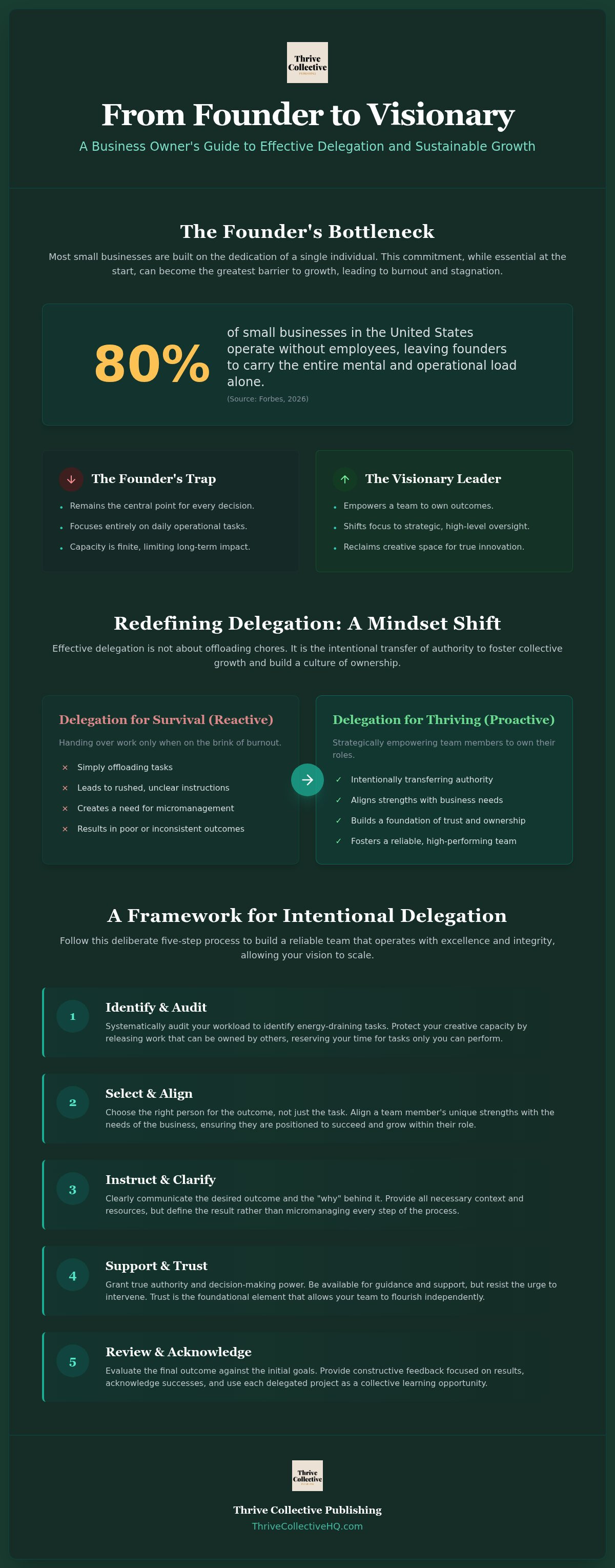
What if the very dedication that built your business is now the single greatest barrier to its growth? Statistics from Forbes in July 2026 show that over 80 percent of small businesses in the United States operate without employees, leaving founders to carry the entire mental load alone. You likely feel the weight of every decision, from minor administrative tasks to the high-level shifts that define your legacy. It is natural to feel like a bottleneck when you are deeply invested in your work, yet this exhaustion often stems from a fear that no one else can meet your standards.
At Thrive Collective Publishing, we believe that leadership is an invitation to step into a bigger version of yourself. This business owner's guide to effective delegation provides a visionary framework to help you move from daily operations to strategic oversight. By mastering the art of intentionality, you can build a team that thrives independently and reclaim the space needed for true innovation. We will examine how to transfer ownership of outcomes rather than just tasks, ensuring your company scales with ease while you focus on your long-term impact.
Key Takeaways
- Shift from a survival mindset to a state of thriving by redefining delegation as the intentional transfer of authority rather than the simple offloading of chores.
- Use this business owner's guide to effective delegation to move beyond the constraints of daily operations and step into your role as a visionary leader.
- Protect your capacity for high-level creative work by auditing your workload to identify and release energy-draining tasks that hinder your professional impact.
- Follow a deliberate five-step framework of identification, selection, instruction, support, and review to build a reliable team that operates with excellence.
- Utilize educational resources and curated titles from our catalog to support your personal evolution as you cultivate a community that succeeds collectively.
What defines effective delegation for the modern business owner?
Effective delegation is the intentional transfer of authority and decision-making power from a leader to a team member to foster collective growth. It is a strategic shift from simply offloading tasks to empowering others to own outcomes. This defines effective delegation as a tool for scaling impact rather than a desperate act of survival. At Thrive Collective Publishing, we see this transition as the hallmark of a visionary leader who understands that no one succeeds in a vacuum. By moving beyond the mechanics of a to-do list, you create a culture where every team member is invested in the brand legacy.
Many founders delegate for survival, handing over work only when they are on the brink of burnout. This is reactive and often leads to poor results because the instructions are rushed and the context is missing. In contrast, delegation for thriving is proactive. It aligns a team member's unique strengths with the needs of the business, ensuring that every project contributes to your long-term vision. You aren't losing control of your standards; you are building a system where those standards are upheld by a reliable team. True authority involves giving someone the right to make a call without checking in with you first. If they have to ask permission for every minor adjustment, you haven't delegated; you've just added a middleman to your own workflow.
Moving beyond the survival mindset
The founder's trap occurs when you remain the central point for every decision, from social media captions to high-level contract negotiations. This overworking culture limits your long-term impact because your capacity is finite. Consider the transition of a literary curator who once spent twenty hours a week on basic proofreading. By delegating these tasks to a trusted editor, they were able to focus on discovering new voices for their leadership and growth collection, eventually doubling their annual title output. This business owner's guide to effective delegation encourages you to view your time as your most precious resource, reserved for the work only you can do.
The role of intentionality in leadership
Every delegated task must serve a larger purpose in your business catalog. Intentionality requires you to identify the "why" before the "how." Much like the direct and warm approach of Kimberly Burk Cordova, effective leadership requires a balance of authority and deep support. When you clearly communicate the desired outcome and the reason it matters to the collective, you remove the need for micromanagement. Trust becomes the foundational element. It allows you to step back and watch your team flourish as they take ownership of their roles, ensuring that your vision scales with ease and integrity.
Why the transition from founder to visionary leader requires delegation
Being a founder often means being the primary engine of your business. You're the one who started the fire, but to keep it burning without consuming yourself, you must evolve. The transition from founder to visionary leader is the process of moving from daily operations to strategic oversight. This shift is not about doing less; it is about doing what matters most. As a visionary, your role is to look toward the horizon, identifying the opportunities and risks that will define your company in 2026. This business owner's guide to effective delegation serves as your map for this evolution, ensuring your presence is felt through your influence rather than your constant activity.
Every hour spent on administrative tasks is an hour stolen from your legacy. We encourage you to consider the "highest and best use" of your daily schedule. If you are the only one who can set the creative direction for your next project, that is where you belong. If a team member can handle the logistics of a book launch or manage reader inquiries, those tasks must be released. Protecting your time is an act of integrity toward your business and your community. When you focus on your unique strengths, you create a ripple effect of alignment that allows the entire collective to thrive.
Protecting your creative bandwidth
Administrative clutter stifles the ability to innovate or plan for the future. When your mind is occupied with minor details, there is no room for the expansive thinking required for long-term growth. Creating clear mental space offers profound psychological benefits, reducing the risk of burnout while increasing your capacity for joy. For many entrepreneurs, this identity shift is the most difficult part of scaling. Engaging with leadership coaching can facilitate this change, helping you release the need to be the hero in every scenario so you can become the guide.
Building a team of leaders
We believe in cultivating a community of contributors rather than just managing employees. True delegation involves transferring authority, not just assigning chores. When you delegate authority, you give your team the power to lead within their own spheres of influence. For example, imagine a team member taking full ownership of a specific project title, such as the production of a new release in our curated leadership titles. They aren't just following your instructions; they are using their judgment to ensure the project aligns with the brand's purpose. This level of trust empowers them to thrive and ensures that the business can grow even when you are not in the room.
Identifying the specific tasks that hinder your professional impact
However, certain elements of your business are non-negotiable. You should never delegate the definition of your core values or the final vision of your company. These are the heartbeat of the collective. Your role is to ensure that every title published and every community interaction reflects the integrity of your brand. By identifying what only you can do, you create a path for others to step into their own leadership roles. Releasing the mundane allows you to focus on the soulful ambition that started your business in the first place.
The impact vs joy audit
A simple four-quadrant exercise can help you categorize your weekly tasks. On one axis, measure the impact the task has on your business growth. On the other, measure the joy or energy it provides you. Tasks that fall into the low-impact and low-joy quadrant are your primary targets for immediate removal. Be specific in this process. If you realize that manual data entry consumes 15 percent of your 40-hour week, you can calculate the exact cost of your overworking. For those seeking deeper resources on strategic planning, our leadership and growth collection offers curated titles that discuss these frameworks in detail.
Recognizing your unique contribution
Your unique genius is the specific contribution that only you can provide to your business. Holding onto low-level tasks is not just a burden to you; it is a disservice to your team's growth. When you refuse to let go, you prevent your contributors from developing their own skills and taking ownership of their work. The fear of letting go often stems from a belief that no one else will care as much as you do. While their approach may differ, a well-supported team will often find more efficient ways to achieve the desired outcome. Trusting the collective is the only way to scale with ease and ensure your business survives your absence.
What are the essential steps to implement a culture of delegation?
Effective delegation follows a structured sequence of identification, selection, instruction, support, and review. This framework ensures that the transfer of authority is a deliberate act of leadership rather than a reaction to an overflowing schedule. As explored in this business owner's guide to effective delegation, the process begins with identifying the desired outcome with absolute clarity. If you cannot visualize the finished result, your team will struggle to meet your standards. Once the goal is defined, you must select the right person based on their current skills and their growth potential, ensuring they are prepared for the responsibility.
Providing the necessary resources is the third essential step in this sequence. This involves sharing the tools required for the task and the deeper "why" behind the project or title. When a contributor understands how their work supports the collective vision, they are more likely to act with intentionality. From there, you must establish a rhythm for feedback that offers support without hovering. The final step is to review the outcome and celebrate the collective win. Recognizing the success of your team reinforces a culture of trust and encourages every individual to step into a bigger version of themselves.
Setting clear expectations from the start
Vague requests lead to vague results in a professional environment. To ensure alignment, utilize specific formats for instructions that match the complexity of the work. Whether you use a recorded video, a written brief, or a verbal conversation, clarity is your most important tool. Every delegated task requires a firm deadline and a concrete definition of what "done" looks like. This level of specificity prevents the frustration of misaligned expectations and allows your team to thrive within clear boundaries. When the standard of excellence is understood by everyone, the business can scale with ease and integrity.
The art of the feedback loop
Constructive feedback is a vital element that encourages personal evolution within your team. There is a distinct difference between a supportive check-in and micromanaging. A check-in focuses on removing obstacles and providing encouragement, while micromanaging stifles independence by focusing on minute, technical details. We recommend documenting your leadership growth and the progress of your contributors to maintain a long-term perspective. Using journals from the Just Write Collection can provide a quiet space to reflect on these shifts in your leadership style. By fostering a loop of open communication, you build a resilient community of leaders who are invested in the business legacy.
To further refine your approach to team management and explore frameworks for organizational growth, we invite you to browse our curated collection of leadership titles.
Scaling with ease through the Thrive Collective Publishing catalog
Educational resources provide a silent mentorship that guides you through the complexities of professional growth. While this business owner's guide to effective delegation offers a framework for action, the internal shift required for leadership often needs a different kind of support. At Thrive Collective Publishing, we curate titles that speak to the heart of the entrepreneur. These books are not just about increasing profit margins; they are about the legacy you leave behind and the community you build. For instance, The Mother I Did Not Know by K.B. Cordova explores themes of personal evolution that are essential for any leader learning to release the past to embrace a new future. By engaging with these narratives, you find the courage to trust your team and step into your unique genius.
Supporting independent authors and presses is a vital part of cultivating a healthy literary ecosystem. When you choose to buy direct from our catalog, you ensure that more of your investment goes directly to the creators who inspire your journey. This practice strengthens the collective and allows us to continue publishing works that prioritize alignment and purpose over traditional corporate metrics. It is a small but intentional choice that reflects the values of a visionary leader. Our leadership and growth collection is designed to be a companion for those who seek to scale with ease and integrity.
Titles for the intentional leader
Your next step toward visionary leadership
The path from founder to visionary is paved with intentional choices. By implementing the steps outlined in this business owner's guide to effective delegation, you are choosing to prioritize your highest and best use. Trust the process and the team you have cultivated. As you release the administrative clutter, you will find the mental space needed to innovate for 2026 and beyond. We invite you to join our community and continue this evolution alongside other conscious entrepreneurs. If you are looking for a specific book recommendation or have inquiries about our publishing process, please email us at info@thrivecollectivehq.com. We are here to support your transition into the leader you were meant to be.
Embrace the Future of Your Leadership
You've explored how to audit your workload for joy and impact and how a structured five-step framework can protect your creative bandwidth. This business owner's guide to effective delegation is more than a set of instructions; it is an invitation to evolve from a founder who does everything to a visionary who directs the collective. By transferring authority and ownership, you ensure that your business can thrive independently while you focus on the high-level shifts that define your legacy. True leadership is not found in the volume of your tasks, but in the clarity of your vision and the strength of the team you empower.
Every title published by Thrive Collective Publishing is curated for the serious independent entrepreneur who values alignment and soulful ambition. With works authored by visionary leaders like Kimberly Burk Cordova, our catalog provides the mentorship needed to scale with ease and integrity. We believe that your success is a collective endeavor, and we are honored to walk this path with you. Explore our leadership and growth titles to support your transition and begin your next chapter today. For a specific title recommendation or to discuss your publishing goals, please reach out to us at info@thrivecollectivehq.com.
Frequently Asked Questions
How do I start delegating when I have a very small team?
Start by identifying the one repeatable task that consumes the most of your creative energy. Give a team member ownership of that specific outcome rather than a scattered list of chores. This builds trust and allows you to test the alignment of their skills with your vision without overwhelming the collective.
What are the most common mistakes business owners make when delegating?
The most frequent error is failing to define the desired outcome with absolute clarity. Owners often delegate tasks while holding onto the mental load, which leads to a culture of micromanagement. This business owner's guide to effective delegation emphasizes the transition from founder to visionary by transferring authority rather than just assigning a to-do list.
What should a CEO or founder never delegate to someone else?
Core values, the final company vision, and high-level strategic alignment must always remain with the founder. You are the curator of the brand's soul and legacy. While a team member can manage the production of a title, only you can decide if that project aligns with the long-term purpose of Thrive Collective Publishing.
How can I ensure the quality of work remains high after I delegate a task?
Establish a clear definition of what "done" looks like and provide a structured review process. Quality is maintained through thorough documentation and the use of resources like a reader's companion. When your team understands the intentionality behind the standard, they are more likely to uphold it with the same care you would provide yourself.
Is delegation possible for a solopreneur who has no full-time employees?
Solopreneurs can delegate by hiring independent contractors or specialists for technical needs. By paying for specific expertise, such as bookkeeping or digital formatting, you reclaim your mental bandwidth. This allows you to focus on your unique genius while the specialist handles the operational details more efficiently than you could alone.
How much time should I expect to spend on training someone to take over a task?
Plan to spend approximately three times the duration of the task itself during the initial training phase. This investment covers the instruction, the first few reviews, and the feedback loop. While it feels time-consuming at first, this level of intentionality prevents future errors and ensures the task eventually leaves your desk entirely.
What happens if a delegated task is not completed correctly?
Use the error as an opportunity for personal evolution and a review of your original instructions. If the outcome was misaligned, check if the definition of success was clear enough. A visionary leader provides constructive feedback that focuses on the process rather than the person, ensuring the collective learns and grows from the experience.
How do I overcome the guilt of asking others to do work I used to do myself?
Reframe delegation as an opportunity for your team members to grow and contribute to a larger purpose. When you hold onto tasks others can do, you are actually limiting their professional impact and development. Releasing these responsibilities allows you to thrive in your visionary role while empowering your community to lead.

Article by
Kimberly Cordova
Kimberly Burk Cordova is the founder of Thrive Collective Publishing, an independent multi-imprint publishing house based in Santa Fe, New Mexico. She is the author of books on leadership, business growth, AI and automation, emotional intelligence, and personal development, written for readers who want clear thinking, useful frameworks, and books they actually finish.
Before turning her full attention to publishing, Kimberly spent more than two decades in strategy, operations, and program leadership, working with public agencies and private organizations on transformation, technology, and large-scale change. That operator's lens shows up in everything she writes and publishes: real frameworks, real numbers, no fluff.
As publisher, she leads a catalog of more than 80 titles from six authors across multiple imprints, spanning literary suspense, true crime, children's biography, relationships, travel, guided journals, and coloring books. The house publishes regularly across its core series, including The Casita Series, Shadows of the Past, the Young Legends Collection, The Growth Leader Collection, the AI and Automation Blueprint, The Heirloom Series, The Art of Manifestation, the Just Write Collection, and Travel: Destination Guides.
She lives in Santa Fe with her husband Greg, a self-taught silversmith and lapidary artist. When she is not writing or publishing, she is building Wildflower Artisans, their Turquoise jewelry brand, or curating the next round of Just Write journals.
Connect with Kimberly and Thrive Collective Publishing at thrivecollectivehq.com.