

The ceiling of your business is rarely your strategy; it is almost always your own personal evolution. You likely started this venture to build something significant, yet you may now find yourself measuring your worth solely by the spreadsheet while your own sense of purpose feels static. It is a common struggle to feel like you are working for your company rather than growing with it. We understand the weight of being the one who holds the vision, especially when the demands of a scaling team begin to outpace your current leadership style.
Establishing professional development goals for entrepreneurs is not just about adding another skill to your repertoire (it is about becoming the person capable of holding the future you are creating). This guide offers a thoughtful framework for aligning your personal growth with the practical needs of your business. We will examine how to refine your leadership architecture, increase emotional intelligence for better team management, and ensure your daily actions contribute to a lasting legacy. By moving from a state of survival into intentional growth, you allow your business and your spirit to thrive in unison.
Key Takeaways
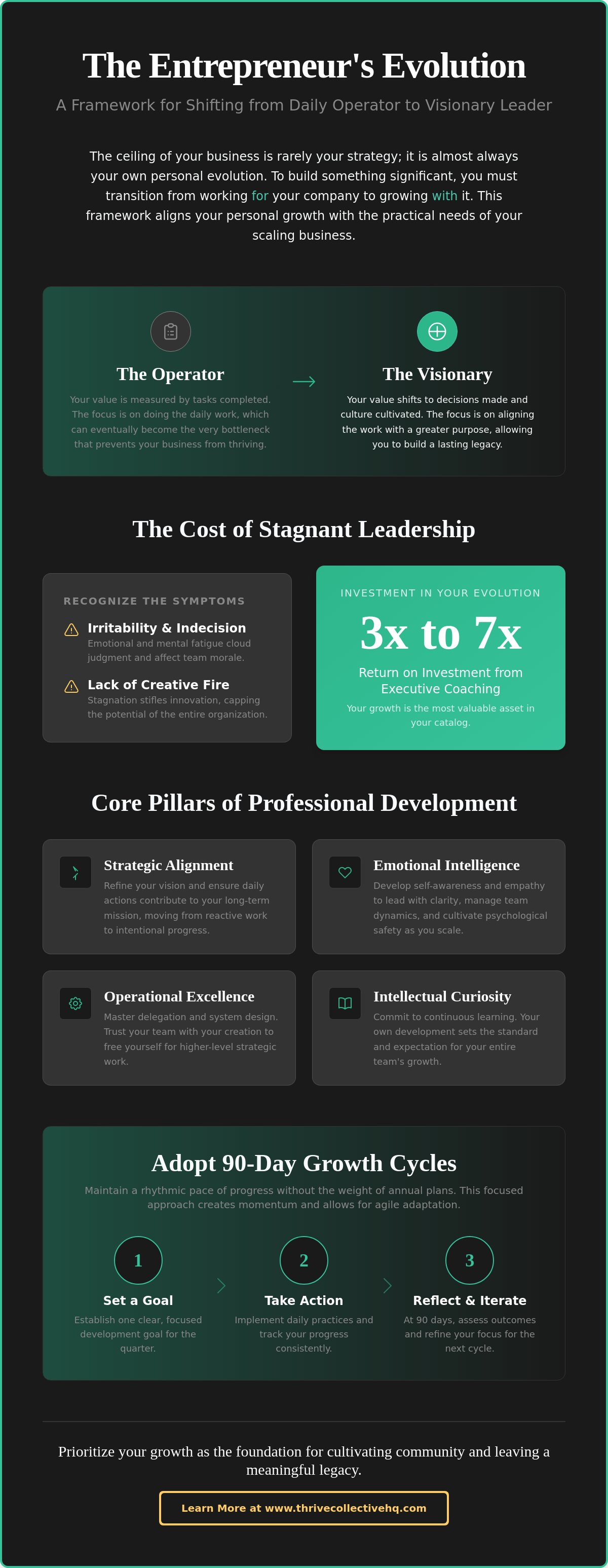
- Transition from the role of daily operator to visionary leader by shifting your focus toward the broader architecture of your business.
- Establish professional development goals for entrepreneurs that allow you to scale with ease by aligning your personal evolution with your business mission.
- Adopt 90-day growth cycles to maintain a rhythmic pace of progress without the weight of annual plans.
- Strengthen your emotional intelligence to lead with clarity and empathy as your team and impact expand.
- Prioritize your own growth as the foundation for cultivating a community and leaving a meaningful legacy.
The Evolution of the Entrepreneurial Leader
Growth for a founder is rarely a linear path up a ladder; it is the quiet, steady strengthening of a foundation. In the corporate world, a promotion is often handed down by a superior, but for you, a promotion is something you claim by expanding your capacity to hold a larger vision. This shift requires a fundamental change in how you view your contribution to the business. You are no longer the person who does the work; you are the person who ensures the work aligns with a greater purpose.
This transition demands a specific type of Entrepreneurial leadership that balances strategic risk with deep empathy for the collective. Traditional corporate goal-setting often fails the small business owner because it focuses on external metrics like job titles or quarterly quotas. For the entrepreneur, professional development goals for entrepreneurs must center on the internal evolution that precedes external scaling. If your identity remains tied to being the primary operator, you will eventually become the very bottleneck that prevents your business from thriving.
To better understand the mindset required for this growth, watch this helpful video:
Moving from Operator to Visionary
The transition from operator to visionary is a psychological crossing. In the early days, your value was measured by the tasks you completed (the emails sent, the orders packed, the code written). As you scale, your value shifts toward the decisions you make and the culture you cultivate. For example, a founder moving from a team of five to twenty must evolve their communication style from informal check-ins to structured leadership. You must identify the daily tasks that keep you tethered to the grind and intentionally release them. Trusting others with your creation is difficult, but it is the only way to move from simply surviving to building a lasting legacy.
The Cost of Stagnant Leadership
When a leader stops growing, the organization follows suit. Your personal limitations eventually become the ceiling for your entire team. Recognizing the signs of leadership fatigue (such as irritability, indecision, or a lack of creative fire) is essential before these symptoms affect your bottom line. Investing in your evolution is not a luxury; it is a strategic necessity. Studies have shown that executive coaching can deliver a return on investment of three to seven times the initial cost, highlighting that your growth is the most valuable asset in your catalog. We suggest exploring titles like The Emotional Intelligence Advantage to begin refining the internal skills that support sustainable business growth.
Core Pillars of Professional Development for Founders
The architecture of your business is only as strong as the pillars supporting your leadership. While technical mastery might launch a startup, the long-term success of any venture depends on your ability to cultivate human-centered skills. Understanding the importance of professional development allows you to move beyond the reactive firefighting stage of business ownership. It transforms your daily work into an intentional practice of growth. When setting professional development goals for entrepreneurs, we recommend focusing on four specific areas: strategic alignment, emotional intelligence, operational excellence, and intellectual curiosity. These are the foundations of a leader who does more than just work; they thrive.
Research indicates that 59% of workers believe corporate education directly improves their performance. As a founder, your commitment to learning sets the standard for your entire team. If you aren't growing, your readers and your collective will notice the stagnation. Professional development for the founder is not merely about staying competitive. It is about ensuring the business remains a true reflection of your highest potential.
Cultivating Emotional Intelligence
Self-awareness is the most valuable asset in a founder's catalog. Your ability to regulate your emotions directly influences the psychological safety of your team. In small teams, conflict often arises from unexpressed expectations or misaligned communication styles. Developing high emotional intelligence allows you to resolve these tensions with clarity rather than defensiveness. For those looking to deepen this specific skill, we recommend exploring the emotional intelligence advantage. This title provides actionable frameworks for managing the complex dynamics of a growing collective without losing your own sense of peace.
Strategic Alignment and Values
Decision-making becomes significantly easier when your personal values are in harmony with your business mission. Friction often occurs when an entrepreneur tries to acquire skills that don't match their natural strengths or their long-term vision. Intentionality is key here. Every book you read and every title you add to your library should serve a specific purpose in your evolution. Sometimes, understanding your own history is the best way to move forward in leadership. Titles that explore personal history, such as understanding your own narrative, can provide the perspective needed to lead with greater empathy and self-respect. When your personal purpose and business legacy are aligned, the daily grind feels less like a burden and more like a contribution.
Designing Your Professional Development Roadmap
Learning for the sake of learning is a luxury few founders can afford. Without a structure, you risk falling into a scattergun pattern of consuming information that never translates into action. Establishing professional development goals for entrepreneurs requires a ruthless prioritization of what your business actually needs from you in this specific season. It is about moving from a state of reactive absorption to intentional mastery. A roadmap ensures that every hour you spend reading or studying yields a tangible return for the collective.
We find that 90-day cycles are far more effective than annual plans for those in leadership. A year is an eternity in a growing business, but three months is long enough to see real progress and short enough to maintain focus. This rhythm prevents you from becoming overwhelmed by a distant future and keeps your attention on the immediate evolution required of you. Success markers in this roadmap should go beyond financial revenue; consider metrics like team retention, your own stress levels, and the clarity of your vision as the true indicators of growth.
The 90 Day Leadership Audit
To begin your roadmap, perform a simple audit of your current operation. This process helps you move from dreaming to doing with precision. First, identify the single biggest leadership bottleneck in your daily routine. Is it an inability to delegate, or perhaps a lack of clear communication? Once identified, select exactly one title or course to study that directly addresses this gap. If focus is your primary challenge, a title like The Procrastination Cure can provide immediate relief. Finally, schedule weekly reflection time to integrate these new concepts into your leadership style. Without this integration, knowledge remains purely theoretical.
Integrating Reflection into the Workday
Reflection is the bridge between reading a book and changing a behavior. We believe that handwriting is a foundational tool for strategic thinking that digital tools simply cannot replicate. Using physical journals and keepsakes allows you to slow down the frantic pace of digital life. Research suggests that writing by hand clarifies thoughts more effectively than typing because it engages different neural pathways. This practice helps you see patterns in your leadership that you might otherwise miss in the rush of the day.
Setting aside twenty minutes each morning for intentional planning can change the entire trajectory of your business. Use this time to write down your intentions before you open your inbox or check your notifications. This small window of quietude ensures that your day is driven by your vision rather than the demands of others. It is a simple act of self-respect that anchors your growth in daily practice, ensuring your evolution as a leader is both steady and sustainable.
Overcoming the Isolation of Growth
Leadership is often described as a solitary endeavor. While you hold the vision, the weight of every decision rests on your shoulders alone. This isolation can lead to a specific type of fatigue that stalls your personal evolution. Finding your collective is not just a comfort; it is a strategic requirement for survival. When setting professional development goals for entrepreneurs, you must include the cultivation of a support system that challenges your assumptions and mirrors your potential. No one succeeds in a vacuum, and your growth is accelerated when you are surrounded by those who understand the unique pressures of scaling a business.
Finding Your Collective
There is a distinct difference between a peer group and a professional coach. A peer group offers the camaraderie of those in the trenches, while a coach provides the objective distance needed to see your blind spots. Both are essential for a well-rounded leadership evolution. We suggest seeking out mentors who have successfully walked the path you are currently on. Learning from their history allows you to avoid common pitfalls and lead with greater confidence. You can explore specific strategies for this in our guide on leadership coaching for entrepreneurs. This type of targeted support ensures your growth remains focused and intentional.
The Power of Shared Learning
Growth should not be a top-down mandate. It is an invitation to your entire team. When you lead a culture of continuous learning, you change a hierarchy of workers into a community of contributors. Hosting internal book clubs is one of the most effective ways to foster this environment. It creates a shared vocabulary and helps you model how to achieve professional development goals for entrepreneurs for those you lead. Research shows that 76% of employees are more likely to stay with a company that provides continuous training. This collective pursuit of excellence ensures that your business legacy is built on a foundation of shared purpose rather than individual effort.
Sometimes the most profound growth comes from looking backward to understand how your history shapes your current leadership. We invite you to explore titles that examine the roots of personal narrative to gain a deeper perspective on your journey.
Cultivating a Legacy Through Continuous Learning
We believe that true success is measured by the impact you leave behind. It is found in the way your vision outlasts your daily presence and continues to inspire those you have led. The professional development of the leader is the greatest gift to the business. When you invest in your evolution, you aren't just improving your own skills; you are expanding the possibilities for everyone in your collective. This work is the foundation of a legacy that transcends quarterly reports and annual revenue targets. It is about becoming the person who can sustain the weight of a growing and thriving organization.
The pursuit of knowledge must be a permanent part of your identity rather than a temporary phase of your career. Establishing professional development goals for entrepreneurs is an act of intentionality that signals your readiness for the next level of impact. It is a commitment to a lifelong path of refinement. By selecting titles from our leadership and growth collection, you ensure that your next cycle of development is grounded in high-level thinking. This curated approach prevents the overwhelm of scattered learning and focuses your energy on the areas that will yield the greatest long-term results for your business and your spirit.
Beyond the Bottom Line
Continuous learning prepares you for the eventual transition of your business. Whether you plan to sell, pass the torch to a successor, or step into a new venture, your evolution ensures the organization is resilient enough to thrive without your constant intervention. There is a profound satisfaction in watching your team grow as a direct result of your own shift in identity. You aren't just building a company; you are cultivating a community of leaders who share your values. Establishing a personal philosophy of growth ensures that your influence outlasts your current role and continues to shape the industry long after you have moved on to your next chapter.
Taking the Next Step
Begin by reviewing your current catalog of leadership titles and identifying where your curiosity is pulling you next. Are your current resources challenging you to step into a bigger version of yourself? Commit to one specific goal for the next ninety days that aligns with your personal evolution. Perhaps it is mastering the art of delegation or deepening your emotional intelligence. Whatever you choose, let it be a reflection of your heart-centered ambition. If you are looking for a starting point for your next chapter, we recommend reaching out to info@thrivecollectivehq.com for tailored recommendations. We are invested in your success and look forward to helping you architect a leadership style that is both powerful and sustainable.
Architecting Your Future Self
Your journey as a founder is defined by the depth of your foundation rather than the height of your achievements. By establishing clear professional development goals for entrepreneurs, you ensure that your personal evolution keeps pace with the scaling of your business. We have explored how shifting from an operator to a visionary requires a change in identity, the importance of 90-day growth cycles, and the necessity of finding your collective to ward off isolation. This architecture of leadership is not a static plan; it is a living commitment to excellence and empathy.
As an independent press dedicated to visionary leadership, we curate titles that focus on holistic growth and strategic alignment. Our catalog is shaped by experienced founders and editors who understand that the person holding the vision is the business's most valuable asset. To begin your next chapter of growth, we invite you to explore our leadership and growth titles and select the resource that speaks to your current season. Your legacy is waiting to be written, and we are honored to support your path toward a thriving future.
Frequently Asked Questions
What are good professional development goals for small business owners?
Effective goals prioritize the transition from operator to visionary leader. You might focus on increasing emotional intelligence to manage a growing team or mastering delegation to free up strategic thinking time. These professional development goals for entrepreneurs ensure that your internal capacity expands at the same rate as your business revenue. Investing in your own growth is a reliable way to increase the ceiling of your entire organization.
How do I balance professional development with running a business?
Integration is more effective than separation. We suggest setting aside twenty minutes each morning for intentional planning and reflection using a guided journal. By treating your growth as a core strategic driver rather than a secondary task, you ensure that learning becomes a permanent part of your daily workflow. This small window of quietude anchors your day in vision rather than just reacting to your inbox.
Why is emotional intelligence important for entrepreneurs?
Emotional intelligence is the foundation of high performing teams and a healthy workplace culture. It allows you to regulate your own reactions and lead through empathy when tensions arise. As you scale from a small team to a larger collective, your ability to manage human dynamics becomes more critical than your technical expertise. This internal skill set allows you to lead with a calm authority that inspires trust.
Can professional development goals help with founder burnout?
Burnout often stems from a lack of intentionality and the feeling of being trapped in the daily grind. Setting professional development goals for entrepreneurs helps you reclaim a sense of agency and purpose. It shifts your focus from merely surviving the workday to thriving through personal evolution and strategic growth. By separating your personal worth from daily business metrics, you create a sustainable path for long term leadership.
What is a useful way to track progress on leadership goals?
Tracking leadership progress is achieved through qualitative reflection rather than just quantitative metrics. Use physical journals from our catalog to record your thoughts, challenges, and wins over a 90 day period. This practice helps you identify patterns in your behavior and clarifies how your leadership style is evolving alongside your business. It provides a concrete record of your growth that numbers on a spreadsheet simply cannot capture.
How often should an entrepreneur update their development plan?
We recommend updating your plan every ninety days. A year is often too long for the fast paced nature of entrepreneurship; quarterly cycles allow for greater agility and focus. This rhythmic approach ensures that your learning remains relevant to the current needs of your operation and your team. Regular audits prevent your growth from becoming stagnant or misaligned with the actual demands of your scaling business.
Should I share my professional development goals with my team?
Sharing your growth objectives fosters a culture of transparency and mutual respect within your organization. It signals to your readers and your team that you value continuous improvement and are willing to do the work. This vulnerability encourages others to set their own development goals, transforming your hierarchy into a community of learners. It bridges the gap between the leader and the individual contributor through shared purpose.
How do I choose between a coach and a peer group for my growth?
Choose a coach when you need objective feedback on specific blind spots or a structured path for leadership evolution. A peer group is better suited for finding solidarity and perspective among others who face similar challenges in the trenches. Both are valuable components of a well rounded support system. Identifying whether you need a mentor's wisdom or a peer's camaraderie is a vital step in your selection.

Article by
Kimberly Cordova
Kimberly Burk Cordova is the founder of Thrive Collective Publishing, an independent multi-imprint publishing house based in Santa Fe, New Mexico. She is the author of books on leadership, business growth, AI and automation, emotional intelligence, and personal development, written for readers who want clear thinking, useful frameworks, and books they actually finish.
Before turning her full attention to publishing, Kimberly spent more than two decades in strategy, operations, and program leadership, working with public agencies and private organizations on transformation, technology, and large-scale change. That operator's lens shows up in everything she writes and publishes: real frameworks, real numbers, no fluff.
As publisher, she leads a catalog of more than 80 titles from six authors across multiple imprints, spanning literary suspense, true crime, children's biography, relationships, travel, guided journals, and coloring books. The house publishes regularly across its core series, including The Casita Series, Shadows of the Past, the Young Legends Collection, The Growth Leader Collection, the AI and Automation Blueprint, The Heirloom Series, The Art of Manifestation, the Just Write Collection, and Travel: Destination Guides.
She lives in Santa Fe with her husband Greg, a self-taught silversmith and lapidary artist. When she is not writing or publishing, she is building Wildflower Artisans, their Turquoise jewelry brand, or curating the next round of Just Write journals.
Connect with Kimberly and Thrive Collective Publishing at thrivecollectivehq.com.