

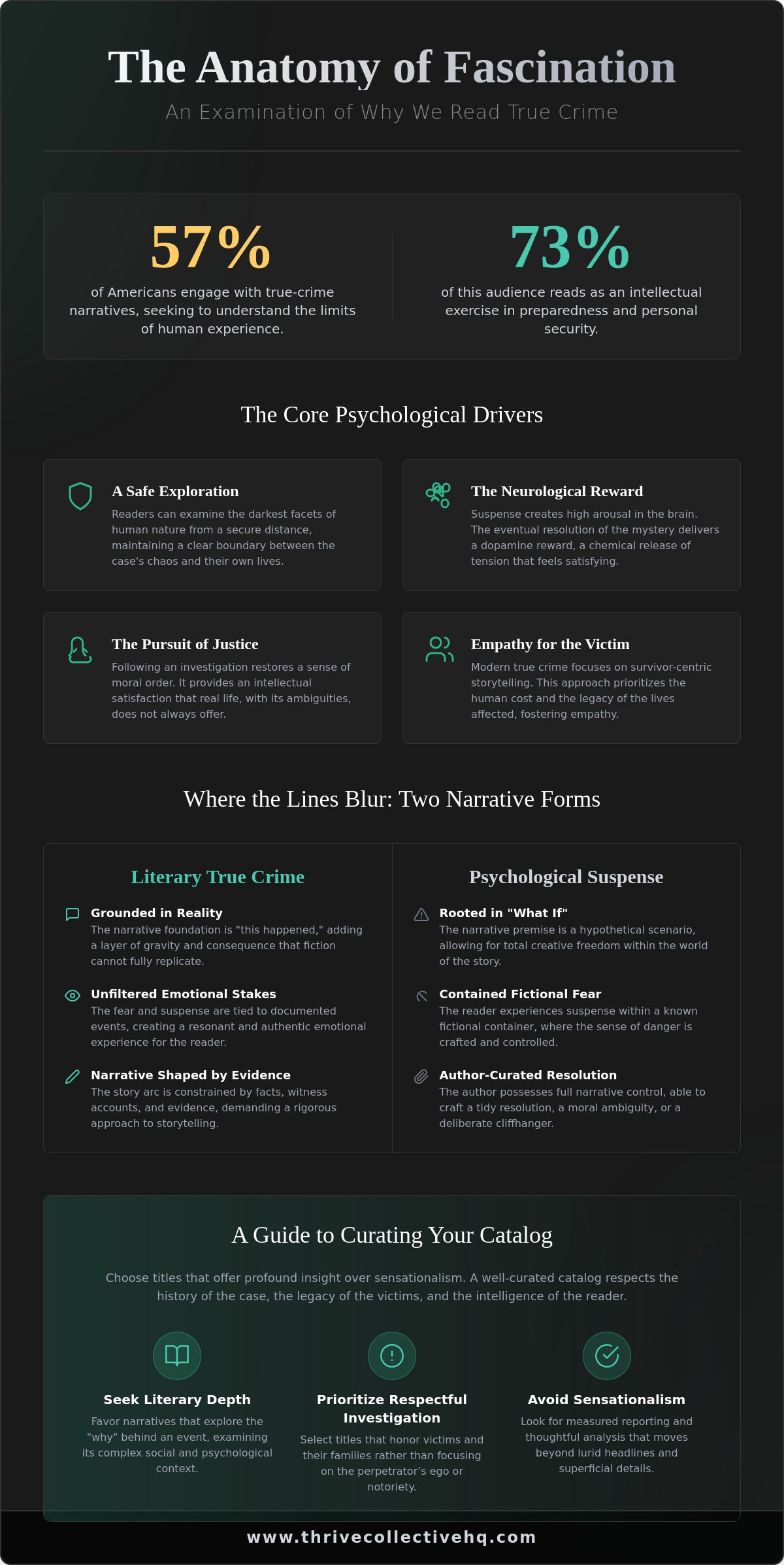
Fifty-seven percent of Americans report consuming true-crime content, a statistic that reflects a deep, shared curiosity about the boundaries of the human experience. You likely find yourself drawn to these narratives while questioning the ethics of your interest, but the appeal of true crime stories is often a literary pursuit of justice rather than mere voyeurism. Understanding this fascination requires us to look past sensational headlines and examine our inherent desire for safety, preparedness, and moral clarity. Our Collective believes that engaging with these dark narratives allows for a safe exploration of human limits. It's an exercise in empathy.
We recognize that your time is valuable and your reading life should be shaped with intentionality. In this article, we explore the psychological and literary reasons behind our enduring fascination with the shadows and how these works compare to the craft of psychological suspense. You will learn to distinguish between sensationalist media and literary true crime that respects the legacy of the victims and the history of the case. This perspective will help you curate a catalog of titles that offer profound insight, ensuring your intellectual life thrives rather than just survives the noise of the modern world.
Key Takeaways
- Learn why examining dark themes from a safe distance serves as an intellectual exercise in preparedness and personal security.
- Explore the structural commonalities between narrative non-fiction and psychological thrillers to understand why real events often feel more compelling than fiction.
- Examine the appeal of true crime stories through a lens of integrity, helping you identify titles that honor the history of the case without falling into sensationalism.
- Discover how the narrative architecture of a well-crafted mystery uses pacing and rhythmic sentence structure to move the reader toward a state of clarity.
- Gain insights on building a personal catalog of titles from independent imprints that favor literary depth and respectful investigation over lurid headlines.
Understanding the human fascination with true crime
True crime is more than a list of facts or a cold police report. It's a sophisticated exploration of real-world events through a narrative lens, where the reader acts as a witness to the complexities of human nature. When you explore what defines the true crime genre, you find a literary tradition that dates back centuries, rooted in our shared desire to understand the "why" behind the unthinkable. It's a way to witness the shadows while standing firmly in the light.
The appeal of true crime stories lies in the psychological safety of the medium. You can study the darkest corners of the human experience from the comfort of your favorite reading chair, maintaining a clear boundary between the chaos of the crime and the order of your own life. Biologically, your brain responds to these narratives with a surge of dopamine. Suspense creates a state of high arousal, and as the mystery unfolds, the resolution provides a chemical reward that feels like a physical release of tension.
To better understand this biological and psychological pull, watch this helpful video:
Beyond the biological thrill, there is a practical element of preparedness. Research indicates that 73% of consumers are driven by curiosity and a desire to prepare for dangerous situations. For many readers, these titles serve as a manual for survival, helping you identify warning signs, understand manipulation tactics, and cultivate a sense of vigilance. This isn't about living in fear; it's about moving through the world with intentionality and awareness, ensuring you are equipped to thrive.
The search for justice and closure
The resolution of a case provides an intellectual satisfaction that real life often denies us. You become a silent participant in the investigation, weighing the evidence and testing your own theories against the facts. When a title offers a clear resolution, it restores a sense of moral order. Even unsolved mysteries, such as those featured in our true crime series, create a unique form of narrative tension that keeps your mind engaged long after the final page is turned. This intellectual exercise helps us process the concept of justice in a complex world.
Empathy and the victim perspective
Modern publishing is seeing a necessary shift toward survivor-centric storytelling. High-quality titles now focus on the human cost rather than the perpetrator’s ego, prioritizing the legacy of the lives lost. This approach allows you to move beyond the crime itself to understand the profound ripple effects on families and communities. By understanding the appeal of true crime stories through the lens of empathy, we ensure that these narratives honor the truth while supporting your personal evolution and your commitment to community well-being.
Psychological thrillers vs true crime: Where the lines blur
The line between a dark novel and a factual account is often thinner than you might expect. Both genres rely on a carefully constructed narrative arc to keep you engaged, employing suspense, foreshadowing, and character development to build a sense of inevitability. However, the emotional stakes differ fundamentally. In non-fiction, the appeal of true crime stories is rooted in the "this actually happened" realization. This reality adds a layer of gravity that even the most skilled novelist struggles to replicate. Psychological fiction often borrows from real criminal patterns to build realism, but it can never quite match the chilling resonance of a documented event.
Narrative control in fiction
Authors of psychological thrillers possess a unique power, the ability to curate a perfect resolution. They can tie up every loose thread, ensure justice is served, or leave the reader with a haunting, intentional cliffhanger. This genre allows us to explore the darkest human impulses without the burden of real-world consequences. Titles within The Casita Series exemplify this literary suspense, using the freedom of fiction to examine complex psychological patterns while maintaining a safe distance for the reader. It's a space where we can test our boundaries and find alignment with our own moral compass.
The weight of reality in non-fiction
Writing true crime requires a different set of muscles and a deep commitment to integrity. We must respect the ethical boundaries in true crime, balancing the need for a compelling narrative with a strict adherence to the historical record. Real-world details often provide a resonance that invented ones lack because they carry the weight of legacy and truth. A meticulous researcher doesn't need to invent a twist when the evidence itself provides a shocking revelation. This grounding in reality is what makes the appeal of true crime stories so enduring, it challenges our understanding of human limits in a way that fiction cannot.
If you find yourself drawn to the intersection of personal history and mystery, you might enjoy exploring The Mother I Did Not Know, a title that captures the quiet tension of uncovering a hidden past.
The ethical compass in crime reporting and publishing
As an independent press, we believe that the appeal of true crime stories should never come at the cost of human dignity. Our responsibility as a publisher is to maintain a clear ethical compass, ensuring that every title in our true crime catalog is built on a foundation of respect. This means moving away from lurid reporting that focuses on the mechanics of violence and instead leaning into a literary investigation that explores the social and psychological impact of the event. A curator's voice acts as a vital buffer. It trusts you to handle the truth without needing to be prodded by sensationalist hooks. By maintaining a respectful distance from the tragedy, we allow for deep reflection and learning rather than mere consumption.
Substance over sensationalism
We avoid breathless prose and stacked superlatives because they diminish the gravity of the subject matter. Instead, our Collective favors calm, editorial analysis that allows the facts to speak for themselves. This intentionality ensures that you are engaging with a narrative that has been researched with integrity rather than manufactured for shock value. High-quality titles focus on legacy and alignment with the truth. They provide a space where readers can reflect on the human condition without feeling like voyeurs. When you choose a title from our Shadows of the Past collection, you are choosing a narrative that values substance over sensationalism. It is about finding the light within the shadows and ensuring your reading life thrives rather than just survives the noise of the media landscape.
The role of the citizen sleuth
The rise of digital media has introduced the phenomenon of the citizen sleuth, which brings both opportunities and risks. While public interest can occasionally help solve cold cases, it often leads to dangerous parasocial relationships that can interfere with the right to a fair trial. Professional research is the bedrock of a reliable title, as it balances the public's curiosity with a strict adherence to legal and ethical boundaries. Our editors work to ensure that the appeal of true crime stories is balanced with a commitment to the privacy of those involved. By choosing titles from a reputable imprint, you support a movement that values accuracy over engagement metrics. This approach helps you cultivate a reading life that is both informed and grounded, allowing your intellectual curiosity to flourish in a community of conscious readers who value impact over hype.
The narrative architecture of mystery and suspense
The appeal of true crime stories depends heavily on a structural foundation that most readers never see. It is the narrative architecture, the invisible scaffolding of pacing and tension, that transforms a series of unfortunate events into a compelling title. We look for a sense of inevitability in these stories. This isn't about mere unpredictability. It's about a rhythm that moves you from a state of questioning to a state of understanding. Writers often employ parallel phrasing to create this momentum, using repeated sentence structures to build a psychological heartbeat within the text. This technique creates a feeling of alignment between your pulse and the story's progression, ensuring you remain engaged with every page.
Atmosphere also plays a vital role, particularly when we consider the "literary Southwest." The vast landscapes and isolated settings of New Mexico or Colorado provide more than just a backdrop. They act as a character. This regional context adds a layer of depth that grounds the mystery in a specific time and place, making the transition from a problem to a solution feel both earned and grounded. It's about more than the crime; it's about the legacy of the land where it occurred.
Building tension through specific detail
Concrete examples are the anchors of narrative non-fiction. While a general description of a crime might feel distant, the inclusion of small, mundane facts makes the reality feel immediate and visceral. You might read about a half-eaten meal on a table or a ticking clock in an empty hallway. These details ground you in the story, reminding you that these events happened to real people in real spaces. For those interested in how regional identity shapes these narratives, you can explore our thoughts on Defining the Literary Southwest. This regional specificity is a hallmark of our catalog, ensuring that every mystery we publish feels authentic and respectful.
The editor’s role in shaping the story
Curation is the process of transforming raw facts into a meaningful narrative legacy. We believe that an editor’s role is to find the balance between cold information and emotional resonance. A quiet, confident voice is far more effective for handling dark themes than breathless prose ever could be. By removing the noise of sensationalism, we allow the truth to emerge with clarity. This intentionality ensures that the appeal of true crime stories remains rooted in intellectual growth rather than voyeurism. We trust our readers to appreciate the nuance of a well-edited investigation.
If you are looking for a title that exemplifies this careful narrative architecture and emotional depth, we recommend you explore The Mother I Did Not Know for a masterclass in quiet suspense and personal discovery.
Choosing titles that respect the history and the reader
Independent presses provide a vital service by curating perspectives that often escape the notice of larger, more commercial houses. In our Collective, we believe that the appeal of true crime stories is most potent when the narrative is handled with a sense of stewardship. This means choosing titles that prioritize the search for truth over the desire for a viral moment. Building a personal library is an opportunity for personal evolution. It requires intentionality.
A recommendation for the thoughtful reader
If you are looking for a title that exemplifies this commitment to narrative integrity, The Mother I Did Not Know is an essential addition to your catalog. Published under the Eliza Hawthorne imprint, this work is a study in family mystery that balances personal history with a rigorous search for the truth. The Eliza Hawthorne persona is one of historical care and deep respect, ensuring that every detail is verified and every voice is honored. This title avoids the breathless prose of sensationalist reporting, opting instead for an editorial voice that is both confident and calm. It is a work that trusts you to appreciate the weight of the history being uncovered.
Next steps for your personal catalog
We encourage you to explore the Shadows of the Past series to find more titles that match this level of depth and dedication. This series is designed for readers who want their literary life to thrive rather than just survive the surface-level noise of the modern world. Processing these complex themes is often more effective within a community, and our book clubs offer a space for intentional conversation and shared growth. For further guidance on building your collection or to learn more about our specific imprints, please reach out to us at info@thrivecollectivehq.com. We are committed to helping you find the stories that resonate with your purpose and your legacy.
Cultivating a library of intentionality
We have explored how the appeal of true crime stories is rooted in our shared desire for safety, empathy, and moral clarity. It is a literary pursuit that demands a high level of integrity from both the writer and the publisher. By focusing on narrative architecture and the legacy of the victim, we move beyond the noise of sensationalism into a space of deep, purposeful reflection. You have the power to curate a catalog that reflects your values, choosing titles that honor the truth while challenging your perspective. This intentional approach ensures your intellectual life continues to thrive.
If you are ready to engage with a narrative built on these principles, we invite you to Explore the mystery of The Mother I Did Not Know. Published by Thrive Collective Publishing: Books, Journals, and Guides, this title is a study in historical care and narrative integrity. It is available in multiple formats for your personal catalog, including paperback, hardcover, and Kindle. Your curiosity is a gift, and we're honored to support your pursuit of alignment and growth as you step into a bigger version of your reading life.
Frequently Asked Questions
Why do people find value in true crime even when the subject matter is disturbing?
People often engage with these narratives because they provide a safe environment to explore the boundaries of human behavior. The appeal of true crime stories is frequently rooted in a desire for moral clarity and the intellectual satisfaction of seeing a complex puzzle solved. It is a way to witness the shadows of the world while remaining firmly grounded in your own reality, ensuring your mind stays active and aware.
Is it ethical to consume narratives about real-life crimes?
Consuming these stories is ethical when the publisher prioritizes the legacy of the victims and the integrity of the historical record over sensationalism. We recommend choosing titles from independent presses that employ a curator's voice and maintain a respectful distance from the tragedy. This shift from voyeurism to literary investigation ensures your reading habits support a more conscious and respectful publishing community.
What is the primary difference between true crime and a psychological thriller?
The difference lies in the weight of reality and the constraints placed upon the author. A psychological thriller allows for the creation of a perfect resolution or the exploration of imagined scenarios, while true crime must remain faithful to documented facts. While both genres use similar narrative architecture to build suspense, the emotional stakes in non-fiction are anchored in the knowledge that these events actually occurred to real people.
How can I identify a well-researched title in this genre?
A well-researched title typically includes specific details, clear citations, and a calm, editorial tone that avoids breathless prose. You should look for an author who values substance over hype and provides a bibliography or a note explaining their research process. At Thrive Collective, we prioritize titles that favor historical integrity, ensuring our readers receive a narrative built on a foundation of truth rather than manufactured shock.
Can reading true crime help manage personal anxiety or fear?
Many readers find that these stories provide a sense of preparedness that actually helps mitigate fear. Research shows that a significant number of consumers are driven by a desire to learn survival strategies or identify warning signs in real-world situations. By understanding these dark narratives, you may feel better equipped to move through the world with intentionality, helping you thrive in your daily life by replacing the unknown with knowledge.
Which true crime audiobooks are recommended for new readers?
New readers often find clarity in titles that prioritize narrative depth and personal history. We suggest exploring our true crime audiobooks new releases, which emphasize the psychological impact of the case rather than the mechanics of the act. These titles are curated to provide a sophisticated introduction to the genre, ensuring your initial experience is one of intellectual growth and alignment with high editorial standards.
How do publishers maintain respect for the victims involved?
Respectful publishers shift the focus of the narrative from the perpetrator to the human cost of the event. We ensure our editors prioritize the lives lost and the ripple effects on the community, using survivor-centric storytelling to honor those affected. This approach avoids the use of stacked superlatives and sensationalist hooks, maintaining a professional intimacy that respects the truth of the history without exploiting the tragedy.
Why is the Southwest frequently used as a setting for these titles?
The Southwest offers an atmosphere of vast landscapes and isolated settings that act as a silent character in the story. In places like New Mexico or Colorado, the contrast between natural beauty and the shadows of the past creates a natural tension that grounds the mystery. This regional identity helps the appeal of true crime stories feel more authentic and visceral, connecting the events to the unique legacy of the land.

Article by
Kimberly Cordova
Kimberly Burk Cordova is the founder of Thrive Collective Publishing, an independent multi-imprint publishing house based in Santa Fe, New Mexico. She is the author of books on leadership, business growth, AI and automation, emotional intelligence, and personal development, written for readers who want clear thinking, useful frameworks, and books they actually finish.
Before turning her full attention to publishing, Kimberly spent more than two decades in strategy, operations, and program leadership, working with public agencies and private organizations on transformation, technology, and large-scale change. That operator's lens shows up in everything she writes and publishes: real frameworks, real numbers, no fluff.
As publisher, she leads a catalog of more than 80 titles from six authors across multiple imprints, spanning literary suspense, true crime, children's biography, relationships, travel, guided journals, and coloring books. The house publishes regularly across its core series, including The Casita Series, Shadows of the Past, the Young Legends Collection, The Growth Leader Collection, the AI and Automation Blueprint, The Heirloom Series, The Art of Manifestation, the Just Write Collection, and Travel: Destination Guides.
She lives in Santa Fe with her husband Greg, a self-taught silversmith and lapidary artist. When she is not writing or publishing, she is building Wildflower Artisans, their Turquoise jewelry brand, or curating the next round of Just Write journals.
Connect with Kimberly and Thrive Collective Publishing at thrivecollectivehq.com.