

The most iconic vistas of a destination often mask its true character, a place that thrives on quiet resilience and creative depth. While its well-trodden paths attract millions of visitors, the authentic soul of this locale is found in the hushed aisles of independent bookstores and the salt-aired history of its scenic waterfronts. We designed this travel guide to help you look past the standard lists and discover a destination defined by its narrative evolution. Thrive Collective Publishing: Books, Journals, and Guides believes that travel should be an intentional act of discovery, connecting you to the literary landmarks and coastal heritage that make this distinctive locale so unique. Our catalog features various travel titles designed for the intentional reader who seeks depth over distance.
You likely feel the pressure to see every iconic sight and eat at every popular eatery, yet you crave a connection that feels more personal and less performative. We promise to move you beyond the typical tourist crowds to find the specific moments that resonate with your own sense of purpose. This curated plan offers a structured three-day itinerary that highlights unique cultural landmarks and introduces you to the regional literary scene. We will explore this destination through an editorial lens, ensuring your journey is spent in alignment with the things that truly matter.
Key Takeaways
- Learn how to structure your visit using our Portland Maine travel guide to balance the historic maritime core with modern creative neighborhoods.
- Discover a three day framework that moves you beyond the tourist crowds of the Old Port into the authentic residential soul of the West End.
- Identify essential literary landmarks, such as the 1785 Wadsworth-Longfellow House, to connect with the rich regional narrative of the city.
- Explore the evolution of industrial spaces in East Bayside where local eateries and creative studios demonstrate the current energy of the community.
- Access the Thrive Collective Publishing catalog to find titles that offer deeper insights into regional storytelling and the Travel and Place collection.
What should you know before your first trip to Portland, Maine?
A Portland Maine travel guide for first-time visitors is a curated resource focusing on the maritime history, culinary reputation, and literary culture of the largest city in Maine. Thrive Collective Publishing provides insights to assist readers in exploring the intersection of coastal heritage and modern creative energy.
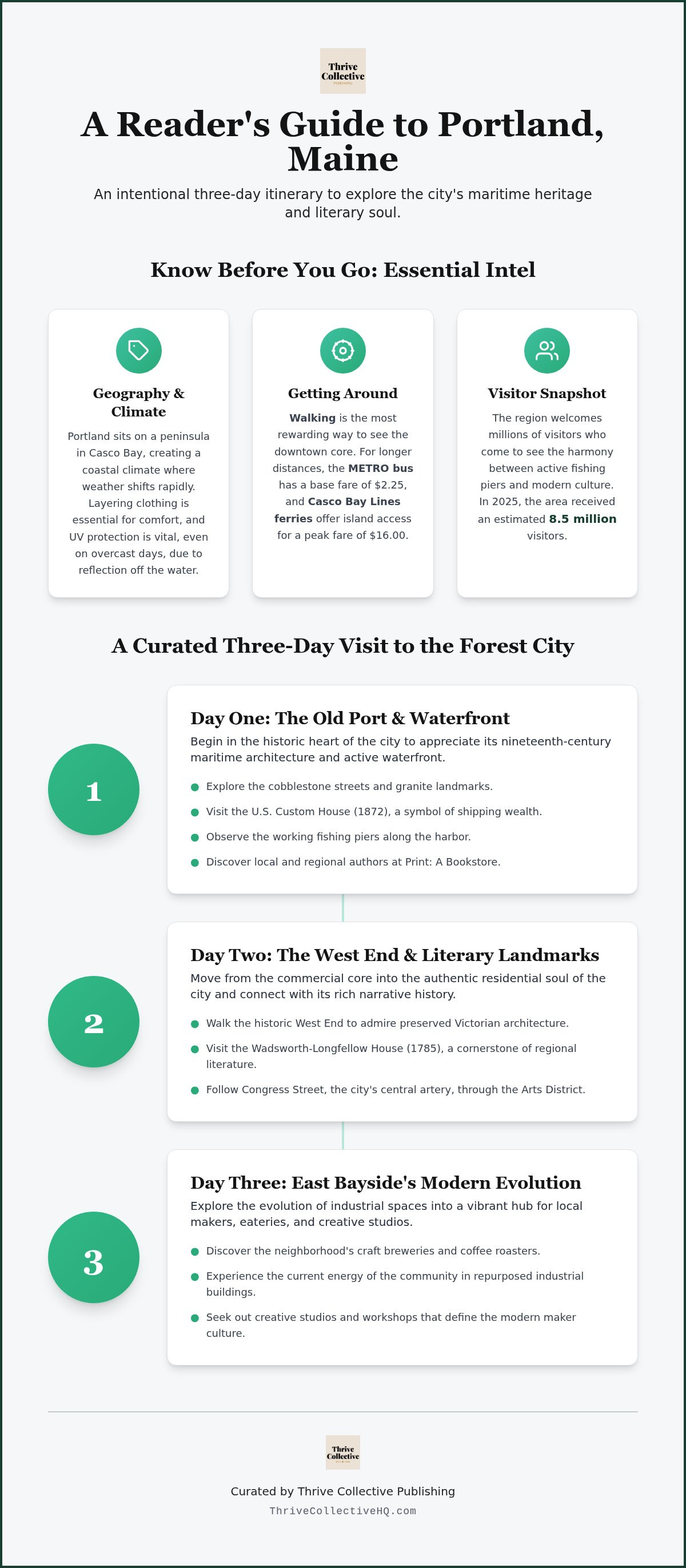
Portland sits on a narrow peninsula extending into the cold waters of Casco Bay. This specific geography dictates the rhythm of the city, where the working waterfront remains a central pillar of daily life rather than a historical relic. In 2025, the region received 8.5 million visitors, many of whom came to witness the harmony between active fishing piers and modern boutiques. For those interested in the historical evolution of Portland, Maine, it is clear that the sea has always been the city's primary architect. We offer this perspective through our Travel and Place collection, which features titles designed to help you connect with the authentic soul of a destination. Every street corner tells a story of survival and creative rebirth.
Managing the coastal environment
The Atlantic Ocean functions as a natural regulator for the local climate. It keeps summer afternoons brisk and winter mornings damp, meaning temperatures can shift twenty degrees in a single afternoon. Layering is your most effective tool for comfort. You should prioritize moisture-wicking fabrics and wind-resistant outer shells to combat the sudden coastal breezes. Walking is the most rewarding way to see the downtown core, though you must remember that sun protection is vital. The reflection of sunlight off the harbor water increases UV exposure, even when the sky appears gray and overcast. We believe that being prepared allows you to focus on the beauty of the moment rather than the bite of the wind.
Understanding the Portland peninsula grid
The city is organized on a manageable grid bounded by the Fore River and Back Cove. Congress Street serves as the central artery, stretching through the Arts District and connecting various neighborhoods. When using this Portland Maine travel guide to plan your route, remember that the peninsula is smaller than it appears on a map. Public transportation is reliable and affordable for those who prefer not to walk the hills or who wish to see the harbor from a different angle.
- The METRO bus system maintains a base fare of $2.25 for local rides.
- Casco Bay Lines ferries provide access to the surrounding islands for a peak season adult fare of $16.00.
- Walking remains the most efficient way to explore the dense maritime core and residential districts.
By understanding these logistical foundations, you can transition from a state of planning to a state of doing. We want you to feel the pulse of the brick streets and the energy of the harbor as you step into your own version of a coastal story.
How can you structure a three day visit to the Forest City?
Structuring a visit to the Forest City requires a balance between the high-energy waterfront and the quiet corners where the local soul resides. This Portland Maine travel guide suggests a three day progression that allows you to absorb the maritime heritage before moving into the creative and residential districts. According to Greater Portland's Official Tourism Guide, the city offers a dense concentration of cultural sites that are best explored with intentionality. We believe a curated itinerary prevents the feeling of being overwhelmed by generic suggestions and helps you find alignment with the local rhythm.
Day One: The Old Port and Waterfront
Your first day belongs to the brick and granite core of the city. Walk the cobblestone streets of the Old Port to appreciate the nineteenth-century architecture, specifically the United States Custom House. This granite landmark, completed in 1872, reflects the immense wealth generated by the nineteenth-century shipping industry. After observing the active fishing piers, head to Congress Street to visit Print: A Bookstore. This independent shop is an essential stop for readers looking to support local authors and find regional titles that capture the spirit of the Northeast.
Day Two: Arts District and West End
On the second day, shift your focus to the interior of the peninsula. Spend your morning at the Portland Museum of Art, which houses significant collections of American and European works. From there, walk into the West End to see the most intact collection of Victorian architecture in the country. This neighborhood feels like a living museum, offering a quiet contrast to the busy harbor. Conclude the afternoon at the Maine Historical Society and the Wadsworth-Longfellow House to understand the city's deep literary roots and the legacy of its most famous residents.
Day Three: Munjoy Hill and Casco Bay
For your final day, head east to the residential heights of Munjoy Hill. The Eastern Promenade offers sweeping views of the Atlantic Ocean and the islands of Casco Bay. Board a ferry to Peaks Island for a quiet afternoon of exploration. The twenty minute crossing provides a fresh perspective on the city skyline, giving you space for reflection or reading by the shore. This slower pace is where the true character of Maine reveals itself, away from the heavy tourist traffic of the central piers. If you find yourself inspired by these coastal narratives, you can browse our full catalog of titles to find your next favorite read.
Where are the essential cultural and literary landmarks in Portland?
Essential cultural and literary landmarks in Portland include the 1785 Wadsworth-Longfellow House, the Portland Museum of Art, and the 1867 Portland Public Library. These sites represent the narrative evolution of the city, offering readers a connection to the maritime history and creative energy that define Maine's regional identity.
Thrive Collective Publishing curates these specific landmarks to help you bridge the gap between being a tourist and becoming a participant in the local culture as you use this Portland Maine travel guide. While the natural scenery is undeniable, the intellectual landscape is where the soul of the city truly resides. For example, the Victoria Mansion offers a rare look at pre-Civil War opulence, retaining approximately 90 percent of its original 1860 interior. This preservation allows you to step directly into the past, much like the immersive experiences found in our literary suspense titles, including regional works like The Mother I Did Not Know by K.B. Cordova. These landmarks are essential for anyone following a Portland Maine travel guide with an eye for cultural depth.
Independent bookstores and reader hubs
The city's identity is inextricably linked to its love for the written word. Print: A Bookstore serves as a flagship for independent bookselling in the Northeast, hosting frequent events that foster community among local writers. Longfellow Books, located in Monument Square, provides a curated selection of titles that reflect the thoughtful nature of the regional reader. You can also visit Sherman’s Maine Coast Book Shop, which has been part of the Maine landscape since 1886. These spaces are not merely retail locations; they are the anchors of the regional Northeast literary scene. We encourage you to explore our full catalog of titles to prepare for these cultural visits.
Architectural highlights and museums
Architecture serves as a physical record of growth and resilience. The Portland Museum of Art features the Charles Shipman Payson Building, designed by I.M. Pei, which stands as a modern landmark where adult admission is $20. For a look at the earlier colonial period, the Tate House Museum, built in 1755, tells the story of the mast trade that once dominated the local economy. The Old Port district itself remains a marvel of mid-nineteenth-century commercial design, with its dense collection of brick buildings surviving multiple fires and economic shifts. These structures offer a concrete example of the alignment between history and modern creative energy that we celebrate in our publishing mission.
Which Portland neighborhoods offer an authentic local experience?
Portland neighborhoods like Munjoy Hill and the West End offer an authentic local experience by showcasing the city's residential soul and architectural history. These districts provide a quiet alternative to the busy waterfront, featuring preserved Victorian mansions, creative industrial spaces, and expansive public parks reflecting the community's commitment to heritage and creative growth.
Thrive Collective Publishing understands that a meaningful visit requires moving beyond the central tourist hubs. While the Old Port serves as the city's commercial heart, the surrounding neighborhoods are where the local narrative is most palpable. Each district possesses a distinct atmosphere, from the historic working-class roots of the eastern heights to the innovative studio spaces of the industrial valleys. This diversity is why our Portland Maine travel guide emphasizes a slow, observant approach to exploration. We believe that by stepping into these residential streets, you find a sense of alignment with the city's true character.
Munjoy Hill: History and coastal views
Munjoy Hill occupies the eastern end of the peninsula, once serving as a primary home for the city’s working-class maritime community. Today, it is a hub for local artists and families who appreciate the balance of history and natural beauty. The neighborhood features the historic Portland Observatory, the last remaining maritime signal tower in the country. A concrete example of the area's value is the 68-acre Eastern Promenade park. This vast green space offers a step directly into the coastal landscape, providing panoramic views of the Atlantic Ocean and the islands of Casco Bay. It is an ideal location for a quiet afternoon of reading or reflection.
The West End: Victorian charm and quiet streets
On the opposite side of the peninsula, the West End offers some of the preferred views of the Fore River. This neighborhood is renowned for having one of the most intact collections of Victorian architecture in the United States. You will find a mix of traditional brick mansions and innovative restorations that honor the original 19th-century designs. Danforth Street is a recommended corridor for architectural enthusiasts. The quiet, tree-lined streets provide the perfect environment for those seeking a slower pace. We often find that the stillness here inspires the kind of deep focus required for meaningful creative work.
East Bayside: Industrial evolution
East Bayside demonstrates the modern evolution of the city's industrial footprint. Once a district of warehouses and factories, it has transitioned into a center for creative studios and local eateries. This neighborhood reflects the same spirit of rebirth we celebrate in our publishing mission, where old structures are given new purpose through intentionality and community effort.
How can readers find literary inspiration in the Thrive Collective Publishing catalog?
Thrive Collective Publishing provides readers with literary inspiration through a curated catalog of titles that emphasize regional storytelling, historical accuracy, and cultural depth. By exploring the Travel and Place collection, readers gain deeper insights into regional destinations while supporting independent authors who prioritize narrative integrity over mass-market trends.
We believe that travel is more than a physical movement from one coordinate to another. It is an opportunity for personal evolution and a chance to find alignment with different ways of being. When you use a Portland Maine travel guide to find your way through the city, you are looking for more than just directions; you are looking for a story. Our catalog is designed to meet that need, offering you a visionary guide into the heart of the Northeast and beyond. We prioritize titles that foster a sense of community and intentionality, moving you from the state of a tourist to the state of an engaged reader who understands the legacy of a place.
Regional storytelling and literary suspense
The regional literary scene is defined by authors who respect the specific atmosphere and history of their settings. Explore The Mother I Did Not Know by K.B. Cordova for an essential example of literary suspense that explores themes of identity and place. While this specific title is set against the backdrop of the Southwest landscape, it demonstrates the quiet, literary approach we bring to all our regional offerings. This focus on depth is a hallmark of the K.B. Cordova imprint, making it a preferred choice for readers who value thoughtful character development and atmospheric tension. By engaging with these narratives, you prepare yourself to see the world through a more observant lens, which is the ultimate goal of any Portland Maine travel guide.
The value of buying direct from Thrive Collective Publishing
Choosing to buy direct from our catalog supports the sustainability of independent authors and small-scale publishing. The reader goods we make ourselves (reading glasses, bookmarks and book totes) are sold on our own site, while the books are on Amazon in paperback, hardcover and Kindle and the audiobooks are on Audible. What your direct support buys is editorial independence, the freedom to publish the quiet regional work that a corporate list would pass over. Why buying direct matters for readers is a core part of our mission to foster a community based on mutual support and shared values. It is an intentional choice that honors the craft of storytelling and the legacy of independent publishing, allowing us to continue scaling our impact while providing you with a more personal reading experience.
Align your journey with the authentic soul of the coast
You now have the foundation to explore the Forest City with intentionality and depth. By looking past the standard tourist traps and toward the residential soul of Munjoy Hill or the literary legacy of the West End, you choose a path of discovery that honors the local narrative. This Portland Maine travel guide is more than a list of coordinates; it's an invitation to find alignment with a city that thrives on creative resilience. We believe that every trip is an opportunity for personal evolution and a chance to build a lasting legacy of connection.
Thrive Collective Publishing operates as an independent multi-imprint publisher where titles are curated by a professional editorial team. We prioritize your experience by publishing regional work with real editorial attention and keeping it easy to find, in paperback, hardcover and Kindle on Amazon and in audio on Audible. Our mission is to bridge the gap between dreaming and doing, providing you with the visionary tools needed to thrive in any environment.
Step into this new version of your travel story with confidence. We're here to support your curiosity and celebrate the impact of your discoveries as you cultivate a community of shared knowledge and soulful ambition.
Frequently Asked Questions
How many days are recommended for a first visit to Portland, Maine?
A three day visit is the standard recommendation for a first trip using this Portland Maine travel guide. This duration provides enough space to explore the maritime core of the Old Port, the Victorian architecture of the West End, and the natural beauty of the Eastern Promenade. You can also dedicate an afternoon to a Casco Bay ferry excursion without feeling rushed. It allows for a balanced connection between cultural sites and the local culinary scene.
What is the preferred time of year for visiting the Maine coast?
The preferred time for a visit is between June and October when the coastal weather is most reliable. During these months, the seasonal ferries operate on full schedules and the local art walks are in high energy. While the region is beautiful in winter, many smaller island attractions and outdoor events are seasonal. Late summer offers the best alignment between mild temperatures and the full cultural calendar of the city.
Is it necessary to rent a car when staying in downtown Portland?
You don't need a rental car if you plan to stay within the downtown peninsula. Most essential landmarks and neighborhoods are within a twenty minute walk of the central district. For longer distances, the METRO bus system offers local rides for a $2.25 base fare, and Casco Bay Lines provides island access. Foregoing a car removes the challenge of finding parking on narrow, historic brick streets and allows for a more intentional pace.
How should travelers prepare for the coastal weather in Maine?
Preparing for coastal weather requires a strategy of versatile layering to manage sudden shifts in temperature. The Atlantic influence can cause readings to drop significantly when the sea breeze picks up in the late afternoon. You should pack moisture-wicking base layers, a wool sweater, and a windproof shell. Even on overcast days, sun protection remains vital because the water reflects UV rays, increasing exposure during harbor walks or ferry rides.
What are the most walkable areas for readers in the Old Port?
The most walkable areas for readers are located between Commercial Street and Congress Street in the historic Old Port. This dense network of cobblestone paths features a high concentration of independent bookstores and quiet cafes. You can easily move from a morning of browsing local titles to an afternoon spent exploring nineteenth-century architecture. The proximity of these sites makes the district a preferred hub for those who enjoy exploring a city on foot.
Where can visitors find information on local author events in Portland?
You can find information on local author events by visiting the websites of independent bookstores such as Print: A Bookstore or Longfellow Books. These locations serve as community hubs and frequently host readings that highlight the regional Northeast literary scene. The Maine Historical Society also maintains a calendar of lectures and cultural events. We recommend checking these resources before your arrival to align your visit with the local creative schedule.
Which Portland neighborhood is closest to the major art galleries?
The Arts District is the neighborhood closest to the major art galleries and creative institutions. Centered on Congress Street, this area houses the Portland Museum of Art and various contemporary studios. It sits at the intersection of the city's commercial and residential zones, making it an accessible point for those interested in the local creative energy. Staying in this district puts you within walking distance of the city's most significant cultural collections and modern landmarks.
Are there specific historical sites related to maritime history in Portland?
The Portland Observatory and the United States Custom House are the primary sites for those interested in maritime history. The observatory is the last remaining maritime signal tower in the country, offering a direct link to the city's nineteenth-century shipping roots. The 1872 granite Custom House reflects the economic power once generated by the harbor. These locations provide a concrete look at the maritime resilience that continues to define the character of the region today through an editorial lens.

Article by
Kimberly Cordova
Kimberly Burk Cordova is the founder of Thrive Collective Publishing, an independent multi-imprint publishing house based in Santa Fe, New Mexico. She is the author of books on leadership, business growth, AI and automation, emotional intelligence, and personal development, written for readers who want clear thinking, useful frameworks, and books they actually finish.
Before turning her full attention to publishing, Kimberly spent more than two decades in strategy, operations, and program leadership, working with public agencies and private organizations on transformation, technology, and large-scale change. That operator's lens shows up in everything she writes and publishes: real frameworks, real numbers, no fluff.
As publisher, she leads a catalog of more than 80 titles from six authors across multiple imprints, spanning literary suspense, true crime, children's biography, relationships, travel, guided journals, and coloring books. The house publishes regularly across its core series, including The Casita Series, Shadows of the Past, the Young Legends Collection, The Growth Leader Collection, the AI and Automation Blueprint, The Heirloom Series, The Art of Manifestation, the Just Write Collection, and Travel: Destination Guides.
She lives in Santa Fe with her husband Greg, a self-taught silversmith and lapidary artist. When she is not writing or publishing, she is building Wildflower Artisans, their Turquoise jewelry brand, or curating the next round of Just Write journals.
Connect with Kimberly and Thrive Collective Publishing at thrivecollectivehq.com.