

What if the greatest obstacle to managing remote employees effectively is the very instinct to monitor their every move? You may find yourself checking activity statuses or worrying that productivity slips the moment a screen goes dark, yet intentional leadership in 2026 requires a departure from these traditional anxieties. At Thrive Collective Publishing, we recognize that with 55% of job seekers now preferring hybrid arrangements, a distributed workforce demands a more soulful approach to oversight. It's natural to fear the loss of team cohesion when you no longer share a physical hallway, but the most resilient teams are built on a foundation of shared intention rather than constant visibility.
You deserve a team that operates with both autonomy and alignment, moving toward a collective legacy without the weight of micromanagement. As Kimberly Burk Cordova often emphasizes in our leadership titles, success is a collective endeavor that requires trust over tracking. This guide provides the principles of intentional leadership to help you build a high-performing remote team rooted in collective purpose. We will explore how adopting outcomes-based performance metrics and establishing clear systems for asynchronous communication can transform your culture into a space where every individual can truly thrive.
Key Takeaways
- Shift your leadership focus from monitoring daily activity to measuring meaningful outcomes and fostering intentional alignment.
- Build a catalog of standard operating procedures so every reader on your team understands their specific role and impact.
- Maintain a thriving culture by replacing physical proximity with deliberate rituals and the shared pursuit of collective goals.
- Learn the essential principles for managing remote employees effectively to build a high-performing team rooted in trust.
- Scale your organization by transitioning from a task supervisor to an architect of clarity and visionary systems.
What does it mean to manage remote employees effectively in 2026?
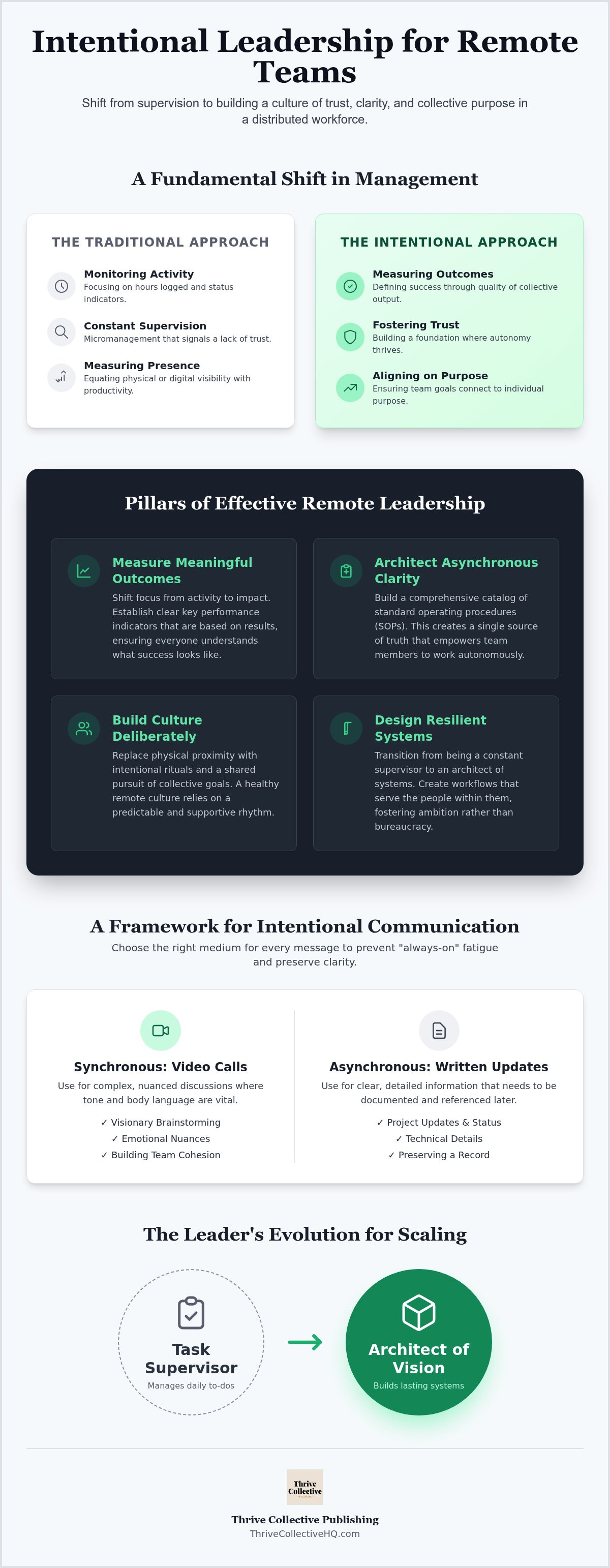
Managing remote employees effectively requires a transition from monitoring activity to measuring outcomes and fostering intentional alignment between team goals and individual purpose. In 2026, the role of the leader shifts from a supervisor of tasks to a curator of environment and clarity. Success in a remote setting is defined by the quality of the collective output rather than the quantity of hours logged. A foundational step in this evolution is understanding remote work as a discipline of focus rather than a change in geography.
Thrive Collective Publishing views this shift as a beautiful opportunity for personal and professional evolution. When you lead with intention, you create a space where team members feel supported to do their best work independently. It's no longer about the visibility of the worker; it's about the visibility of the vision. By prioritizing these principles, managing remote employees effectively becomes a natural extension of your brand mission and legacy.
To better understand the practical side of this transition, watch this helpful video:
The shift from supervision to intentionality
Traditional micromanagement fails in a digital environment because it erodes the very trust necessary for a collective to thrive. When a leader attempts to monitor every keystroke, they signal a lack of belief in their team potential. Kimberly Burk Cordova often shares that a visionary leader must set the North Star and then step back to allow their staff to shine. We move toward a model of servant leadership where the founder empowers the team, transforming business challenges into growth opportunities. For more insights on this approach, you may explore our business and entrepreneurship collection.
Defining success in a remote small business
Success requires establishing clear key performance indicators that focus on results rather than physical presence. You must communicate the why behind every project to ensure team buy-in and alignment. For those looking to deepen their expertise, our leadership and growth collection offers several titles that explore these concepts. This outcome-based management allows you to scale with ease, ensuring your catalog of work continues to expand without your constant intervention in every minor decision.
Designing a framework for asynchronous clarity
Clarity is the greatest gift a leader can provide to a remote employee. In a small, high-performing team, ambiguity acts as a silent drain on energy and focus. When you are managing remote employees effectively, you understand that your primary responsibility is to remove the fog of uncertainty. This is not about creating rigid rules; it is about providing the scaffolding that allows your team to reach their highest potential. By building a comprehensive catalog of standard operating procedures, you ensure that every reader on your team knows exactly how to contribute to the collective mission without needing constant permission or oversight.
Intentional communication requires you to choose the right medium for every message. Complex emotional nuances or visionary brainstorming sessions often require the warmth of a video call, while technical details and project updates are best preserved in writing. This deliberate choice prevents the "always-on" fatigue that leads to burnout. We recommend consulting a strategic guide for managing teams to better understand how documentation fosters engagement. Systems should always serve the people within them, acting as a foundation for soulful ambition rather than a cage of bureaucracy.
Establishing a rhythm of communication
A healthy remote culture relies on a predictable rhythm. Weekly alignment meetings should be curated to add value, focusing on connection and high-level strategy rather than a simple list of tasks. You can protect your team’s deep work time by utilizing asynchronous updates for routine status reports. This practice preserves institutional knowledge and allows for more reflective, thoughtful contributions. When information is documented clearly, it becomes a permanent resource that empowers everyone to move forward with confidence. If you are looking for more ways to refine your approach, you might find inspiration in our full catalog of titles.
The tools of intentional leadership
Leadership is a craft that requires constant refinement and the right resources. You can build a strong management foundation by selecting specific titles from our leadership and growth collection. For example, The Emotional Intelligence Advantage by Kimberly Burk Cordova offers profound insights into understanding the subtle dynamics of a digital team. We believe that integrating professional development into the weekly schedule is a requirement for any visionary founder. By prioritizing these intentional resources, you signal to your Collective that their personal evolution is just as important as the business’s financial success.
How do leaders maintain team culture without a physical office?
Culture is not a byproduct of shared physical space; it is a conscious creation born from shared intention and collective purpose. When you are managing remote employees effectively, you recognize that the strength of your team lies in the invisible threads of trust and psychological safety that bind you together. Fostering a true sense of belonging in the Collective requires more than just occasional Zoom happy hours or digital small talk. It demands that you model the vulnerability and integrity you wish to see in your staff, creating an environment where it is safe to fail forward and evolve.
A healthy remote culture flourishes when every individual feels their impact is seen and valued. This is particularly vital in a small press or creative business where every contribution shapes the legacy of the catalog. By prioritizing the pursuit of collective goals over the mere presence of workers, you cultivate a culture that thrives without the need for a physical office. This shift allows your team to operate with a sense of soulful ambition, knowing they are supported by a leader who values their growth as much as their output.
Cultivating connection in a digital collective
Creating virtual watercooler moments that feel natural is an art of intentionality. You might establish dedicated spaces for sharing personal wins, creative inspiration, or local New Mexico literary news to keep the conversation fluid and human. Shared values act as the North Star, keeping a dispersed team moving in the same direction even when working across different time zones. Celebrating wins from a distance requires specificity; instead of a general thank you, highlight the concrete impact a specific task had on the broader mission of Thrive Collective Publishing.
Encouraging professional growth and community
Professional growth should be a communal experience rather than a solitary task. You can spark deep, meaningful conversation by starting a workplace book club using our reader companion guides. These resources provide the structure for your team to explore new ideas and align their personal growth with the vision of the business. When giving feedback, we find that the direct and warm approach favored by author Kimberly Burk Cordova builds trust while maintaining high standards. Inviting team members to contribute to the collective vision makes them stakeholders in your success, ensuring that the legacy you build is one you create together.
Practical steps for scaling a remote small business
Scaling a remote small business requires you to move from being the center of every decision to being the architect of a sustainable system. When managing remote employees effectively, your focus must shift toward creating a structure that supports growth without requiring your constant presence. This transition is essential for building a legacy that outlasts your daily involvement. You must invest in the right resources to support your team as they take on more responsibility, focusing on long-term impact rather than short-term activity metrics. At Thrive Collective Publishing, we believe that scaling with ease is a byproduct of intentional design rather than sheer effort.
The onboarding process for remote success
Standardizing your onboarding process ensures that new hires feel aligned and supported from day one. The first step involves providing a clear mission statement and a comprehensive team handbook that serves as a cultural anchor. Second, we recommend assigning a mentor or buddy to help with the social transition, which helps bridge the gap created by the lack of a physical office. Finally, you should set 30, 60, and 90-day goals that are measurable and achievable. These clear objectives prevent the feeling of being adrift and allow new team members to celebrate their early wins with confidence.
Leading with intentionality to avoid burnout
As a visionary founder, you must set the example for digital boundaries. If you send communications at midnight, your team will feel pressured to respond, regardless of what your written policies state. Practical tips from our guide on leadership coaching can help you stay aligned with these boundaries. Identifying signs of disengagement early is also crucial for preventing turnover. If a previously vocal team member becomes quiet, it is often a sign of misalignment. By adopting the direct and warm approach of author Kimberly Burk Cordova, you can address these subtle shifts with integrity. We invite you to explore our catalog of leadership titles to help you build the systems your business deserves.
The role of intentional resources in leadership growth
Managing remote employees effectively is a discipline that requires more than just technical proficiency; it demands a continuous commitment to your personal evolution as a visionary guide. As you transition from a founder who handles every task to a leader who curates a high-performing environment, the resources you consume become the foundation of your success. Thrive Collective Publishing provides the titles and tools necessary to support this shift, ensuring that your growth keeps pace with the expansion of your business. We believe that a leader who prioritizes their own learning signals to their Collective that development is a core value of the organization.
Building a library of leadership titles creates a shared language for your entire team, allowing everyone to move with the same intentionality and purpose. When you invest in your own growth, you are also investing in the longevity and legacy of your company. This practice transforms the challenge of distance into an opportunity for deep, reflective leadership that transcends the limitations of a digital workspace. By surrounding yourself with elevated thought, you ensure that your management style remains grounded in integrity and soulful ambition.
Curating your leadership library
A well-curated library is an essential asset for any entrepreneur looking to scale with ease. Our collection of entrepreneurship titles is specifically selected to help you understand the nuances of modern business with confidence and grace. Beyond traditional business strategy, maintaining your own mental clarity is paramount. We often recommend incorporating a digital detox journal into your routine to provide a necessary reprieve from the constant connectivity of remote work. Using these journals to track your evolution allows you to see the patterns in your management style and make intentional adjustments that benefit the whole Collective.
Next steps for your remote team
We invite you to encourage your team to explore the Thrive Collective Publishing catalog for their own professional development. When every member of the team is engaged in their own growth, the entire organization begins to thrive in a way that feels effortless. Specific titles such as The Emotional Intelligence Advantage by Kimberly Burk Cordova can significantly improve your internal communication by providing a framework for direct and warm feedback. These resources are essential for managing remote employees effectively over the long term, as they foster a culture of mutual respect and understanding. Remember that success is a collective endeavor; no one succeeds in a vacuum. By fostering a community of learners, you ensure that your remote team remains a vibrant, aligned, and high-performing hub for connection and growth.
Managing a remote team is an ongoing practice of alignment and intentionality. To continue your leadership evolution, we recommend beginning with The Emotional Intelligence Advantage to refine your communication style. For personalized recommendations for your leadership library, please email info@thrivecollectivehq.com.
Stepping into your legacy as a visionary leader
Leading a distributed team is a practice of constant refinement and trust. By moving away from the instinct to monitor hours and toward a focus on meaningful outcomes, you create a space where your Collective can truly flourish. Managing remote employees effectively in 2026 requires you to be the architect of clarity, ensuring that systems serve the people and that rituals preserve the heart of your culture. You've already begun the shift from being the center of every decision to becoming a curator of alignment and purpose.
You have the potential to build a high-performing team that operates with autonomy and soulful ambition. At Thrive Collective Publishing, we provide the curated resources to guide this evolution. Our titles, published by our press and curated by visionary leaders for entrepreneurs, focus on intentionality and the shared language of success. We invite you to explore our Leadership and Growth collection to support your team’s evolution as you cultivate a community rooted in collective impact. You are capable of leading with grace, and we are here to support every step of your progress.
Frequently Asked Questions
How do I track remote employee productivity without micromanaging?
Tracking productivity should focus on outcomes and results rather than hours logged. By setting clear key performance indicators and measurable goals, you empower your team to manage their own schedules. This shift from activity to impact is a cornerstone of managing remote employees effectively. You create a system where the work speaks for itself, allowing you to remain a visionary guide rather than a supervisor of minor tasks.
What are the best communication tools for managing a small remote team?
How can I build trust with employees I have never met in person?
Building trust requires consistent integrity and the modeling of vulnerability from the leader. You should share the purpose behind your decisions and be open about your own challenges as you grow the business. Trust is cultivated through small, reliable interactions over time rather than a single event. By prioritizing psychological safety, you ensure that every member of the Collective feels seen and valued, even across a digital distance.
What should I do if a remote employee is underperforming?
Address underperformance with a direct and warm conversation focused on alignment and clarity. Start by verifying that the employee has the resources and systems needed to succeed; often, performance issues stem from a lack of clear documentation. If the misalignment continues, use your team handbook to reference shared goals. This helps you determine if the individual is still the right fit for the Collective mission and legacy.
How often should I have one-on-one meetings with remote staff?
A weekly or bi-weekly cadence is typically most effective for maintaining alignment and connection. These sessions should focus on personal growth and strategic roadblocks rather than a simple list of status updates. By keeping these meetings consistent, you provide a predictable rhythm that supports the employee evolution. It ensures that no one feels isolated or adrift while working toward the goals published by your press.
How do I maintain work-life boundaries when managing a remote team?
Maintaining work-life boundaries requires you to lead by example and respect digital disconnect times. Managing remote employees effectively involves recognizing that rest is a requirement for high-level creativity and sustained impact. When you honor your own boundaries by avoiding late-night messages, you give your team the permission to do the same. This intentionality prevents the burnout that often plagues dispersed teams and preserves the energy of your Collective.
Is it possible to maintain a strong company culture in a fully remote environment?
Culture thrives when it is built on shared values and deliberate rituals rather than physical proximity. You can maintain a vibrant culture by celebrating individual impact and creating spaces for deep, focused work. Using resources like reader companion guides for a workplace book club can spark the meaningful conversations that bind a team together. Culture is a conscious creation that requires your intentionality and belief in the team potential every day.
What are the most common mistakes leaders make when managing remote teams?
The most frequent errors include over-reliance on synchronous meetings and a failure to document essential processes. Many leaders also fall into the trap of micromanagement because they fear a loss of control in a digital environment. These mistakes often stem from a survival mindset rather than a visionary one. Success requires moving toward a system where clarity and trust replace the need for constant, hourly oversight.

Article by
Kimberly Cordova
Kimberly Burk Cordova is the founder of Thrive Collective Publishing, an independent multi-imprint publishing house based in Santa Fe, New Mexico. She is the author of books on leadership, business growth, AI and automation, emotional intelligence, and personal development, written for readers who want clear thinking, useful frameworks, and books they actually finish.
Before turning her full attention to publishing, Kimberly spent more than two decades in strategy, operations, and program leadership, working with public agencies and private organizations on transformation, technology, and large-scale change. That operator's lens shows up in everything she writes and publishes: real frameworks, real numbers, no fluff.
As publisher, she leads a catalog of more than 80 titles from six authors across multiple imprints, spanning literary suspense, true crime, children's biography, relationships, travel, guided journals, and coloring books. The house publishes regularly across its core series, including The Casita Series, Shadows of the Past, the Young Legends Collection, The Growth Leader Collection, the AI and Automation Blueprint, The Heirloom Series, The Art of Manifestation, the Just Write Collection, and Travel: Destination Guides.
She lives in Santa Fe with her husband Greg, a self-taught silversmith and lapidary artist. When she is not writing or publishing, she is building Wildflower Artisans, their Turquoise jewelry brand, or curating the next round of Just Write journals.
Connect with Kimberly and Thrive Collective Publishing at thrivecollectivehq.com.