

Imagine sitting down to a meal and feeling a sense of dread rather than nourishment. For many of us, the days following a cholecystectomy are marked by a hesitant relationship with the kitchen and a fear that a single bite might trigger bloating or urgency. You are likely facing a sea of conflicting advice about what constitutes a healthy fat or how many grams are safe for your body now. It is a period of physical vulnerability where the simple act of eating feels like a gamble.
At Thrive Collective Publishing: Books, Journals, and Guides, we believe recovery is not just about avoiding pain; it is about reclaiming your vitality through intentional choices. Our low fat meal plan after gallbladder surgery provides a structured, editorial framework designed to move you from reactive survival to a state of dietary alignment. We will outline a staged approach for reintroducing whole foods and lean proteins while maintaining a limit of 30 percent of calories from fat. This guide offers the clarity you need to manage your new biological reality with confidence and grace, drawing on the same grounded wisdom found in our Eat Without Fear Series.
Key Takeaways
- Understand how your liver now continuously secretes bile and what this shift means for your daily digestive comfort.
- Learn how to structure a low fat meal plan after gallbladder surgery that transitions from clear liquids to soft solids over a four-week period.
- Discover the specific difference between inflammatory saturated fats and the essential unsaturated fats your body needs to absorb vitamins.
- Use the practice of intentional food journaling to build a bridge between your physical symptoms and your daily nutritional choices.
- Explore the Eat Without Fear Series for recipes that prove a medically necessary diet can still be flavorful and sophisticated.
What is the primary function of digestion after gallbladder removal?
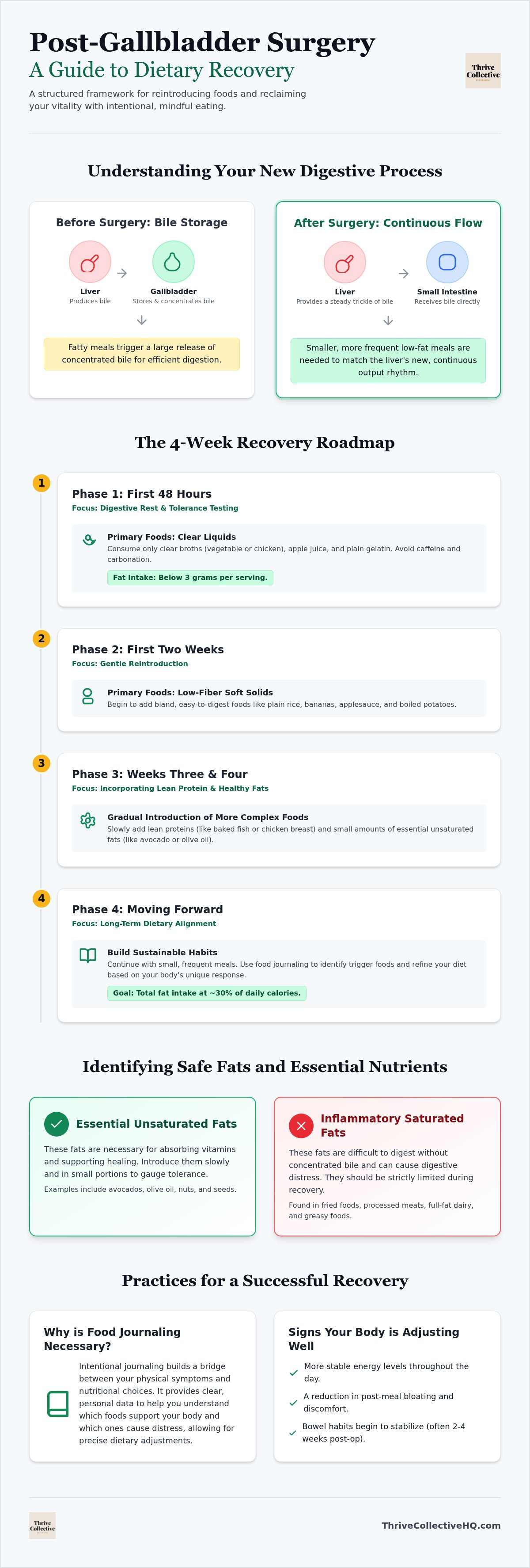
Digestion after gallbladder removal is defined by a transition from the storage and concentration of bile within a reservoir to a state of continuous liver secretion directly into the small intestine. This means your body no longer has a holding tank to release a large volume of bile when you consume a heavy or fatty meal. Instead, the liver provides a steady, thin trickle of bile throughout the day. Without that concentrated surge, the process of fat emulsification becomes less efficient, often leading to undigested lipids passing into the colon. This shift is the primary reason why a low fat meal plan after gallbladder surgery is essential for preventing the digestive distress often labeled as Postcholecystectomy syndrome.
When the liver cannot provide a concentrated burst of bile to match a high fat intake, the result is often bile acid malabsorption. In this state, excess bile acids that are not utilized for digestion enter the large intestine and act as a natural laxative, leading to urgency or discomfort. At Thrive Collective Publishing: Books, Journals, and Guides, we view this phase not as a permanent limitation, but as a period of biological recalibration. Understanding this mechanism allows you to move from a place of confusion to one of intentionality as you select foods that align with your liver's new output rhythm.
To better understand how to manage your nutrition during this transition, watch this helpful video:
The liver and the new digestive rhythm
The liver is a resilient organ that adapts to its new role of direct secretion with remarkable efficiency. However, because the bile flow is now a constant stream rather than a triggered response, your eating habits must shift to match this rhythm. Structuring a low fat meal plan after gallbladder surgery requires a focus on smaller, more frequent feedings. By consuming five or six mini meals throughout the day, you provide the small intestine with manageable amounts of food that the continuous bile flow can process. Timing becomes a tool for alignment; spacing your intake ensures that you are never overwhelming the liver's current output capacity.
Signs your body is adjusting well
Recovery is a gradual process, and it is helpful to look for the small victories as your system finds its new balance. You might notice your energy levels becoming more stable throughout the afternoon or a reduction in post meal bloating. Most readers find that their bowel habits begin to stabilize between two and four weeks after the procedure. If you are experiencing fewer instances of sudden urgency, it is a clear sign that your body is successfully calibrating to its new reality. We offer various journals and keepsakes that can help you track these daily improvements, turning a period of physical change into a moment of intentional self care.
How do you structure a low fat meal plan after gallbladder surgery?
A structured plan begins with clear liquids, moves to low-fiber soft solids, and gradually introduces healthy fats over a four-week period. This staged approach allows your digestive system to calibrate its continuous bile flow without the sudden shock of complex lipids. During the initial recovery phase, it is vital to keep your fat intake below 3 grams per serving. Adhering to these specific parameters helps prevent the cramping and urgency often associated with a standard gallbladder removal diet. Beyond fat monitoring, maintaining electrolyte balance through consistent hydration is essential. We recommend a steady intake of water and non-caffeinated herbal teas to support the liver as it assumes its new role.
Phase one: The first forty eight hours
The immediate window following your procedure is dedicated to testing digestive tolerance with the gentlest possible inputs. Focus exclusively on clear liquids such as vegetable or chicken broths, apple juice, and plain gelatin. You should strictly avoid caffeine and carbonated beverages during this sensitive time, as they can cause painful gas or stimulate the gut too aggressively. A sample rotation for your first day home might include a cup of warm broth every three hours, interspersed with small sips of diluted fruit juice to maintain energy levels. This period is about stillness and observation rather than nutrition.
Phase two: Days three to seven
Once you have tolerated liquids, you can begin introducing soft, low-fiber foods that provide more substance without straining the intestines. White rice, bananas, and plain toast are excellent staples for this transition. For protein, focus on lean, easily digestible sources like poached chicken breast or white fish such as cod. You may find that dairy, even in its low-fat forms, remains problematic during the first week. Many readers report better success by delaying milk or yogurt until the second week to avoid potential bloating. If you are looking for more structured guidance on healthful living, our catalog of wellness titles offers various perspectives on physical alignment.
Phase three: Weeks two through four
As your internal rhythm stabilizes, you can begin the gradual reintroduction of soluble fiber and a more diverse low fat meal plan after gallbladder surgery. Soluble fiber acts as a sponge for excess bile, making foods like oats and sweet potatoes particularly beneficial. A sample daily schedule for this phase includes:
- Breakfast: Plain oatmeal topped with a few slices of banana.
- Lunch: Lean turkey slices on white sourdough bread with a side of applesauce.
- Dinner: Steamed white fish served with a small portion of well-cooked zucchini.
During these weeks, you will transition from refined grains back to whole grains as your gut heals. It is important to track your reactions to each new addition, ensuring that you only progress when your body feels settled and strong.
Identifying safe fats and essential nutrients for healing
Healing after surgery requires a sophisticated understanding of how your body now processes lipids. While you must strictly limit total intake, the small amounts of unsaturated fats found in foods like avocado or flaxseed remain essential for the absorption of fat-soluble vitamins A, D, E, and K. These nutrients are vital for immune function and cellular repair, yet they cannot be utilized without a small amount of carrier fat. The goal of a low fat meal plan after gallbladder surgery is to prioritize these beneficial fats while completely avoiding saturated fats, which require significantly more bile to emulsify and often lead to discomfort. At Thrive Collective Publishing, we curate information that moves you beyond simple avoidance toward a state of nutritional intentionality.
Many readers are tempted by processed titles labeled as fat-free, but these are often less healthy than whole, low-fat foods. Manufacturers frequently replace fat with high amounts of refined sugar to maintain flavor, which can lead to energy crashes and inflammation that hinders your recovery. Choosing whole ingredients like seasonal fruits or well-cooked vegetables ensures you are receiving the micronutrients your body craves without the hidden additives found in commercial packaging. This grounded approach to eating, a philosophy often explored by Noelle Varden in her wellness reflections, focuses on nourishing the body rather than just filling it.
The best lean protein sources
Lean proteins are the foundation of tissue repair. During your recovery, your protein requirements typically range from 0.8 to 1 gram per kilogram of body weight to ensure your incisions and internal tissues have the building blocks they need. Egg whites, skinless poultry, and white fish serve as excellent primary sources. Beans and legumes are also high-quality options, though they should be introduced slowly to monitor for gas. To maintain the integrity of your low fat meal plan after gallbladder surgery, focus on preparation methods that require no added oil, such as:
- Steaming in parchment paper with fresh herbs.
- Poaching in a flavorful vegetable broth.
- Baking on a silicone mat to prevent sticking without grease.
Understanding soluble versus insoluble fiber
Fiber is a critical tool for managing the continuous bile flow from your liver. Soluble fiber, found in oats and barley, is much gentler on the post-operative digestive tract than the rough, insoluble fiber found in raw kale or large seeds. Soluble fiber acts like a sponge, binding to excess bile acids in the small intestine and reducing the digestive urgency that many experience after surgery. During the first month of recovery, we recommend focusing on "safe" vegetables that are easy to break down when steamed, such as carrots, peeled zucchini, and green beans. These choices provide the necessary bulk for healthy digestion without the irritation caused by raw, fibrous greens.
Why is food journaling necessary for a successful recovery?
Food journaling provides a direct bridge between your physical symptoms and your nutritional choices. It is common to feel disconnected from your body during the first month home as you navigate a new digestive rhythm. By documenting each component of your low fat meal plan after gallbladder surgery, you begin to see patterns that are invisible to the casual observer. This practice is not about restriction or policing your plate. It is about cultivating intentionality, a concept Noelle Varden often describes as the foundation of a grounded and purposeful life. When you write down what you eat, you move from a state of reactive survival to one of active participation in your healing.
Tracking trigger foods allows you to identify specific irritants without developing a generalized fear of eating. If you notice discomfort after a specific meal, you can look back at your entries to see if the cause was the fat content, the fiber type, or perhaps an external stressor. Documenting non-physical symptoms such as energy levels and mood is equally valuable. Often, a digestive flare up is preceded by a dip in energy or a shift in temperament. Having this data helps you manage your recovery with grace rather than frustration, ensuring that your nutritional choices support your total well being.
The Just Write approach to recovery
At Thrive Collective Publishing: Books, Journals, and Guides, we suggest using a title from the Just Write Collection to document your first thirty days of recovery. This dedicated space allows you to move beyond simple lists and into meaningful reflection. Try using these three specific prompts to guide your daily entries:
- How did I feel two hours after lunch?
- What felt nourishing today?
- Where did I feel tension?
This practice builds a legacy of self awareness that extends far beyond the kitchen. It is the same philosophy we champion in The Heirloom Series, where the act of writing serves to preserve the wisdom of your personal experiences. By treating your recovery as a story worth telling, you transform a medical necessity into an opportunity for growth.
Turning data into a long term catalog of safety
Over time, your journal becomes a personalized catalog of what works for your unique biology. No two recoveries are identical. While clinical guidelines provide a starting point, your own data tells the real story of your healing. This catalog is an invaluable resource to share with a medical professional if your symptoms persist or change unexpectedly. View this period as a time of personal evolution rather than just a recovery. You are learning to listen to your body in a way that will serve you for years to come. To explore more resources for intentional living, view our full catalog of titles.
Curating your kitchen with Thrive Collective Publishing
Thrive Collective Publishing provides a curated selection of resources designed to transform your recovery from a period of restriction into a season of intentional alignment. We believe that a medically necessary diet should never lead to a restricted life, which is why we created the Eat Without Fear Series. These titles serve as the definitive resource for flavorful, low-fat living after a cholecystectomy, moving you beyond the coldness of clinical guidelines toward a more soulful approach to nourishment. When you follow a low fat meal plan after gallbladder surgery, you're not just managing a condition; you're cultivating a new way of being that prioritizes both physical ease and culinary joy.
By choosing to buy direct from our independent press, you're supporting a collective of authors who are deeply invested in your personal evolution. We invite you to learn more about the philosophy behind our work on our Why Direct page. This direct connection between the publisher and the individual reader ensures that every title in our catalog serves as a purposeful tool for growth rather than a mere commercial product. You're joining a movement of thoughtful individuals who believe that success is a collective endeavor and that healing is a path worth walking with intentionality.
Titles for the intentional kitchen
Our cookbooks are designed as sophisticated companions for your recovery. Kimberly Burk Cordova brings a direct and warm perspective to her writing, offering practical management skills that help you feel like the master of your kitchen again. These titles focus on high-impact flavors that respect your liver's new rhythm, ensuring your low fat meal plan after gallbladder surgery remains something you look forward to each day. We view these books as curated tools for growth, providing the structure you need to thrive during a time of significant biological change. They help you bridge the gap between clinical necessity and the aspirational lifestyle you deserve.
Next steps for your thriving recovery
Your recovery is a staged process that moves from the clear liquids of the first forty eight hours to the intentional reintroduction of soluble fibers and lean proteins over four weeks. As you stabilize your digestion and regain your energy, you may find that your focus naturally shifts toward broader areas of personal development. We invite you to explore our Leadership and Growth collection to continue your commitment to a purposeful and impactful life. To begin your journey toward dietary alignment, select a title from our catalog of books today or email us at info@thrivecollectivehq.com with your specific questions. We're here to help you step into a bigger, more vibrant version of yourself.
Stepping into your new state of alignment
Your recovery is more than a medical milestone; it's an invitation to cultivate a deeper connection with your body’s unique needs. By understanding the liver’s new rhythm and embracing a staged approach to nutrition, you move from a place of uncertainty to a state of purposeful living. You now have the tools to manage your low fat meal plan after gallbladder surgery through intentional food choices and reflective journaling. This process transforms a period of physical vulnerability into a legacy of self-awareness and strength.
We at Thrive Collective Publishing are committed to supporting this evolution through curated resources that prioritize both health and flavor. Our titles, such as the Eat Without Fear Series, are curated by independent authors like Kimberly Burk Cordova who understand that growth requires practical, warm guidance. These books are designed to help you thrive rather than just survive, ensuring your kitchen remains a sanctuary of nourishment. We invite you to explore the Eat Without Fear Series in our catalog today to find your next step toward dietary alignment. Your path to a vibrant future is waiting, and we are honored to walk it with you.
Frequently Asked Questions
Can I ever eat pizza or fried food again after gallbladder surgery?
You can eventually enjoy these foods, but they must be reintroduced slowly and in very small portions once your body has adapted. Most readers find that after a four-week adjustment period, they can tolerate occasional high-fat meals without significant distress. It's a matter of testing your body's new tolerance level. We recommend waiting until the initial healing phase is complete before attempting these more complex food pairings.
How much fat is considered "low fat" for a post-op meal?
A low fat meal plan after gallbladder surgery generally defines low fat as foods containing less than 3 grams of fat per serving. Your total daily intake should ideally stay below 30 percent of your total calories to prevent digestive urgency. Keeping to these specific numbers prevents the liver's continuous bile trickle from being overwhelmed. This structured approach ensures your system stays in a state of healthy alignment while you heal.
Is it normal to have diarrhea for several weeks after cholecystectomy?
It is quite common to experience loose stools or urgency for several weeks as your digestive system recalibrates its rhythm. This happens because bile now flows directly into the small intestine, which can sometimes act as a natural laxative. If these symptoms persist beyond the first month, you should consult your medical professional. Documenting these instances in a journal from Thrive Collective Publishing can help you identify if specific foods are the cause.
Should I take digestive enzymes or ox bile supplements?
You should only introduce supplements after discussing them with your doctor to ensure they align with your specific recovery needs. While some readers find relief with ox bile or lipase, others find that a well-structured meal plan is sufficient for their needs. We focus on whole-food intentionality rather than relying on external aids during the early stages of healing. This philosophy is a cornerstone of the grounded approach championed by Noelle Varden.
What are the best snacks for a low fat meal plan?
The best snacks focus on simple, whole ingredients that are easy on the gut, such as rice cakes, fat-free yogurt, or fresh fruit. You might also try baked crackers or a small serving of unsweetened applesauce. These choices provide energy without the risk of triggering the discomfort often caused by processed snack titles. Choosing whole foods ensures you are nourishing your body with the micronutrients it needs for a thriving recovery.
How does weight loss affect my diet after gallbladder removal?
Rapid weight loss can actually increase the risk of developing stones in the bile ducts, so it's important to lose weight gradually. Your diet should focus on steady nourishment rather than extreme calorie restriction during this sensitive time. Maintaining a balanced, low-fat approach ensures your liver and digestive tract remain stable. We believe that true wellness is a collective endeavor that requires patience and a commitment to long-term health goals.
Can I drink coffee or alcohol during my recovery?
You should avoid caffeine and alcohol for at least the first week, as both can irritate the digestive lining and stimulate the gut too quickly. Caffeine can worsen the laxative effect of bile, while alcohol may place unnecessary strain on your liver as it adapts. Reintroduce these liquids slowly once you've successfully transitioned to solid foods. This cautious approach mirrors the practical management skills often discussed by Kimberly Burk Cordova.
What happens if I accidentally eat a high-fat meal too soon?
Eating a high-fat meal too early often results in temporary but sharp discomfort, bloating, or urgent diarrhea. If this happens, return to clear liquids for a few hours to let your system settle and recover its balance. Use your journal to document the reaction, turning the mistake into a useful data point for your long-term catalog of safety. This practice helps you move forward with confidence rather than fear as you continue your recovery.

Article by
Kimberly Cordova
Kimberly Burk Cordova is the founder of Thrive Collective Publishing, an independent multi-imprint publishing house based in Santa Fe, New Mexico. She is the author of books on leadership, business growth, AI and automation, emotional intelligence, and personal development, written for readers who want clear thinking, useful frameworks, and books they actually finish.
Before turning her full attention to publishing, Kimberly spent more than two decades in strategy, operations, and program leadership, working with public agencies and private organizations on transformation, technology, and large-scale change. That operator's lens shows up in everything she writes and publishes: real frameworks, real numbers, no fluff.
As publisher, she leads a catalog of more than 80 titles from six authors across multiple imprints, spanning literary suspense, true crime, children's biography, relationships, travel, guided journals, and coloring books. The house publishes regularly across its core series, including The Casita Series, Shadows of the Past, the Young Legends Collection, The Growth Leader Collection, the AI and Automation Blueprint, The Heirloom Series, The Art of Manifestation, the Just Write Collection, and Travel: Destination Guides.
She lives in Santa Fe with her husband Greg, a self-taught silversmith and lapidary artist. When she is not writing or publishing, she is building Wildflower Artisans, their Turquoise jewelry brand, or curating the next round of Just Write journals.
Connect with Kimberly and Thrive Collective Publishing at thrivecollectivehq.com.