

Choosing between KDP and IngramSpark is often framed as a binary decision, yet for the professional author, the most effective path involves embracing both. The clearest strategy for KDP vs IngramSpark for indie authors is a hybrid approach where KDP handles Amazon sales for higher royalties while IngramSpark manages global distribution to bookstores and libraries. This allows you to maintain professional standards without sacrificing reach. It is easy to feel overwhelmed by conflicting advice regarding ISBN ownership or distribution royalties, but alignment is possible when you understand how these systems interact.
At Thrive Collective Publishing, we believe your work deserves a global stage and a professional finish that mirrors your ambition. We will show you how to strategically combine these platforms to build a professional presence that maximizes reach without compromising on quality. This guide explores a clear distribution strategy and the steps required to ensure your catalog achieves maximum retail availability. Understanding these tools helps you move toward a model where you might sell titles direct to readers, a method we use for new releases like The Mother I Did Not Know by K.B. Cordova.
Key Takeaways
- Discover how to achieve alignment by using KDP vs IngramSpark for indie authors to capture Amazon royalties while securing a place in global bookstores.
- Understand the intentionality behind owning your own ISBN to ensure your titles remain consistent and professional across every retail channel.
- Review the latest 2026 platform updates, including the removal of revision fees, which allows you to manage your catalog with greater ease and confidence.
- Learn the technical sequence for uploading titles to both platforms to avoid distribution overlaps and maintain your professional standing with retailers.
- Consider the impact of selling titles directly to your readers to build a deeper community and a more sustainable creative legacy.
Why the choice between KDP and IngramSpark is often a false dilemma
The choice between these platforms is a false dilemma because they serve different market segments, and using both is the industry standard for a professional publishing presence. Professional authors don't view these services as competitors, they view them as complementary tools in a sophisticated catalog strategy. The comparison of KDP vs IngramSpark for indie authors reveals that a serious press requires both to achieve maximum market penetration. At Thrive Collective Publishing, we use KDP to manage the Amazon ecosystem and IngramSpark to reach the wider world of independent bookstores and libraries. This dual approach allows you to capture the highest possible royalties while maintaining a presence in physical retail spaces.
Since the rise of self-publishing, the industry has matured into a space where exclusivity is rarely the path to a lasting legacy. Relying on a single platform creates a point of failure that can limit your growth. Instead, we advocate for a non-exclusive model that treats each platform as a specialist in its own right. This alignment of resources ensures your titles are available wherever readers prefer to shop, whether that is a digital storefront or a local boutique.
To better understand how these platforms complement each other, watch this helpful video:
The role of Amazon KDP in your retail strategy
KDP is your primary engine for direct-to-consumer sales on the world's largest bookstore. It's essential for capturing the 70 percent royalty rate on ebooks priced between $2.99 and $9.99, a standard we apply to titles like The Mother I Did Not Know by K.B. Cordova. The platform allows for free, rapid file revisions and metadata updates, which is vital for keeping your work current. By keeping your Amazon sales within the KDP ecosystem, you avoid the wholesale fees associated with third-party distributors and ensure your profit margins remain healthy. This direct connection to the Amazon reader base is a cornerstone of a thriving author business.
The role of IngramSpark in professional distribution
IngramSpark serves as the gateway to a global network of over 40,000 retailers, libraries, and academic institutions. While Amazon is a powerhouse for individual readers, many independent bookstores prefer ordering through the Ingram catalog to avoid supporting their primary competitor. This platform is also necessary for producing high-quality hardcover editions with dust jackets, a format that readers often prefer for their personal collections. Using IngramSpark signals to the industry that your work is available for traditional wholesale, which is a requirement for most physical bookstore shelf placements. You can learn more about why we value these diverse channels on our why buy direct page.
Analyzing the technical architecture of independent publishing in 2026
Professional publishing is built on the foundation of data ownership and technical alignment. To succeed, you must own your International Standard Book Numbers (ISBNs) and maintain identical metadata across all distribution channels to avoid retail conflicts. This intentionality ensures your titles, such as those in our collection of books, are recognized as professional products by libraries and bookstores alike. With the growth of the self-publishing industry showing no signs of slowing, your technical choices today define the legacy of your work tomorrow. Thrive Collective Publishing operates with this high-level focus to ensure every title in our catalog reaches its full potential.
The landscape of KDP vs IngramSpark for indie authors has shifted significantly in 2026. Both platforms have moved toward a free-to-upload model, which removes the financial barrier to entry but increases the need for rigorous quality control. While IngramSpark has waived its $49 setup and $25 revision fees, they have introduced a 1.875 percent market access fee per sale. This trade-off means your initial investment is lower, but your long-term strategy must account for these ongoing distribution costs to keep your business healthy. This collective approach to distribution is what allows an independent press to thrive in a competitive market.
The ISBN requirement for professional authors
Ownership is the primary marker of a serious press. Using a free ISBN provided by KDP might seem convenient, but it limits your titles to the Amazon ecosystem and lists Amazon as the publisher of record. An ISBN is the unique identifier that allows a title to exist across multiple platforms simultaneously. To maintain the integrity of your imprint, we recommend purchasing your own block of numbers from Bowker. This allows you to list Cordova Creations or your own press name as the publisher, ensuring your work is seen as a legitimate retail title rather than a platform-exclusive project. It is the difference between a catalog that simply survives on one platform and one that truly thrives across the entire publishing landscape.
Understanding royalty math and trade discounts
Profitability requires a deep understanding of how each platform calculates your earnings. KDP typically offers a 60 percent royalty on print titles, which is calculated after the printing costs are deducted from the list price. In contrast, IngramSpark operates on a wholesale model where you set a trade discount (typically between 40 and 55 percent). To be considered for physical bookstore shelves, a 55 percent discount is the standard expectation. This discount, combined with a "returnable" status, allows bookstores to stock your titles without the financial risk of unsold inventory. While this reduces your per-unit profit compared to a direct Amazon sale, it is the essential price of global retail availability. You can learn more about how we balance these margins on our why buy direct page.
Maintaining metadata parity is equally vital. Ensuring authors like Liam Cruz or Noelle Varden have identical descriptions and pricing on every platform prevents the listing conflicts that can confuse readers. When your data is aligned, your professional presence is unmistakable.
The physical presence of a title is its first conversation with a reader. When evaluating KDP vs IngramSpark for indie authors, the tactile quality of the paper and the saturation of the ink define that interaction. KDP offers a standard 55lb white or 50lb cream paper, which is reliable for most suspense novels. IngramSpark provides similar weights but often shows slightly higher ink density in their standard black and white interiors, giving the text a crisper, more traditional appearance. According to Alliance of Independent Authors (ALLi) data, authors are increasingly prioritizing these manufacturing details to compete with traditional houses.Cover finishes also play a significant role in the reader's sensory experience. KDP's matte finish has a velvet-like texture that resists fingerprints, while IngramSpark's matte can feel slightly more paper-like and organic. Glossy finishes on both platforms are comparable, though IngramSpark's lamination is often cited for its consistency across multiple print runs. These subtle variations in the finish of your cover can dramatically change the mood of a true crime title or a literary suspense novel, making the choice of provider a matter of intentional design.
Hardcover options and the craft of the physical book
The physical feel of a title impacts reader perception before the first page is turned. KDP provides casebound hardcovers, which are durable but lack the traditional aesthetic of a dust jacket. For a title like The Mother I Did Not Know by K.B. Cordova, we prefer the elegance of a linen-wrapped board and a professionally designed jacket. IngramSpark offers these cloth-bound options alongside digital cloth and foil stamping for special editions. These craft-forward details transform a simple book into a keepsake, elevating your catalog from a mere collection of titles to a professional library.
Global reach and library access
Distribution is about being where your readers already spend their time. IngramSpark allows your titles to be ordered by local libraries and independent shops through the OverDrive network and the global Ingram wholesale catalog. While KDP offers Expanded Distribution, it is often limited in international markets and carries a higher cost for the retailer. Most independent bookstores in New Mexico and beyond are hesitant to order from a direct competitor, making IngramSpark the essential choice for physical retail placement. KDP excels at speed and Amazon-specific fulfillment while IngramSpark excels at professional hardcover variety and retail cataloging.
Establishing a professional publishing workflow for serious titles
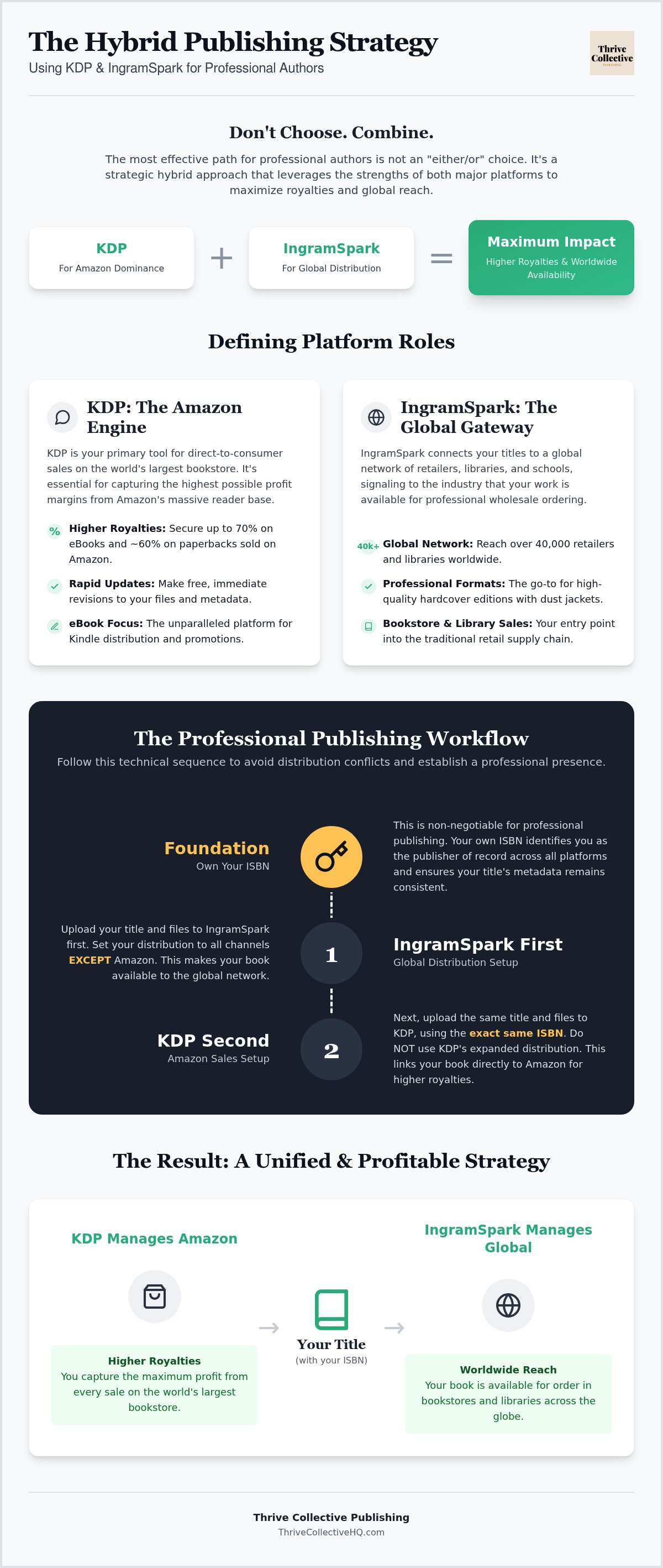
Professional authors achieve distribution alignment by uploading to KDP for Amazon sales and IngramSpark for wholesale reach while disabling Amazon’s expanded distribution to avoid technical conflicts.
A professional publishing sequence respects the strengths of each platform. When managing KDP vs IngramSpark for indie authors, the order of operations determines how smoothly your titles enter the market. A scattered approach leads to metadata conflicts, but a methodical workflow ensures your work appears as a unified, professional catalog. At Thrive Collective Publishing, we view this alignment as a form of intentionality that honors the craft of our authors. We avoid the rush of a hasty launch in favor of a calm, curated process that protects the integrity of every title we release.
The step-by-step synchronization process
A successful launch begins with a structured sequence that ensures your data remains consistent across the entire collective. By following these steps, you allow your titles to be available to the widest possible audience without technical friction.
- Step 1: Secure your own ISBNs for all formats, including ebook, paperback, and hardcover. This establishes your imprint, such as Cordova Creations, as the publisher of record for the life of the title.
- Step 2: Upload your files to KDP for Amazon-specific sales. It's vital that you don't select the Expanded Distribution option. Choosing this setting allows Amazon to act as a middleman, which creates a conflict when you attempt to list the same title directly on IngramSpark.
- Step 3: Upload your files to IngramSpark to access their global wholesale network. This gives you direct control over your trade discount and ensures libraries can order your work with ease.
Quality control and the proofing phase
Ordering a physical proof from both providers is a non-negotiable step for any professional title. Digital previews are helpful, but they can't replicate the tactile experience of holding the finished book. You must examine the margin alignment to ensure the text isn't too close to the gutter and verify that the spine text is perfectly centered. Color accuracy is equally important, as slight variations in ink density can change the impact of your cover design. We recommend allowing a timeline of at least 3 to 4 weeks for this phase to accommodate shipping and any necessary file adjustments. This patient approach ensures that when readers explore our catalog of titles, they receive a book that meets the highest independent press standards. Whether you're publishing a literary suspense novel by K.B. Cordova or a grounded guide by Noelle Varden, these details define your professional presence. Metadata entry should be handled with similar care, ensuring that every description and category is identical across all platforms to maintain perfect retail alignment.
The Thrive Collective approach to independent press standards
Thrive Collective Publishing views the comparison of KDP vs IngramSpark for indie authors as a choice between two specialized instruments that, when played together, create a professional publishing presence. We don't see these platforms as merely logistical hurdles; we see them as tools to serve the reader and honor the title. By aligning the high-margin efficiency of KDP with the global reach of IngramSpark, you establish a foundation that allows your creative work to thrive. This intentionality ensures that your work is available in the formats readers desire without sacrificing your professional standing.
While these platforms provide essential infrastructure, we also value the intimacy of direct connection. Our Why Buy Direct page explains how buying from an independent press supports the creators and ensures that more resources go back into the craft. This approach shifts the focus from transactional volume to long-term legacy and impact. We prioritize titles over products and readers over customers, because we believe that a book is a shared experience between the author and the individual who holds it.
Curation over mass production
In a noisy marketplace, a calm and editorial voice is a necessity. We believe that publishing should be an intentional act of curation rather than a race for mass production. The Thrive Collective authors, including Kimberly Burk Cordova, K.B. Cordova, Eliza Hawthorne, Liam Cruz, and Noelle Varden, exemplify this standard. They focus on the intricate craft of the story, confident that the distribution architecture we've built is sound and professional. This allows the work of Cordova Creations to stand alongside titles from traditional houses with complete technical parity. When you move beyond the "hustle" of publishing, you find the space to create work that truly matters.
Joining the collective of serious authors
The standards you set for your publishing process reflect the quality of the writing itself. When you choose to own your ISBNs and master the nuances of KDP vs IngramSpark for indie authors, you're signaling to the world that your work is a serious contribution to the literary landscape. We invite you to explore our current catalog of titles to see these principles in action. Publishing is a collective endeavor, and success is found when we share knowledge and support one another’s progress. By treating your work with the respect it deserves, you invite your readers to do the same.
In summary, a professional publishing presence is built on technical alignment, intentional curation, and a commitment to reader connection. Your next step is to review your current distribution settings and ensure you aren't sacrificing global reach for platform convenience. For specific questions about our submission process or distribution philosophy, please email info@thrivecollectivehq.com.
Designing your publishing legacy
The transition from an aspiring writer to a professional author requires a shift in perspective regarding your distribution architecture. Mastering the technical nuances of KDP vs IngramSpark for indie authors is not just a logistical task; it is an act of stewardship for your creative work. By owning your ISBNs and synchronizing your metadata, you ensure that your titles are available to readers in every corner of the market while maintaining the highest small press standards. This alignment allows you to focus on the craft of your story, knowing that your physical editions meet the rigorous quality expectations of bookstores and libraries.
At Thrive Collective Publishing, we are committed to elevating the New Mexico literary community through high-quality physical editions that stand the test of time. It's our belief that every title in a catalog should reflect the intentionality of its creator. We invite you to explore our professional publishing philosophy and view the Thrive Collective Publishing catalog to see these principles in action. Your work deserves a professional stage, and with the right strategy, you can build a publishing presence that truly thrives. For a specific next step, we recommend reading The Mother I Did Not Know by K.B. Cordova to see how we apply these standards.
Frequently Asked Questions
Can I use the same ISBN on both KDP and IngramSpark?
Yes, you can use the same ISBN on both platforms as long as you are the publisher of record and own the identifier. Owning your ISBN through an agency like Bowker allows for perfect alignment across your catalog. This ensures that the same edition of a title like The Mother I Did Not Know by K.B. Cordova is recognized as a single professional product by all global retailers.
Is it better to use KDP Expanded Distribution or IngramSpark for bookstores?
IngramSpark is the superior choice for reaching physical bookstores. While KDP Expanded Distribution exists, many independent bookstores in New Mexico and beyond hesitate to order titles from their primary competitor. IngramSpark provides the standard 55 percent wholesale discount and returnability that bookstores require to stock your work without financial risk.
Does IngramSpark charge a fee to upload or revise titles in 2026?
IngramSpark does not charge setup or revision fees as of 2026. This shift allows you to manage your catalog with greater ease and flexibility than in previous years. When weighing KDP vs IngramSpark for indie authors, you should simply account for the 1.875 percent market access fee per sale while enjoying the freedom of free file updates.
Can I move my book from KDP to IngramSpark later if I change my mind?
You can move your title between platforms only if you own the ISBN. If you used a free ISBN provided by KDP, that number is permanently locked to the Amazon ecosystem. To move to IngramSpark or a professional distributor, you would need to publish a new edition with a new ISBN, which is why we advocate for purchasing your own identifiers from the start.
Do bookstores really refuse to stock books published through Amazon?
Many independent bookstores refuse to stock titles that are clearly published by Amazon. Using a KDP-assigned ISBN or only offering your work through Amazon’s expanded network signals a lack of professional wholesale alignment. By using IngramSpark, you ensure your titles are available through the Ingram catalog, which is the standard ordering system for the majority of physical retail spaces.
Which platform provides better print quality for hardcover books?
IngramSpark generally provides a more professional variety of hardcover options for serious authors. While KDP offers casebound hardcovers, IngramSpark allows for cloth-bound boards and dust jackets. These traditional flourishes are vital for literary suspense and true crime titles where the tactile quality of the physical book enhances the reader’s experience and the author’s legacy.
How do I handle ebook distribution between KDP and IngramSpark?
We recommend using KDP for your Kindle editions and IngramSpark for wide print distribution. Note that KDP Select requires ebook exclusivity to Amazon, so if you enrol a title you cannot sell that ebook anywhere else, including from your own website. Decide which matters more to you, the Kindle Unlimited page reads or the wider ebook reach, before you enrol.
What is the most important setting to check when using both platforms together?
The most critical setting to check is KDP Expanded Distribution. When navigating the technical side of KDP vs IngramSpark for indie authors, you must leave this box unchecked on the Amazon platform. Disabling this feature prevents technical conflicts and allows IngramSpark to act as your primary wholesale distributor to the global market without interference.

Article by
Kimberly Cordova
Kimberly Burk Cordova is the founder of Thrive Collective Publishing, an independent multi-imprint publishing house based in Santa Fe, New Mexico. She is the author of books on leadership, business growth, AI and automation, emotional intelligence, and personal development, written for readers who want clear thinking, useful frameworks, and books they actually finish.
Before turning her full attention to publishing, Kimberly spent more than two decades in strategy, operations, and program leadership, working with public agencies and private organizations on transformation, technology, and large-scale change. That operator's lens shows up in everything she writes and publishes: real frameworks, real numbers, no fluff.
As publisher, she leads a catalog of more than 80 titles from six authors across multiple imprints, spanning literary suspense, true crime, children's biography, relationships, travel, guided journals, and coloring books. The house publishes regularly across its core series, including The Casita Series, Shadows of the Past, the Young Legends Collection, The Growth Leader Collection, the AI and Automation Blueprint, The Heirloom Series, The Art of Manifestation, the Just Write Collection, and Travel: Destination Guides.
She lives in Santa Fe with her husband Greg, a self-taught silversmith and lapidary artist. When she is not writing or publishing, she is building Wildflower Artisans, their Turquoise jewelry brand, or curating the next round of Just Write journals.
Connect with Kimberly and Thrive Collective Publishing at thrivecollectivehq.com.