

What if the most effective way to scale your impact is to slow down and write by hand? You are likely familiar with the exhaustion of a day spent reacting to digital notifications rather than pursuing the goals that actually matter for your long-term legacy. It is easy to find yourself stuck in a cycle of surviving the afternoon instead of thriving in your role as a visionary leader.
At Thrive Collective Publishing, we believe that journaling for business clarity is not merely a wellness habit, but a rigorous professional discipline that allows you to distinguish between the noise of the urgent and the weight of the important. This guide examines the structural differences between digital systems and the intentional friction of physical paper, such as our Just Write Collection, to help you find a repeatable method for mental decluttering. By comparing these approaches, you can begin to build a physical record of your growth and approach every decision with renewed alignment and focus.
Key Takeaways
- Learn how journaling for business clarity allows you to externalize complex thoughts and evaluate your strategic decisions with greater objectivity.
- Understand why the tactile friction of paper journals reduces cognitive load and fosters deeper analysis compared to digital tools.
- Discover the benefits of using guided prompts from the Just Write Collection to provide structure when you feel paralyzed by a blank page.
- Establish a repeatable system for mental decluttering by integrating a three-minute brain dump into your daily leadership routine.
What is journaling for business clarity?
Clarity in leadership is the deliberate absence of noise and the presence of intentionality. For the modern entrepreneur, business clarity is the bridge between a founder’s vision and a leader’s execution. At Thrive Collective Publishing: Books, Journals, and Guides, we view journaling for business clarity as a systematic practice of externalizing strategic thoughts to evaluate them with objectivity. It is an act of professional curation where you audit your own mental catalog to ensure every action aligns with your ultimate goals. This process builds on the principles of Journal therapy, which uses reflective writing to process mental clutter and transform it into actionable insights. When you move your thoughts from your mind to the page, you stop being a passenger in your own company and start acting as the curator of its future.
To better understand the cognitive benefits of this practice, watch this helpful video:
The difference between surviving and thriving in business
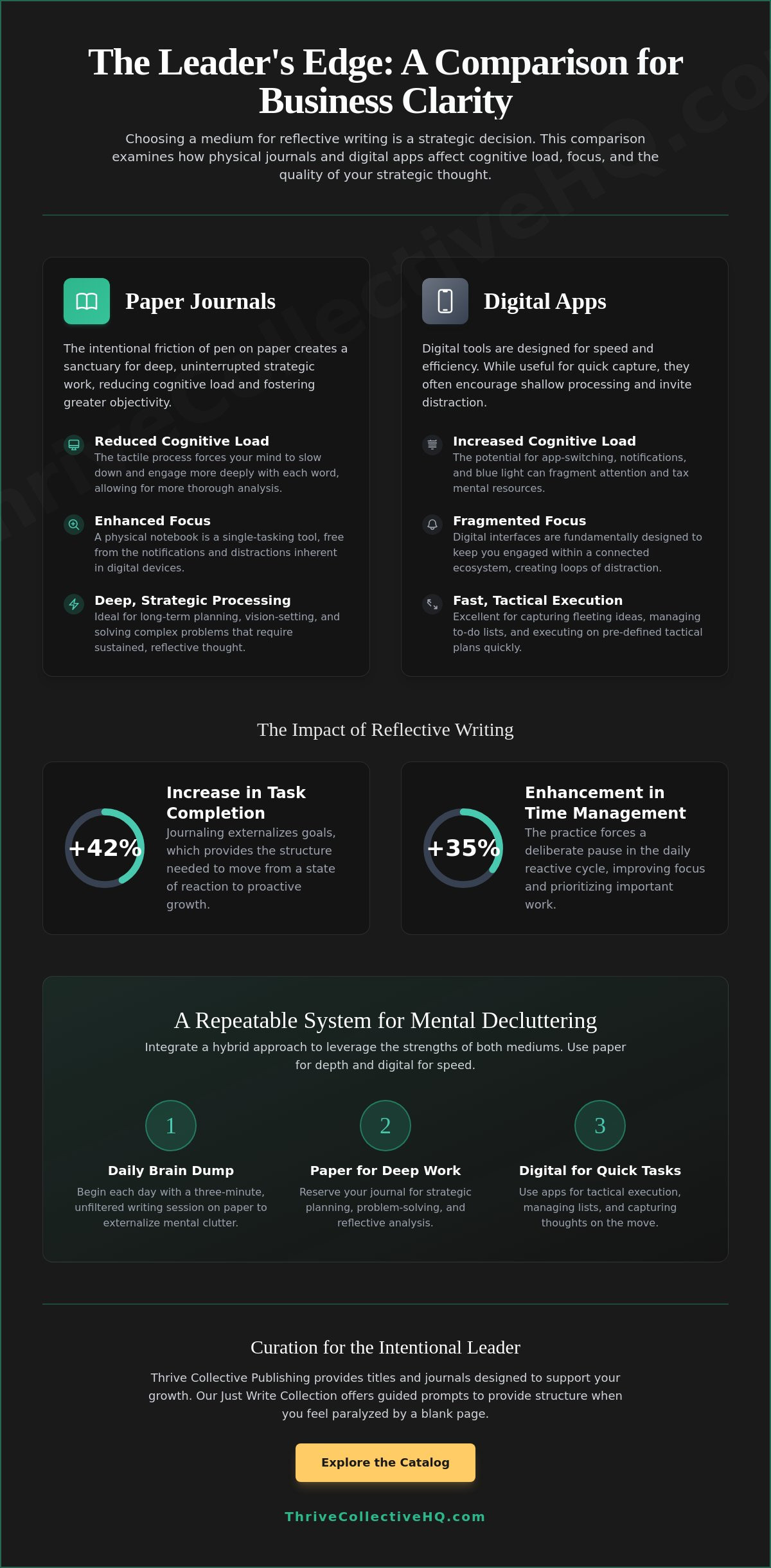
Survival mode relies on reactive digital pings and urgent notifications. When you are in this state, you are merely responding to the demands of others and the immediate pressures of the market. Thriving requires a dedicated space for reflective thought and long-term planning. Journaling acts as the boundary between daily operations and visionary leadership. It gives you the distance needed to see the larger picture. Data from 2026 suggests that journaling can increase task completion by 42 percent, which is a vital metric for anyone moving from a state of constant reaction to one of proactive growth. By creating this boundary, you protect your mental energy for the decisions that actually move the needle for the Collective.
Why traditional business jargon fails the creative entrepreneur
Standard planning tools often ignore the emotional intelligence required for growth. They focus on spreadsheets and dry metrics, but reflective writing captures the specific "why" behind the numbers. This is essential for scaling with ease and maintaining alignment with your core values. A leader’s journal serves as a primary source for future professional development, offering a concrete record of how you solved past problems and managed complex transitions. You can find resources to support this evolution in our leadership and growth collection, which features titles designed to help you cultivate a lasting professional legacy. Using journaling for business clarity ensures that your personal evolution keeps pace with your professional ambition, making success a sustainable endeavor rather than a source of burnout.
Digital apps versus paper journals: A comparison of cognitive load
Choosing between a digital app and a physical notebook is not just a matter of convenience. It is a strategic decision that affects how your brain processes information. Digital tools offer undeniable speed, yet they often invite the very distractions they aim to solve. When you use journaling for business clarity to find strategic focus, the medium you choose dictates the quality of your reflection. We recommend a hybrid approach where paper is reserved for deep strategic work and digital tools are used for quick tactical execution. This ensures that your most vital thoughts are protected from the notification loops of a connected device.
The core of the argument for physical writing lies in cognitive load. Research into journaling for leadership development suggests that slowing down the thinking process allows for greater objectivity. Digital interfaces are designed for efficiency, which often leads to shallow processing. In contrast, the tactile friction of a pen on paper forces your mind to engage more deeply with each word. This reduction in blue light and the elimination of pings create a sanctuary for the intentional leader to explore complex problems without interruption. Data indicates that the practice of reflective journaling can enhance time management by 35 percent, largely because it forces a deliberate pause in the reactive cycle.
The distraction of the digital interface
Apps are fundamentally designed to keep you within the interface. Every digital entry carries the risk of a notification interrupting a breakthrough just as it begins to form. Paper is different because it is designed to help you exit into thought rather than stay tethered to a screen. You can explore this further in our editorial on the cognitive case for paper, which highlights how sensory engagement helps clear mental clutter. By removing the digital layer, you allow your brain to enter a flow state that is rarely possible on a smartphone or tablet.
Tactile intentionality and memory retention
The physical act of writing creates a stronger neural pathway for the information you record. When you write by hand, your brain must coordinate complex motor skills, which reinforces memory and comprehension. Paper journals also allow for total freedom in non-linear thinking. You can sketch, mind-map, or circle key concepts without being constrained by the rigid formatting of a software tool. Over time, a physical journal becomes a tangible asset in your library. It is a physical record of your legacy that you can touch and revisit, which feels far more permanent than a cloud-based note. To find a companion for this reflective work, you might browse the curated titles in our catalog that support these intentional leadership habits.
Prompted journals versus blank notebooks for strategic growth
Choosing your medium is a matter of matching your current cognitive needs with the right structural support. Journaling for business clarity requires a tool that either provides the guardrails of a framework or the open space of a blank page. If you find yourself staring at a white expanse with a sense of paralysis, a prompted title may be the catalyst you need to begin. If your mind is overflowing with non-linear connections and complex data, a blank notebook offers the necessary freedom to map those thoughts without restriction. The Just Write Collection, published by Thrive Collective Publishing: Books, Journals, and Guides, balances these two needs by offering structured guidance alongside room for expansive, unscripted thought.
When to choose a guided experience
Guided journals provide a structural framework for leaders who feel paralyzed by a blank page. These titles are particularly effective during specific transitions, such as moving from the role of a hands-on founder to a visionary leader. Prompts act as a silent coach, asking the difficult questions you might otherwise avoid. For example, titles like The Art of Manifestation series help you align your professional goals with your personal values. By answering specific questions, you can bypass the resistance of not knowing where to start and move directly into the work of strategic alignment. This structured approach is also useful for maintaining consistency, as it removes the cognitive burden of deciding what to write about each day.
The power of the unscripted brain dump
Blank notebooks offer total freedom for the seasoned visionary to explore complex, non-standard problems. This unscripted approach is the best tool for identifying recurring patterns in your leadership style and uncomplicating business challenges through raw data output. Author Liam Cruz often emphasizes the need for an accessible space where no idea is too small for the page. In his view, the blank page is a mirror that reflects the true state of your mental catalog. When you practice journaling for business clarity without the constraints of a prompt, you allow your subconscious to surface connections that a structured format might miss. Research suggests that for creative tasks, unscripted journaling can help generate 50 percent more ideas, providing a significant advantage when you are looking for a breakthrough. This raw output is essential for the leader who needs to declutter their mind before making a high-stakes decision, as it ensures that every variable is visible and accounted for on the page.
How to integrate reflective writing into a leadership routine
Integrating journaling for business clarity into your daily life requires more than just a notebook; it requires a ritual that signals a shift in your mental state. At Thrive Collective Publishing: Books, Journals, and Guides, we view this as a professional appointment with your own vision. Select a consistent time and place that tells your mind the workday has officially ended or begun. This physical anchor prevents the bleed of operational stress into your personal life and provides the distance needed for objective analysis. Start each session with a three-minute brain dump to clear immediate mental noise and surface the anxieties that often cloud judgment. Once the surface-level clutter is removed, transition into a single strategic question regarding the legacy you wish to build. Close the session by identifying one specific action that aligns with your leadership core values. This structure ensures that every entry leads to a concrete outcome rather than just a collection of thoughts.
The morning vision versus the evening audit
The timing of your writing dictates the nature of your focus. Morning journaling sets the intentionality for the day ahead, focusing on the high-level impact you intend to make. It is a proactive stance that helps you distinguish between urgent pings and important strategic goals before the noise of the day begins. In contrast, an evening journaling practice serves as an audit of what was accomplished and what requires further reflection. While we noted the time management benefits of this practice earlier, the evening audit specifically addresses the emotional closure needed for a healthy work-life boundary. Both practices are essential because they prevent the overworking culture by creating defined start and stop points for your professional brain. You can find resources to support these daily habits in our leadership and growth collection.
Creating a sensory environment for clarity
Your environment should be a sanctuary free from digital devices to ensure a full digital detox. The presence of a smartphone, even if it is turned over, creates a cognitive drain that limits your capacity for deep thought. Using a high-quality physical title from our catalog makes the ritual feel significant and signals to your subconscious that this work is a priority. Consistency is far more valuable than duration; five minutes of focused writing is more effective than an hour of wandering thoughts. By treating this time as a professional discipline, you cultivate the alignment required to scale your business with ease. Explore our curated collection of leadership titles to find the right tool for your daily practice.
Curation for the intentional leader: The Thrive Collective Publishing catalog
Thrive Collective Publishing curates titles that support the holistic evolution of the entrepreneur. We believe that the tools you use should reflect the quality of the business you are building. When you engage in journaling for business clarity, you are not merely managing a to-do list; you are curating your professional evolution. Our Just Write Collection is specifically designed for those seeking this strategic focus through guided prompts. For leaders documenting a longer professional history, the Heirloom Series provides a permanent space to record a lasting legacy. Every entry made in a physical notebook serves as a tangible asset that digital notes cannot replicate.
Titles for personal and professional evolution
Explore our Leadership and Growth collection for titles that challenge traditional management theories. These works are selected for their ability to help you align your personal values with your professional output. For example, the work of K.B. Cordova, including her title The Mother I Did Not Know which is scheduled to ship on August 31, 2026, reflects the deep emotional intelligence we value in modern leadership. While her literary work explores complex human connections, the same depth is found in the business journals curated by Kimberly Burk Cordova. She provides direct and warm guidance through our business-focused journals, ensuring that your reflective practice remains both grounded and aspirational.
The commitment to quality and community
Every title published by Thrive Collective Publishing is a testament to our belief in the collective success of our readers. We do not view business as a cutthroat competition, but as a shared endeavor where the growth of one leader supports the growth of the community. We invite you to view our full catalog of journals and keepsakes to find your next tool for clarity. By choosing physical journals over digital interfaces, you join a movement of leaders who prioritize intentionality over the constant pressure of the hustle. This commitment to quality ensures that your written record remains a professional resource for years to come.
In this guide, we have examined how the structural differences between journaling methods can help you find strategic focus. Whether you prefer the guidance of prompts or the freedom of a blank page, the act of externalizing your thoughts is essential for any intentional leader. As you move from a state of surviving the day to thriving in your role, we encourage you to select tools that honor your ambition. For a specific recommendation on starting your practice, we suggest exploring the Just Write Collection or emailing us at info@thrivecollectivehq.com with your leadership goals.
Stepping into your visionary legacy
The choice to move from reactive survival to intentional thriving begins with the page. By embracing the tactile friction of physical writing, you reduce cognitive load and create a sanctuary for strategic thought. As a founder-led boutique publishing house, we believe that your tools should match the soulful ambition of your company. Titles curated by visionary leaders, such as those in our catalog, ensure that every session of journaling for business clarity contributes to a lasting professional record. We offer national US shipping for all physical titles to support your commitment to growth wherever you are based.
The path toward alignment is paved with small, consistent acts of reflection. You have the potential to build a business that is both successful and heart-centered. Discover our curated Just Write Collection to begin your journey toward business clarity. We look forward to seeing how your leadership evolves as you cultivate your own mental catalog.
Frequently Asked Questions
Is journaling for business different from a personal diary?
Yes, business journaling is a professional audit of your strategic thoughts rather than a purely emotional outlet. While a personal diary might focus on venting daily frustrations, journaling for business clarity is a systematic practice of externalizing your vision to evaluate it with objectivity. As Kimberly Burk Cordova often suggests, this practice allows you to curate your mental catalog so that your daily actions align with your long-term goals.
How much time should a business owner spend journaling for clarity?
Consistency is more important than duration, and five to fifteen minutes per session is sufficient for most leaders. Research from 2026 indicates that journaling three to four times per week provides significant benefits without leading to burnout. You don't need to write for hours to find focus. A short, disciplined session at the start or end of your day is enough to distinguish between urgent pings and important strategic milestones.
Can I use a digital detox journal if I still need to use my phone for work?
You can use a physical journal to create a temporary, tactile boundary from your digital obligations. The goal is not to abandon technology entirely, but to carve out a sanctuary for deep thought. Using a physical title from our catalog allows your brain to enter a flow state that is protected from the constant pings of a connected device. This intentional pause helps you return to your digital tasks with renewed focus and alignment.
What are the best prompts for finding business clarity?
The most effective prompts are those that force you to evaluate your impact and the legacy you wish to build. Questions like "What is the one move today that makes everything else easier?" or "How does this decision serve the Collective?" are foundational. These prompts help you practice journaling for business clarity by shifting your perspective from daily operations to visionary leadership. They act as a silent coach, ensuring you address the questions you might otherwise avoid.
Should I share my business journal with my team or coach?
A business journal is primarily a private sanctuary for raw data output and honest self-reflection. While you may choose to share the specific insights or decisions derived from your writing, the journal itself should remain confidential. This privacy ensures that you can explore complex challenges and recurring patterns without the pressure of external performance. Keeping it private allows for the level of honesty required to uncomplicate your most difficult business problems.
How do I choose between a blank notebook and a prompted journal?
Choose based on whether you currently need structural guardrails or expansive mental freedom. If you feel paralyzed by a blank page, a prompted title from the Just Write Collection provides the necessary framework to begin. If your thoughts are non-linear and you need to map out complex connections, a blank notebook is more appropriate. Author Liam Cruz often notes that the right tool is the one that removes the most friction from your thinking process.
What happens if I cannot stay consistent with my journaling practice?
Missing a session is an opportunity to practice self-compassion rather than a reason to stop the practice entirely. The discipline is a tool for your evolution, not a rigid rule that should cause additional stress. If you miss a day or a week, simply return to the page when you next need to clear mental noise. The benefits of reflective writing are cumulative, and your journal will always be there to help you regain your strategic focus.
How does journaling help in preventing entrepreneur burnout?
Journaling prevents burnout by creating a defined start and stop point for your professional brain. By externalizing stress and identifying recurring patterns, you move from a state of surviving the day to one where you can thrive. Reflective writing has been shown to enhance time management by 35 percent, which directly reduces the sense of being overwhelmed. It allows you to process the emotional weight of leadership so it doesn't spill over into your personal life.

Article by
Kimberly Cordova
Kimberly Burk Cordova is the founder of Thrive Collective Publishing, an independent multi-imprint publishing house based in Santa Fe, New Mexico. She is the author of books on leadership, business growth, AI and automation, emotional intelligence, and personal development, written for readers who want clear thinking, useful frameworks, and books they actually finish.
Before turning her full attention to publishing, Kimberly spent more than two decades in strategy, operations, and program leadership, working with public agencies and private organizations on transformation, technology, and large-scale change. That operator's lens shows up in everything she writes and publishes: real frameworks, real numbers, no fluff.
As publisher, she leads a catalog of more than 80 titles from six authors across multiple imprints, spanning literary suspense, true crime, children's biography, relationships, travel, guided journals, and coloring books. The house publishes regularly across its core series, including The Casita Series, Shadows of the Past, the Young Legends Collection, The Growth Leader Collection, the AI and Automation Blueprint, The Heirloom Series, The Art of Manifestation, the Just Write Collection, and Travel: Destination Guides.
She lives in Santa Fe with her husband Greg, a self-taught silversmith and lapidary artist. When she is not writing or publishing, she is building Wildflower Artisans, their Turquoise jewelry brand, or curating the next round of Just Write journals.
Connect with Kimberly and Thrive Collective Publishing at thrivecollectivehq.com.