

What if the persistent self-doubt you feel isn't a personal failing, but a calculated outcome of someone else's influence? You might find yourself second-guessing your memory or feeling an inexplicable weight of responsibility for another person's happiness. It's exhausting to live in mental fog, wondering if you're overreacting to slights that feel like significant betrayals. Understanding how to recognize manipulation in relationships is the first step toward reclaiming your sense of self. At Thrive Collective Publishing, we believe that personal evolution begins with identifying systematic patterns of guilt, gaslighting, and isolation that undermine your autonomy.
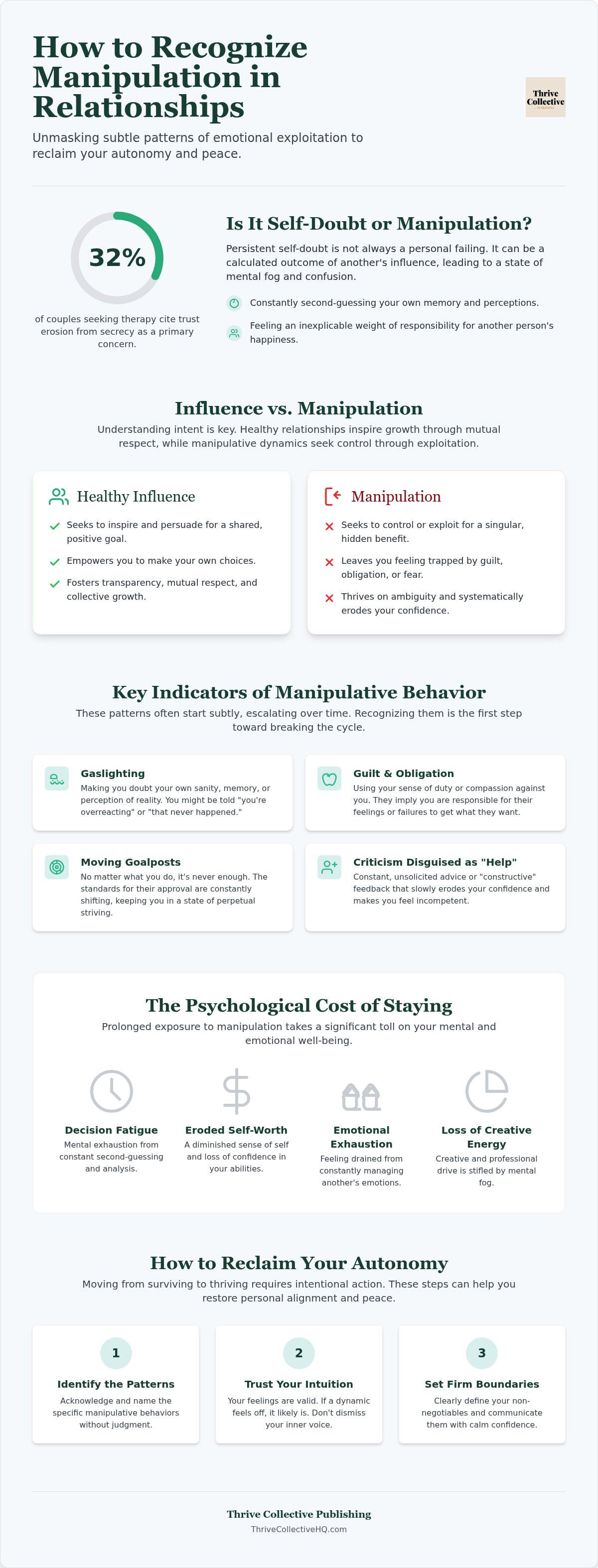
You deserve a life where your boundaries are respected and your identity is secure. In 2026, trust erosion from secrecy accounts for 32% of couples seeking therapy, yet the most damaging manipulation often happens in silence. In this article, you'll learn to identify the subtle patterns of emotional exploitation and gain practical steps to restore your peace. We will explore seven key signs of manipulative behavior, providing the language you need to move from surviving to thriving. By examining these dynamics through the lens of psychological depth found in titles like The Mother I Did Not Know by K.B. Cordova, you can begin to cultivate a future rooted in alignment, intentionality, and confidence.
Key Takeaways
- Learn how to recognize manipulation in relationships by identifying the subtle transition from supportive mentorship to restrictive patterns of control.
- Spot the early indicators of emotional exploitation, such as a constant feeling of walking on eggshells or taking responsibility for another person's emotional state.
- Reclaim your creative energy and mental clarity by understanding how unaligned dynamics contribute to persistent decision fatigue.
- Develop the confidence to set firm boundaries through the intentional identification of your core non-negotiables in both personal and professional spheres.
- Gain clarity on complex human motivations by engaging with psychological suspense titles from Thrive Collective Publishing, which serve as mirrors for real-world interactions.
What is emotional manipulation in a modern relationship?
Emotional manipulation is a deliberate pattern of behavior where one individual uses mental distortion and emotional exploitation to gain power over another, often disguised as care or professional guidance. While healthy relationships are built on the pillars of transparency and mutual respect, manipulation thrives in the shadows of ambiguity and hidden agendas. It is a systematic theft of your intentionality that requires a thoughtful lens to unmask. Learning how to recognize manipulation in relationships is the first step toward restoring your personal alignment and reclaiming your peace.
This behavior rarely begins with overt hostility. Instead, it frequently starts under the guise of deep care, mentorship, or a shared vision for the future. Over time, these subtle interactions escalate into restrictive patterns that leave you feeling responsible for another person's emotional state. Psychological manipulation often involves the use of fear, obligation, and guilt to ensure compliance, effectively eroding your confidence and sense of self. Titles published by Thrive Collective Publishing, such as Mind Games Exposed, offer a deeper look into these psychological tactics to help readers identify when a dynamic has shifted from supportive to predatory.
To better understand this concept, watch this helpful video:
The difference between influence and manipulation
Influence is a tool for collective growth. It seeks to inspire or persuade for a shared goal, a hallmark of healthy leadership and community. Manipulation, conversely, seeks to control or exploit for a singular benefit that is rarely disclosed. Understanding the intent behind a request helps you distinguish between a healthy ask and a manipulative tactic. If a request leaves you feeling empowered to choose, it's likely influence; if it leaves you feeling trapped by guilt, it's likely manipulation.
Why high-achievers are often targeted
Your empathy and desire to solve problems are beautiful traits, but they can be exploited by those seeking to avoid personal responsibility. Entrepreneurs often value keeping the peace to maintain momentum in their businesses, which a manipulator can use as leverage. Sometimes, your commitment to personal evolution is even used against you through weaponized self-improvement language. By studying the frameworks in The Emotional Intelligence Advantage, you can learn to protect your creative energy while remaining open to genuine connection. How to recognize manipulation in relationships becomes a vital skill for anyone dedicated to leading a life of impact and legacy.
What are the subtle signs of manipulative behavior?
Subtle signs of manipulation often manifest as a persistent sense of guilt, confusion, and the feeling that you are constantly walking on eggshells to avoid conflict.
Recognizing these patterns requires a high level of self-awareness and a willingness to trust your intuition. You may find yourself apologizing for things you did not do, or perhaps you feel the need to justify valid emotions that should be accepted without question. This quiet undermining is a primary indicator of how to recognize manipulation in relationships. It is not always a loud argument; it is more often a slow dimming of your own inner light, purpose, and confidence.
You might also encounter the moving goalpost phenomenon. In this dynamic, your efforts are never quite enough to satisfy the other person, regardless of how much you sacrifice or achieve. This tactic ensures you remain in a state of constant striving, perpetual deficit, and emotional exhaustion. It is often accompanied by a growing sense of isolation. A manipulator may subtly suggest that your trusted community or family members don't understand your unique bond, effectively severing the ties that provide you with objective perspective. Identifying these signs of emotional manipulation is essential for protecting your long-term mental health.
Identifying the cycle of intermittent reinforcement
A particularly effective tactic is intermittent reinforcement. The manipulator alternates between intense warmth and cold withdrawal to keep you off-balance and searching for stability. This creates a psychological hook. You begin to crave the return of the positive phase and will often change your behavior to secure it. It's vital to recognize that the warm phase is usually a tool used to maintain the dynamic rather than a sign of permanent change. Understanding this cycle allows you to step back and view the relationship with the clarity required for personal evolution and alignment.
The language of mental distortion and gaslighting
Mental distortion often relies on specific linguistic patterns designed to make you doubt your own reality. Phrases like 'you are overreacting' or 'that never happened' serve to erode your trust in your own memories and perceptions. Over time, this erosion leads to significant cognitive dissonance, where your lived experience contradicts the narrative being forced upon you. For those seeking a deeper look at these specific patterns, the title Mind Games Exposed published by Thrive Collective Publishing provides an editorial deep dive into the mechanics of gaslighting. Learning these linguistic markers is a practical step in how to recognize manipulation in relationships. If you are ready to expand your understanding of these dynamics, we invite you to browse the thoughtful titles in our catalog.
The psychological cost of staying in an unaligned dynamic
Chronic stress from a manipulative dynamic creates mental clutter that stalls your professional legacy and erodes your creative agency. When you are entangled in a relationship that lacks mutual respect, your internal world becomes occupied by another person's projections and volatility. This is not merely a personal struggle; it is a direct threat to your ability to lead with clarity and purpose. We believe that thriving is only possible when you are in full alignment with your own values, free from the weight of emotional exploitation.
The long-term impact of remaining in such a dynamic is a diminished sense of agency. You may find that your professional growth has plateaued or that your passion for your work has been replaced by a persistent mental fog. Understanding how to recognize manipulation in relationships is essential because these costs are often cumulative. They don't appear overnight. Instead, they manifest as a slow drain on your vitality, eventually leaving you with a stalled legacy and a compromised sense of self. Reclaiming your intentionality requires a clear assessment of the psychological toll you are currently paying.
Decision fatigue and the erosion of leadership
When you are constantly managing someone else's emotions, you have significantly less bandwidth for strategic growth. Every ounce of energy spent predicting a partner's reaction or diffusing a manipulative situation is energy taken away from your vision. This fatigue often leads to playing small. You might find yourself making safer, less ambitious choices simply to avoid triggering a manipulative response. Reclaiming this energy is essential for any visionary who wishes to scale their impact. Leadership requires a clear head and a steady heart, neither of which can exist in a state of perpetual emotional defense.
Restoring your emotional intelligence
Manipulation numbs your ability to trust your intuition, which is arguably your most valuable asset as an entrepreneur. When someone consistently distorts your reality, your internal sensors begin to fail. Developing a high level of self-awareness is the only effective antidote to this external distortion. It's about learning to hear your own voice again above the noise of another's demands. To help rebuild these internal sensors, readers can turn to titles like The Emotional Intelligence Advantage. This work provides a framework for healthy interaction and helps you identify how to recognize manipulation in relationships before it compromises your peace. Restoring your emotional intelligence is a vital step in moving from a state of survival to one of true alignment.
How do you establish boundaries and restore intentionality?
Establishing a boundary is the act of defining what you will allow into your mental and emotional space rather than an attempt to change another person's behavior. While learning how to recognize manipulation in relationships focuses on external patterns, setting boundaries is an internal shift. It requires you to identify your non-negotiables in both business and personal interactions. These are the lines that protect your creative energy and your ability to lead with alignment. When you clearly define these limits, you stop being a reactive participant in someone else's agenda and start acting as the curator of your own life.
Communicating these limits requires language that is calm, direct, and free from ambiguity. Manipulators often thrive in the "gray areas" of communication, so precision is your greatest ally. You must also prepare yourself for what psychologists call an extinction burst. This is a temporary but significant increase in manipulative behavior that occurs when a person first realizes their old tactics are no longer working. It is a testing phase that requires you to remain steady in your resolve. Consistency is the foundation of peace; without it, a boundary is merely a suggestion.
Crafting your boundary statements
Effective boundaries are built on "I" statements that focus on your needs and the consequences of a violation. For example, you might say, "I am happy to discuss this when we can both remain calm (but I will step away if the conversation becomes aggressive)." This statement does not demand the other person change; it simply states what you will do to protect your own mental state. In the literary suspense titles curated by Thrive Collective Publishing, we often see characters struggle when they prioritize intensity over consistency. True reclamation of your intentionality happens in the quiet, daily enforcement of these small but vital limits.
Curating your environment for growth
You cannot thrive in a vacuum. Surrounding yourself with a Collective of peers who value integrity and transparency provides the objective perspective needed to stay grounded. When you limit the time spent in high-conflict or unaligned environments, you create the space necessary for personal evolution. We invite you to explore the Leadership and Growth collection for resources on building healthy team dynamics and protecting your visionary path. Establishing these standards is how you move beyond survival and into a legacy of impact. To find further guidance on reclaiming your autonomy, you can browse the thoughtful titles in our catalog.
Cultivating healthy connections through literature and growth
Reading stories of psychological complexity helps you recognize patterns in your own life that might otherwise remain obscured by the fog of daily interaction. Literary suspense, such as the titles published by Thrive Collective Publishing, provides a safe space to explore the depths of human motivation and the mechanics of influence. Investing in your own education through thoughtful reading is a powerful way to signal to yourself that your personal evolution is a priority. We invite you to explore our catalog to find voices that resonate with your current path and help you identify how to recognize manipulation in relationships with greater precision.
Engaging with complex narratives allows you to practice discernment without the immediate emotional stakes of your personal life. When you analyze a character arc or a plot twist rooted in psychological realism, you are effectively training your mind to see the "moves" before they happen. This intellectual distance is vital for restoring your intentionality and alignment. By making literature a cornerstone of your growth, you cultivate a mind that is less susceptible to external distortion and more attuned to its own inner truth.
The power of narrative in understanding the self
Characters in psychological fiction often mirror our own struggles with truth and perception. In The Mother I Did Not Know by K.B. Cordova, the narrative explores how family secrets and subtle pressures can shape a person's reality. Analyzing these narratives builds the critical thinking skills needed to spot manipulation in real time, as you begin to see the linguistic and emotional markers of exploitation. Use literature as a mentor for your own personal evolution. It provides a framework for understanding how to recognize manipulation in relationships by showing, rather than just telling, the impact of systematic control.
Taking the next step toward alignment
Personal growth is a collective endeavor, and you should not feel pressured to do this work in a vacuum. Reach out to mentors, peers, or a trusted community who have walked this path and value the same standard of integrity that you do. Focus on thriving rather than just surviving your current circumstances. For more information on why we believe in the power of direct connection and supporting independent voices, visit our Why Buy Direct page. Reclaiming your peace is a process of small, intentional choices that lead to a legacy of impact and self-assurance.
In summary, recognizing manipulation is the first step toward restoring your boundaries and your creative energy. We recommend beginning your restoration with a title from our curated catalog to gain fresh perspective. If you have questions about our titles or wish to share your thoughts on this topic, please email us at info@thrivecollectivehq.com.
Reclaiming your intentionality and peace
Restoring your sense of self begins with the quiet acknowledgment that your reality is valid. You've explored the systematic nature of emotional exploitation, from the subtle shift in power dynamics to the heavy psychological cost of decision fatigue. Learning how to recognize manipulation in relationships is the first step toward a life defined by alignment rather than reaction. By setting firm boundaries and curating an environment of integrity, you protect your creative energy and your professional legacy.
Thrive Collective Publishing operates as a serious independent press in New Mexico, maintaining rigorous editorial standards in every work we release. We believe that the right title can act as a visionary guide for your personal evolution. Our curated selection of leadership and psychological titles, including works by authors like K.B. Cordova and Noelle Varden, offers the depth needed to understand complex human motivations. We invite you to explore our catalog of titles for personal growth and leadership to find the resources that support your path toward thriving. Your potential is vast, and we're here to support your progress with every page you turn.
Frequently Asked Questions
What is the most common sign of manipulation in a relationship?
The most common sign is a persistent sense of confusion or the habit of second-guessing your own judgment. You might feel like you're constantly walking on eggshells to avoid conflict or unpredictable reactions from the other person. This emotional instability is a core tactic used to keep you off-balance and easier to control. Understanding how to recognize manipulation in relationships often begins with noticing this subtle, recurring shift in your internal confidence.
How do I tell if I am being gaslit or if we just have different memories?
Gaslighting is characterized by a deliberate attempt to make you doubt your reality, whereas a simple disagreement about memories usually involves mutual respect for differing perspectives. If the other person consistently uses your perceived emotional state to dismiss your concerns, it moves into the territory of mental distortion. True connection requires transparency and honesty, not the systematic undermining of your own lived experience, memory, and sense of truth.
Can a relationship survive a pattern of manipulation?
Survival depends on the willingness of both parties to acknowledge the behavior and commit to radical transparency and mutual respect. However, many manipulative patterns are deeply ingrained and resistant to change. We often find that personal evolution requires moving toward dynamics that are already in alignment with your values rather than trying to fix a fundamentally exploitative relationship. Thriving is difficult when you are constantly in a defensive state of survival.
What is love bombing and why is it considered manipulative?
Love bombing is an initial period of intense affection and attention designed to create a rapid, deep emotional bond. It is manipulative because it overwhelms your natural discernment process, making you more susceptible to control once the cold phase of the cycle begins. This tactic effectively masks the manipulator's true intentions under a layer of overwhelming, performative care. It creates a psychological hook that makes it harder to set boundaries later.
How do manipulators usually react when you set a firm boundary?
Manipulators often react with an extinction burst, which is a temporary but significant increase in the very behavior you are trying to limit. They might use guilt, anger, or even a sudden return to the warm phase to pressure you into dropping the boundary. Consistency in your response is the only way to establish a new standard and protect your intentionality. Preparing for this reaction helps you stay grounded in your purpose.
Why do I feel so much guilt when I try to say no to this person?
You feel guilt because the manipulator has likely weaponized your empathy and your desire to be a supportive person. They frame your boundaries as a personal attack or a failure of character, which triggers a sense of responsibility for their emotional well-being. This guilt is a tool used to keep you in a state of compliance and prevent you from thriving. Reclaiming your peace requires recognizing that you aren't responsible for another's reactions.
Is manipulation always intentional or can it be a subconscious habit?
Manipulation can be a learned survival mechanism that feels subconscious to the individual, but the impact on your mental clarity remains the same. Understanding how to recognize manipulation in relationships focuses on the behavior and its effect on your autonomy. Whether intentional or not, these patterns require firm boundaries to ensure you maintain your own alignment. You deserve to interact with others from a place of honesty rather than strategic habit.
How can reading psychological suspense help me in real life?
Reading titles like The Mother I Did Not Know by K.B. Cordova allows you to observe complex human dynamics from a safe, analytical distance. This practice builds the critical thinking skills needed to spot patterns of distortion in your own life. Literature serves as a mentor for your personal evolution, providing the language to describe experiences that often feel unspeakable. Analyzing these narratives helps you cultivate the discernment necessary to protect your legacy and peace.

Article by
Kimberly Cordova
Kimberly Burk Cordova is the founder of Thrive Collective Publishing, an independent multi-imprint publishing house based in Santa Fe, New Mexico. She is the author of books on leadership, business growth, AI and automation, emotional intelligence, and personal development, written for readers who want clear thinking, useful frameworks, and books they actually finish.
Before turning her full attention to publishing, Kimberly spent more than two decades in strategy, operations, and program leadership, working with public agencies and private organizations on transformation, technology, and large-scale change. That operator's lens shows up in everything she writes and publishes: real frameworks, real numbers, no fluff.
As publisher, she leads a catalog of more than 80 titles from six authors across multiple imprints, spanning literary suspense, true crime, children's biography, relationships, travel, guided journals, and coloring books. The house publishes regularly across its core series, including The Casita Series, Shadows of the Past, the Young Legends Collection, The Growth Leader Collection, the AI and Automation Blueprint, The Heirloom Series, The Art of Manifestation, the Just Write Collection, and Travel: Destination Guides.
She lives in Santa Fe with her husband Greg, a self-taught silversmith and lapidary artist. When she is not writing or publishing, she is building Wildflower Artisans, their Turquoise jewelry brand, or curating the next round of Just Write journals.
Connect with Kimberly and Thrive Collective Publishing at thrivecollectivehq.com.