

What if the most effective tool for your team’s evolution wasn't another software integration or a mandatory seminar, but a shared stack of titles and a quiet hour of conversation? You likely feel the weight of a disconnected culture or the exhaustion of a team that simply has no more room on their plates. Learning how to create a book club at work doesn't have to mean adding another burden to the calendar; it should be an intentional space to breathe, align, and grow.
We understand that your time is a sacred resource and your energy is already stretched thin. You want to cultivate a culture of continuous learning without contributing to the burnout that stalls collective progress. This guide offers a thoughtful path to establishing a sustainable reading circle that transforms leadership concepts into shared wisdom. We will explore how to select titles that mirror your values, structure discussions that spark genuine connection, and ensure this practice remains a source of inspiration rather than a chore.
Key Takeaways
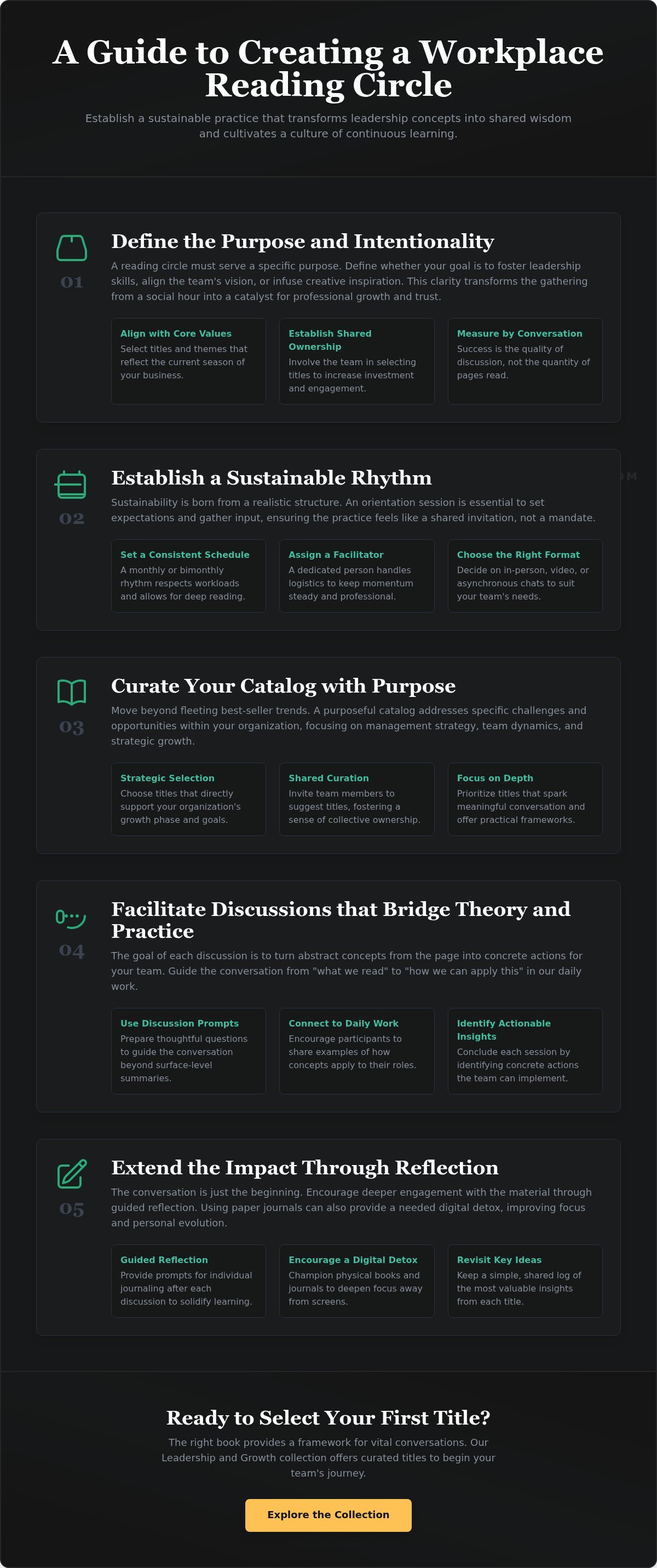
- Define a clear intention for your reading circle, whether you aim to foster leadership skills or align your team’s vision, to ensure every session serves a specific purpose.
- Establish a sustainable rhythm and cadence that respects existing workloads, allowing the group to remain a source of inspiration rather than an additional obligation.
- Learn how to create a book club at work by curating a catalog of titles that address management strategy and strategic growth instead of following fleeting best-seller trends.
- Facilitate discussions that bridge the gap between abstract concepts and daily business practice, turning insights into concrete actions for your collective success.
- Extend the impact of each title through guided reflection and paper journals, encouraging a digital detox that deepens personal evolution and professional focus.
Defining the Purpose and Intentionality of Your Reading Circle
A workplace book club is far more than a social hour or a casual assembly of colleagues. It is a structured forum designed for the intentional exploration of professional titles that challenge our perspectives and sharpen our skills. Understanding how to create a book club at work begins with clarity of purpose. Without a clear objective, these gatherings can quickly feel like another aimless meeting on an already crowded calendar. You must decide if your primary goal is leadership development, team alignment, or perhaps a needed infusion of creative inspiration.
By establishing a specific intent, you transform a simple book discussion club into a catalyst for professional intimacy. This is especially vital for small teams where the lines between roles are often fluid. When you share thoughts on a text, you reveal your values and your vision. This vulnerability builds a level of trust that traditional corporate communication often lacks. It creates a space where you can speak as peers and partners in a collective endeavor, ensuring that the time spent reading translates into a stronger, more connected culture.
Aligning the Club with Leadership Core Values
Your reading choices should reflect the current season of your business. If you are navigating the shift from a hands-on founder to a visionary leader, your selections should mirror that evolution. Choosing a theme that supports your growth phase ensures that the time spent reading directly benefits the health of your organization. You might focus on strategic scaling or the nuances of high-level management. For those ready to deepen their impact, exploring our Leadership and Growth collection can provide the necessary framework for these vital conversations.
Establishing the Collective Mindset
True success in a workplace book club is not found in a top-down mandate where a manager dictates the syllabus. Instead, it thrives through shared ownership of the catalog. We believe that every reader in the Collective contributes to the group’s success. When your team helps select the titles, they are more invested in the outcome. The metric of success here is not how many pages were turned or how quickly you finished a series; it is the quality of the conversation and the subtle shifts in team alignment that occur when you process new ideas together.
Practical Steps for Establishing a Realistic Cadence
Before you open the first title, you must gather your team for an orientation session. This is the moment to set expectations and gather input, ensuring the club feels like a shared invitation rather than a top-down mandate. When considering how to create a book club at work, the initial setup is where sustainability is born. You should discuss the desired medium, whether that is a quiet hour in the office, a structured video call, or an asynchronous chat for remote teams. Assigning a dedicated facilitator helps keep the momentum steady. This person handles the calendar invites and discussion prompts, ensuring the logistics don't fall onto the plates of already busy contributors. By formalizing the process early, you create a sense of professional commitment that feels supportive rather than demanding.
Consistency is the heartbeat of any collective practice. We suggest a monthly or bimonthly rhythm to allow for deep reading without the pressure of an immediate deadline. This cadence respects the team’s existing workload while providing enough space for reflection. Choosing the right medium is equally important. A video call might bridge the gap for a hybrid team, while an asynchronous platform allows for thoughtful, slow-form responses that some readers prefer. For a more detailed framework on these initial steps, you might consult this step-by-step guide to starting a book club, which offers a foundation for professional learning communities.
Setting the Schedule and Format
The time you choose for these discussions signals the value you place on professional growth. Meeting during work hours demonstrates that you view learning as a core part of the business day, while a voluntary lunch session offers a more relaxed, communal feel. Whatever you decide, prioritize consistency over frequency. A high-quality discussion every six weeks is far more impactful than a rushed meeting every fortnight.
Managing the Logistics of Titles
We believe there is a specific, tactile power in physical books. Providing your team with hardcover or paperback copies encourages them to step away from their screens and engage with the text more deeply. When managing these logistics, direct purchasing for bulk orders ensures that every member of the Collective receives their copy at the same time. This removes the friction of individual procurement. If you are looking for a title that explores emotional intelligence, consider The Mother I Did Not Know for your reading list.
Curating Your Catalog with Purposeful Titles
Curation is an act of leadership. While many guides suggest polling for popular titles or chasing the latest bestseller list, a sustainable reading circle requires a more discerning eye. You are not simply filling a shelf; you are crafting a curriculum for your team’s evolution. When considering how to create a book club at work, the titles you choose should bridge the gap between individual curiosity and collective success. This means looking past the hype to find works that offer lasting substance. Learning how to create a book club at work involves more than just picking a title; it requires an editorial mindset that prioritizes long-term growth over fleeting trends.
Selecting for Leadership and Growth
Prioritize titles that foster emotional intelligence and the qualities of a self-respecting leader. These are the soft skills that often determine the long-term health of a business. Our Leadership and Growth Collection offers a curated selection of vetted options specifically designed for entrepreneurs. For those seeking grounded and self-respecting perspectives, the Noelle Varden imprint provides titles that resonate with the quiet strength required to lead with integrity. These works don't just teach management; they invite personal evolution and a deeper understanding of human dynamics within a professional setting.
Evaluating the Relevance of Each Title
Before adding a title to your list, ask if it provides actionable management skills for your specific team. Does the author’s perspective align with your business’s intentionality? You should evaluate how each selection fits into your long-term professional development goals. For example, if your current focus is on communication, a title like The Emotional Intelligence Advantage offers concrete strategies that can be applied immediately. This level of scrutiny ensures that every hour spent reading is an investment in your team’s collective future and a step toward a more aligned workplace culture.
Facilitating Discussions that Bridge Theory and Practice
The true value of a workplace reading circle is realized in the space between the final page and the first meeting. When you are learning how to create a book club at work, the facilitation of the discussion determines whether the insights stick or fade into the background. Move beyond simple summaries. Instead, prepare open-ended questions that invite your team to reflect on how a title’s concepts apply to your specific business context. By creating a safe environment where readers feel empowered to challenge ideas and share personal experiences, you foster a culture of trust and professional intimacy.
We recommend using the power of three to structure your meetings. This framework moves the conversation through three distinct phases: observation, reflection, and application. This rhythmic approach ensures that every session remains high-value and results-oriented.
- Observation: What were the core arguments or themes presented in the title?
- Reflection: How do these ideas resonate with our current team dynamics or challenges?
- Application: What is one concrete change we can implement based on this reading?
Crafting the Discussion Guide
Every impactful conversation starts with a high-level hook to ground the participants. Develop questions that explore personal evolution and the broader professional impact of the text. You don't have to start from scratch. We provide Book Club Discussion Questions as pre-made templates to help you guide your Collective through even the most complex narratives. These guides are designed to spark curiosity and keep the focus on strategic growth. This structure allows you to lead with confidence while leaving room for the team’s unique insights to surface.
Encouraging Active Participation
Retention is often a challenge in busy environments. Address potential drop-off by keeping your sessions focused and strictly timed. Encourage every reader to bring one specific example from the text that mirrored a real-world situation they faced. This practice bridges the gap between theory and the daily grind. Highlighting the connection between emotional intelligence and effective group discussion can also deepen engagement. For a title that explores these human nuances and fosters deep reflection, we suggest reading The Mother I Did Not Know to practice these facilitation skills in a literary context.
Extending the Impact Through Guided Reflection and Journals
The shared conversation of a reading circle provides the spark for new ideas, but the true integration of those concepts happens on the individual page. While understanding how to create a book club at work provides the necessary structure for shared learning, the personal evolution of your team requires a space for quiet, guided reflection. We believe that a digital detox is essential for this process. By stepping away from the relentless noise of screens and notifications, readers can engage more deeply with the leadership concepts they have just discussed. Paper journaling offers a tactile sanctuary where abstract theories become concrete professional development goals.
Journaling serves as the vital bridge between collective wisdom and individual impact. When you encourage your team to document their thoughts, you help them process complex emotions and strategic insights that might otherwise be lost in the daily grind. This practice ensures that the intentionality established during your meetings translates into lasting change. It is not enough to simply read a title; one must write through the implications of that title to truly thrive within the Collective.
Integrating Journals into the Club
We suggest incorporating a dedicated 10-minute quiet writing period at the conclusion of each session. This allows the energy of the discussion to settle into meaningful insights before the team returns to their tasks. Readers may find our Journals and Keepsakes Collection particularly helpful for this practice. Specific tools, such as the Art of Manifestation or our specialized digital detox journals, provide the prompts necessary to bridge the gap between theory and daily action. This small addition to your routine reinforces the idea that professional growth is a continuous, self-respecting endeavor.
Documenting the Team’s Legacy
The growth of your business is a story worth preserving. By using keepsake legacy journals from The Heirloom Series, you can encourage your team to discuss and document the concept of a professional legacy. This practice creates a shared history of the business’s evolution from its founder’s initial vision to its current state of collective success. Documenting these milestones fosters a sense of pride and alignment that stretches beyond a single title or meeting. As you conclude your current series, we recommend exploring the Business and Entrepreneurship Collection to select the next title that will shape your team’s future and strengthen your shared impact.
Cultivating a Legacy of Shared Wisdom
Establishing a reading circle is a quiet, powerful investment in the long-term health of your business. By focusing on intentional curation and a realistic cadence, you bridge the gap between individual evolution and collective success. You now have the framework for how to create a book club at work; it's a path that respects your team’s time while fostering deep professional intimacy. This practice transforms a simple discussion into a catalyst for alignment and leadership development.
Our editorial approach at Thrive Collective Publishing ensures that every title we offer supports independent authors while providing entrepreneurs with the tools for intentional growth. We invite you to join this movement of conscious leaders who believe that success is a collective endeavor. Explore our curated catalog of leadership and growth titles to select the next work that will inspire your team. Step into this bigger version of your business with confidence and heart.
Common Questions About Workplace Reading Circles
How do I handle team members who do not have time to finish the reading?
Focus on the value of participation over perfect completion. If a reader hasn't finished the title, they can still contribute by reflecting on the specific chapters they managed to complete. Encourage them to listen and learn from others' insights during the session. This approach ensures the club remains a supportive space for growth rather than a source of stress or a mandatory task that adds to an already heavy workload.
Can a workplace book club work for a remote or hybrid team?
Remote and hybrid teams can successfully sustain a reading circle through digital video platforms or asynchronous discussion threads. Understanding how to create a book club at work in a virtual environment involves choosing tools that allow for both face-to-face connection and slow-form reflection. These shared digital spaces help bridge the geographical gap, fostering a sense of community and alignment that is often missing in distributed workforces.
Should the business pay for the books and the time spent in the club?
We recommend that the business covers the cost of the titles and treats the meeting time as part of the professional work day. Providing physical copies through bulk orders signals that you value the team's personal evolution and the collective success of the group. When the business invests in these resources, it transforms the club from a voluntary social activity into a core component of your leadership development strategy.
What happens if the team does not like the selected title?
If a title fails to resonate, use the session to explore why the author's perspective didn't align with your team's current values or challenges. These moments of friction are often the most revealing, providing insights into the current growth phase of your business. You don't have to finish every title; sometimes the decision to pivot to a new selection is an act of intentionality that respects the team's energy.
How do I measure the success of a workplace book club?
Measure success by the subtle shifts in your team's shared vocabulary and their ability to apply new concepts to business challenges. You might notice increased alignment during strategic planning or a higher level of emotional intelligence in daily communications. While participation rates are a practical metric, the true impact is found in the long-term evolution of your office culture and the legacy of continuous learning you build together.
Is it better to focus on fiction or non-fiction for professional development?
A blend of both genres is most effective for holistic professional development. Non-fiction titles provide the strategic frameworks and management skills necessary for scaling, while fiction and literary suspense foster empathy and complex problem-solving. This variety keeps the catalog engaging and ensures that readers are developing both their technical expertise and their human-centered leadership qualities throughout the year.
How do I keep the discussion from turning into a complaining session about work?
Use structured discussion guides and the power of three to keep the conversation focused on growth and application. By starting with a high-level hook and moving toward concrete professional goals, you prevent the session from devolving into a vent session. A strong facilitator ensures that every reflection is tied back to the title's concepts, maintaining an atmosphere of professional authority and visionary ambition.
What is the ideal group size for a workplace reading circle?
The most effective reading circles typically consist of five to ten participants to ensure everyone has a voice. This size allows for deep professional intimacy and ensures the conversation remains manageable and high-value. If your team is larger, consider creating multiple smaller groups that occasionally come together to share their collective findings, maintaining the community-oriented spirit that is the hallmark of a successful workplace book club.

Article by
Kimberly Cordova
Kimberly Burk Cordova is the founder of Thrive Collective Publishing, an independent multi-imprint publishing house based in Santa Fe, New Mexico. She is the author of books on leadership, business growth, AI and automation, emotional intelligence, and personal development, written for readers who want clear thinking, useful frameworks, and books they actually finish.
Before turning her full attention to publishing, Kimberly spent more than two decades in strategy, operations, and program leadership, working with public agencies and private organizations on transformation, technology, and large-scale change. That operator's lens shows up in everything she writes and publishes: real frameworks, real numbers, no fluff.
As publisher, she leads a catalog of more than 80 titles from six authors across multiple imprints, spanning literary suspense, true crime, children's biography, relationships, travel, guided journals, and coloring books. The house publishes regularly across its core series, including The Casita Series, Shadows of the Past, the Young Legends Collection, The Growth Leader Collection, the AI and Automation Blueprint, The Heirloom Series, The Art of Manifestation, the Just Write Collection, and Travel: Destination Guides.
She lives in Santa Fe with her husband Greg, a self-taught silversmith and lapidary artist. When she is not writing or publishing, she is building Wildflower Artisans, their Turquoise jewelry brand, or curating the next round of Just Write journals.
Connect with Kimberly and Thrive Collective Publishing at thrivecollectivehq.com.