

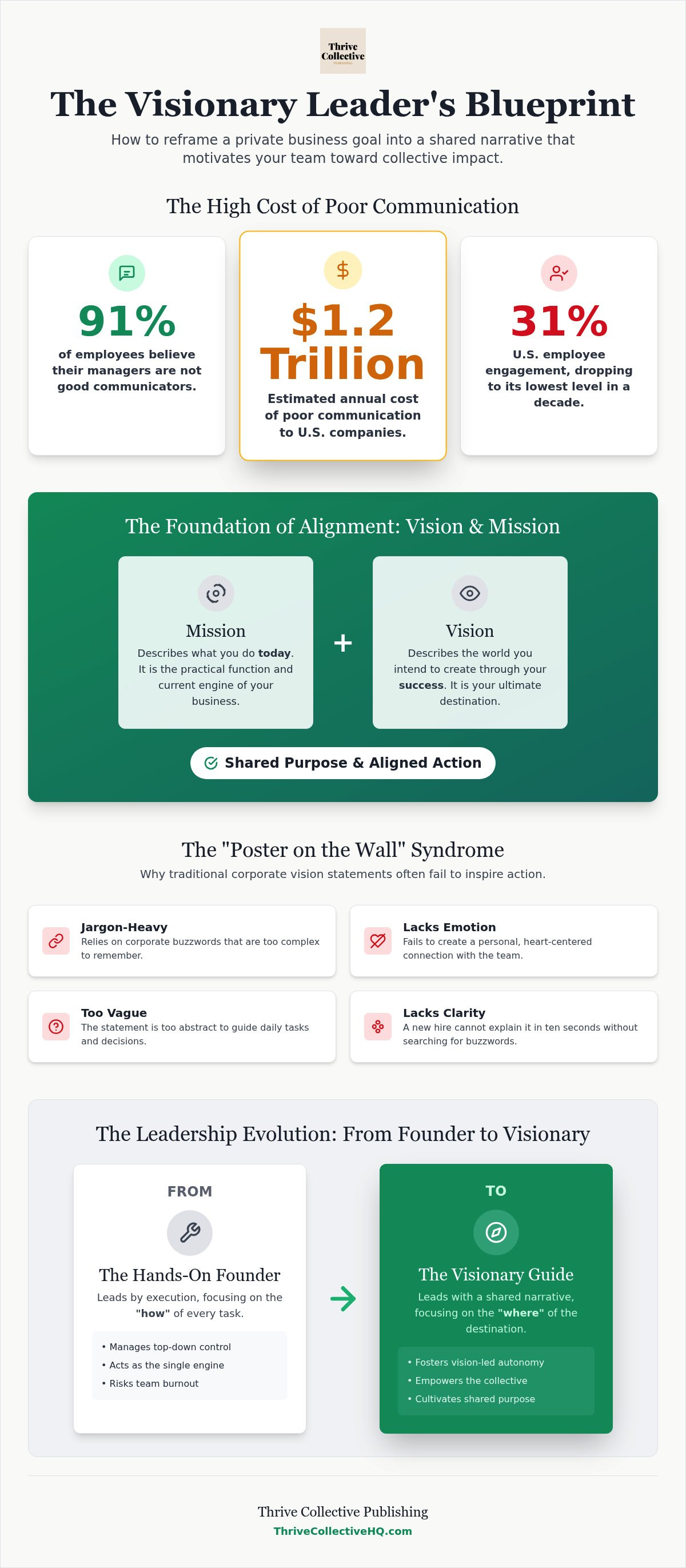
Recent data from 2026 indicates that 91 percent of employees believe their managers are not good communicators, a disconnect that costs U.S. companies an estimated 1.2 trillion dollars every year. Communicating vision to your team effectively is the practice of moving beyond static mission statements to create a living narrative where every individual sees themselves as a vital contributor to the company’s legacy. At Thrive Collective Publishing: Books, Journals, and Guides, we understand that when you are the only person driving the business forward, the pressure can lead to deep exhaustion. This guide will show you how to reframe a private business goal into a shared narrative that motivates your team toward collective impact.
It is frustrating to experience the friction of team confusion or the burnout that follows over-explaining basic goals. You deserve a team that makes decisions aligned with the company’s future without constant oversight. We will explore how to ground your leadership in intentionality and empathy to reduce management friction and clarify professional purpose. This approach ensures your business moves from a state of surviving daily tasks to a state of thriving through shared ambition and clear direction.
Key Takeaways
- Define vision as the clear articulation of a future state that inspires collective action and serves as the foundation for every daily task.
- Shift from founder-led execution to vision-led autonomy, allowing your team to make independent decisions that remain aligned with your core values.
- Master the craft of communicating vision to your team effectively by using narrative leadership to position your staff as the protagonists of your business story.
- Audit your current internal messaging to identify where your purpose is obscured and replace it with a narrative focused on shared legacy and collective impact.
- Utilize the leadership development titles published by Thrive Collective Publishing to support your transition from a solitary founder to a visionary guide.
What does it mean to communicate vision to your team effectively?
Communicating vision to your team effectively is the act of articulating a future state so clearly that it inspires immediate collective action. Vision is the bridge between your current operations and your future impact. While many leaders focus on the practical "what" of their business, true visionary leadership centers on the "why." At Thrive Collective Publishing, we view this as a storytelling craft where you invite your team to become part of a legacy that extends beyond financial gain. It is the difference between a team that survives the work week and a collective that thrives on purpose.
Effective communication requires translating high-level ambitions into the daily reality of your readers and team members. If your vision remains a private thought or a static document, it cannot influence the hundreds of small decisions your team makes every day. Research from Axios HQ in 2026 shows that 79 percent of employees believe the quality of communication from leaders directly impacts their understanding of organizational goals. To move forward, your team must see the direct line between their specific tasks and the company's ultimate destination.
The difference between vision and mission
Mission describes what you do today, focusing on the practical function and the current engine of your business. Vision describes the world you intend to create through your success. Alignment occurs when your team understands how today's mission fuels tomorrow's vision. For example, if your mission is to publish high-quality leadership development books, your vision might be to cultivate a generation of more empathetic and intentional entrepreneurs. When these two elements are synchronized, every project feels like a step toward a meaningful future rather than a repetitive chore.
Why traditional corporate vision statements fail
Traditional vision statements often fail because they rely on jargon-heavy sentences that lack emotional resonance, a problem often called the "poster on the wall" syndrome. These statements are usually too vague to guide behavior or too complex to remember. This level of intentionality is essential for successful strategy implementation within any scaling business. Focus on clarity over cleverness. A new hire should be able to explain the vision in ten seconds without searching for corporate buzzwords. Our leadership and growth collection features titles like The Emotional Intelligence Advantage that help leaders refine this specific skill. By stripping away the coldness of traditional corporate communication, you create space for a more personal and heart-centered connection with your team.
Why is a shared vision the foundation of a scaling business?
A shared vision is the foundation of a scaling business because it replaces top-down control with decentralized alignment, allowing a team to move toward a common goal without constant intervention. Scaling requires a fundamental shift from founder-led execution to vision-led autonomy. As the founder, you cannot remain the single engine for every decision. Communicating vision to your team effectively allows individuals to act with confidence, knowing their choices align with the company's core values. This shared narrative reduces the need for constant oversight, which in turn frees you to focus on high-level strategy and the long-term health of the collective.
In 2026, employee engagement in the U.S. remains a significant challenge, dropping to its lowest level in a decade at 31 percent. A clear vision acts as a powerful tool for retention, particularly in small teams where every person's contribution is visible. When the readers of your internal strategy understand their professional purpose, they are less likely to experience the burnout associated with aimless tasks.
From founder to visionary leader
The transition from a hands-on founder to a visionary leader requires letting go of the "how" and focusing on the "where." You must trust your team to find the best path to the destination you have curated. This personal evolution is often supported by studying the experiences of others and reflecting on your own leadership style. You can explore our titles on leadership and growth to find resources that speak to this shift. For those seeking deeper context, we recommend our Leadership Coaching for Entrepreneurs guide, which details how to scale with purpose in the current landscape.
The cost of a disconnected team
A disconnected team operates in a survival cycle, where confusion leads to overworking and inevitable burnout. Misalignment creates a constant background noise that prevents the harmonious progress of an aligned collective. Without a shared vision, managers often spend an average of six to eight hours each week simply clarifying basic goals and correcting misaligned priorities. This lost time represents a significant drain on both financial resources and emotional energy. Effective communication requires being actionable and anticipating the needs of your staff. You can find useful frameworks for communicating with leadership and teams through established government standards, which emphasize clarity and directness. By establishing a clear vision today, you prevent the friction that stalls progress tomorrow.
How can you use storytelling to make your vision concrete?
A story provides the emotional resonance that a spreadsheet cannot. It allows your team to see the impact of their work on the community, turning a standard business objective into a shared mission. When people understand the narrative arc of the company, they don't just work for a paycheck; they work to see the story through to its successful conclusion. This sense of participation is what separates an inspired collective from a group of individuals just performing tasks.
The craft of the visionary narrative
A successful visionary narrative starts with the heart of the story, explaining why your business matters to the community or the world at large. You must be honest about the obstacles, such as market shifts or rising competition, while painting a clear picture of how the team will overcome them. This approach is central to building a clear and compelling vision that resonates across all levels of an organization. Kimberly Burk Cordova serves as a model for this style, utilizing a direct and warm tone that acknowledges difficulty while remaining deeply encouraging. Her approach demonstrates that leadership isn't about ignoring conflict but about framing it as an opportunity for collective growth.
Using titles and resources to anchor the story
To make a vision stick, leaders can use physical resources to anchor the narrative in daily life. For instance, The Emotional Intelligence Advantage by Kimberly Burk Cordova helps leaders connect emotionally with their teams, ensuring the vision is felt as much as it is understood. Beyond leadership guides, our journals and keepsakes allow teams to document the business legacy as it unfolds. This practice turns the vision into a living record of progress. We encourage you to explore our leadership and growth collection for more examples of how to bridge the gap between dreaming and doing. By curating a catalog of growth, you provide your team with the tools to see themselves as the authors of the company’s future.
What are the specific steps to align a team with a new vision?
Alignment is not an accidental byproduct of proximity; it is a result of intentional strategy. To begin, you must audit your current communication channels to identify where the vision is missing or obscured by administrative noise. Data from 2026 suggests that while 56 percent of internal communicators make manager communication their top focus, only 4 percent feel those managers are very effective at cascading messages. Communicating vision to your team effectively requires closing this gap by moving beyond the founder's head and into a shared, written narrative. This draft should be editorial and calm, focusing on the collective impact your team creates rather than just high-level financial targets.
Once the narrative is set, host a vision-alignment session where the primary goal is listening rather than speaking. This allows the team to articulate how their specific roles fit into the broader story you have curated. From there, the vision must be integrated into the daily rhythm of the business, appearing in meeting agendas, internal emails, and performance evaluations. As a leader, you must model the vision through every choice you make, ensuring your actions serve as the ultimate proof of the narrative.
Practical rituals for consistent alignment
Consistency transforms a vision from a concept into a culture. One specific ritual we recommend is the "Vision Minute," where every meeting begins with a brief reminder of the "why" behind the current agenda. This practice grounds the team in professional purpose before they tackle the practical tasks of their day. You should also connect individual professional development goals to the company's future state. Utilizing guided journals for personal growth can help team members reflect on their evolution within the collective. This practice of intentional reflection is a cornerstone of the philosophy at Thrive Collective Publishing: Books, Journals, and Guides.
Measuring the success of your communication
You can measure the clarity of your communication by asking team members to describe the vision in their own words without referring to a handbook. Consistency in these responses indicates that the narrative has been successfully internalized. Additionally, observe if decision-making becomes more autonomous over time. A vision-aligned decision is a choice made by a team member that independently mirrors the company's core values and future goals. When these benchmarks are met, you can be confident that you are communicating vision to your team effectively. To further support this alignment, we invite you to browse the leadership development titles in our current catalog.
How does the Thrive Collective approach support visionary leadership?
At Thrive Collective Publishing: Books, Journals, and Guides, we believe that leadership is a collective endeavor rather than a solitary pursuit. No one succeeds in a vacuum, and the most resilient organizations are built on the principle of mutual empowerment. Communicating vision to your team effectively is the primary tool for this evolution, as it transforms a private goal into a shared legacy. By focusing on intentionality, you move beyond the daily survival of management tasks and begin to thrive through shared ambition. This heart-centered approach ensures that success is measured not just by financial gain, but by the impact you have on your community and your team's professional purpose.
The role of the independent press in professional growth
Our identity as a New Mexico independent press allows us to curate titles that challenge traditional corporate thinking. We believe that reading diverse genres expands a leader's perspective and fosters the empathy required for modern leadership. For instance, the literary and quiet suspense in the work of K.B. Cordova, such as The Mother I Did Not Know, encourages readers to explore complex human identities. Similarly, the historically careful true crime titles by Eliza Hawthorne provide insights into the nuances of human behavior. By supporting independent authors and choosing to buy direct from our press, you invest in a literary culture that values depth and editorial integrity over hype-driven trends.
Next steps for your leadership evolution
Your path toward communicating vision to your team effectively begins with a commitment to documentation and reflection. We invite you to spend time this week drafting your own vision narrative, perhaps using a notebook from our Just Write Collection to ground your thoughts. You can explore the full range of our leadership and strategy resources in the Thrive Collective Publishing: Books, Journals, and Guides catalog. If you are seeking a specific curation of titles for your team or have questions about our publishing process, please email info@thrivecollectivehq.com. We are here to help you step into a bigger version of yourself and lead with intentionality.
Step into your role as a visionary guide
Building a scaling business requires a fundamental shift from individual effort to collective impact. You have learned that vision is not a static statement on a wall but a living narrative that invites every team member to become a protagonist in the company's story. By auditing your internal messaging and establishing daily rituals like the Vision Minute, you create a culture where independent decisions align naturally with your core values. Communicating vision to your team effectively is the bridge that moves your leadership from the exhaustion of survival to the ease of thriving with purpose.
As an independent press based in New Mexico, we are dedicated to providing the resources you need for this evolution. We are the publishers of The Emotional Intelligence Advantage by Kimberly Burk Cordova, a title curated specifically for intentional entrepreneurs who value heart-centered leadership. We invite you to explore the Leadership and Growth Collection at Thrive Collective Publishing to find the titles that will anchor your shared narrative. Your potential to lead with impact is limitless, and we are honored to support you as you build your professional legacy.
Frequently Asked Questions
How often should I communicate the vision to my team?
You should communicate your vision in every formal gathering and within weekly internal updates. Consistency is more vital than frequency. If you only discuss the future during annual retreats, your team will remain trapped in a cycle of short-term survival. Aim to weave the "why" into at least 80 percent of your strategic conversations to ensure it remains a living part of your culture.
What if my team doesn't seem interested in the long-term vision?
Lack of interest often suggests that the vision feels like a distant corporate theory rather than a personal reality. Reframe the narrative to show how the company’s impact directly supports their own professional evolution. When team members see themselves as protagonists in the story, their engagement shifts from passive compliance to active participation in the collective mission and shared legacy.
Can a vision change as the business grows?
A vision can and should evolve as your business matures and your understanding of your purpose deepens. While your core values stay firm, the specific future you are curating may change based on market shifts or community needs. Communicating vision to your team effectively during these shifts requires you to be clear about the evidence that prompted the change and how it serves the collective.
How do I communicate vision to a remote or distributed team?
Remote teams require higher levels of intentionality and asynchronous documentation to remain aligned. Utilize video updates to provide the warm, human resonance that text sometimes lacks. Ensure your vision narrative is documented in a central, digital location where it can serve as a benchmark for autonomous decision-making across different time zones and locations, moving the team from survival to a state of thriving.
What is the best way to handle team members who are resistant to a new vision?
Handle resistance with a calm, editorial approach by first seeking to understand the root of the friction. Resistance often masks a fear of instability or a misunderstanding of the new direction. Open a dialogue to clarify how the vision protects the team’s future. If alignment is impossible after deep support, it may indicate a fundamental mismatch with the company's intentional growth and culture.
Should the team be involved in creating the vision statement?
While the founder must set the aspirational destination, the team should be involved in defining the practical steps to reach that future. This collaborative drafting process ensures the vision is rooted in the daily reality of those executing the work. When people help build the narrative, they are more likely to take ownership of the results and see the business as a shared endeavor.
How do I know if my vision communication is actually working?
Success is visible when your team begins to make independent decisions that prioritize long-term impact over short-term convenience. Listen for the vision’s vocabulary in their own updates and project briefs. When your staff can explain the "why" of their work without prompting, your communication has successfully moved from a top-down directive to a shared internal compass that guides the whole collective.
Can I use external books or resources to help explain my vision?
External resources are powerful tools for providing a shared vocabulary and intellectual foundation for your team. Our catalog at Thrive Collective Publishing offers leadership titles that help refine the skills needed for communicating vision to your team effectively. Titles like The Emotional Intelligence Advantage by Kimberly Burk Cordova can be used as a study guide to deepen the collective understanding of your purpose.

Article by
Kimberly Cordova
Kimberly Burk Cordova is the founder of Thrive Collective Publishing, an independent multi-imprint publishing house based in Santa Fe, New Mexico. She is the author of books on leadership, business growth, AI and automation, emotional intelligence, and personal development, written for readers who want clear thinking, useful frameworks, and books they actually finish.
Before turning her full attention to publishing, Kimberly spent more than two decades in strategy, operations, and program leadership, working with public agencies and private organizations on transformation, technology, and large-scale change. That operator's lens shows up in everything she writes and publishes: real frameworks, real numbers, no fluff.
As publisher, she leads a catalog of more than 80 titles from six authors across multiple imprints, spanning literary suspense, true crime, children's biography, relationships, travel, guided journals, and coloring books. The house publishes regularly across its core series, including The Casita Series, Shadows of the Past, the Young Legends Collection, The Growth Leader Collection, the AI and Automation Blueprint, The Heirloom Series, The Art of Manifestation, the Just Write Collection, and Travel: Destination Guides.
She lives in Santa Fe with her husband Greg, a self-taught silversmith and lapidary artist. When she is not writing or publishing, she is building Wildflower Artisans, their Turquoise jewelry brand, or curating the next round of Just Write journals.
Connect with Kimberly and Thrive Collective Publishing at thrivecollectivehq.com.