

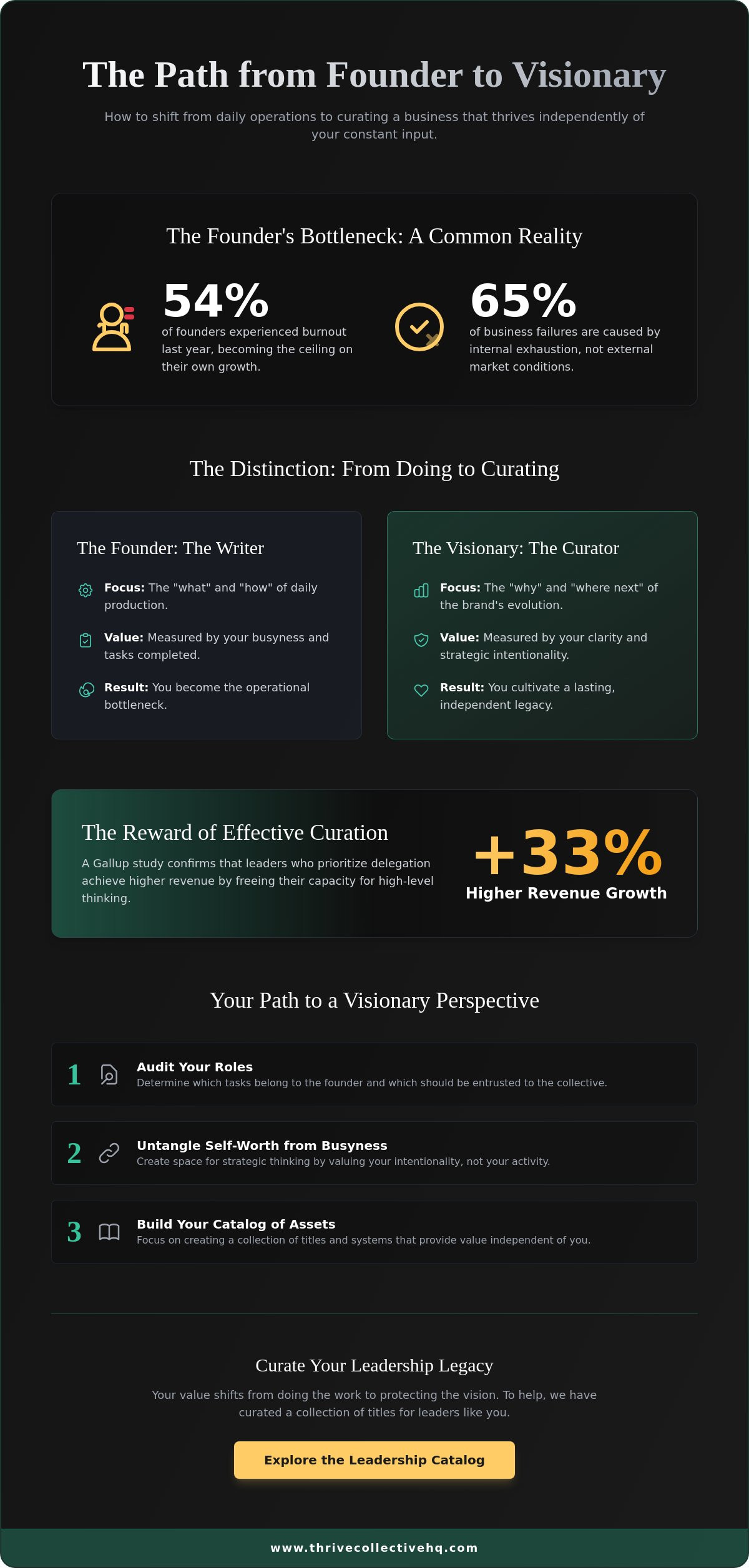
If 54% of founders experienced burnout in the past year, the problem isn't your ambition; it's your current seat at the table. According to research from Sifted and Octopus Ventures, nearly two-thirds of business failures stem from this internal exhaustion rather than external market shifts. You likely feel like the bottleneck in your own creation, watching your energy drain into daily operations while your long-term strategy gathers dust. It's a heavy realization that the business you built for freedom now requires your constant presence just to survive.
You can transition from founder to visionary by adopting an editorial mindset, shifting your focus from writing every line of the business to curating its most impactful chapters. This article explains how to reclaim your space for creative work and build a catalog that thrives independently of your daily input. We will examine the practical steps to delegate effectively, a trait Gallup links to 33% higher revenue, so you can focus on the collective impact of your leadership rather than the friction of the machine.
Key Takeaways
- Recognize the operational ceiling where your constant approval limits the growth of your team and your long-term impact.
- Understand how the transition from founder to visionary requires you to stop writing every line and start curating the strategic story.
- Untangle your self-worth from daily busyness to create the necessary space for high-level strategic thinking and intentionality.
- Audit your current roles to determine which titles belong to the founder and which should be entrusted to the collective.
- Build a catalog of assets that serve as a lasting legacy, allowing your business to thrive independently through thoughtful curation.
Recognizing the Operational Ceiling
The operational ceiling is the point where your personal capacity becomes the hard limit on what your business can achieve. In the early stages, your hands-on involvement is a survival mechanism. You write the copy, approve the designs, and answer the reader inquiries because you are the only one who can. However, as your catalog grows, this involvement becomes a liability. When every decision requires your approval, you aren't leading; you're hovering. Research from Octopus Ventures shows that 65% of startup failures are linked to internal conflict or founder burnout rather than market conditions. If you are part of the 54% of founders who experienced burnout in the last 12 months, you've likely hit this ceiling.
To better understand this concept, watch this helpful video:
Signs that you are stuck in the founder phase include a growing backlog of approvals, a feeling that your team is paralyzed without your presence, and a complete lack of time for creative work. Moving from founder to visionary means shifting your role from the primary laborer to the lead curator of the brand story. This requires a transition into strategic leadership, where your value is measured by your ability to see what's coming next rather than how many tasks you completed today. While your presence was necessary for survival, your distance is now necessary for the business to thrive.
The Difference Between a Founder and a Visionary
A founder is focused on the "what" and the "how" of daily production. They ensure the paperback books are printed correctly and the imprints are organized. A visionary, by contrast, focuses on the "why" and the "where next" of the brand's evolution. The visionary leader is the person who ensures every title in the catalog aligns with a single purpose. While the founder builds the engine, the visionary determines the destination.
Why the Transition Feels Uncomfortable
Relinquishing the daily operations often feels like a risk to the integrity of your business. You might fear that without your direct touch, the soul of the brand will dissipate. This shift from tangible tasks to the intangible work of strategic thinking can feel like you're doing nothing. It is a necessary evolution where you must stop valuing yourself for your busyness and start valuing yourself for your intentionality. Letting go of control isn't about abandonment; it's about giving your collective the space to grow while you cultivate the legacy.
The Distinction Between Doing and Curating
If a founder is the writer, laboring over each sentence to ensure the ink hits the page, the visionary is the chief editor. You are no longer responsible for the first draft of every operational task. Instead, you refine the narrative flow of the business to ensure it remains cohesive as you scale. This shift from founder to visionary is the only way to manage a growing catalog without succumbing to cognitive overload. Consider an independent publisher managing three distinct imprints. If the leader attempts to proofread every title, the production schedule halts. By shifting to a curator's mindset, you empower your collective to execute the details while you protect the overarching vision.
Setting the narrative rhythm means establishing the pace at which your organization moves. It is the difference between reacting to every reader email and building a system that anticipates their needs. When you stop "doing" and start "curating," you create a space where your team can thrive. A Gallup study indicates that leaders who prioritize delegation achieve 33% higher revenue growth. This isn't because they work more hours; it's because they have cleared the mental clutter required to see the horizon clearly. Exploring our leadership development books can help you identify the specific traits needed for this transition.
In a multi-imprint structure, such as one that produces both true crime audiobooks and guided journals, the visionary ensures that while the content differs, the quality remains uniform. You are the guardian of the catalog's reputation. This level of oversight requires you to trust the intelligence of your readers and the competence of your staff. This transition from founder to visionary is an editorial shift that moves you from a state of constant "doing" to a state of purposeful "being," where your primary contribution is your perspective.
The Visionary as Chief Editor
Your operations are essentially a manuscript in progress. As a visionary, you review the chapters written by your team, ensuring they align with the brand’s intentionality. You aren't just correcting errors. You are improving the overall impact of the work. This allows you to step back from the minutiae of Kindle formatting or hardcover distribution and focus on the strategic growth of your imprints and series. You provide the framework, and your team writes the success stories within it.
Protecting the Intellectual Property of the Brand
Consistency is the hallmark of a respected brand. Your core values act as an editorial style guide, dictating how the business speaks to readers and how it handles challenges. This ensures that even as you step away from daily tasks, the voice of the company remains unmistakable. Many leaders find that leadership coaching provides the clarity needed to codify these values into a repeatable framework. By protecting the soul of the business, you ensure its legacy survives long after you've moved out of the daily operations.
Overcoming the Identity Crisis of the Self-Made Leader
You are more than your output. For years, your worth has been measured by the number of titles you launched or the reader questions you answered. This attachment to busyness is a weight that prevents you from stepping into your true professional authority. The transition from founder to visionary requires a deliberate rejection of the hustle culture that got you here. It demands quiet. It requires space for reflection. Without these, your strategic thinking remains shallow, and your business remains tethered to your physical presence. According to the DDI Global Leadership Forecast from November 2025, 71% of leaders report being under increased stress, with 40% considering leaving their roles entirely. Much of this stress stems from the self-imposed pressure to remain the primary operator.
Moving from a state of constant reaction to one of aligned action means you must trust the collective you have built. If you find yourself procrastinating on big ideas, it's often because you are distracting yourself with small, manageable tasks that provide a false sense of accomplishment. You must trade the dopamine hit of a cleared inbox for the deeper satisfaction of a well-curated legacy. This shift is uncomfortable because it feels like you are doing less, but in reality, you are finally doing the work that only you can do. You are moving from the survival mode of the founder to the intentionality of the visionary leader.
Ending the Habit of Overworking
Overworking is often a defense mechanism against the vulnerability of leading. If you stay busy with the minutiae of Kindle formatting or hardcover shipping logs, you don't have to face the high-stakes decisions of where the brand goes next. This transition requires a digital detox from the constant noise of small tasks. When you feel the urge to jump back into the daily operations, recognize it as a habit of procrastination on your bigger goals. Learning how to get out of the habit of procrastination is a vital step in reclaiming your time for visionary work. By stepping back, you allow the business to breathe and the team to take ownership of their roles.
Cultivating Professional Authority
A visionary provides direction rather than just seeking consensus. While we value the collective effort, the visionary must be the one to set the final course for each imprint and series. This authority is delivered with sisterly encouragement, building up the next layer of leaders so they can handle the "rejected drafts" of business life. For example, when a new series launch fails to meet its reader engagement targets, the founder might try to fix the marketing copy themselves. The visionary, however, analyzes why the title didn't resonate with the catalog's purpose and guides the team toward a more aligned strategy for the next release. You aren't there to do the work; you are there to ensure the work matters.
Five Steps to Cultivate a Visionary Perspective
Moving from founder to visionary requires more than a change in title; it requires a structural overhaul of your daily habits. If you continue to operate as a generalist, your business will eventually plateau at the level of your personal output. To break through this ceiling, you must implement a system of high-level curation that prioritizes long-term impact over immediate gratification. This process begins with a clear-eyed assessment of where your energy is currently spent and where it actually belongs. By following these five steps, you can begin to build a business that reflects your highest intentions.
Step 1: The Responsibility Audit
The first step is to categorize every task on your plate as either "writing" (the act of doing) or "editing" (the act of overseeing). As a founder, you likely find yourself in the weeds of Kindle formatting or managing shipping logs for your imprints. Identify three specific tasks that you can hand off to your collective in the next 30 days. This might include reader support, inventory tracking, or initial manuscript reviews. Remember that delegation is not losing control but expanding your reach. By entrusting these titles and processes to others, you create the space necessary to lead with clarity.
Step 2: Establish Your Core Principles
Once you have cleared the clutter, you must establish a Style Guide for your organizational culture. This document should go beyond font choices and brand colors; it must define the core principles that guide every decision within your imprints and series. This ensures that even when you are not in the room, the work produced by your team aligns with your legacy. You can find resources to support this growth in the collection of leadership development books and journals from Thrive Collective Publishing: Books, Journals, and Guides.
Step 3: Embrace Guided Reflection
A visionary perspective is cultivated in silence. Daily reflection prevents the drift back into operational weeds by anchoring your focus on the 10-year horizon. Using specific prompts helps you maintain intentionality when the noise of small tasks becomes overwhelming. The "The Art of Manifestation" series from Thrive Collective Publishing: Books, Journals, and Guides is designed to facilitate this type of visionary clarity, providing a structured environment for you to explore your long-term legacy. When you dedicate time to this practice, you move from a state of reacting to a state of creating, ensuring that your catalog remains a true reflection of your purpose.
Step 4: Empower Your Collective
Invest in the development of your team. Treat your staff as the authors of your operational success, providing them with the tools and authority they need to excel. This fosters ownership and allows the business to scale beyond your direct involvement, ensuring that your vision is shared and executed effectively by those you trust.
Step 5: Document Your Enduring Legacy
Document every step of the journey and all operational processes. By thoroughly documenting your systems, you ensure that your legacy is transferable and that the business can thrive independently of your day-to-day presence. This comprehensive documentation serves as the ultimate archive of your impact, allowing your vision to endure long after you've stepped away from the daily grind and into a truly visionary role.
Curating Your Leadership Legacy
Legacy is not merely what you leave behind after you depart; it is the living structure you build to endure while you are still present. Too many leaders view their eventual exit as the moment their legacy begins, but for those moving from founder to visionary, the legacy is the catalog itself. Every decision you make to step back from the daily operations is a decision to let the business speak for itself. It is a transition from being the voice of the company to being the architect of a system that amplifies that voice through every imprint and series you oversee. This requires a calm confidence in the collective you have built and a commitment to the long-term health of your organization.
Your business assets are more than just inventory; they are the curated chapters of your professional story. When you lead with intentionality, your catalog becomes a collection of successes that demonstrate your values to your readers and your community. Thrive Collective Publishing: Books, Journals, and Guides, operated by Cordova Consulting LLC in New Mexico, provides the specific titles and tools designed to support this evolution. We believe that a well-curated business allows you to focus on the strategic work that defines a visionary, ensuring your impact remains steady even as your daily role shifts. Your professional authority is not found in the volume of tasks you complete, but in the clarity of the direction you set.
Building a Catalog of Impact
Viewing your leadership as a work of art requires a shift in how you value your time. Instead of measuring success by the volume of your daily output, you should measure it by the alignment and quality of your ventures. Every new imprint should be a deliberate choice that fits within the larger narrative of your brand. This intentionality ensures that your business does not just survive; it thrives as a cohesive collective. When you treat your business as a curated collection, you invite your team and your readers into a story that is much bigger than any single individual. Your role is to ensure that this story remains consistent, high-quality, and deeply rooted in your original purpose.
Next Steps for the Aspiring Visionary
The path from founder to visionary begins with a single, focused choice to change your perspective. You do not have to overhaul your entire operation in a single day, but you must start the process of stepping back. Review the Thrive Collective Publishing: Books, Journals, and Guides products list to find the journals and leadership titles that resonate with your current stage of growth. These tools are designed to help you maintain the reflection cycles necessary for high-level curation. If you are seeking specific guidance on how to align your catalog with your long-term goals, we recommend contacting us at info@thrivecollectivehq.com. Step into your role with the confidence that your vision is the most valuable asset your business possesses.
Step Into Your Strategic Power
The evolution from founder to visionary is the definitive step toward building a business that outlasts your daily effort. By moving from the labor of a writer to the oversight of an editor, you protect the intentionality of your brand while expanding the reach of your collective. You have explored the operational ceiling, the necessity of curation, and the specific steps to reclaim your reflection cycles. This transition represents a shift in value from what you do to what you enable others to achieve. It is the moment you stop being the bottleneck and start being the architect of your own impact.
Thrive Collective Publishing: Books, Journals, and Guides, operated by Cordova Consulting LLC in New Mexico, supports this growth through serious editorial curation. We provide the tools, including Red Dot award-winning insights, to help you navigate the strategic complexities of being a working author and leader. Whether you are expanding your catalog or refining your leadership legacy, our resources offer the clarity required for long-term alignment. Explore our catalog of leadership titles and guided journals to begin your own editorial shift. Trust the intelligence of your readers, the strength of your team, and the power of your own vision.
Frequently Asked Questions
What is the primary difference between a founder and a visionary leader?
A founder focuses on the mechanics of building the business (the how and the what), while a visionary leader focuses on the long-term impact and direction (the why and where next). While the founder ensures the paperback books are printed correctly, the visionary ensures that every title in the catalog aligns with a single, purposeful legacy. This shift allows the leader to move from active production to strategic curation.
How do I know if I am ready to transition from founder to visionary?
You are ready when your personal capacity becomes the bottleneck that prevents your collective from growing. If you find yourself in the 54% of founders experiencing burnout, it is a clear sign that your involvement in daily operations has reached its limit. Readiness is marked by having a team capable of managing imprints and series without your constant, hands-on approval.
Can a small business owner be a visionary without a large team?
Yes, you can lead with vision as a solo creator by shifting your focus from constant production to strategic curation. This involves carving out non-negotiable time for reflection and using systems to manage your catalog efficiently. Even without a team, you can act as the chief editor of your own work by prioritizing intentionality over daily busyness.
What are the most common mistakes when moving to a visionary role?
The most frequent error is failing to let go of small operational tasks, such as reader support or formatting logs. This mistake often stems from a fear that the business will lose its soul without your direct touch. Moving from founder to visionary requires you to trust your established style guide so you can focus on the horizon rather than the daily weeds.
How does guided journaling help in leadership development?
Guided journaling provides a structured space for the reflection necessary to maintain high-level curation. It prevents the drift back into daily friction by anchoring your thoughts on your 10-year goals. Using titles like our "The Art of Manifestation" series helps you document your progress and lead your collective with a sense of calm and clarity.
What is an "editorial shift" in a business context?
An editorial shift is a transition where you stop writing every line of your business operations and start curating the overall brand story. Instead of doing the work, you review and refine the "manuscript" of your collective's output. This shift ensures that the narrative flow of your business remains consistent across all imprints as you scale with ease.
How can I maintain my company culture while stepping back from operations?
You protect your culture by creating a comprehensive Style Guide that defines your core values and professional standards for your team. This document acts as an editorial framework, ensuring every decision aligns with your brand's intentionality even when you aren't present. By empowering your collective to follow this guide, you ensure the business thrives independently of your daily input.
Where can I find books to help me become a visionary leader?
You can find a curated selection of leadership development books and journals in our online catalog. We offer a range of titles specifically designed to help you move from founder to visionary with professional authority. These resources focus on building a lasting legacy and are published by our independent imprint based in New Mexico.

Article by
Kimberly Cordova
Kimberly Burk Cordova is the founder of Thrive Collective Publishing, an independent multi-imprint publishing house based in Santa Fe, New Mexico. She is the author of books on leadership, business growth, AI and automation, emotional intelligence, and personal development, written for readers who want clear thinking, useful frameworks, and books they actually finish.
Before turning her full attention to publishing, Kimberly spent more than two decades in strategy, operations, and program leadership, working with public agencies and private organizations on transformation, technology, and large-scale change. That operator's lens shows up in everything she writes and publishes: real frameworks, real numbers, no fluff.
As publisher, she leads a catalog of more than 80 titles from six authors across multiple imprints, spanning literary suspense, true crime, children's biography, relationships, travel, guided journals, and coloring books. The house publishes regularly across its core series, including The Casita Series, Shadows of the Past, the Young Legends Collection, The Growth Leader Collection, the AI and Automation Blueprint, The Heirloom Series, The Art of Manifestation, the Just Write Collection, and Travel: Destination Guides.
She lives in Santa Fe with her husband Greg, a self-taught silversmith and lapidary artist. When she is not writing or publishing, she is building Wildflower Artisans, their Turquoise jewelry brand, or curating the next round of Just Write journals.
Connect with Kimberly and Thrive Collective Publishing at thrivecollectivehq.com.