

What if your absence from daily operations was actually the greatest gift you could give your team? Many leaders at Thrive Collective Publishing find themselves trapped in a cycle of constant interruptions, feeling like a bottleneck in the very business they built to find freedom. Delegating tasks without micromanaging involves providing team members with clear objectives and resources while granting them the autonomy to determine the specific path to completion. This shift allows you to move from a manager of tasks to a curator of impact, ensuring your business scales without demanding more of your personal time. You likely started your company to create a legacy, yet you may still spend your afternoons answering low-level questions that your team should already own.
In this guide, you will learn how to empower your team and scale your business impact by mastering the delicate balance between oversight and autonomy. We will explore practical strategies for building trust and setting boundaries that protect your energy for high-level strategy. By the end, you will understand how to cultivate a team that takes full ownership of their roles, moving from a state of surviving the daily grind to thriving as a visionary. Our catalog of leadership titles, including The Emotional Intelligence Advantage by Kimberly Burk Cordova, provides additional resources for those ready to lead with intentionality and grace.
Key Takeaways
- Master the art of delegating tasks without micromanaging by shifting your focus from the specific path of execution to the final objective.
- Identify the three levels of task maturity to provide the appropriate amount of support without stifling individual creativity or ownership.
- Utilize a five step framework for delegation kickoffs to ensure every team member understands their specific role and the resources available to them.
- Move from being a bottleneck in your business to a visionary curator who empowers others to take full responsibility for their results.
- Discover how intentional leadership creates a thriving environment where scaling occurs with ease and purpose.
Why does delegating tasks without micromanaging feel so difficult for entrepreneurs?
Delegating tasks without micromanaging feels difficult because entrepreneurs frequently equate personal value with direct task completion and worry that errors will damage the brand. This psychological hurdle prevents leadership from transitioning into a curator role, a shift essential for scaling a business and fostering a team that takes full ownership of results.
It often begins with a specific, visceral fear. You worry that a task requiring ten minutes of your time will morph into a two-hour mistake if handled by someone else. This hesitation is natural for leaders who built their businesses from the ground up, but it can become a ceiling for your success. Delegation is not just about offloading work; it is about evolving your role from the primary doer to a visionary curator. At Thrive Collective Publishing, we see this transition as a pivotal moment in an author's or leader's professional life.
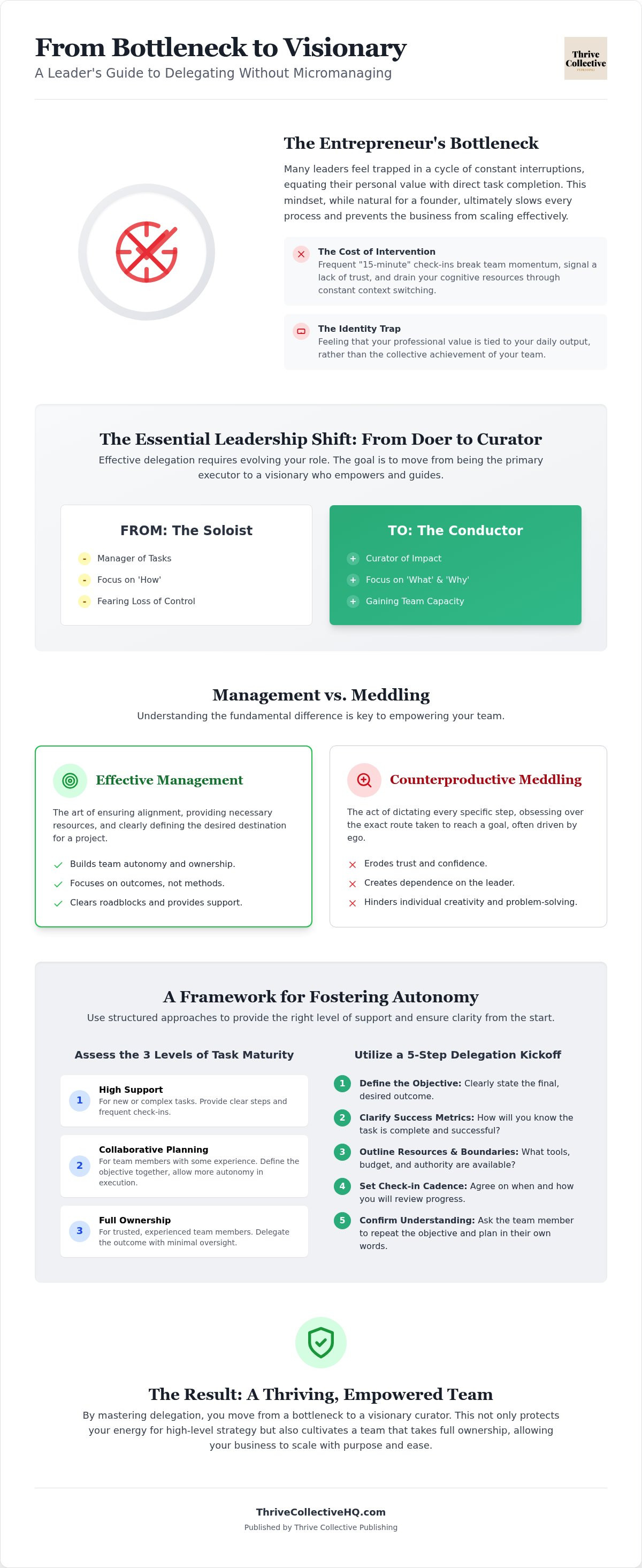
Many leaders fall into what we call the identity trap. You might equate your professional value with your daily output, feeling that if you aren't physically doing the work, you aren't leading effectively. This mindset turns you into a bottleneck that slows every process within your organization. Real growth requires a mental shift where you recognize that your impact is measured by what your team achieves collectively, not just what you finish yourself. It is the difference between being a soloist and a conductor.
The cost of the 15-minute intervention
Small interruptions are deceptive. You might think a quick check-in helps, but these frequent interventions break your team's momentum and signal a lack of trust. There is a heavy hidden cost to context switching that drains your own cognitive resources. For example, a founder might delegate a task to save one hour, but then spend three hours hovering and correcting minor stylistic details that don't change the final outcome. This pattern doesn't just waste your time; it erodes the self-reliance of your team and prevents them from taking full responsibility for their work.
Reframing control as a barrier to impact
Control often feels like safety, but in reality, it acts as a barrier to your potential. Shifting your perspective from losing control to gaining capacity is essential for scaling. When you practice delegating tasks without micromanaging, you invest in your long-term legacy rather than just solving a short-term problem. Our Leadership and Growth collection features titles like The Emotional Intelligence Advantage by Kimberly Burk Cordova, which helps readers work through the emotional nuances of trust and team autonomy. Scaling with ease requires you to trust the systems and people you have carefully put in place.
What is the fundamental difference between management and meddling?
Management is the art of ensuring alignment and providing resources, whereas meddling is the act of dictating every specific step of a process. Effective delegation requires a leader to define the desired destination clearly without obsessing over the exact route a team takes to arrive at a goal.
Management is about alignment. Meddling is about ego. To master delegating tasks without micromanaging, you must develop the self-awareness to recognize when your desire to help is actually hindering progress. It's about trusting the collective expertise you have assembled. You can find more insights on this shift in our curated catalog of leadership titles.
The IC hat versus the manager hat
Every leader wears multiple hats, but the trouble starts when you try to wear the Individual Contributor (IC) hat and the Manager hat simultaneously. An IC executes the work, focusing on the tactical details of a project. A manager's role is to clear the path and ensure the team remains aligned with the broader vision. You cannot effectively wear both hats during the same 60-minute meeting. If you are debating the font size or the specific phrasing of an email, you have stepped out of your leadership role and back into the weeds of execution. This duality often causes confusion for your team, as they don't know whether you are offering a suggestion as a peer or a directive as a boss.
Focusing on results rather than methods
One of the most difficult lessons for a visionary is learning to differentiate between a standard of quality and a personal preference. A standard of quality is objective and necessary for brand integrity. A personal preference is simply your way of doing things. When you impose your specific methods on your team, you stifle their creativity and growth. This behavior often stems from a lack of trust in the team's ability to reach the same high standard through a different path.
Learning How to Delegate Effectively involves setting clear expectations for the final result while leaving the "how" to the person responsible. This requires a high degree of emotional intelligence. We recommend reading titles like The Emotional Intelligence Advantage by Kimberly Burk Cordova to help build the self-awareness needed to step back. When you focus on results, you empower your team to innovate, which ultimately leads to a more resilient business and a more peaceful work environment for everyone involved.
Assessing task maturity to determine your level of involvement
Delegation is not a binary choice. It is a sliding scale that shifts based on the specific task and the team member's experience. Mastering the art of delegating tasks without micromanaging requires you to evaluate "task maturity" rather than judging a person's general competence. Even a senior leader might be a Level 1 when learning a new software or a specific internal process. This approach ensures you provide the right amount of support at the right time, preventing both abandonment and over-interference.
One helpful benchmark is the 70% Rule. If a team member can complete a task to 70% of your current standard, you should delegate it. This gap represents the space where they can learn and eventually surpass your own proficiency. Applying the 70% rule is a practical way to begin delegating tasks without micromanaging, as it prevents you from being the bottleneck and allows you to focus on high-level impact.
Level 1: High involvement for new tasks
When a task is new, frequent check-ins are a form of investment. You aren't hovering to catch mistakes; you are providing the scaffolding necessary for success. The goal here is clarity. If you find yourself feeling impatient, you might use guided journals for personal growth to reflect on your own evolution as a learner. For example, if a new editor is learning your house style, you might review their first three chapters daily to ensure alignment before moving to a lighter touch.
Level 2: Shifting to outcome-based check-ins
Once the team member is capable, your focus must shift from the "how" to the "when." You move from daily pings to a weekly alignment rhythm. Instead of asking how they are performing a specific step, you ask if they are on track for the deadline. This transition protects team momentum while keeping you informed. If a project manager has successfully launched two titles, you no longer need to see their draft emails; you only need to see the final production schedule.
Level 3: True autonomy for the expert
At the expert level, you become a resource provider rather than a supervisor. Your role is to stay informed through high-level reporting without being involved in the execution. If an author in our catalog has reached this stage with their marketing plan, you simply ensure they have the budget and support they need to thrive. Step back entirely and trust the systems you have built. This is where true scaling happens, as it allows your team to innovate beyond your own limitations. You are no longer managing people; you are managing the environment in which they work.
How can you set clear expectations that foster autonomy?
Setting expectations involves defining the desired final result and the specific constraints while allowing team members to choose their own methods. By focusing on the "what" rather than the "how," leaders create a space where autonomy thrives and accountability is built through shared understanding rather than constant supervision.
Ambiguity is the primary driver of micromanagement. When a team member is unclear on the objective, a leader feels a natural urge to step in and correct the course. Delegating tasks without micromanaging requires a commitment to upfront clarity and the use of plain language. A One-Page Intent document acts as a single source of truth, ensuring alignment without the need for constant verbal reminders. This tool allows you to document the vision once and trust the team to execute it.
The 5-step framework for intentional delegation
Successful delegation begins with a structured kickoff. This process ensures that everyone is moving in the same direction from the first day. We recommend following these five steps to ensure clarity:
- Step 1: Define the successful outcome in two sentences. This should be a concrete description of the finished work, such as "The seasonal catalog is ready for print with all 15 titles updated and formatted."
- Step 2: Identify the three most important constraints. These typically include the budget, the final deadline, and adherence to the brand voice.
- Step 3: Establish specific check-in points on the calendar. Setting these dates in advance eliminates the "just checking in" habit and respects team momentum.
- Step 4: Ask what resources are needed to reach the goal. This gives the team the tools they need to solve problems independently.
- Step 5: Confirm mutual agreement on the quality standards. This ensures that your definition of excellence matches theirs.
Establishing the "Definition of Done"
In our work at Thrive Collective Publishing, we find that a clear project brief is the best defense against meddling. A "Definition of Done" removes the guesswork from a project. For a new catalog release, this might include a finalized PDF, a specific list of authors who have been notified, and the upload of 12 new titles to the server. When these specifics are documented, you can walk away with peace of mind. You don't need to hover because the finish line is visible to everyone involved. This level of intentionality allows you to focus on the high-level growth of your collective while your team handles the details of execution with confidence.
Cultivating a legacy through intentional leadership and shared resources
Building a business is an act of creation. Leading one into the future is an act of curation. When you commit to delegating tasks without micromanaging, you aren't just clearing your schedule; you are building a thriving collective where every member feels the weight and worth of their own contribution. This approach transforms your organization from a hub-and-spoke model, where you are the single point of failure, into a resilient network capable of scaling with purpose and ease. Your team’s performance is ultimately a reflection of your ability to empower them rather than your ability to control them.
True leadership growth requires a mental shift in how you view success. Instead of measuring your value by the number of emails sent or tasks checked off, you begin to measure it by the impact of your team’s collective output. Our Leadership and Growth collection offers a range of titles designed to support you through this transition, providing the mental models needed to step back with confidence. This evolution is what allows a business to move from a state of surviving the daily grind to thriving as a visionary organization.
The shift from founder to visionary
Transitioning from a founder who does everything to a visionary who curates excellence is a personal evolution. This shift changes your daily to-do list from a series of tactical fires to a list of strategic questions. You begin to ask how you can provide better resources rather than how you can fix a specific error. At Thrive Collective Publishing, we believe in making intentional choices that prioritize long-term health over short-term speed. You can learn more about our philosophy on our Why Buy Direct page, which outlines why we value direct connections and sustainable business practices.
Your next step in leadership growth
The path toward intentional leadership starts with a single, small action. We encourage you to choose one task today and apply the 5-step framework we discussed to set clear boundaries and expectations. If you want to bring your team along on this evolution, consider starting a book club using titles from our catalog to align your shared values. Reading together creates a common language that makes delegating tasks without micromanaging a natural part of your culture. For specific inquiries about our catalog or how our titles can support your organization, please contact us at info@thrivecollectivehq.com. We are here to help you cultivate a legacy that lasts.
Stepping into your role as a visionary curator
Mastering the balance of delegating tasks without micromanaging is the key to moving from a state of survival to one where you and your business truly thrive. You've learned that leadership is not about controlling every detail, but about curating an environment where your team can take full ownership. By assessing task maturity and providing a clear definition of done, you protect your own strategic energy while fostering a culture of trust and intentionality.
Your evolution from a founder to a visionary is an investment in your legacy. When you empower others, you create a collective that is stronger than any single individual. We invite you to redefine your leadership style by engaging with titles like The Emotional Intelligence Advantage that prioritize alignment and high-level impact. These resources are designed for leaders who are ready to scale their businesses without sacrificing their peace of mind.
Scaling with ease is possible when you choose to lead with purpose. Join our collective of intentional entrepreneurs and discover how the right resources from Thrive Collective Publishing can help you build a business that reflects your highest potential.
Frequently Asked Questions
How do you delegate without micromanaging in the current business environment?
Effective leadership requires a shift from tracking daily activities to measuring final results. Delegating tasks without micromanaging involves providing your team with clear objectives and the necessary resources while trusting them to find the most efficient path to completion. This approach fosters a thriving collective where every member feels empowered to take ownership. By using tools like the One-Page Intent, you ensure alignment with the broader business mission without hovering over tactical details.
What are the 5 steps of effective delegation?
Successful delegation follows a structured kickoff to ensure clarity from the start. First, define the successful outcome in two sentences. Second, identify the three most important constraints, such as budget or brand voice. Third, establish specific check-in points on the calendar to prevent interruptions. Fourth, ask what resources are needed to reach the goal. Fifth, confirm mutual agreement on quality standards. This framework creates a transparent and predictable path for your team to follow independently.
Why do I feel the need to micromanage my team?
The urge to meddle often stems from an identity trap where you equate your personal value with your daily output. You might fear that a ten-minute task will turn into a two-hour mistake if you aren't directly involved in the process. This psychological hurdle is common among founders transitioning into visionary roles. Recognizing this behavior as a barrier to scaling is the first step toward building a resilient organization at Thrive Collective Publishing.
What is the difference between delegating and micromanaging?
Delegation focuses on the final result, while micromanagement dictates the specific methods used to get there. When you delegate, you provide the objective and the purpose, leaving the specific execution to the person responsible for the task. Micromanagement occurs when you impose your personal preferences over objective standards of quality. This behavior stifles creativity and prevents your team from developing the expertise needed to manage their own roles with full autonomy and confidence.
How often should I check in on a delegated task?
Check-in frequency depends on the task maturity of the team member involved. For a new task, frequent reviews help build confidence and ensure alignment with the catalog standards. As a team member becomes more capable, you should shift to outcome-based check-ins that occur weekly or bi-weekly. Experts require very little oversight and should only need you as a resource provider. This sliding scale ensures you are supportive rather than intrusive during the delegation process.
What should I do if a delegated task is not being done correctly?
Address any misalignment by revisiting the original definition of done and the established constraints. Use the opportunity for a teaching moment rather than taking the task back yourself. Ask the team member what resources or clarity they need to correct the course. This approach reinforces their ownership and prevents you from becoming a bottleneck. Titles like The Emotional Intelligence Advantage by Kimberly Burk Cordova offer guidance on providing direct yet warm feedback.
Can you delegate authority as well as tasks?
True delegation requires you to transfer the authority to make decisions alongside the responsibility for the work. If a team member must ask for permission at every step, you haven't truly delegated the task. Providing authority empowers your team to solve problems in real-time, which is essential for scaling with ease. This shift allows you to focus on high-level strategy while your team handles the operational decisions that keep the business moving forward daily.
How do I know if I am a micromanager?
You might be micromanaging if you find yourself frequently saying it is faster if I do it myself or if your team rarely makes decisions without your input. Another sign is spending more time reviewing delegated work than performing your own strategic tasks. If your team seems hesitant to take initiative, it may be a reflection of your level of control. Self-awareness is the key to evolving your leadership and cultivating a more independent collective.

Article by
Kimberly Cordova
Kimberly Burk Cordova is the founder of Thrive Collective Publishing, an independent multi-imprint publishing house based in Santa Fe, New Mexico. She is the author of books on leadership, business growth, AI and automation, emotional intelligence, and personal development, written for readers who want clear thinking, useful frameworks, and books they actually finish.
Before turning her full attention to publishing, Kimberly spent more than two decades in strategy, operations, and program leadership, working with public agencies and private organizations on transformation, technology, and large-scale change. That operator's lens shows up in everything she writes and publishes: real frameworks, real numbers, no fluff.
As publisher, she leads a catalog of more than 80 titles from six authors across multiple imprints, spanning literary suspense, true crime, children's biography, relationships, travel, guided journals, and coloring books. The house publishes regularly across its core series, including The Casita Series, Shadows of the Past, the Young Legends Collection, The Growth Leader Collection, the AI and Automation Blueprint, The Heirloom Series, The Art of Manifestation, the Just Write Collection, and Travel: Destination Guides.
She lives in Santa Fe with her husband Greg, a self-taught silversmith and lapidary artist. When she is not writing or publishing, she is building Wildflower Artisans, their Turquoise jewelry brand, or curating the next round of Just Write journals.
Connect with Kimberly and Thrive Collective Publishing at thrivecollectivehq.com.