

The desert is not a vacant backdrop for a character's arc, but a living, breathing collection of narratives that existed long before the first spurs hit the dust. You may find yourself weary of the narrow lens that often frames our region as nothing more than a land of cowboys and cacti. It is often difficult to find modern titles that capture the true, complicated beauty of New Mexico and Arizona, especially when the deep influences of Indigenous and Hispanic cultures are sidelined for simpler myths. We believe you deserve a deeper connection to the literary Southwest, one that honors the grit and the grace of our actual home.
We agree that the frontier myth has overstayed its welcome in our bookstores and on our shelves. In this exploration, we promise to guide you through the landscape-driven narratives and diverse voices that define the modern Southwestern movement. You will learn to identify the core themes of the region, discover how our Collective of imprints like K.B. Cordova and Eliza Hawthorne serves the reader, and see how the current suspense movement is redefining our literary legacy. This discussion moves beyond the stereotypes to step into the authentic, soulful stories that allow our regional identity to truly thrive.
Key Takeaways
- Learn how the literary Southwest moves beyond the frontier myth by treating the high deserts and plateaus as a living character rather than a passive backdrop.
- Understand the technical influence of geography on prose, where elements like aridity and light dictate the pacing and atmosphere of modern regional titles.
- Explore the shift toward a collective regional history through the rise of Indigenous noir and Hispanic psychological suspense.
- Discover the essential role of independent imprints in New Mexico that curate specific, landscape-driven stories often overlooked by larger publishing houses.
- Identify foundational titles to build a meaningful Southwestern reading list, ranging from historical mysteries to contemporary true crime collections.
What defines the literary Southwest?
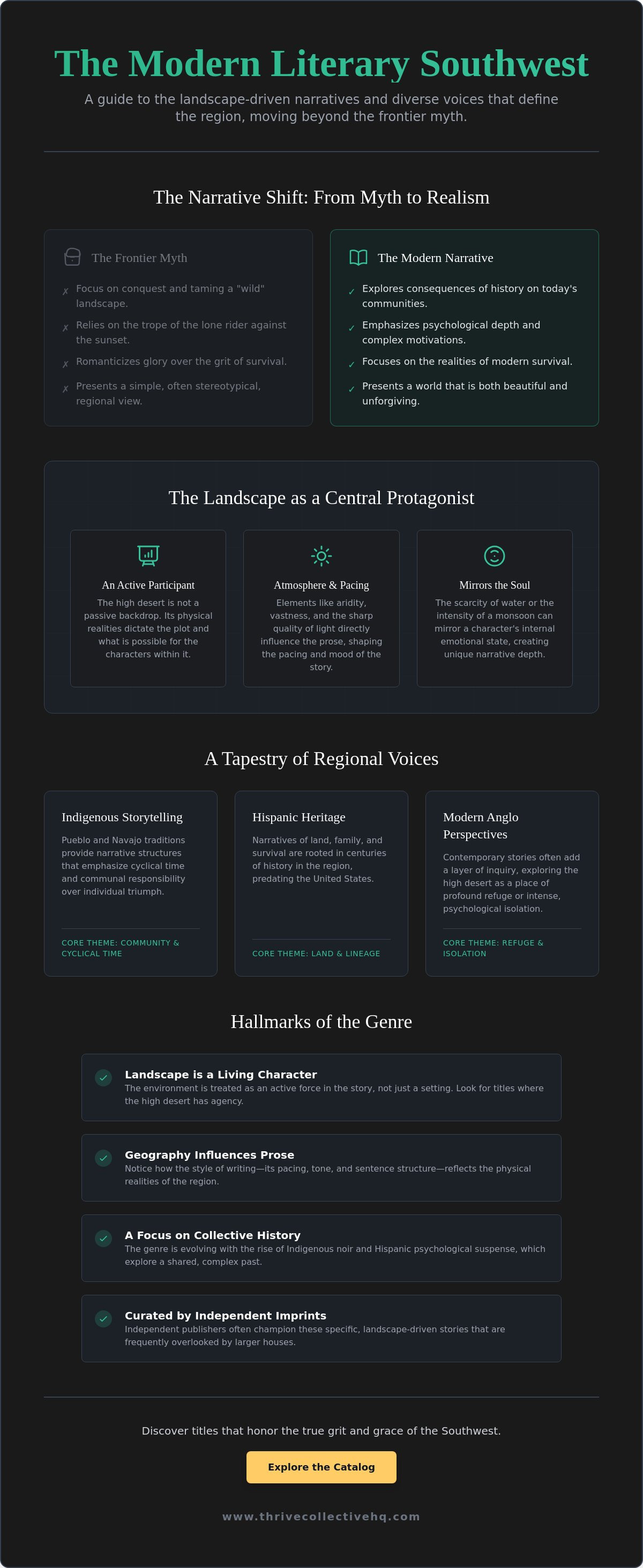
The literary Southwest is not a static category found on a dusty bookshelf. It is a vibrant movement that encompasses titles set in or deeply influenced by the high deserts and plateaus of New Mexico, Arizona, and the surrounding four-corners region. In these stories, we prioritize a sense of place that functions as a living character. It isn't just about where a story happens; it is about how the environment dictates what is possible for the people within it. This movement blends Indigenous oral traditions, Hispanic heritage, and modern Anglo perspectives into a singular, soulful conversation. Ultimately, we define the genre as a collision of vast geography and intimate human struggle.
To better understand how these stories shape our community and the power of the voices within them, watch this helpful video:
The transition from traditional Westerns to literary realism
Historically, our regional narrative was dominated by Western fiction, which often focused on the mythic frontier and the concept of conquest. These stories relied on a "wild" landscape that needed to be tamed. Modern literary Southwest titles move away from these tropes to explore the actual consequences of that history on today's communities. Instead of the lone rider against the sunset, we see a shift toward psychological depth and complex character motivations. We look for stories that ask what happens after the frontier is closed, focusing on the grit of modern survival rather than the romanticized glory of the duel. This realism honors the reader's intelligence by presenting a world that is both beautiful and unforgiving.
Core cultural influences in the region
The richness of this movement comes from a collective of voices that have been in dialogue for centuries. We see the enduring presence of Pueblo and Navajo storytelling structures, which often emphasize cyclical time and communal responsibility over individual triumph. These contrast and blend with Hispanic narratives of land, family, and survival that have been rooted in this soil since before the United States existed. Modern Anglo perspectives often add a layer of the high desert as a place of refuge or intense isolation. This intersection creates a unique narrative tapestry that you won't find anywhere else. If you want to see how these themes manifest in contemporary storytelling, our Casita Series offers a window into these local complexities and the enduring spirit of our shared landscape.
The landscape as a central protagonist
In the literary Southwest, the earth is rarely silent. Geography in this region is never a passive backdrop for the plot; it is an active participant that demands a seat at the table. When you read a title set in the high desert, you aren't just observing a setting. You are feeling the weight of the aridity and the sharp edge of the light. These physical realities dictate the pacing and atmosphere of the prose. Authors often use the scarcity of water or the intensity of a summer monsoon to mirror the internal emotional states of their characters. It is a world where the harshness of the environment is only matched by the resilience of those who inhabit it.
Scholars often describe this relationship as the landscape and cultural axes that ground the region's storytelling. This intersection allows the physical world to act as a mirror for the soul, creating a narrative depth that is unique to our corner of the world.
The role of Abiquiu and the Chama River Valley
Specific New Mexico locations, like the red cliffs of Abiquiu or the winding Chama River Valley, inspire a quiet, literary aesthetic. This landscape is a primary influence on writers like K.B. Cordova, whose work often prioritizes a stillness that reflects the high desert's solitude. By using physical isolation, authors can heighten suspense without relying on artificial plot devices. The silence of the mesa becomes a pressure cooker for the characters, forcing them to face truths they might avoid in a crowded city. It's a technique that turns a simple location into a haunting presence that lingers long after you close the book.
Light, shadow, and the psychological impact of the desert
The visual clarity of the Southwest serves as a powerful metaphor for truth or exposure. There is nowhere to hide under a midday sun that bleaches the color from the hills. This vastness of the horizon affects character development by stripping away pretension. We see the desert as a place of spiritual or personal evolution, where the scale of the sky reminds the reader of their own potential. If you are looking for a story that captures this delicate balance between a haunting past and a landscape that refuses to let go, you might find resonance in The Mother I Did Not Know. It is a title that understands how the land holds our secrets and eventually brings them to light.
Diverse voices and the evolution of regional narratives
Modern titles in the literary Southwest reject the old, singular perspectives of the past. Instead, we see a movement toward a collective history that honors the complexity of our region. This evolution has paved the way for the rise of Indigenous noir and Hispanic psychological suspense, where the focus shifts from the mythic hero to the community. These stories aren't just entertainment. They often address urgent modern issues that affect our daily lives:
- Legal battles over water rights and ancestral land.
- The ongoing efforts for land conservation and ecological preservation.
- The tension between urban expansion and rural tradition.
Authenticity is the pulse of this movement. Readers expect and deserve the accurate representation of local dialects and customs, which helps these narratives feel lived-in and true. When a writer captures the specific cadence of a Northern New Mexico "Spanglish" or the rhythmic pauses in a Navajo elder's speech, they aren't just adding flavor. They are practicing a form of literary stewardship. This dedication to truth creates a stronger bond between the author and the reader, as it acknowledges the reality of our shared environment. This shift ensures that the literary Southwest remains a living tradition rather than a museum piece.
To see how these diverse voices are celebrated and discussed, you can explore The Literary Southwest series at Yavapai College. This series highlights how writers from the West and beyond are pushing the boundaries of what regional storytelling can be through a lens of inclusivity and craft.
Modern psychological suspense in the high desert
The high desert is a perfect setting for mysteries and unsolved cases. There is a specific kind of tension found in small-town New Mexico life, where everyone knows your name but no one knows your secrets. We curate titles like the Casita Series to capture this grounded, modern suspense. These stories explore the darker undercurrents of our communities without losing sight of the human heart. The vast landscape provides room for secrets to hide, but the tight-knit social structures ensure the truth is never truly buried.
Literary quietude and the Noelle Varden imprint
Not every story needs a high body count to be impactful. Through the Noelle Varden imprint, we focus on literary quietude and grounded, self-respecting characters. These narratives often explore the delicate balance of modern relationships against the backdrop of traditional cultural expectations. We favor genres that prioritize character growth and internal evolution over explosive action. This approach allows for a deeper exploration of how our legacy and landscape shape who we become. It's about finding the extraordinary in the ordinary moments of Southwestern life.
The role of independent imprints in New Mexico
Independent publishing in New Mexico is a defiant act of storytelling. While large houses in metropolitan hubs often prioritize broad commercial tropes, independent imprints have the freedom to focus on the specific, regional narratives that define the literary Southwest. We believe that stories from the high desert require a curator’s touch; someone who understands that the silence between sentences is as important as the words themselves. Thrive Collective Publishing: Books, Journals, and Guides operates as this curator, bridging the gap between local authenticity and global readers. By employing high-quality, direct-to-reader models, we ensure that niche literary markets receive the attention they deserve. Our imprint, Cordova Creations, exemplifies this by focusing on the craft-forward nature of our region, where the physical book is treated with as much respect as the narrative it contains.
The multi-imprint structure of Thrive Collective Publishing: Books, Journals, and Guides
We support a diverse collective of authors who write across genres, including true crime, suspense, and guided journals. This multi-imprint structure isn't just about variety; it is about maintaining a consistent editorial voice that trusts your intelligence as a reader. We view our catalog as a cohesive collection of regional talent rather than a disparate list of titles. By organizing our work through specific imprints, such as the historically careful Eliza Hawthorne or the operator-direct warmth of Kimberly Burk Cordova, we provide clear paths for you to find the stories that resonate with your own experience. This intentionality ensures that every title we publish contributes to a larger conversation about our shared culture.
New Mexico as a hub for literary innovation
Our state has a long history as a haven for thinkers and creators. From the early literary colonies of Santa Fe and Taos to the modern independent presses of today, New Mexico remains a hub for innovation. Modern technology now allows us to reach a global audience from the heart of the high desert, proving that you don't need a skyscraper to build a legacy. Being a boutique publishing house in this creative market allows us to remain agile and intentional. We aren't just selling books; we are cultivating a community of readers who value depth over hype. If you are ready to explore a title that perfectly captures this intersection of local history and modern suspense, we invite you to discover The Mother I Did Not Know. It is a testament to the power of independent voices in the modern Southwest.
Building a Southwestern reading list
Building a collection of titles that reflect our home is an intentional act of curation. It requires looking beyond the mass-market tropes to find the soulful stories that actually live here. To truly understand the literary Southwest, we suggest starting with works that establish the unique atmosphere and complex history of the high desert. You might begin with the expansive light of the plateaus and then transition into the darker, grittier side of our region. Exploring true crime and historical mysteries allows you to see the grit that exists beneath the beautiful surface. We also believe in the power of personal reflection. Incorporating journals into your reading practice helps you document your own connection to this land, turning a passive hobby into a lifelong legacy of growth and alignment.
Look for imprints that prioritize the quiet, literary quality of the Southwest over loud, formulaic plots. These imprints, such as K.B. Cordova or Noelle Varden, focus on the interior lives of characters who are shaped by the isolation and beauty of the desert. When you choose these stories, you are supporting a movement that values authenticity over hype. By selecting titles that honor the landscape as much as the narrative, you ensure that the regional spirit continues to thrive in your own home library.
Essential titles for the modern reader
If you are seeking psychological depth set against the backdrop of small-town New Mexico, The Casita Series is an ideal starting point. These stories capture the specific tension of high-desert life with precision and grace. For those interested in a profound study of family dynamics and regional history, we recommend The Mother I Did Not Know. It captures the quiet, literary quality that defines our most resonant regional work. If your interest leans toward high-stakes tension, The Vanishing Act serves as a gateway to Southwestern suspense.
How to engage with the Southwest literary community
No reader succeeds in a vacuum. Engaging with others who share your passion for the region helps our collective literary culture flourish. You can join book clubs that focus specifically on regional authors and themes. We also encourage you to visit literary landmarks in Santa Fe and Abiquiu to feel the physical environment that inspired these stories. If you need assistance finding a specific title or want a personalized recommendation for your next read, please reach out to us at info@thrivecollectivehq.com. We are here to support your growth as a reader and a steward of Southwestern stories.
Stepping into the modern Southwest narrative
The high desert is a place of perpetual evolution; it is where the ancient landscape meets the modern search for truth. You've seen how the literary Southwest is defined by its refusal to be simplified, choosing instead to embrace the complex interplay of culture, light, and silence. As an independent New Mexico-based publishing house, we are committed to maintaining Red Dot quality editorial standards across our entire catalog. We curate a selection of literary suspense and regional non-fiction that honors your intelligence and the integrity of our home.
Your connection to these stories doesn't have to end with a single page. It is an opportunity to align your personal library with the authentic voices of the region. We invite you to explore our curated catalog of Southwestern titles and find the narrative that speaks to your own sense of place. Whether you are drawn to the psychological depth of our suspense series or the reflective power of our journals, your presence in this collective matters. We believe in your potential to carry these stories forward and help our regional identity thrive.
Frequently Asked Questions
What is considered Southwestern literature?
Southwestern literature includes titles set in or deeply inspired by the high deserts and plateaus of the American Southwest. It is defined by a profound connection to place where the environment acts as a central protagonist rather than just a setting. This genre captures the collision of vast geography and intimate human struggle, reflecting the diverse cultures that have inhabited the land for centuries.
Who are the most famous authors of the literary Southwest?
Foundational voices like Leslie Marmon Silko, Rudolfo Anaya, and Willa Cather have defined the literary Southwest through their exploration of regional identity. Silko's work often explores the intersection of Indigenous tradition and modern trauma, while Anaya's narratives are deeply rooted in the Hispanic experience of New Mexico. These authors moved the regional narrative away from tropes toward a more authentic and complex representation of life in the desert.
How does the Southwest landscape influence writing?
The landscape influences writing through its visual clarity and the physical pressure of its climate. Aridity and intense light often dictate the pacing of the prose, creating a sense of urgency or stillness. Authors use the vast horizon to mirror a character's internal state, often using the desert as a space for spiritual evolution or the unavoidable exposure of hidden truths.
What are the main themes of modern Southwestern suspense?
Modern Southwestern suspense often explores themes of land rights, historical secrets, and the psychological impact of isolation. Unlike urban thrillers, these stories rely on the physical environment to heighten tension and create a sense of unease. You'll often find narratives centered on unsolved cases in small communities where the landscape itself seems to guard the secrets of the past.
Is Southwestern literature only about cowboys and the Wild West?
No, Southwestern literature has evolved far beyond the romanticized myths of the Wild West. While traditional Westerns focused on the frontier and conquest, modern titles prioritize literary realism and cultural complexity. We focus on stories that reflect the actual lives of people in New Mexico and Arizona today, including the ongoing influences of Hispanic and Indigenous heritage.
Where can I find independent publishers in New Mexico?
New Mexico is a significant hub for independent publishing, particularly in Santa Fe and Taos. Thrive Collective Publishing operates as a curator for regional voices from our base in Santa Fe. You can also find a vibrant community of small presses and boutique consultancies that prioritize high-quality, craft-forward titles that larger, national houses might overlook.
What is the difference between Westerns and Southwestern literary fiction?
Westerns typically rely on the myth of the frontier and the lone hero, whereas Southwestern literary fiction focuses on the consequences of history and communal identity. Westerns often emphasize action and expansion. In contrast, Southwestern titles tend to favor psychological depth, character growth, and a realistic portrayal of how the land shapes human relationships over generations.
How do Indigenous voices shape the Southwest literary tradition?
Indigenous voices provide the foundational storytelling structures for the region, emphasizing cyclical time and a deep, ancestral connection to the soil. This influence shifts the narrative focus from individual triumph to communal survival and sovereignty. By integrating these perspectives, the literary Southwest gains a unique depth that acknowledges the land as a sacred and living entity.

Article by
Kimberly Cordova
Kimberly Cordova is the founder of Thrive Collective, an independent publishing brand based in Santa Fe, New Mexico. She's the author of more than 200 books across business, AI and automation, leadership, emotional intelligence, true crime, travel, guided journaling, and personal growth, published in paperback, hardcover, Kindle, and Audible audiobook formats.Kimberly writes for readers who want clear thinking, useful frameworks, and books they actually finish. Her work spans practical guides for entrepreneurs navigating AI and online business, deep-dive leadership books for women and modern managers, atmospheric true crime stories pulled from America's forgotten past, and guided journals that help readers slow down, reflect, and capture what matters.Before turning her full attention to publishing, Kimberly spent more than two decades in strategy, operations, and program leadership, working with public agencies and private organizations on transformation, technology, and large-scale change. That operator's lens shows up in everything she writes: real frameworks, real numbers, and no fluff.She lives in Santa Fe with her husband Greg, a self-taught silversmith and lapidary artist. When she's not writing, she's researching the next Shadows of the Past story, building Wildflower (her artisan turquoise jewelry brand with Greg), or curating the next round of Just Write Collection journals.Thrive Collective publishes regularly across its core series, including the AI and Automation Blueprint, The Growth Leader Collection, Shadows of the Past, The Heirloom Series, The Art of Manifestation, the Just Write Collection, and Travel: Destination Guides.Connect with Kimberly and Thrive Collective at thrivecollectivehq.com.