

A digital archive of thousands of unsorted photos is not a legacy, it is simply a storage problem that future generations may never solve. At Thrive Collective Publishing, we believe that creating a family history keepsake journal is the most effective way to transition from a collector of data to a curator of meaning, ensuring your family's impact survives the digital age in a tangible form. While the global genealogy products market is valued at US$6.04 billion in 2026, the most valuable record remains the one you hold in your own hands.
You likely feel the weight of this responsibility, perhaps feeling overwhelmed by the volume of stories you want to save or paralyzed by the sight of a blank page. This article provides a structured plan to organize your records, overcome writer's block, and craft a beautiful physical book that feels like a piece of history. We will explore how to select the right titles from our catalog and use intentionality to bridge the gap between a simple list of names and a soulful narrative, proving that when we document our history, we ensure our collective legacy continues to thrive.
Key Takeaways
- Moving beyond digital storage to a permanent physical record ensures your family's history remains accessible and intact across multiple generations.
- A meaningful heirloom requires a balance of vital statistics and personal anecdotes to capture both the historical facts and the emotional spirit of your ancestors.
- You will learn a structured approach to creating a family history keepsake journal, choosing between the guided prompts of the Heirloom Series or the creative freedom of the Just Write Collection.
- Mastering the art of the oral history interview allows you to gather rich, open-ended stories that bridge the gap between simple data and a living legacy.
- Selecting durable, high-quality titles from our catalog ensures your family's narrative is preserved in a format that feels as significant as the stories it holds.
Why a physical keepsake journal remains the most enduring way to share your family history?
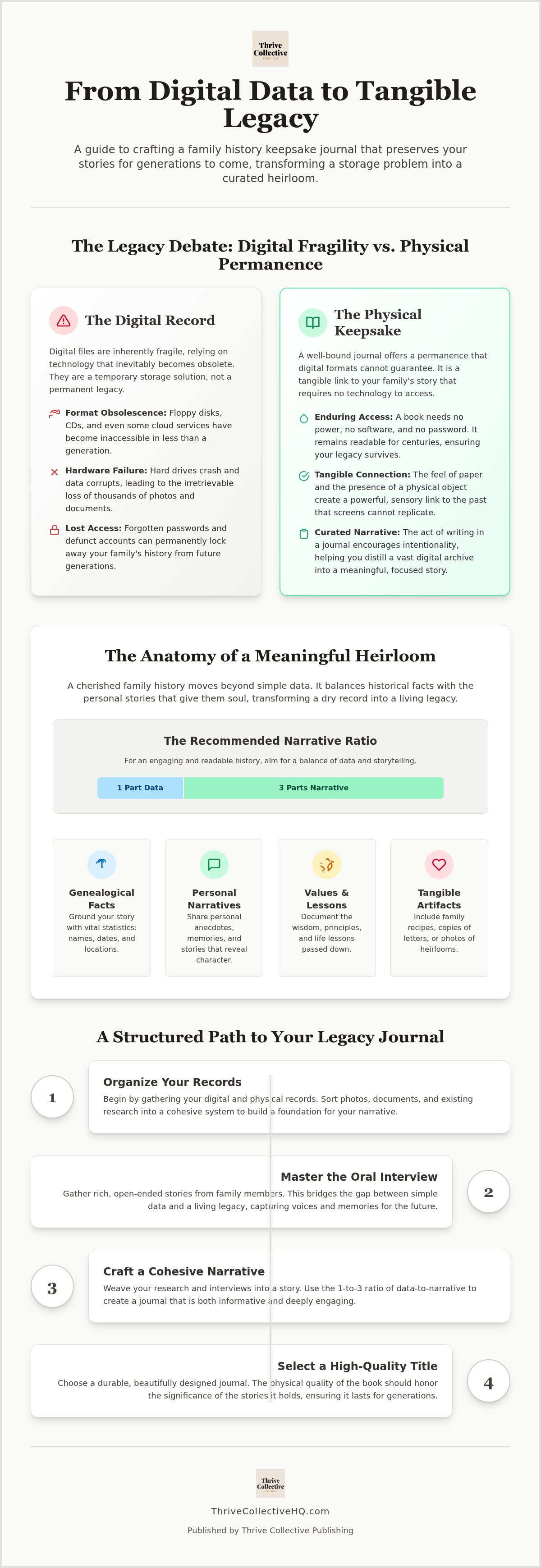
A family history keepsake journal is a physical volume dedicated to preserving ancestral stories, personal reflections, and genealogical data for future generations. Physical paper offers a level of permanence that digital cloud storage cannot guarantee over decades; it requires no technology to access, ensuring your legacy remains readable for centuries.
The study of families and family history often reveals that the most precious records aren't stored on servers, but in cedar chests and on library shelves. While the global genealogy market is projected to grow to US$15.97 billion by 2036, much of that data remains trapped behind screens. At Thrive Collective Publishing, we believe that data without a physical home is a fragile legacy. Digital formats shift with alarming speed. We've watched floppy disks, CDs, and external hard drives become obsolete in less than a single generation. By contrast, a well-bound book from our journals and keepsakes catalog bypasses these technical hurdles entirely. It requires no power source, no software updates, and no subscription fees to remain accessible.
The digital vs. physical legacy debate
Digital files are inherently fragile. They rely on hardware that inevitably fails and passwords that are often lost when an author passes away. In a world where platforms like FamilySearch are adding millions of records from countries such as Cameroon and South Korea, the volume of information can become overwhelming. A physical journal provides a necessary filter. It carries the weight and presence of a real object in your home. When you hold a book, you feel the texture of the paper and the history it contains. It becomes a tangible link that says your family's story is worth the space it occupies on a shelf.
Cognitive benefits of the analog approach
Writing by hand is an act of deep intentionality. It forces us to slow down and consider the weight of our words. Research into The Cognitive Case for Paper suggests that writing on physical pages improves memory retention and encourages deeper focus. When you're creating a family history keepsake journal, this analog process facilitates a digital detox. It allows you to step away from the noise of notifications to connect soulfully with the narrative of your ancestors. This slower pace ensures that the stories you document are not just facts, but reflections of the values and impact your family has made over time.
Creating a family history keepsake journal is a commitment to the future. It is a record of names, a collection of values, and a map of purpose. By choosing a physical medium, you're ensuring that your children and their children don't just inherit a file path, but a piece of their own identity they can hold in their hands.
What are the essential elements of a meaningful family heirloom journal?
A meaningful heirloom journal balances vital statistics with personal narratives to create an engaging history. By blending dates and locations with life lessons, values, and tangible artifacts like recipes or letters, you transform a dry record into a soulful legacy that future generations will cherish and protect.
The most common mistake in creating a family history keepsake journal is focusing solely on the "who" and "when" while neglecting the "how" and "why." While it's necessary to know that an ancestor was born in 1892 in Santa Fe, that data point doesn't tell us about their character or the values they held. A journal that thrives is one that feels alive. It should serve as a repository for the wisdom you've gained, the challenges you've overcome, and the impact you hope to leave behind. We believe that a curated approach, focusing on depth rather than just volume, ensures your family's story is read rather than just stored.
Blending genealogical facts with narrative
Ground your stories in historical context by using specific dates and locations. Aim for a rhythmic ratio; for every one page of data, include three pages of narrative. This structure prevents the journal from feeling like a dry academic text. Focus on the motivations behind major life events. If a grandfather moved the family across the country in 1945, don't just record the move; record the hope or necessity that fueled it. This approach transforms a genealogy chart into a compelling story that resonates with the reader's own experiences.
The role of photography and artifacts
Visual anchors are essential for engagement. Choose photographs that reveal character or environment rather than just stiff, posed portraits. A photo of a great-aunt in her garden tells a richer story than a formal studio shot. When adding these to your journal, use archival-safe adhesives to prevent damage over time. You should also include secondary artifacts like a scanned family recipe or a handwritten letter. Describe the sensory details of these items; the smell of the ink or the texture of a grandmother's linen apron adds a layer of intimacy that text alone cannot provide. As you curate these elements, you may find that our curated collection of titles offers the perfect physical home for these memories.
By prioritizing the emotional resonance of your family's history, you create a document that serves as both a record and a mentor. This intentionality ensures that your legacy is not just a collection of names, but a source of strength for those who follow.
Comparing guided prompts versus blank pages for documenting life stories
Choosing between guided prompts and blank pages depends on your writing style. Guided journals provide the structure needed to overcome writer's block, while blank pages offer creative freedom for non-linear stories and large inserts. A hybrid approach uses prompts for core facts while leaving space for free-form reflection and artifacts.
The decision of which medium to use is the first step in the intentional process of creating a family history keepsake journal. For many, the greatest obstacle is not a lack of stories, but the paralysis that comes from staring at an empty white page. We understand that documenting a legacy is a significant undertaking, and the format you choose should support your natural rhythm rather than create additional friction. Whether you prefer a visionary guide to lead you through your memories or an open canvas to paint your own picture, the goal remains the same; to ensure your family's impact is recorded with clarity and purpose.
When to choose a guided heirloom title
A guided title is ideal for those who feel overwhelmed by the vastness of their family history. It breaks the project down into manageable segments, asking specific questions about childhood, values, and turning points. This structure is particularly helpful if you are coordinating contributions from several family members, as it maintains a consistent editorial tone throughout the book. By using The Heirloom Series, you can ensure that vital details are not overlooked. These prompts act as a mentor, sparking recollections that might otherwise be lost to time. This method reduces the cognitive load of organizing a narrative from scratch, allowing you to focus on the soulful work of reflection.
The freedom of the blank page
For readers who possess a clear, unconstrained vision for their story, a blank journal offers the necessary flexibility. This format is best suited for authors who have already conducted extensive research or for those who wish to include non-linear storytelling. Titles from the Just Write Collection provide the space needed for full-page inserts, such as ancestral maps, long-form correspondence, or detailed sketches. If your family history involves complex, sprawling narratives that don't fit into standard categories, the blank page allows you to curate your own structure. This approach requires more discipline, but it results in a book that is entirely unique to your family's specific heritage. It is an invitation to step into a bigger version of your story, unhampered by pre-set boundaries.
Ultimately, the most effective journal is the one you will actually complete. Many successful curators find that a hybrid approach works best, using guided prompts to anchor the essential facts while reserving blank sections for spontaneous thoughts and physical artifacts. This balance ensures that your family history keepsake journal is both a reliable record and a deeply personal piece of history.
How to organize your research and stories into a cohesive narrative structure?
Successful organization involves determining a primary focus, such as a specific maternal line, and conducting interviews with elder family members using open-ended questions. By categorizing findings into themes like "Early Years" and "Lessons Learned," you create a clear roadmap that transforms disparate data into a soulful, lasting legacy.
A pile of disorganized notes is not a story; it is a puzzle that requires a curator's eye to assemble. When you begin the process of creating a family history keepsake journal, the sheer volume of information can feel daunting. We suggest starting with a narrow lens. Instead of attempting to document every ancestor simultaneously, choose a specific era or a single branch of your family tree to anchor your narrative. This intentionality prevents your journal from becoming a cluttered list of names and ensures each entry has room to breathe. By creating a rough outline on separate paper before committing ink to your final title, you maintain the elegance and alignment that a physical heirloom deserves.
Interviewing family members for oral history
Oral histories provide the emotional texture that records cannot capture. When you sit down with elder family members, avoid questions that result in simple yes or no answers. Instead, ask questions that begin with "how" or "why" to elicit detailed responses. You might ask how a grandparent felt during a significant world event or why they chose a specific career path. We recommend recording these sessions to ensure accuracy. This allows you to focus on the conversation in the moment and transcribe the most impactful quotes into your journal later. These personal reflections are what make your family's impact feel real and immediate to future readers.
Thematic vs. chronological organization
There is no single correct way to structure your book, but your choice should reflect your desired outcome. A chronological structure is often best for a complete life story, moving logically from birth through the various stages of adulthood. However, a thematic organization works well for highlighting specific values or traditions, such as "Family Recipes" or "Lessons in Resilience." You may also consider adding a "Legacy" section at the end of your journal. This space serves as a visionary guide for future generations, offering advice and reflections that bridge the gap between where your family has been and where they are going.
By organizing your research with purpose, you ensure that the final book is more than just a collection of facts. It becomes a curated narrative that honors the past while empowering the future. This structure is the foundation upon which a thriving legacy is built, turning your research into a piece of history that your family will be proud to display.
Selecting the right title from the Thrive Collective Publishing catalog
Choosing a title from Thrive Collective Publishing ensures your family's narrative is preserved in a medium that reflects its worth. Our catalog features durable, acid-free materials and elegant designs that transform your research into a permanent heirloom. By selecting a professional title, you guarantee that your legacy thrives for centuries.
The final step in creating a family history keepsake journal is choosing a physical home that matches the weight of your stories. You've done the work of researching, interviewing, and organizing; now, you must ensure the physical object can withstand the passage of time. At Thrive Collective Publishing, we curate titles that act as a bridge between your visionary efforts and the readers of the future. A generic notebook might suffice for daily tasks, but a legacy project requires a medium designed for long-term preservation. Choosing a title from a professional catalog ensures that the physical medium matches the importance of your content. Our designs are intentional, created to hold a prominent place on a bookshelf alongside your most cherished literature. We offer a range of styles to suit different family aesthetics, from classic to modern, ensuring the final product feels like a natural extension of your home.
Why quality materials matter for an heirloom
The longevity of your journal depends on the integrity of its materials. Acid-free paper is a non-negotiable requirement for any heirloom, as it prevents the yellowing and brittleness that often destroy older documents over the decades. A sturdy spine is equally vital; it allows the book to be handled and read frequently without falling apart or losing pages. We believe that the physical container of your story should be as resilient as the family it documents. You can read more about our commitment to these standards and our independent press philosophy on our Why Direct page.
Next steps for your journaling project
The most important action you can take is to begin. It's easy to wait until your genealogical research feels finished, but history is a continuous process that evolves with every generation. We suggest you start with one story today rather than waiting for a perfect moment that may never arrive. Browse our Journals and Keepsakes collection to find a starting point that resonates with your vision. If you need assistance selecting the right title for your specific project, please reach out to our team at info@thrivecollectivehq.com for a recommendation tailored to your family's goals.
Honoring your family's impact through intentional curation
Your family's history is a collection of values, lessons, and turning points that deserve a permanent home. By moving beyond the fragility of digital storage and embracing the intentionality of a physical book, you ensure your legacy remains accessible for generations. We've explored how balancing genealogical data with personal narrative transforms a list of names into a soulful record of impact. Whether you choose the structure of guided prompts or the creative freedom of a blank page, the process of creating a family history keepsake journal is an act of deep respect for those who came before you.
Thrive Collective Publishing titles are designed for lasting impact and physical durability, providing a sanctuary for your memories away from the noise of the digital world. Our journals are curated for those who value a digital detox and the slow, rhythmic practice of analog documentation. You have the vision to preserve your family's story; now, you have the tools to begin.
Step into your role as your family's curator and start documenting the stories that matter most today.
Frequently Asked Questions
What is the best way to start a family history journal if I have very little information?
Start with your own experiences and the immediate stories you carry. You are the primary source for your own era; documenting your values, childhood, and career provides a foundation for the future. Creating a family history keepsake journal doesn't require a complete family tree to be meaningful. It begins with the intentionality of recording what is known today, acting as a bridge for future research.
How do I choose between a prompted journal and a blank notebook for my family story?
Base your decision on whether you prefer guidance or total creative freedom. Prompted titles like our Heirloom Series are excellent for those who want a structured mentor to lead them through specific life stages and memory triggers. If you have a non-linear narrative or wish to include large physical artifacts, a blank title from the Just Write Collection offers the flexibility needed for a custom layout.
Can I include non-family members in my family history keepsake journal?
You should include anyone who has significantly impacted your family's growth or core values. Mentors, close friends, and long-term neighbors often play a vital role in the collective story of a household. Documenting these relationships provides a holistic view of the community that supported your family's evolution. It reinforces the idea that a legacy is often a collective endeavor rather than a solitary one.
How do I handle sensitive or difficult family stories in a legacy journal?
Address sensitive topics with honesty and a focus on the resilience they required. You don't have to include every painful detail; however, acknowledging challenges can provide strength and perspective for future generations. Focus on the lessons learned and how the family navigated those periods with integrity. This approach turns a difficult history into a source of wisdom and emotional alignment for your descendants.
What kind of pen should I use to ensure the writing does not fade over time?
Select archival-quality pens with pigment-based ink for the best long-term results. Brands like Pigma Micron are preferred because their ink is waterproof, fade-resistant, and pH neutral. This ensures your handwritten reflections remain legible and sharp for over a hundred years. Using the right tools is a simple but critical step in ensuring your physical journal survives the passage of time.
How often should I update the journal once the initial history is documented?
Aim for an annual update to record new milestones and shifting reflections. Setting a specific date, such as a family holiday or the start of a new year, helps maintain consistency without making the task feel burdensome. These regular additions ensure the journal remains a living document that grows alongside your family. It prevents the narrative from becoming a static relic of the distant past.
Is it better to write the journal myself or have multiple family members contribute?
A collaborative approach often results in a richer narrative with more diverse perspectives. While having one primary curator ensures a cohesive structure, inviting siblings or parents to contribute their specific memories adds layers of depth. This collective effort makes the final book feel like a community project. It ensures that multiple branches of the family tree feel represented and invested in the preservation project.
How can I protect my physical keepsake journal from damage or aging?
Store your journal in a cool, dry location away from direct sunlight and high humidity. While our titles use acid-free paper to prevent yellowing, physical protection from the elements is still necessary for long-term preservation. If you include loose items like newspaper clippings or old photos, use archival-safe sleeves. This prevents chemical migration between the artifacts and the journal pages, keeping the entire volume pristine.

Article by
Kimberly Cordova
Kimberly Burk Cordova is the founder of Thrive Collective Publishing, an independent multi-imprint publishing house based in Santa Fe, New Mexico. She is the author of books on leadership, business growth, AI and automation, emotional intelligence, and personal development, written for readers who want clear thinking, useful frameworks, and books they actually finish.
Before turning her full attention to publishing, Kimberly spent more than two decades in strategy, operations, and program leadership, working with public agencies and private organizations on transformation, technology, and large-scale change. That operator's lens shows up in everything she writes and publishes: real frameworks, real numbers, no fluff.
As publisher, she leads a catalog of more than 80 titles from six authors across multiple imprints, spanning literary suspense, true crime, children's biography, relationships, travel, guided journals, and coloring books. The house publishes regularly across its core series, including The Casita Series, Shadows of the Past, the Young Legends Collection, The Growth Leader Collection, the AI and Automation Blueprint, The Heirloom Series, The Art of Manifestation, the Just Write Collection, and Travel: Destination Guides.
She lives in Santa Fe with her husband Greg, a self-taught silversmith and lapidary artist. When she is not writing or publishing, she is building Wildflower Artisans, their Turquoise jewelry brand, or curating the next round of Just Write journals.
Connect with Kimberly and Thrive Collective Publishing at thrivecollectivehq.com.