

The relentless hustle that launched your company is often the primary barrier preventing you from truly leading it. You likely feel the weight of every decision, the friction of delegation, and the persistent fog of the daily grind. It is exhausting to be the engine of your business when you were meant to be its architect. At Thrive Collective Publishing, we believe that the characteristics of a great small business leader are not inherent gifts, but intentional practices that any founder can cultivate. Research indicates that 74 percent of entrepreneurs remain optimistic about their growth in 2026, yet the transition from manager to visionary remains the most significant hurdle for those looking to scale.
This article explores how you can move beyond reactive management to embrace a more purposeful leadership style. You will learn to foster a high performing team and clarify your long term vision with the same precision found in titles written by Liam Cruz or Kimberly Burk Cordova. We will examine the specific traits of emotional intelligence, strategic delegation, and self awareness that allow you to lead with ease. By shifting your focus from the immediate task to the broader impact, you can finally step into the role your business requires to flourish.
Key Takeaways
- Understand how the characteristics of a great small business leader have shifted toward internal alignment and visionary focus for 2026.
- Recognize the difference between a tactical founder and a visionary leader to begin scaling your business with greater purpose and ease.
- Learn to use intentionality as a tool for creating professional stability and cultivating a loyal, high performing team.
- Implement a rhythmic daily routine that balances tactical requirements with the space needed for long term strategic dreaming.
- Utilize titles from the Thrive Collective Publishing catalog to cultivate the self awareness necessary for sustainable leadership growth.
What defines a great small business leader in 2026?
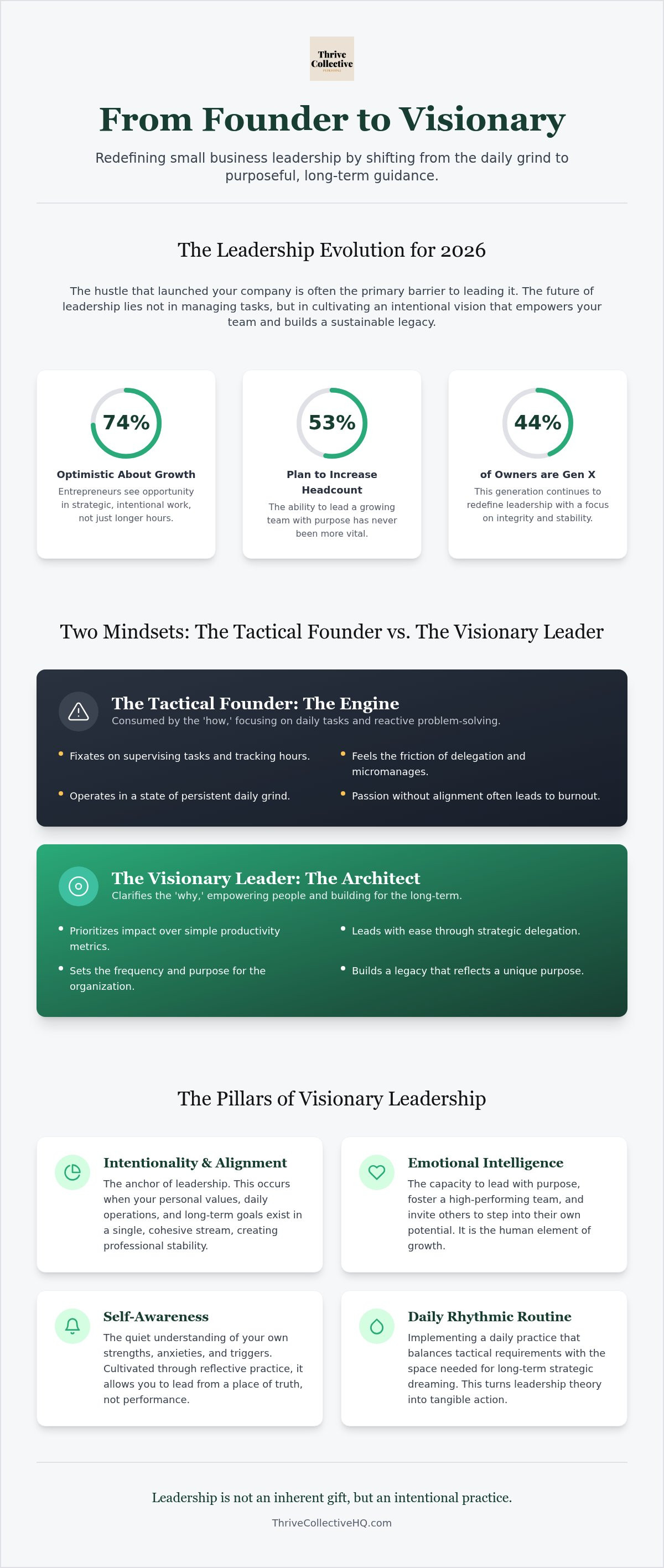
A great small business leader is a visionary who prioritizes internal alignment and intentionality over the reactive management of daily tasks. This shift from tactical supervising to soulful guidance allows you to build a sustainable legacy while empowering your team to thrive. At Thrive Collective Publishing, we believe that the characteristics of a great small business leader are defined by a commitment to personal evolution. Leadership is no longer a solitary burden or a list of management tasks; it is a collective endeavor that requires you to set the frequency for your entire organization. Since 53 percent of small businesses plan to increase their headcount in 2026, the ability to lead a growing team with purpose has never been more vital.
To better understand this concept, watch this helpful video:
Traditional management traits are secondary to your internal growth. When your business operations reflect your deepest values, you create a sense of professional stability that protects you from market volatility. Authors like Liam Cruz emphasize that true leadership is an invitation for others to step into their own potential. By focusing on intentionality, you move from just keeping the doors open to building a legacy that reflects your unique purpose. Our Cordova Creations imprint highlights the craft of leadership, showing that the characteristics of a great small business leader are built through steady, thoughtful practice rather than erratic bursts of effort.
The difference between management and soulful leadership
Management often fixates on the 'how' of a business, tracking hours and supervising specific tasks. Soulful leadership clarifies the 'why.' It seeks to empower people rather than just manage their output. When you prioritize impact over simple productivity metrics, you allow your team to find meaning in their work. This approach draws from various leadership theories and styles that emphasize the human element of growth. Our The Growth Leader Collection provides curated titles that help you make this critical transition with confidence.
Why the hustle culture model is no longer effective
The old model of survival through constant hustle is failing. Forcing growth through overwork only obscures the vision you need to scale with ease. In 2026, 74 percent of small business leaders report feeling optimistic, not because they're working more, but because they're working with more strategic intentionality. You should view business challenges as opportunities for personal evolution rather than just problems to solve. This mindset shift allows you to move from surviving the daily grind to thriving within a business that runs with purpose and clarity.
The quiet power of intentionality and professional alignment
Intentionality is the anchor of your leadership. It is the quality that allows you to remain grounded even when the market is loud and demanding. While many founders believe that passion alone will carry them through, we have seen that passion without alignment leads to burnout. One of the core characteristics of a great small business leader is the ability to maintain calm authority through professional alignment. This occurs when your personal values, your daily operations, and your long term goals exist in a single, cohesive stream. When your business reflects who you are, every decision becomes simpler. You no longer have to perform a role; you simply lead from a place of truth. This stability is essential as Gen X, who currently represent 44 percent of small business owners, continue to redefine what it means to lead with integrity. Research shows that 74 percent of leaders remain optimistic about their growth in 2026, a sentiment that is only sustainable through deep alignment.
Cultivating self-awareness through reflective practice
Self-awareness is the quiet understanding of your own anxieties, strengths, and triggers. Your internal state as a founder acts as a thermostat for your business; it dictates the culture, the pace, and the overall performance of your team. If you are unsettled, the collective will be unsettled. We recommend using the Just Write Collection to facilitate daily clarity and professional reflection. By committing to a reflective practice, you move from a survival mindset to a state where you can lead with presence and intention. This practice helps you identify where your business may be drifting away from your original vision, allowing you to course correct before the friction becomes a burden.
The role of emotional intelligence in small teams
In the intimate setting of a small business, empathy is a strategic advantage. You aren't managing a faceless workforce; you are leading a community of individuals with their own ambitions and fears. Managing these dynamics requires the directness and warmth often found in the work of Kimberly Burk Cordova. It involves listening as much as speaking. High emotional intelligence allows you to address conflict before it escalates and to celebrate wins in a way that feels genuine to your team. For those seeking to deepen this skill, The Emotional Intelligence Advantage serves as a foundational title in our catalog. This level of alignment is what separates a founder who is merely busy from one who is building a legacy. You might find that exploring our wider catalog of leadership titles provides the perspective needed to refine your own approach and lead with heart-centered authority.
Moving from tactical founder to visionary leader
Building a legacy through strategic delegation
Delegation is far more than a management technique. It is an act of trust and a fundamental step in building a community rather than just a workforce. When you move from doing every task to curating the success of others, you create space for your team to contribute their own brilliance. This shift allows you to focus on the high level decisions that determine your long term impact and legacy. By trusting your collective to handle the tactical details, you foster a culture of ownership and high performance. You can find resources to support this transition in our guide on Leadership Coaching for Entrepreneurs: A Visionary Guide to Scaling with Purpose in 2026, which explores how to empower others while you maintain the broader vision.
The importance of clear core values
Core values act as a compass for every business decision you make. Without them, growth is erratic and exhausting. A visionary leader communicates their vision with the literary precision of authors like K.B. Cordova, ensuring that every team member understands the deeper "why" behind their daily work. This clarity creates a sense of belonging within the collective. When your values are explicit, you don't need to micromanage because your team is already aligned with the desired outcome. This allows you to maintain your integrity even when making difficult growth decisions, such as managing the 9.00 percent to 11.75 percent APR variable rates common for SBA 7(a) loans in 2026. By anchoring your expansion in your core values, you ensure that your growth never comes at the cost of your professional soul.
How do successful leaders cultivate these characteristics daily?
Leadership qualities are not static traits you possess; they're muscles you strengthen through repetitive, daily action. In 2026, where 59 percent of small business owners see AI as essential for competitiveness, the ability to maintain human focus is a distinct competitive advantage. You must establish a rhythmic routine that deliberately balances the "doing" of the business with the "dreaming" required to lead it. This balance is one of the most practical characteristics of a great small business leader. Without a structured approach to your day, the noise of inflation (currently affecting 31 percent of businesses) and cash flow concerns will consume your visionary capacity. Thrive Collective Publishing provides the resources to help you protect this mental space and lead with intentionality.
Utilizing guided journals for personal growth
Handwriting offers specific cognitive benefits for processing complex leadership challenges that digital tools simply can't replicate. By slowing down to put pen to paper, you engage parts of the brain responsible for deep reflection and memory. The The Art of Manifestation series supports this visionary planning by helping you move from abstract desires to concrete intentions. We explore this further in our editorial on The Cognitive Case for Paper: Understanding Digital Detox Journal Benefits. Setting daily intentions ensures that your immediate actions remain in alignment with your long term legacy goals, preventing the "hustle cycle" from taking root again.
Continuous learning through business and growth titles
Developing the characteristics of a great small business leader requires more than just instinct; it requires a commitment to the ideas that have shaped successful founders before you. A curated library is significantly more effective than consuming random business advice from social media. Great leaders select titles that challenge their current management perspectives and force them to think critically about their impact. You should seek out a range of voices, from the accessible guidance of Liam Cruz to the grounded perspectives of Noelle Varden. This diversity of thought prevents the stagnation that leads to business failure. We invite you to browse our Leadership and Growth collection to find resources that speak to your specific stage of evolution. You can begin curating your visionary library by exploring our complete catalog of leadership titles to ensure your vision remains sharp and your strategies remain intentional.
Integrating leadership growth with the Thrive Collective catalog
Thrive Collective Publishing acts as a curator for the modern founder, providing the intellectual and emotional scaffolding required to move from tactical management to visionary leadership. The characteristics of a great small business leader are best developed within a community that values intentionality and professional alignment. By engaging with our catalog, you are not just purchasing a book; you are investing in a resource designed to help you scale with purpose. We believe that true success is a collective endeavor. It requires a commitment to growth that extends beyond financial metrics to include personal evolution and lasting impact. This commitment to alignment helps you move from the stress of surviving to the clarity of thriving.
Resources for the modern entrepreneur
Our catalog includes diverse titles that address the multifaceted nature of leadership. While Liam Cruz offers accessible guidance for the business side of growth, we also value the emotional depth found in literary titles like "The Mother I Did Not Know" by K.B. Cordova. This balance is critical for a leader who seeks to understand the human condition as deeply as they understand their balance sheet. For those focused on specific skills, the Growth Leader Collection provides curated resources for scaling operations without losing your professional soul. We encourage you to learn more about why buying direct from our New Mexico press supports a more sustainable and intentional publishing ecosystem.
Connecting with the Thrive Collective community
Stepping into a bigger version of your professional self is a journey best taken with others who share your values. We invite you to engage with our authors and join a collective that prioritizes substance over hype. For those who lead through their own words, we welcome manuscript submissions that align with our editorial standards. You can review our submission guidelines to see if your work fits our current catalog. If you are looking for a specific starting point for your growth, we invite you to email info@thrivecollectivehq.com for personalized recommendations tailored to your current challenges. Cultivating the characteristics of a great small business leader is a lifelong practice, and we are honored to walk that path with you.
Stepping into your visionary potential
The evolution from a tactical founder to a visionary leader is the most significant shift you'll make in your professional life. It requires moving beyond the daily grind to embrace intentionality and professional alignment. By focusing on the internal qualities that define your impact, you create a business that can flourish without your constant supervision. These characteristics of a great small business leader aren't just about managing others; they're about curating a culture where every member of your collective can thrive. Success is a rhythmic practice of balancing daily action with long term dreaming.
We invite you to deepen your leadership practice with expertly curated resources from our catalog. Whether you seek the direct guidance of Liam Cruz or the warm encouragement of Kimberly Burk Cordova, our titles support your personal evolution and the strength of independent literary culture. We believe in your potential to lead with purpose and clarity. Explore the Leadership and Growth Collection at Thrive Collective Publishing to find your next essential resource. If you'd like a personalized recommendation, please email our team at info@thrivecollectivehq.com. You have the vision required to build a lasting legacy.
Frequently Asked Questions
What is the single most important characteristic of a small business leader?
Intentionality is the cornerstone of leadership because it anchors all other characteristics of a great small business leader. It allows you to move away from reactive decisions and toward a state where your business operations reflect your personal values. By being intentional, you ensure that your team remains focused on the impact you wish to create rather than just the daily tasks at hand.
Can leadership qualities be learned or are they innate?
Leadership qualities are developed through consistent practice and self-reflection rather than being innate gifts. While some individuals may have a natural inclination toward communication, the specific skills required to scale a business with purpose are cultivated over time. We believe that anyone can step into a visionary role by studying the guidance of authors like Liam Cruz and committing to a rhythmic routine of professional growth.
How can I develop leadership skills without taking time away from my business?
You can integrate leadership development into your existing daily routine through micro-learning and reflective journaling. Spending fifteen minutes each morning with a title from our catalog or a guided journal allows you to grow while still managing your operations. This approach ensures that your evolution happens alongside your business growth rather than competing with it for your limited time.
What are the common mistakes new small business leaders make?
New leaders often struggle with the "hustle cycle" where they attempt to control every tactical detail themselves. This over-management prevents the team from taking ownership and eventually leads to founder burnout. Another common error is failing to communicate a clear vision, which leaves the collective without a compass for making independent decisions. Strategic delegation is the primary tool for correcting these early mistakes.
How does emotional intelligence impact small business success?
Emotional intelligence is one of the essential characteristics of a great small business leader because it fosters a culture of trust and belonging. In small, intimate teams, your ability to empathize with your employees directly affects their loyalty and performance. Leaders who use the direct and warm approach exemplified by Kimberly Burk Cordova can resolve conflicts more effectively and maintain a high-performing collective during periods of change.
Why is vision more important than tactical management for scaling?
Vision provides the necessary direction for scaling while tactical management only addresses the immediate path. When you lead with a clear vision, your team understands where the business is headed and can make tactical adjustments on their own. This allows you to focus on high-level opportunities, such as managing the 2026 SBA loan interest rates, which currently range from 9.00 percent to 11.75 percent APR for variable 7(a) loans.
How do I start transitioning from founder to visionary leader today?
Start your transition today by identifying one operational task to delegate and beginning a daily reflection practice. Use a guided journal to clarify your long-term goals and assess where your current schedule is misaligned with your vision. This practice, supported by our Cordova Creations imprint, creates the mental space required to move from the doer of the business to the architect who curates its future success.

Article by
Kimberly Cordova
Kimberly Burk Cordova is the founder of Thrive Collective Publishing, an independent multi-imprint publishing house based in Santa Fe, New Mexico. She is the author of books on leadership, business growth, AI and automation, emotional intelligence, and personal development, written for readers who want clear thinking, useful frameworks, and books they actually finish.
Before turning her full attention to publishing, Kimberly spent more than two decades in strategy, operations, and program leadership, working with public agencies and private organizations on transformation, technology, and large-scale change. That operator's lens shows up in everything she writes and publishes: real frameworks, real numbers, no fluff.
As publisher, she leads a catalog of more than 80 titles from six authors across multiple imprints, spanning literary suspense, true crime, children's biography, relationships, travel, guided journals, and coloring books. The house publishes regularly across its core series, including The Casita Series, Shadows of the Past, the Young Legends Collection, The Growth Leader Collection, the AI and Automation Blueprint, The Heirloom Series, The Art of Manifestation, the Just Write Collection, and Travel: Destination Guides.
She lives in Santa Fe with her husband Greg, a self-taught silversmith and lapidary artist. When she is not writing or publishing, she is building Wildflower Artisans, their Turquoise jewelry brand, or curating the next round of Just Write journals.
Connect with Kimberly and Thrive Collective Publishing at thrivecollectivehq.com.