

What if the most valuable asset your family owns is currently sitting in a fragile cloud server or a scattered collection of fading digital notes? Most of us recognize that digital data is transient, yet we often struggle to find a permanent home for the stories that define us. The best family history keepsake journals are those that combine archival-grade materials with thoughtful, guided prompts to ensure stories are preserved for generations. High-quality options include the Heirloom Series published by Thrive Collective Publishing under the Cordova Creations imprint, which provide the physical durability and narrative structure needed to transform memories into a permanent legacy.
You likely feel the weight of responsibility to capture these stories before they are lost, yet the prospect of writing an entire life history feels overwhelming. This guide provides an editorial perspective on selecting high-quality journals that transform family stories into physical heirlooms. We will examine structural durability, the efficacy of guided prompts, and how to choose a vessel that aligns with your family values to ensure your history thrives for years to come.
Key Takeaways
- Identify the structural standards, such as acid-free paper and Smyth-sewn bindings, that ensure your family records remain intact for centuries.
- Learn why the best family history keepsake journals use guided prompts to simplify the writing process and help you capture memories without feeling overwhelmed.
- Evaluate the differences between structured titles and blank notebooks to find the format that best aligns with your storytelling style.
- Establish a sustainable writing rhythm by focusing on specific themes or time periods rather than attempting to document an entire life story at once.
- Discover how The Heirloom Series from Thrive Collective Publishing offers a curated approach to legacy building through high-quality materials and intentional design.
What defines the best family history keepsake journals for legacy preservation?
The best family history keepsake journals are archival vessels designed to bridge the gap between your present experiences and the curiosity of future generations. A true keepsake title acts as a structured physical record, ensuring that the nuance of a life story is not lost to the vagaries of memory or the transience of digital storage. Choosing a vessel that reflects your family's unique culture requires intentionality, as the physical object itself communicates the value you place on your heritage. It is a commitment to the study of families, family history, and the personal narratives that bind them together. When you choose a high-quality vessel, you are creating a bridge that allows your voice to be heard by those you may never meet.
To better understand how to approach this creative process, watch this helpful video:
The shift from digital noise to physical permanence
Handwriting offers cognitive benefits that typing cannot replicate. When you put pen to paper, you engage multiple sensory pathways that improve memory retention and emotional processing. There is also the growing concern of digital rot. Cloud servers fail, file formats become obsolete, and passwords are forgotten. A physical book exists outside of these vulnerabilities. This is why we emphasize the digital detox journal benefits that come from slowing down and engaging with a tangible page. A legacy plan that relies on a hard drive is not a legacy plan at all; it is a technical debt you leave for your heirs. Paper is patient. It is permanent. It is personal.
Why intentionality matters in family storytelling
The act of selecting a specific title from The Heirloom Series published by Thrive Collective Publishing sets an immediate tone for the work ahead. It signals that these stories are not casual entries but curated insights. You are stepping into the role of a curator for your own history. A casual diary often captures the mundane, but one of the best family history keepsake journals focuses on the pivotal. It asks you to consider your impact, your alignment with your values, and the lessons you wish to pass down. This intentionality transforms a simple book into a mentor for those who will read it decades from now. Titles published under our Cordova Creations imprint are designed with this craft-forward mindset, ensuring that the physical durability matches the weight of the stories inside. It ensures your family doesn't just survive in memory but continues to thrive through the wisdom you leave behind.
Which physical features ensure a journal lasts for generations?
The best family history keepsake journals must utilize acid-free archival paper and Smyth-sewn bindings to withstand the passage of time. To ensure a record survives long enough to be held by your great-grandchildren, you must prioritize the structural integrity of the book itself. Many commercially produced notebooks rely on acidic wood-pulp paper and glued spines that become brittle within a few decades. In contrast, a curated legacy title is built to museum standards, ensuring that your reflections don't just exist but endure. This level of intentionality reflects a commitment to your family's future alignment with its past.
Physical durability and archival standards
Archival quality begins with the chemistry of the page. When you seek to preserve your family history materials, understanding the composition of your paper is essential. Acid-free paper is processed to have a neutral or basic pH, which prevents the chemical breakdown that leads to the yellowing and crumbling seen in vintage mass-market paperbacks. We recommend looking for titles with a paper weight of at least 100 to 120 GSM (grams per square meter). This thickness prevents ink from bleeding through to the other side, allowing you to use both sides of the page without distraction. For the best results, pair your journal with pigment-based, waterproof ink that resists fading when exposed to light or moisture over several decades.
Thoughtful design and aesthetic appeal
The binding method is perhaps the most critical factor in a book's longevity. Smyth-sewn bindings involve stitching groups of pages together with thread before bonding them to the spine. This creates a "lay-flat" design that makes writing comfortable and prevents the pages from falling out as the adhesive ages. Hardcover titles published by Thrive Collective Publishing under the Cordova Creations imprint offer superior protection against environmental wear compared to standard paperbacks. A minimalist, elegant cover design often ages better than trendy patterns, serving as a timeless vessel for your story. Features like a built-in ribbon marker and an expandable inner pocket for loose photographs add practical value to the archival process. Choosing a title from our curated catalog ensures you are starting with a foundation designed for permanent legacy building. A beautiful object invites you to return to its pages, turning the task of writing into a ritual of connection.
Comparing prompted journals and blank notebooks for family history
Selecting the right format for your family records depends entirely on your relationship with the blank page. For many, the prospect of writing a life story from scratch feels like an insurmountable task. The best family history keepsake journals address this by providing a series of intentional prompts that act as a mentor through the process. These structured titles are particularly helpful for reluctant storytellers who need a starting point to spark their memory. When choosing between the best family history keepsake journals, you should consider whether you thrive under the guidance of a specific question or the liberty of an open page.
Author K.B. Cordova, known for the quiet and literary depth of her work, often utilizes structure to ground complex narratives. In titles like The Mother I Did Not Know, the narrative power comes from focused, specific moments rather than broad generalizations. You can apply this same principle to your own records by choosing a title that encourages deep, specific reflection over generic chronological reporting. A hybrid approach often works best, where you use a prompt as a springboard but allow yourself the space for long-form reflection as the memory expands.
The benefits of guided prompts for reluctant storytellers
Guided prompts lower the barrier to entry by transforming a massive project into a collection of small, achievable conversations. Effective prompts avoid the generic. Instead of asking for a summary of your youth, a well-designed journal might ask you to describe the specific scent of your grandmother's house or the sound of the kitchen during a holiday meal. This specificity triggers emotional resonance and prevents writer's block by narrowing your focus to a single, vivid memory. By breaking a life story into manageable sections, these titles ensure the project reaches completion rather than sitting half-finished on a shelf.
The creative freedom of unprompted writing
For those who identify as visual storytellers or experienced writers, a blank or dot-grid format offers unparalleled freedom. These titles, such as those found in our Just Write Collection, allow you to include more than just text. You can draft hand-drawn maps of your childhood neighborhood, paste in original diagrams of a family business, or include quick sketches that capture a moment better than words. This stream of consciousness approach captures your authentic voice without the filter of predefined questions. If you choose this path, we recommend creating your own table of contents in the first few pages to help future readers find specific stories with ease. This provides the necessary alignment between your creative expression and the reader's need for navigation.
Practical steps for starting your family history record
How do you begin a legacy record without feeling overwhelmed? You start by selecting a single theme or a specific five year window rather than attempting to capture an entire lifetime at once. This focused approach prevents the paralysis that often accompanies a large creative project. Selecting one of the best family history keepsake journals is an important first step, but the true value is created through the intentionality you bring to the page. By narrowing your scope, you ensure that the task remains a source of reflection rather than a burdensome chore.
Selecting the primary focus of your narrative
You might choose to write a traditional chronological autobiography, but many readers find more success with a thematic legacy book. This method allows you to group memories by specific values, life lessons, or family roles. For inspiration on how to peel back the layers of a personal narrative, we recommend reading The Mother I Did Not Know by K.B. Cordova. This title demonstrates how uncovering small, quiet mysteries within a family can lead to a deeper understanding of one's heritage. Focusing on the "why" behind your life choices often carries more weight for future generations than a simple list of dates and places. When you use the best family history keepsake journals to document these insights, you are building a bridge of alignment between your experiences and those who will follow.
Incorporating physical artifacts and photographs
A journal becomes a multidimensional heirloom when you include external artifacts such as photographs, handwritten letters, or ticket stubs. To ensure these items don't damage the archival paper over time, use acid-free photo corners or adhesives specifically designed for preservation. We suggest captioning every photograph with the full names of the people pictured and the approximate date. Context is easily lost within a single generation; a clear caption ensures the significance of the image remains intact for decades. Including these physical pieces of ephemera transforms a standard book into a curated archive published by your own hand.
Establishing a consistent rhythm is more important than writing long passages. You might find that monthly reflections are more sustainable than attempting to write every day. When you document shared family traditions or cultural practices, feel free to use the first person plural to create a sense of collective identity. Writing that "we always gathered at the casita for the winter solstice" invites the reader into the heart of your family culture. If you are ready to select a vessel for these stories, you can find a variety of high-quality titles in our curated catalog of legacy journals. Titles published under our Cordova Creations imprint are specifically designed to support this level of craft and durability.
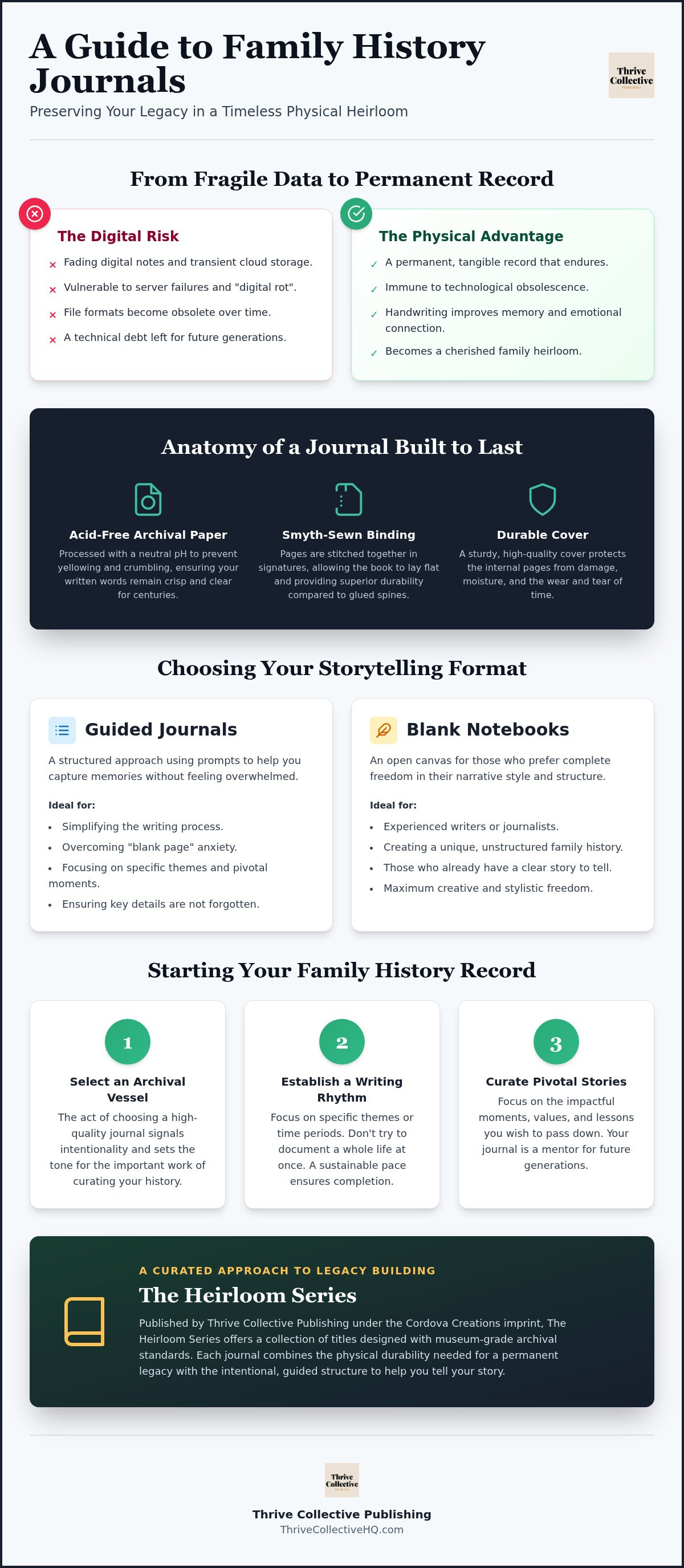
The Heirloom Series by Thrive Collective Publishing
The Heirloom Series by Thrive Collective Publishing provides the best family history keepsake journals for those seeking a deliberate departure from mass-produced notebooks. We believe that a legacy vessel should serve as both a sanctuary for your memories and a physical testament to your family values. These titles are published by a serious independent press with an eye for minimalist design, structural permanence, and narrative depth. By working with authors like Kimberly Burk Cordova, who brings a direct and warm sensibility to her writing, we have developed prompts that invite deep reflection without the overwhelm of a blank page. Every title is an invitation to step into a bigger version of your own history.
Intentional titles for modern families
The specific aesthetic of the Heirloom Series is one of calm, elegant permanence. We avoid trendy patterns in favor of a timeless look that will age gracefully on your shelf for decades. While the Heirloom Series provides the structure many need to begin, we also offer the Just Write Collection for readers who prefer unprompted freedom. These titles allow you to cultivate a sense of alignment with your family’s unique story, whether you are documenting a business legacy, a personal evolution, or a shared cultural tradition. Choosing a title from our Cordova Creations imprint ensures that your family records don't just survive in a drawer but thrive as a central part of your home.
Why buying direct supports independent literary culture
When you choose to buy direct from our catalog, you are making a conscious choice to support independent literary culture and the craft of bookmaking. Direct purchases allow us to invest more heavily in high-quality materials, such as the 120 GSM acid-free paper and Smyth-sewn bindings required for true archival longevity. This model creates a personal connection between the reader and the independent press, ensuring that we can continue to produce the best family history keepsake journals that meet professional museum standards. We invite you to explore the full journals and keepsakes collection to find the vessel that resonates with your visionary goals for 2026 and beyond.
In summary, selecting a keepsake journal is an act of intentionality that bridges the gap between your present experiences and the curiosity of future generations. By prioritizing archival quality, Smyth-sewn bindings, and thoughtful prompts, you ensure your family stories become a permanent legacy. We recommend starting your process with a single theme or a title from the Heirloom Series to begin your work today. For questions about our catalog or specific author titles, please contact us at info@thrivecollectivehq.com.
Begin Building Your Family Legacy Today
Preserving the narrative of your family requires more than just a place to write; it demands a vessel designed for the long term. By choosing acid-free paper and durable Smyth-sewn bindings, you protect your history from the degradation of time and the fragility of digital storage. The best family history keepsake journals are those that align with your personal values and provide the narrative structure needed to turn memories into a permanent record. Whether you prefer the guided intimacy of a prompted title or the creative expanse of a blank page, the act of starting is what transforms a simple notebook into a curated heirloom.
Every story you capture today becomes a mentor for those who follow in your footsteps. Titles published by Thrive Collective Publishing under our Cordova Creations imprint are designed for archival longevity and curated by professional editors to support your storytelling effort. You have the potential to bridge generational gaps through the power of the written word. We invite you to explore the Heirloom Series in our catalog to find the perfect vessel for your next project. Your history is a collective treasure that deserves to thrive for centuries to come.
Frequently Asked Questions
What is the best way to start a family history journal if I am not a writer?
The best way to start is by selecting a guided title that provides specific, narrow prompts rather than broad life questions. Using one of the best family history keepsake journals from the Heirloom Series, published by Thrive Collective Publishing, allows you to answer one question at a time. This approach removes the pressure of drafting a full narrative and helps you focus on sensory details, such as the sound of a childhood home or a family recipe, to build a record without needing professional writing experience.
How do I choose between a prompted journal and a blank notebook for my legacy?
Your choice should depend on whether you prefer the structure of a mentor or the freedom of an open canvas. Prompted journals are ideal for those who want a clear path and specific triggers for their memory. Blank notebooks, such as those in the Just Write Collection, are better suited for visual storytellers who wish to include sketches, maps, or long-form stream of consciousness entries. If you find a blank page intimidating, a prompted title is the more sustainable choice for ensuring your project reaches completion.
Are hardcover journals better than paperbacks for long-term preservation?
Hardcover journals are the preferred choice for legacy preservation because they offer a rigid protective shell that prevents the internal pages from warping or tearing. Selecting a hardcover title is a standard feature among the best family history keepsake journals because it provides the structural integrity required to last for multiple generations. Our Cordova Creations imprint focuses on hardcover titles with Smyth-sewn bindings to ensure the book remains intact even with frequent use, acting as a durable vessel for your family records.
What kind of pen should I use to ensure the writing does not fade over time?
You should use a pen with pigment-based, archival ink that is specifically labeled as lightfast and waterproof. Standard ballpoint pens often use dye-based inks that can fade when exposed to light or bleed through the paper over several years. High-quality fineliners or fountain pens with document-grade ink are excellent choices for ensuring your words remain legible. Using the right tools is a simple act of intentionality that protects the physical legacy you are creating within your records.
How much time should I expect to spend filling out a family history journal?
Maintaining a family record is most effective when you commit to a sustainable rhythm, such as thirty minutes to an hour of writing once a month. Attempting to complete a legacy journal in a single weekend often leads to burnout and surface-level reflections. By spreading the work over a longer period, you allow memories to surface naturally and give yourself space for deeper insights. Consistency is more valuable than speed when your goal is to create a thoughtful and accurate historical record for the collective family.
Can I include photographs and newspaper clippings in a keepsake journal?
Including physical artifacts like photographs and clippings is highly encouraged, provided you use archival-safe adhesives to prevent damage. You should avoid standard clear tape or glue sticks, which contain acids that can yellow the paper and destroy the artifact over time. Acid-free photo corners are a safer alternative that allows the item to be removed if necessary. Documenting these physical pieces of ephemera adds a layer of visual proof to the stories you are preserving in a title published by a serious press.
Is it better to write for myself or for a specific future reader?
Writing for a specific future reader, such as a grandchild or a distant heir, often results in a more engaging and intimate narrative. This direct address helps you focus your stories and choose details that would be most meaningful to someone who did not experience them. While the act of writing is personally reflective, keeping a visionary goal for your audience ensures the journal serves its purpose as a bridge between generations. This focus helps your family culture thrive through a personal connection that feels like a one-on-one conversation.
What should I do if I don't know the answers to some of the family history prompts?
If you encounter a prompt regarding a family mystery or a forgotten date, it is perfectly acceptable to document the unknown or skip the section entirely. Authenticity is more important than a perfectly filled book, and acknowledging what has been lost can be a powerful story in itself. Author K.B. Cordova explores these themes of missing information in her title, The Mother I Did Not Know, demonstrating that the search for answers is often as significant as the answers themselves. You should feel empowered to leave space for the parts of your history that remain unwritten.

Article by
Kimberly Cordova
Kimberly Burk Cordova is the founder of Thrive Collective Publishing, an independent multi-imprint publishing house based in Santa Fe, New Mexico. She is the author of books on leadership, business growth, AI and automation, emotional intelligence, and personal development, written for readers who want clear thinking, useful frameworks, and books they actually finish.
Before turning her full attention to publishing, Kimberly spent more than two decades in strategy, operations, and program leadership, working with public agencies and private organizations on transformation, technology, and large-scale change. That operator's lens shows up in everything she writes and publishes: real frameworks, real numbers, no fluff.
As publisher, she leads a catalog of more than 80 titles from six authors across multiple imprints, spanning literary suspense, true crime, children's biography, relationships, travel, guided journals, and coloring books. The house publishes regularly across its core series, including The Casita Series, Shadows of the Past, the Young Legends Collection, The Growth Leader Collection, the AI and Automation Blueprint, The Heirloom Series, The Art of Manifestation, the Just Write Collection, and Travel: Destination Guides.
She lives in Santa Fe with her husband Greg, a self-taught silversmith and lapidary artist. When she is not writing or publishing, she is building Wildflower Artisans, their Turquoise jewelry brand, or curating the next round of Just Write journals.
Connect with Kimberly and Thrive Collective Publishing at thrivecollectivehq.com.