

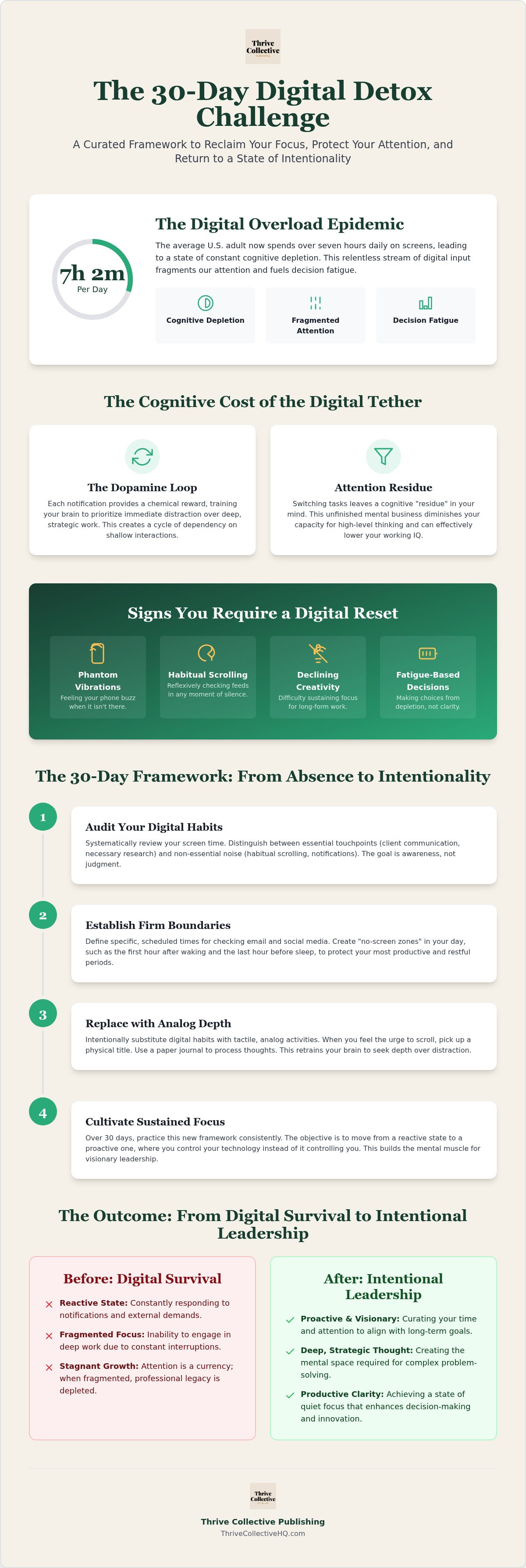
The average adult in the United States now spends seven hours and two minutes every day looking at a screen, a statistic that explains why so many of us feel cognitively depleted before lunch. You likely recognize the sensation of fragmented attention and the decision fatigue that comes from a relentless stream of notifications. At Thrive Collective Publishing: Books, Journals, and Guides, we believe your focus is a sacred resource that deserves protection from the constant pull of the digital world. This 30-day digital detox challenge for adults offers a curated framework to help you step away from the noise and return to a state of intentionality.
We understand that a complete disconnection is rarely practical for the modern professional, so this guide focuses on creating boundaries that support your ambition rather than hindering it. You'll learn how to replace shallow scrolling with the kind of analog depth found in our catalog of titles to regain your capacity for deep work and improve your sleep quality. This article outlines the specific daily shifts required to move from simply surviving the digital onslaught to thriving in a space of quiet, productive clarity.
Key Takeaways
- Understand how a digital detox challenge for adults serves as a structured framework to reclaim your cognitive focus through intentional boundaries.
- Identify the hidden costs of task switching and the dopamine loops that create attention residue, which can diminish your capacity for high level decision making.
- Explore why tactile tools like paper journals and physical titles are essential for leaders who prioritize deep comprehension and long term information retention.
- Master the systematic process of auditing your digital habits to replace distracting applications with meaningful analog rituals that support your daily productivity.
- Shift from a state of digital survival to a lifestyle of intentionality by curating a personal catalog of titles that support your long term professional evolution.
What is a digital detox challenge for adults?
A digital detox challenge for adults is a structured period of intentional disconnection from digital devices to prioritize cognitive recovery and analog engagement. It involves setting clear boundaries around social media, email, and mobile notifications to move from a state of reactive survival to a state of proactive leadership. Unlike a total technology blackout, this professional digital detox focuses on removing non-essential noise while maintaining the touchpoints necessary for your work. We view this process at Thrive Collective Publishing as a form of mental curation, much like the way we select specific titles for our catalog to ensure every word serves a purpose.
To better understand the foundational concepts of this reset, watch this helpful video:
The distinction between absence and intentionality
A total tech ban often fails the modern entrepreneur because it ignores the realities of a connected career. You cannot simply disappear if you are responsible for a team, a project, or a creative legacy. Instead, we advocate for a distinction between essential and non-essential digital touchpoints. Essential interactions might include specific client communication hours or necessary research. Non-essential touchpoints are the habitual, reflexive checks of social feeds that offer no professional or personal value. As a visionary leader, protecting your own attention is a serious responsibility. It requires you to define exactly when and why you engage with a screen. This intentionality allows you to maintain your professional edge while reclaiming the mental space needed for deep, strategic thinking.
Signs that you require a digital reset
You may recognize the need for a digital detox challenge for adults when you experience "phantom vibration" syndrome, the sensation of your phone buzzing when it is not even in your pocket. This is a physical sign that your nervous system has become overly attuned to digital interruptions. Other indicators include habitual scrolling during brief moments of silence or a noticeable decline in your creative output. When your attention is fragmented, you lose the ability to lead with purpose. At Thrive Collective Publishing, we see this often in authors who find it difficult to sustain the focus required for long form narrative work. If you find yourself making decisions based on fatigue rather than clarity, it is time to return to analog roots. Engaging with physical tools, such as the Just Write Collection from Cordova Creations, can help bridge the gap between digital noise and the quiet required for true innovation.
The cognitive cost of the digital tether
Every notification that appears on your screen triggers a small release of dopamine, a chemical reward that trains your brain to prioritize immediate distraction over deep, strategic thought. This loop is particularly damaging for leaders who must make complex decisions. When you habitually switch between a deep work task and a digital notification, you encounter what researchers call attention residue. This is the cognitive cost of leaving one task unfinished in your mind while attempting another, a state that can effectively lower your IQ in the moment. In 2026, the capacity for sustained focus is the most significant competitive advantage available to the modern professional.
Attention as your most valuable currency
Your ability to focus is not just a personal habit; it is the currency that funds your professional legacy. Fragmented focus leads to a reactive team culture and a stagnant bottom line. Engaging in a digital detox challenge for adults is often the catalyst that allows a founder to finally step into the role of a visionary. While a founder reacts to the immediate, a visionary curates the future. This transition requires a level of intentionality that is impossible to maintain while tethered to a 24-hour digital cycle. By reclaiming your attention, you create the space necessary to lead with alignment rather than anxiety. You cannot scale your impact if your cognitive resources are constantly being drained by non-essential digital noise.
Recovery and the creative spark
Meaningful innovation requires periods of analog reflection that digital devices often steal. Research indicates that U.S. adults spend an average of 7 hours and 2 minutes on screens daily, leaving very little room for the productive boredom that sparks new ideas. This digital saturation also carries a physical toll. A 2024 systematic review revealed that each hour of nighttime screen use is linked to 15 to 25 minutes of lost sleep. This loss of rest directly impairs your ability to lead with clarity the next morning. Protecting your early hours from the digital world is essential for your cognitive health. We suggest starting your day by engaging with physical titles that encourage deep thinking, such as the quiet and literary prose of K.B. Cordova in The Mother I Did Not Know, rather than immediately surrendering your focus to an inbox.
Analog depth: Why paper is the leader’s greatest tool
Most guides regarding a digital detox treat the process as a period of deprivation. We prefer to view it as a period of curation. When you remove digital noise, you create a vacuum that should be filled with higher quality inputs. At Thrive Collective Publishing, we prioritize physical formats because the tactile experience of a book or journal provides a level of depth that a screen cannot replicate. A digital note is always one swipe away from a distraction. A physical page is a closed ecosystem that demands your full presence. This shift from digital consumption to analog depth is the cornerstone of any successful digital detox challenge for adults.
The case for the physical page
Handwriting is more than a traditional habit; it is a cognitive anchor for memory and goal alignment. When you write by hand, your brain processes information more deeply than when you type on a keyboard. This is why we recommend using journals and keepsakes for documenting your leadership path. A physical journal from Cordova Creations allows you to track your evolution without the intrusion of blue light or the temptation of an open browser tab. Digital consumption is often passive and fleeting, while analog study is active and permanent. Using a physical tool forces you to slow down, which is the first step in reclaiming your cognitive focus and ending the cycle of reactive decision making.
Curation over consumption
Building a personal library of leadership development books for entrepreneurs is a visual commitment to your own growth. In a world of infinite digital content, the act of choosing a single title to master over the course of a month is a powerful statement of intentionality. Physical books act as environmental cues. They remind you of your priorities every time you see them on your desk or nightstand. When you read a physical title published by Thrive Collective, you are engaging in a singular conversation with the author. This focused engagement is what allows the insights of writers like Noelle Varden or Eliza Hawthorne to take root and influence your business strategy. Mastery requires the kind of presence that digital devices are designed to disrupt. By choosing analog tools, you are not just stepping away from a screen; you are stepping into a more grounded version of your professional self.
How do you complete a 30-day digital detox challenge?
To complete a 30-day digital detox challenge, you must systematically audit your digital habits and replace them with intentional analog rituals. This process requires a transition from reactive engagement to a curated life where you control your attention rather than surrendering it to an algorithm. You begin by identifying the three applications that consume the most of your non-essential time and removing them from your mobile device for the duration of the month. Establishing a strict window without screens for the first and last 60 minutes of every day ensures that your subconscious mind is not immediately flooded with external noise. At Thrive Collective Publishing, we believe this return to analog roots is the most effective way to reclaim your cognitive focus.
Week 1 and 2: Auditing and boundary setting
The first half of the digital detox challenge for adults focuses on awareness and the establishment of firm barriers. You should conduct a digital audit using your device's built-in tracking tools to see exactly where your cognitive energy is being spent. For many professionals, this reveals a pattern of reactive leadership where hours are lost to checking emails that do not require immediate action. We recommend setting specific office hours for your phone and communicating these boundaries clearly to your team and family. Explain that you are prioritizing deep focus to better serve the collective goals of your business. This clarity prevents the anxiety of being unreachable and sets a standard for intentionality within your organization.
Week 3 and 4: Deep work and analog integration
Once you have cleared the digital clutter, you must fill the resulting space with high quality analog inputs. This period is for scheduling blocks of deep work where no digital devices are permitted in the room. You might use this time to process complex business decisions using the Just Write Collection from Cordova Creations. By using physical paper, you remove the possibility of a notification interrupting your train of thought. Replace your usual evening scrolling with 20 minutes of daily journaling or reading a physical book. Noelle Varden's grounded approach to leadership is particularly effective when studied in a quiet, analog environment. Authors like Liam Cruz also offer accessible insights that are best absorbed when you are away from the blue light of a screen. As you reach the end of the 30 days, you will likely notice a significant shift in your mental clarity and a reduced sense of morning anxiety. To support this new rhythm, we invite you to browse our catalog of physical titles designed for the thoughtful leader.
Building an intentional leadership catalog
A digital detox challenge for adults serves as the gateway to a life of curated excellence rather than a brief pause in digital habits. Once you have cleared the initial noise, the long term success of your focus depends on the quality of the information you allow back into your mental space. Thrive Collective Publishing: Books, Journals, and Guides views the creation of a personal library as a strategic act of leadership. Selecting titles that align with your current professional development goals allows you to maintain the clarity you have gained. We advocate for a diverse reading list that includes literary suspense, true crime, and business strategy to keep your cognitive faculties sharp. Choosing to buy direct from our press supports a healthier, more intentional publishing ecosystem that values the craft of the author over the speed of digital distribution.
Selecting your next great read
Matching your reading list to your specific leadership challenges ensures that your growth remains in alignment with your professional vision. For those seeking a quiet, literary reset after weeks of digital saturation, we suggest starting with The Mother I Did Not Know by K.B. Cordova. This title offers a deliberate engagement with narrative that acts as the perfect antidote to the dopamine loops of social media. If your days involve significant transit time, our true crime audiobooks provide a way to practice focused, long form listening without the distraction of a screen. By choosing one title to master each month, you move from a state of mindless consumption to a state of deep, strategic study.
Joining the Collective
Leadership is not a solo endeavor (it requires a community of intentional peers who are equally invested in their personal evolution). We invite you to learn more about our authors and their commitment to the craft of writing. Authors like Noelle Varden and Liam Cruz produce work that is designed to be studied and reflected upon, rather than merely consumed. Engaging in book clubs or shared analog experiences allows you to process complex ideas within a supportive collective. This shared commitment to growth solidifies your identity as a visionary leader who prioritizes depth over digital noise.
The digital detox challenge for adults provides the curated framework you need to replace digital noise with analog depth and reclaim your cognitive focus. By auditing your habits and embracing physical formats, you can sustain the deep work capacity required for holistic success. We recommend beginning your analog practice with a physical copy of The Mother I Did Not Know by K.B. Cordova. For questions about our catalog or to share your progress, please email info@thrivecollectivehq.com.
Step into a space of curated clarity
You now have the framework to move beyond the reactive cycle of notifications and reclaim your cognitive focus. By committing to this digital detox challenge for adults, you are choosing to prioritize your legacy over the immediate demands of a screen. We have explored how the tactile experience of paper journals and physical titles published by Thrive Collective Publishing can restore your capacity for deep work. This shift from digital noise to analog depth is not just a temporary break; it is an invitation to lead with greater intentionality. Our titles are curated by leadership experts to ensure every page supports your professional evolution. We invite you to explore our catalog of titles to find your next analog companion. Within our collection, you can find independently curated work from authors like Noelle Varden and K.B. Cordova, chosen by a press that takes on books the larger houses pass over. You have the potential to scale your impact by protecting your most valuable currency, which is your attention. We look forward to supporting your progress as you step into this more focused version of yourself.
Frequently Asked Questions
How can I do a digital detox if I work in social media or tech?
You can successfully complete a digital detox by strictly separating your professional requirements from your personal consumption. Define your essential work tasks and perform them during specific office hours, then completely disconnect from those platforms once your professional obligations are met. This boundary prevents the "always-on" mentality that leads to burnout while allowing you to remain effective in your role. We recommend using a dedicated work device that stays in your office to ensure your living spaces remain a sanctuary for analog depth.
Is a digital detox challenge for adults effective if it is only for a weekend?
A weekend reset offers immediate cognitive relief and a necessary break from the dopamine loop, but a full 30-day digital detox challenge for adults is required to establish permanent habit shifts. Short bursts of disconnection are excellent for recovery, yet they often don't provide enough time to move from a state of reactive survival to proactive leadership. Extending the challenge allows your brain to fully adapt to the slower, more intentional pace of analog life. This longer duration is what helps you cultivate a lasting legacy of focus.
What should I do if I feel anxious without my phone during the challenge?
Anxiety is a common physiological response to the removal of constant digital stimulation and the resulting drop in dopamine. When you feel the urge to reach for your device, replace that reflexive action with a physical alternative, such as opening a journal from Cordova Creations. This transition period is a natural part of the process and usually subsides as you become more comfortable with quiet reflection.
Can I use an e-reader like a Kindle during a digital detox?
You may use an e-reader if it is a dedicated device without a web browser or social media notifications, though physical paper remains our preferred medium for deep comprehension. The goal of this challenge is to remove the temptation of digital noise, so ensure your device is in airplane mode to maintain your focus. If you find yourself distracted by the screen itself, we suggest returning to the physical titles in our catalog. There is a unique cognitive benefit to the weight and texture of a real book that digital screens cannot replicate.
How do I handle business emergencies during my "no-screen" windows?
Establish a specific protocol where your team or family can reach you via a traditional phone call for true emergencies only. By white-listing a few critical contacts, you remove the need to habitually check your device for "what if" scenarios. This clear communication with your collective ensures that you are reachable when it truly matters while protecting your windows for deep work and recovery. Most perceived emergencies are simply urgent tasks that can wait until your scheduled digital hours.
What are the long-term benefits of a digital detox for entrepreneurs?
The primary long-term benefit is the restoration of your capacity for deep work, which is the most significant competitive advantage for a visionary leader. You will likely experience better sleep quality, reduced morning anxiety, and a more intentional relationship with your team and technology. Entrepreneurs who disconnect regularly are better equipped to scale their impact because they make decisions based on clarity rather than fatigue. This sustained focus allows you to build a business that thrives on alignment rather than constant reaction.
How does journaling help with the digital detox process?
Journaling serves as a sanctuary for your thoughts and a tool for processing the complex decisions that digital noise often obscures. By using the Just Write Collection from Cordova Creations, you create a physical record of your personal evolution and goal alignment. Handwriting forces a slower pace of thought, which helps improve memory retention and clarifies your strategic vision. It is an essential analog ritual that replaces the shallow habit of scrolling with the deep practice of self-curation.
Is it better to do a digital detox alone or with a partner?
While a solo detox is effective for personal reflection, completing the challenge with a partner or within a collective provides a layer of accountability that often leads to better results. Sharing your intentions with a peer helps normalize the boundaries you are setting and reduces the social pressure to be constantly available. At Thrive Collective Publishing, we believe that success is a collective endeavor. Joining a movement of like-minded individuals who value intentionality can make the transition to an analog-rich lifestyle feel more supported and sustainable.

Article by
Kimberly Cordova
Kimberly Burk Cordova is the founder of Thrive Collective Publishing, an independent multi-imprint publishing house based in Santa Fe, New Mexico. She is the author of books on leadership, business growth, AI and automation, emotional intelligence, and personal development, written for readers who want clear thinking, useful frameworks, and books they actually finish.
Before turning her full attention to publishing, Kimberly spent more than two decades in strategy, operations, and program leadership, working with public agencies and private organizations on transformation, technology, and large-scale change. That operator's lens shows up in everything she writes and publishes: real frameworks, real numbers, no fluff.
As publisher, she leads a catalog of more than 80 titles from six authors across multiple imprints, spanning literary suspense, true crime, children's biography, relationships, travel, guided journals, and coloring books. The house publishes regularly across its core series, including The Casita Series, Shadows of the Past, the Young Legends Collection, The Growth Leader Collection, the AI and Automation Blueprint, The Heirloom Series, The Art of Manifestation, the Just Write Collection, and Travel: Destination Guides.
She lives in Santa Fe with her husband Greg, a self-taught silversmith and lapidary artist. When she is not writing or publishing, she is building Wildflower Artisans, their Turquoise jewelry brand, or curating the next round of Just Write journals.
Connect with Kimberly and Thrive Collective Publishing at thrivecollectivehq.com.