

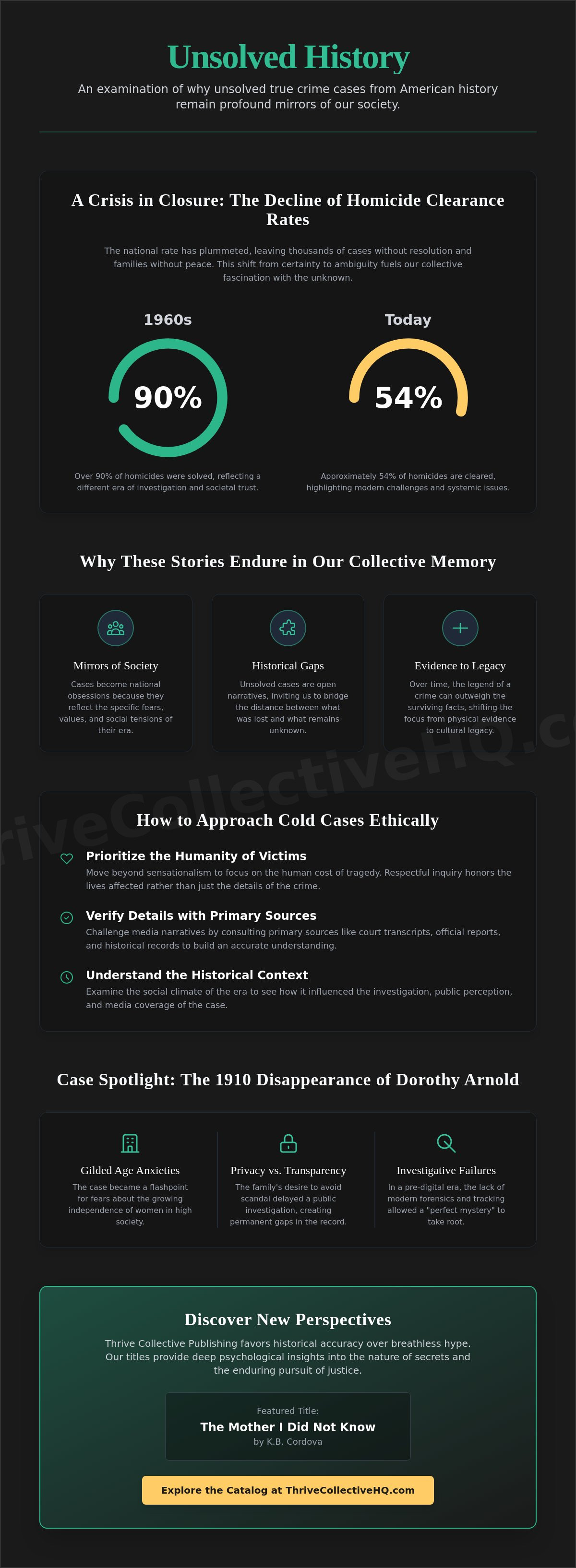
Did you know that the national homicide clearance rate in the United States has plummeted from over 90 percent in the 1960s to approximately 54 percent today? This decline represents more than just a statistic; it signifies thousands of stories left without an ending and families left without peace. At Thrive Collective Publishing, we recognize that you are looking for more than repetitive, sensationalist content that ignores the human cost of tragedy. We believe that unsolved true crime cases from American history serve as profound mirrors of our social anxieties and institutional failures. By looking back with intentionality, we can better understand the legacy of these events and the communities they changed forever.
We agree that readers deserve a more sophisticated approach to true crime, one that favors historical accuracy over breathless hype. This article offers a thoughtful examination of ten enduring cold cases, analyzed through the lens of historical context and careful literary research. You will explore how the social climate of different eras influenced these investigations and discover high-quality titles that provide a deeper, more respectful look at the pursuit of justice. Our goal is to move beyond the surface to find the human stories that still demand our attention and our empathy.
Key Takeaways
- Understand why unsolved true crime cases from American history remain in our collective memory as mirrors of societal tension and historical gaps.
- Examine the 1910 disappearance of Dorothy Arnold to see how early investigative failures illustrate the conflict between family privacy and public transparency.
- Analyze the impact of the sensationalist press on mid-century cases to understand how media narratives can complicate the search for historical truth.
- Learn to research cold cases ethically by prioritizing the humanity of victims and verifying details through primary sources like court transcripts.
- Discover how titles in the Thrive Collective Publishing catalog, such as "The Mother I Did Not Know" by K.B. Cordova, provide deep psychological insights into the nature of secrets.
Why do unsolved true crime cases from American history endure in our collective memory?
Unsolved mysteries endure because they function as open narratives that allow us to examine the historical gaps and societal tensions of our past while seeking a resolution that the official record failed to provide. These unsolved true crime cases from American history represent more than just police files; they are mirrors of the eras in which they occurred. When you engage with these stories, you are participating in a collective effort to bridge the distance between what was lost and what remains. This process of looking back is essential for personal alignment, as it helps us understand the foundations of our modern legal and social systems.
To better understand the layers of these mysteries and why they remain so compelling, watch this helpful video:
The intersection of mystery and social history
A crime is often a product of its era, reflecting the specific fears and values of the time. Eliza Hawthorne, a historian who writes for Thrive Collective Publishing, emphasizes that we must look at the social climate to understand why certain cases became national obsessions. For example, the 1910 disappearance of Dorothy Arnold from Fifth Avenue in Manhattan was not merely a missing persons case. It was a flashpoint for Gilded Age anxieties about the independence of young women. In this pre-digital era, the lack of immediate tracking allowed a "perfect mystery" to take root, where local folklore transitioned into a national media sensation that challenged the perceived safety of the elite class. You can find many such examples within the broader list of unsolved true crime cases from American history, where the silence of the record speaks volumes about the culture of the day.
The transition from evidence to legacy
Over time, the nature of a case shifts from a search for physical evidence to the preservation of a cultural legacy. While physical samples like hair or fabric may degrade over decades, the narrative surrounding the event often expands and evolves. We see this dynamic explored with great intentionality in our titles, where authors examine how the cold facts of an FBI file compare to the psychological depth of a story. In the title The Mother I Did Not Know by K.B. Cordova, the focus on family secrets illustrates how a mystery can shape a person's identity long after the original events have passed. A case typically becomes "unsolvable" in the public mind when the legend of the crime begins to outweigh the surviving facts, creating a space where only literary research and thoughtful analysis can provide a sense of closure.
The Gilded Age Disappearances: Dorothy Arnold and the Mystery of Mary Rogers
The transition from local tragedy to national obsession often begins with a lack of institutional transparency. In the early chapters of unsolved true crime cases from American history, the tension between family privacy and public safety frequently hindered the search for truth. This was never more evident than during the Gilded Age, where wealth could buy a temporary silence that often became permanent. At Thrive Collective Publishing, we believe that understanding these historical constraints is vital for any reader looking to find alignment between the facts of a case and its enduring legacy.
Dorothy Arnold and the constraints of high society
On December 12, 1910, Dorothy Arnold, a 25 year old socialite and heiress to a perfume fortune, vanished from the streets of Manhattan. Her morning was unremarkable; she purchased a book at Brentano’s and a box of chocolates at Park & Tilford’s before a friend spotted her walking toward Central Park. She was never seen again. The Arnold family, fearing a public scandal more than they feared for Dorothy's immediate safety, waited weeks before involving the police. They chose to hire private investigators instead, a decision that allowed the trail to go cold. Theories ranged from a voluntary disappearance to start a new life to a botched medical procedure, but the lack of a professional, transparent investigation in those first critical hours ensured her story remained an open narrative. Eliza Hawthorne notes that this case highlights how high society expectations often prioritized reputation over the humanity of the victim.
Mary Rogers and the birth of the urban mystery
Nearly seventy years before Dorothy vanished, the 1841 murder of Mary Rogers, known as the "Beautiful Cigar Girl," gripped New York and New Jersey. Her body was found in the Hudson River off the coast of Hoboken, but the investigation was hampered by the limitations of early 19th century policing. New York did not yet have a professional, unified police force, and the jurisdictional confusion between states allowed the killer to escape justice. This case became the blueprint for the urban mystery, directly influencing Edgar Allan Poe to write "The Mystery of Marie Rogêt," which was the first murder mystery based on real world events. We explore these types of foundational mysteries in our Shadows of the Past collection, where the intersection of fact and fiction is examined with historical care.
While the FBI later documented modern enigmas such as the Black Dahlia and the Alcatraz Escape, these Gilded Age cases established the cultural fascination with the "unsolvable." They remind us that the archives are often incomplete, leaving room for authors and researchers to seek new perspectives. If you find yourself drawn to the psychological depth of these historical gaps, you might enjoy exploring the curated titles in our catalog that prioritize victim centered storytelling over sensationalism.
The Mid-Century Shadows: Analyzing the Black Dahlia and the Alcatraz Escape
Mid-century America projected an image of stability and progress, but the era's most notorious crimes revealed deep fractures in the systems designed to protect and contain. The 1947 murder of Elizabeth Short and the 1962 escape from Alcatraz remain two of the most significant unsolved true crime cases from American history, illustrating how media interference and institutional overconfidence can stall the path to justice. When you look closely at these events, you see the limitations of early forensic science and the power of a narrative that refuses to be closed.
Elizabeth Short and the dark side of the Hollywood dream
On January 15, 1947, the discovery of Elizabeth Short in a vacant lot in Leimert Park, Los Angeles, became a flashpoint for sensationalist journalism. The press quickly adopted the "Black Dahlia" moniker, a name that arguably did more to preserve a legend than to solve a crime. Reporters frequently contaminated the original scene and withheld information from the police to secure exclusive headlines, a practice that obscured the cold facts for decades. Over 150 men were eventually considered suspects, yet the investigation was hampered by the lack of centralized records and the absence of modern forensic standards. Historians like Eliza Hawthorne remind us that Short was a real person whose story was nearly lost to the dark side of the Hollywood dream. You can examine the official records of these investigations through the FBI's Famous Cases archive, which highlights the limitations of an era before the advent of DNA profiling.
The Alcatraz Escape: A study in architectural and human failure
Fifteen years later, the 1962 escape from Alcatraz challenged the perceived invincibility of the American carceral system. Frank Morris and brothers John and Clarence Anglin utilized a complex plan involving drill bits made from vacuum motor parts and dummy heads crafted from soap and hair to vanish from the island. They spent over six months chipping away at the ventilation ducts in their cells. While the prison was shuttered in 1963, the mystery of their survival persists. The FBI concluded the men likely drowned in the cold currents of the San Francisco Bay, yet the U.S. Marshals Service maintains an active warrant for their arrest. This conflict between official closure and ongoing pursuit reflects the "open narrative" that keeps such mysteries alive in our collective memory.
At Thrive Collective Publishing, we curate titles that look beyond the sensational to find the psychological truth of these events. Whether analyzing the failure of architectural security or the impact of media myths, our authors seek to provide a more grounded perspective on the past. Understanding these mid-century shadows helps us appreciate how far investigative standards have evolved while acknowledging the work that remains to be done.
How should readers approach the ethics of historical true crime research?
Readers should approach research by prioritizing the dignity of the victims over the notoriety of the perpetrators while verifying all claims against primary historical records. Engaging with unsolved true crime cases from American history requires a level of intentionality that moves beyond mere curiosity. It's a commitment to seeing the person behind the police file. With over 346,000 unsolved homicides in the United States since 1965, the scale of these "open narratives" is vast, and each one represents a family still seeking alignment with the truth. Recent legislation, such as the Homicide Victims' Families' Rights Act, underscores a growing national movement to treat these cases with the legal and ethical gravity they deserve.
To conduct research ethically, you must look past digital hearsay and seek out primary sources. Court transcripts, contemporary newspaper archives, and genealogical records provide a clearer picture than the recycled theories often found on major websites. You should also remain aware of the cultural bias inherent in historical media. Reports from the early 20th century often reflected the prejudices of their time, frequently marginalizing victims based on their gender, race, or social standing. By recognizing these biases, we can begin to restore the humanity that was stripped away by the original reporting.
Moving beyond the sensationalist hook
We believe that the language used to describe tragedy matters. At Thrive Collective Publishing, we consciously avoid marketing buzzwords like "game-changer" or "transformative" when discussing sensitive subject matter. While SEO requirements might necessitate a certain title, our internal editorial standards favor plain language and a calm, curated delivery. This approach ensures that the focus remains on the historical facts rather than a "breathless" pursuit of shock value. You can learn more about our commitment to high-quality, thoughtful publishing on our Why Buy Direct page, where we explain our philosophy of putting readers and research first.
The role of the independent publisher in true crime
Independent presses play a vital role in preserving stories that might be overlooked by larger, trend-chasing houses. We select our titles based on the depth of the author's research and their ability to provide a sophisticated analysis of the social climate. For instance, Eliza Hawthorne utilizes a historically careful approach in the Shadows of the Past series to ensure that every detail is grounded in fact. This dedication to accuracy helps readers understand the long-term impact of these stories on the American landscape. If you are ready to explore these cases through a more ethical and scholarly lens, we invite you to browse our curated collection of true crime titles.
Discovering New Perspectives in the Thrive Collective Publishing Catalog
Thrive Collective Publishing offers a curated catalog of titles that examine unsolved true crime cases from American history with psychological depth and historical integrity. We believe that choosing to read with intentionality helps you find alignment between your personal growth and the broader human story. Our mission as an independent New Mexico press is to provide you with a visionary perspective that avoids the noise of sensationalist reporting in favor of a legacy of substance. We are proud to highlight The Mother I Did Not Know by K.B. Cordova, which is scheduled for release on August 31, 2026. This title serves as the flagship for the Casita Series, a collection that explores the intricate layers of family secrets and the quiet suspense of the American Southwest. It is a work that asks you to look deeper into the foundations of identity and the impact of the unspoken.
Titles for the thoughtful reader
We understand that your path as a reader is unique and requires more than just a surface level summary. For those who seek a comprehensive look at historical mysteries, the Shadows of the Past complete collection offers a series of works curated by Eliza Hawthorne. Her historically careful approach ensures that every investigation is grounded in truth, providing a sense of progress through the archives of the past. We also offer immersive true crime audiobooks on Audible for your commute and paperback, hardcover and Kindle editions on Amazon for your home library. Whether you are following the accessible research of Liam Cruz or the grounded narratives of Noelle Varden, you are part of a Collective that values craft, community, and the pursuit of excellence. Our Cordova Creations imprint further supports this exploration by offering journals that help you document your own evolution as you scale your knowledge with ease.
Joining the Collective conversation
No one succeeds in a vacuum, and we believe that the most impactful reading happens when it is shared within a supportive community. We invite you to visit our Book Clubs page to discover discussion guides that help you explore the social implications of unsolved true crime cases from American history. These resources are designed to move you from a state of dreaming to a state of doing, fostering connection through shared insight and intellectual growth. Kimberly Burk Cordova provides a direct and warm perspective on our publishing philosophy, reinforcing our commitment to your success as a conscious consumer of literature. Choosing to read with purpose is a way to thrive rather than just survive in a world of superficial content. To receive personalized book recommendations tailored to your specific interests, please email info@thrivecollectivehq.com.
Cultivating a legacy of intentional reading
Engaging with unsolved true crime cases from American history is about more than satisfying a curiosity. It is an opportunity for personal evolution as you seek to understand the social climate and institutional failures of the past. By prioritizing the humanity of victims and verifying your research through primary sources, you help preserve a legacy that sensationalism often obscures. We believe that every reader has the potential to move from a state of dreaming about justice to a state of doing the work required to remember these stories with integrity.
Our commitment to New Mexico literary culture means we provide titles curated by independent historians who value depth over trend-chasing. Whether you are building a shelf of paperbacks and hardcovers for your collection or listening to immersive narratives that challenge your perspective, our catalog is designed to help you thrive. We invite you to Explore the True Crime Collection at Thrive Collective Publishing and discover the impact of intentional storytelling. Your success as a thoughtful reader is a collective endeavor, and we are honored to walk this path with you. If you would like a personalized recommendation, please reach out to us at info@thrivecollectivehq.com.
Frequently Asked Questions
What is the oldest unsolved murder case in American history?
The 1799 Manhattan Well murder of Gulielma Sands is often cited as the oldest high profile unsolved murder in the United States. While Levi Weeks was tried for the crime, he was acquitted, leaving the case officially open for over two centuries. This early trial was notable for featuring a legal team that included Alexander Hamilton and Aaron Burr, illustrating how wealth and influence have long shaped the outcomes of our legal system.
How does modern DNA testing help solve historical cold cases?
Modern DNA testing, specifically genetic genealogy, allows investigators to identify suspects by comparing crime scene samples with public ancestry databases. This technology has been instrumental in resolving unsolved true crime cases from American history that were previously considered permanent mysteries. The Homicide Victims' Families' Rights Act now requires federal agencies to apply these new technologies to older files, ensuring that we use every available tool to find alignment with the truth.
Why are some famous cold cases never solved despite modern technology?
Some cases remain open because the original crime scenes were contaminated or the physical evidence has degraded beyond the point of usability. In mid-century examples like the Black Dahlia, sensationalist media coverage often interfered with the collection of cold facts by the police. When witnesses pass away and records are lost, even the most advanced technology cannot always reconstruct the missing pieces of a narrative that has already transitioned into folklore.
Is it ethical to write fictional stories based on real unsolved crimes?
Writing fiction based on real tragedy is ethical when the author prioritizes the humanity of the victims and avoids sensationalizing the perpetrator. K.B. Cordova demonstrates this in her literary suspense titles, such as The Mother I Did Not Know, by focusing on the psychological impact of secrets rather than the mechanics of the crime. We believe that thoughtful storytelling can honor a victim's legacy by exploring the social climate that allowed the event to occur.
What are the most famous missing persons cases from the Gilded Age?
The 1874 kidnapping of Charlie Ross and the 1910 disappearance of Dorothy Arnold are two of the most enduring mysteries from this era. While Dorothy's case highlighted high society's desire for privacy, the Charlie Ross case was the first American kidnapping for ransom to receive national media attention. These disappearances fundamentally changed how families perceived public safety in growing urban environments, leaving a legacy of caution that persists in our cultural memory.
How can I find primary source documents for historical true crime research?
You can find primary source documents by accessing the National Archives, the Library of Congress, and local historical society records in the region where the crime occurred. Many researchers also utilize digitized newspaper archives from the 19th and early 20th centuries to verify contemporary accounts. Eliza Hawthorne recommends cross referencing these public records with court transcripts to ensure your research is grounded in intentionality rather than digital hearsay.
Can a case be reopened after 100 years?
A case can be reopened at any time if new evidence or technology becomes available to investigators. While the statute of limitations may prevent prosecution for some lesser crimes, there is no such limit for murder in the United States. Legislation like Kamisha's Law, introduced in February 2026, further emphasizes the commitment to pursuing justice on federal and tribal lands regardless of how much time has passed since the original event.
What is the difference between a cold case and an unsolved case?
A cold case is a specific type of unsolved case where all original leads have been exhausted and the investigation has officially stalled. While all cold cases are unsolved, not every unsolved case is considered cold if the police are still actively following new tips or processing evidence. Understanding this distinction is vital for those studying unsolved true crime cases from American history as it helps define the current state of the legal and social pursuit of justice.

Article by
Kimberly Cordova
Kimberly Burk Cordova is the founder of Thrive Collective Publishing, an independent multi-imprint publishing house based in Santa Fe, New Mexico. She is the author of books on leadership, business growth, AI and automation, emotional intelligence, and personal development, written for readers who want clear thinking, useful frameworks, and books they actually finish.
Before turning her full attention to publishing, Kimberly spent more than two decades in strategy, operations, and program leadership, working with public agencies and private organizations on transformation, technology, and large-scale change. That operator's lens shows up in everything she writes and publishes: real frameworks, real numbers, no fluff.
As publisher, she leads a catalog of more than 80 titles from six authors across multiple imprints, spanning literary suspense, true crime, children's biography, relationships, travel, guided journals, and coloring books. The house publishes regularly across its core series, including The Casita Series, Shadows of the Past, the Young Legends Collection, The Growth Leader Collection, the AI and Automation Blueprint, The Heirloom Series, The Art of Manifestation, the Just Write Collection, and Travel: Destination Guides.
She lives in Santa Fe with her husband Greg, a self-taught silversmith and lapidary artist. When she is not writing or publishing, she is building Wildflower Artisans, their Turquoise jewelry brand, or curating the next round of Just Write journals.
Connect with Kimberly and Thrive Collective Publishing at thrivecollectivehq.com.