

What if the most influential mentor in your child's life lived over a century ago? It is a powerful thought that can transform a reluctant reader into a curious student of the human experience. You likely worry about the lack of positive role models in modern media or feel frustrated when your child finds history irrelevant to their daily life. Children's Biography Books: Why They Matter for Young Readers provide the solution by bridging the gap between the past and the present. At Thrive Collective Publishing: Books, Journals, and Guides, we believe that life stories are blueprints for future leadership and personal character.
In this article, you will discover how these narrative accounts foster deep empathy and help children connect with real-world heroes. We'll explore the differences between picture books and middle grade titles while offering practical strategies for discussing these stories at home. By the end, you'll understand how curated titles like the Young Legends Collection by Liam Cruz support literacy and help your child see themselves in the triumphs of others. This is an invitation to move from simple facts to meaningful legacy and growth.
Key Takeaways
- Discover how Children's Biography Books: Why They Matter for Young Readers enrich learning by transforming dry historical facts into relatable human stories that resonate with a child's daily life.
- Understand the psychological value of life stories in building resilience and empathy as readers witness real-world figures overcome significant challenges.
- Gain clarity on selecting the right titles for different age groups, balancing visual density for younger readers with deeper narrative structure for middle grade students.
- Discover practical strategies for discussing these narratives with children to encourage self-reflection and a stronger connection to the subject's character traits.
- Explore the Young Legends Collection by Liam Cruz, a curated catalog designed to provide accessible role models for the next generation of leaders.
Why does history often feel inaccessible to young readers?
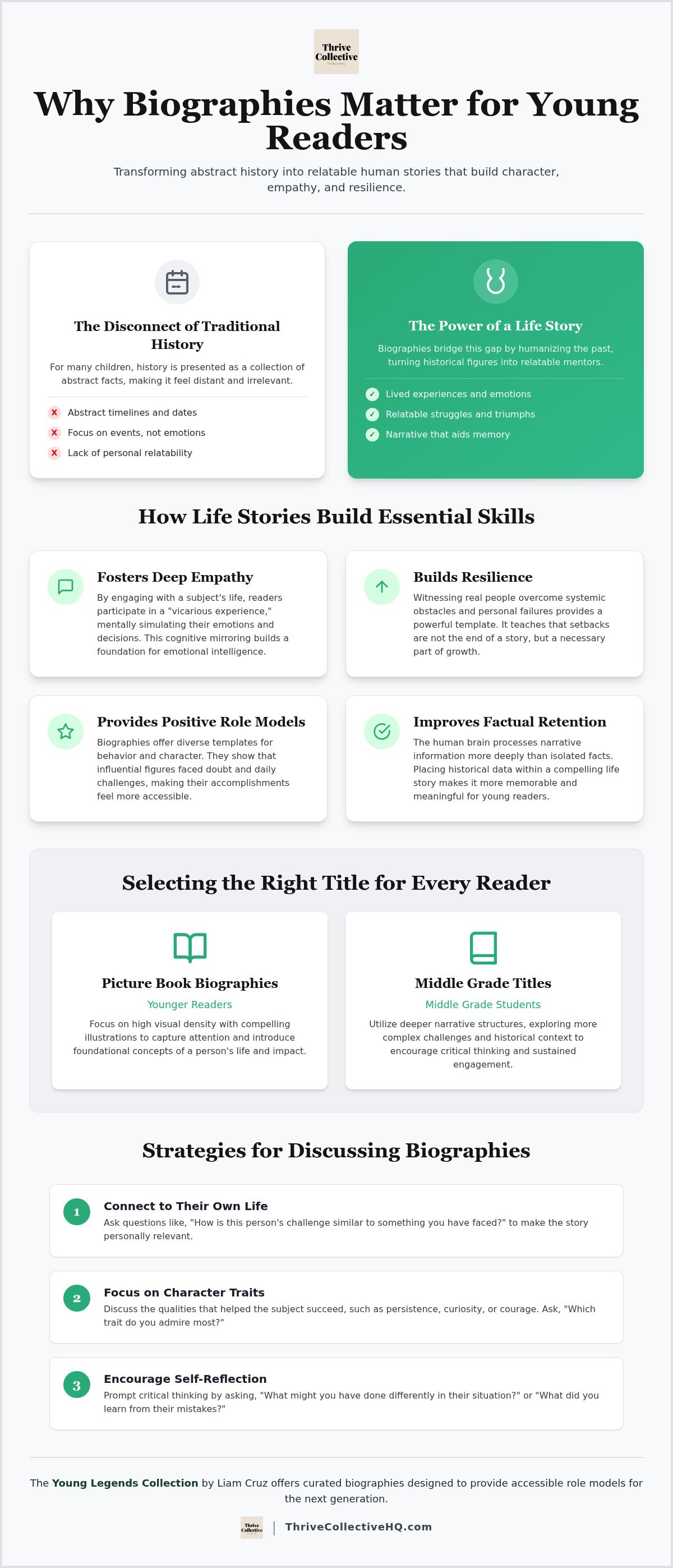
History often feels inaccessible to young readers because traditional education focuses on abstract timelines rather than human emotions. Children's Biography Books: Why They Matter for Young Readers solve this disconnect by using narrative techniques to humanize historical figures, making the past feel relevant to a child's current life and future ambitions.
For many children, the past is a collection of dusty numbers and distant names that seem to have little to do with their current reality. This disconnect occurs when history is presented as a series of inevitable events rather than a record of difficult human choices. At Thrive Collective Publishing: Books, Journals, and Guides, we recognize that history only becomes vibrant when viewed through the lens of a person's life. We believe that real-life stories are the most effective tools for building character and fostering deep empathy. They replace the coldness of a textbook timeline with the warmth of a lived experience.
Defining the role of narrative non-fiction
Children's biography books are specific non-fiction titles that narrate the life of a real person, providing young readers with concrete examples of resilience and leadership. These titles bridge the gap between abstract historical dates and the human experience, making the past feel relevant to a child's own life. Unlike standard school materials that prioritize broad movements and statistical data, these titles focus on the individual. Some educators report that storytelling aids in factual retention because the brain processes narrative information more deeply than isolated facts. When a child reads about a leader's childhood struggles, the historical context becomes the backdrop for a story they actually want to follow.
Overcoming the boredom barrier
The perceived boredom of non-fiction often stems from a lack of relatability. When we focus purely on achievements, we lose the person behind the prize. High-quality biographies for young readers prioritize the human element, showing that even the most influential figures faced doubt, failure, and ordinary daily challenges. In our Young Legends Collection, author Liam Cruz utilizes this approach to make history accessible for children aged 4 to 12. By highlighting relatable moments, such as a famous scientist's early curiosity or an athlete's initial setbacks, the narrative creates a sense of belonging. Vivid illustrations in picture book biographies further capture attention, ensuring that the visual experience is as compelling as the prose. This combination of art and story transforms history from a chore into a source of inspiration for the next generation of thinkers.
How do life stories build empathy and character?
Children's Biography Books: Why They Matter for Young Readers because these narratives offer vicarious experiences that allow children to safely explore challenges and triumphs. Witnessing real people handle failure and persist through adversity builds resilience and emotional intelligence. These life stories foster a deeper understanding of the shared human experience across different cultures and historical eras.
Reading a biography is far more than a simple history lesson. It's a profound exercise in social-emotional development. When your child engages with a life story, their brain participates in what researchers call vicarious experience. They aren't merely observing a sequence of events. They are mentally simulating the emotions and decisions of the subject. This cognitive mirroring builds a foundation for emotional intelligence that directly influences how they treat their peers and view their own potential. You're giving them the chance to walk in another person's shoes before they even leave the house.
Resilience is rarely taught through lectures. It's caught through examples. Seeing a real person face systemic obstacles or personal failure and choose to continue provides a powerful template for a child's own life. At Thrive Collective Publishing: Books, Journals, and Guides, we curate stories that emphasize this persistence. We believe that character is forged in the quiet moments of decision, and biographies offer a front-row seat to those moments. This exposure helps children understand that setbacks are not the end of a story, but a necessary part of growth and eventual impact.
The science of mirroring and role models
Children naturally seek templates for behavior as they form their unique identities. Seeing a diverse range of leaders in a curated catalog of titles provides them with a broad spectrum of possibilities. When a reader sees someone who shares their background or specific struggles achieving greatness, it reinforces their sense of alignment with success. These stories act as blueprints for future leadership, teaching that lasting legacy is the result of steady intentionality. It's about showing them that they belong in the rooms where decisions are made.
Fostering a global perspective from home
Biographies function as both windows and mirrors for young readers. They reflect a child's own experience while providing a window into lives entirely different from their own. Introducing various cultures and eras through a single life story helps break down prejudices by focusing on shared human emotions like hope and determination. This perspective helps children thrive in an increasingly connected world. By understanding that a person from a different century or country felt the same spark of curiosity, the reader connects with a global community of thinkers and doers.
Choosing between picture book biographies and middle grade titles
Understanding Children's Biography Books: Why They Matter for Young Readers helps you select titles that meet a reader exactly where they are, whether that is through vibrant art or detailed primary sources. Selecting age-appropriate titles ensures that historical context remains accessible and engaging for young learners without being oversimplified or too complex for their current developmental stage.
At Thrive Collective Publishing, we focus on the intentionality of a book's structure to support long-term growth. We believe that a well-curated library should evolve alongside the reader, moving from visual immersion to analytical thought. By choosing titles from a consistent catalog, you provide your child with a reliable framework for understanding the world and the people who have shaped it with purpose and impact.
Visual storytelling for early readers
For children aged 4 to 7, the visual experience is just as vital as the text. Illustrations provide essential historical context that words alone might struggle to convey to a young mind. High-quality picture book biographies use rhythmic prose and evocative art to introduce complex topics, such as civil rights or scientific discovery, without overwhelming the reader. You should look for titles that balance a limited word count, often under 1,000 words, with high visual density. This allows the child to absorb the atmosphere of a different era while following a clear narrative arc that emphasizes character and resilience.
Deepening the narrative for middle grade students
As readers move into the 8 to 12 age range, their needs shift toward longer chapters and more nuanced themes. These students are ready to explore the internal motivations of a leader and the structural challenges of their time. Middle grade titles often include primary source documents, such as letters or newspaper clippings, which ground the story in reality. This stage is perfect for encouraging independent research. After finishing a title, a child might want to find out more about the specific city or the scientific principles mentioned in the text. Transitioning to these longer formats helps build the focus required for academic success and lifelong learning.
Regardless of the age group, the most effective titles include comprehensive backmatter. This includes timelines, author notes, and bibliographies that verify the accuracy of the story. To maintain reading momentum, many parents find success in following a specific series. The Young Legends Collection by Liam Cruz is curated to provide this consistency. By sticking with a trusted catalog, you ensure that the quality and tone remain high as your child grows into a more confident and curious reader.
Strategies for discussing biographies with children
Reading a life story is a profound beginning, but the real impact happens during the conversation that follows. Children's Biography Books: Why They Matter for Young Readers because they provide a shared language for discussing ethics, ambition, and community. You can move beyond a simple summary of facts by inviting your child to analyze the heart of the story. This practice transforms a passive reading session into an active lesson in personal evolution and leadership.
We believe that every child has the potential to lead with intentionality. When you discuss a person's life, focus on the 'why' behind their decisions rather than just the 'what' of their achievements. Why did the subject take a risk when others stayed silent? How did they maintain their alignment with their values during a crisis? These questions help your child see that success is rarely an accident. It is the result of steady, purposeful choices made over time. This approach helps them internalize the character traits that lead to a meaningful legacy.
Questions that spark critical thinking
To deepen the experience, use open-ended questions that require more than a one-word answer. You might ask, "What would you have done in this person's situation?" to encourage ethical reasoning and empathy. Another effective prompt is, "Which character trait helped this person succeed?" This helps your child identify specific virtues like grit, curiosity, or compassion. Finally, ask, "How did this person change the world for people living today?" This connects the historical narrative to the child's current reality, making history feel vibrant and relevant.
Connecting books to personal growth
The most effective way to ensure these stories stick is to relate historical resilience to modern playground challenges. If a biographical subject faced rejection or initial failure, use that as a springboard to discuss a recent time your child felt discouraged. You can encourage them to document these reflections in a quiet space. Understanding digital detox journal benefits can help you see how writing by hand solidifies these lessons and improves retention. We also suggest looking at your own family history as a collection of biographies. Every family has stories of resilience that deserve to be told alongside the titles in our curated catalog.
Discovering the Young Legends Collection by Liam Cruz
Thrive Collective Publishing believes that every child deserves a library filled with real-world heroes who provide blueprints for a life of purpose. Finding the right Children's Biography Books: Why They Matter for Young Readers depends on the quality of the curation and the clarity of the voice. We have placed the Young Legends Collection at the heart of our children's imprint because these stories do more than recount facts. They cultivate the vision and resilience necessary for the next generation of leaders to thrive. This collection serves as a cornerstone for families who value intentionality and want to provide their children with role models who represent true integrity.
Liam Cruz is the dedicated author behind these accessible narratives. His writing style avoids the dry, academic tone often found in traditional history books, opting instead for a rhythmic and engaging approach that respects the reader's intelligence. By focusing on the quiet decisions that lead to public triumphs, he helps children understand that leadership is a skill developed over time. His ability to humanize historical figures makes the past feel less like a closed chapter and more like a conversation about what is possible today. We trust his editorial eye to bring these stories to life with a calm, confident authority that speaks directly to the budding leader in your home.
The vision behind the Young Legends Collection
The Young Legends Collection was born from a desire to move beyond surface-level achievements. We focus on historical figures who demonstrated exceptional leadership and a commitment to their community. Each title is crafted to be both educational and deeply moving, ensuring that the legacy of these figures remains vibrant for modern readers. We believe that when a child connects with a real-world hero, they begin to see their own potential for impact. These titles are not just books; they are tools for personal evolution that help young readers understand the weight of their own choices. By highlighting diverse paths to success, we ensure that every reader can find a story that mirrors their own ambitions.
Why buy direct from Thrive Collective Publishing?
When you choose to buy directly from our New Mexico based catalog, you are supporting a community of independent authors and a thoughtful editorial process. We operate as a serious editor, focusing on quality over volume and curate our list with the utmost care. This direct connection lets us publish the kind of carefully researched children's biography that larger houses tend to pass over. Your support of an independent press is what keeps that editorial care possible, and it is why we can keep the list small, the research verified, and the standards high. You can explore the full catalog of children's books to find the next title that will inspire your young reader to lead with purpose and cultivate a lasting impact in their own community.
Cultivating a Legacy of Resilience
Building a thoughtful library for your child is an act of vision. You are not just providing reading material; you are offering a window into the human spirit and its capacity for growth. By moving history from the abstract into the personal, you give your young reader the tools to thrive in a complex world. Understanding Children's Biography Books: Why They Matter for Young Readers allows you to select titles that foster empathy and intentionality.
The Young Legends Collection by Liam Cruz is specifically curated to highlight character and resilience. These stories provide the real-world role models your child needs to see their own potential for leadership. We take pride in offering these thoughtful narratives through our catalog, available in paperback, hardcover and Kindle on Amazon. Supporting independent authors ensures that these vital stories continue to reach the next generation of thinkers and doers.
Your investment in these stories is an investment in your child's future impact. We are honored to be part of that growth.
Frequently Asked Questions
Is it better for children to read biographies or fiction first?
It's not a matter of which genre comes first, but how they complement each other in your child's development. Fiction cultivates the imagination and allows for creative exploration. Biographies provide the real-world templates that ground that imagination in historical truth and personal responsibility. We suggest offering both to create a balanced library that supports a child's ability to dream and their desire to act with purpose and intentionality.
Can biographies help improve a child's reading level?
Reading Children's Biography Books: Why They Matter for Young Readers is clear when you see how they introduce specialized vocabulary and complex narrative structures. These titles often include technical terms related to science, politics, or the arts, which expands a reader's lexicon. Because the stories are grounded in real events, children often feel a greater sense of accomplishment when they master the text. This builds the confidence needed to tackle more challenging academic material.
How do I find age-appropriate biographies for a seven year old?
You should look for picture book biographies that prioritize high visual density and rhythmic prose for a seven year old. At this age, a child needs the support of illustrations to understand historical context and emotional nuances. We recommend checking the word count to ensure it stays under 1,000 words. This ensures the story remains engaging without becoming overwhelming, allowing the reader to focus on the character's resilience rather than just the dates.
What are the benefits of reading about historical figures?
Understanding Children's Biography Books: Why They Matter for Young Readers reveals the benefits of reading about historical figures, such as providing a blueprint for personal integrity. These stories show that greatness is not an accident but the result of steady intentionality and persistence. When children see how leaders handled failure or systemic obstacles, they learn that their own challenges are manageable. It helps them feel connected to a larger community of achievers who have shaped our world.
Are the titles in the Young Legends Collection suitable for school reports?
The titles in the Young Legends Collection are excellent resources for school reports because they prioritize historical accuracy and include comprehensive backmatter. Author Liam Cruz ensures that each narrative is supported by verified facts, timelines, and author notes. These extras provide the primary source information that teachers look for in student research. Using these titles helps a student present a report that is both factual and emotionally resonant, showing a deep understanding of the subject's impact.
How can I encourage a child who only likes fiction to try a biography?
You can bridge the gap by finding a biography that matches your child's current interests, such as a favorite athlete, scientist, or artist. Look for titles labeled as narrative non-fiction, which use the same storytelling techniques as fiction to build tension and character. By focusing on the person's childhood and early struggles, you make the story feel like an adventure. This helps the reader see that real life can be just as compelling as any imagined world.
What should I look for in a quality children's biography book?
A quality biography should balance narrative engagement with strict historical accuracy. Look for titles that include bibliographies, timelines, and a clear distinction between documented facts and narrative flourishes. The writing should avoid oversimplification, trusting the reader to handle complex human emotions. We also suggest checking for high-quality illustrations that complement the text. A well-curated title will focus on the subject's character traits and the lasting impact they left on their local or global community.
Can reading biographies help with a child's emotional development?
Reading these life stories supports a child's emotional development by fostering deep empathy and self-reflection. As children simulate the emotions of historical figures, they practice seeing the world from a different perspective. This cognitive mirroring helps them develop emotional intelligence and a sense of alignment with positive values. Witnessing how others managed fear or doubt gives your child the language to process their own emotions and build a foundation for long-term resilience and growth.

Article by
Kimberly Cordova
Kimberly Burk Cordova is the founder of Thrive Collective Publishing, an independent multi-imprint publishing house based in Santa Fe, New Mexico. She is the author of books on leadership, business growth, AI and automation, emotional intelligence, and personal development, written for readers who want clear thinking, useful frameworks, and books they actually finish.
Before turning her full attention to publishing, Kimberly spent more than two decades in strategy, operations, and program leadership, working with public agencies and private organizations on transformation, technology, and large-scale change. That operator's lens shows up in everything she writes and publishes: real frameworks, real numbers, no fluff.
As publisher, she leads a catalog of more than 80 titles from six authors across multiple imprints, spanning literary suspense, true crime, children's biography, relationships, travel, guided journals, and coloring books. The house publishes regularly across its core series, including The Casita Series, Shadows of the Past, the Young Legends Collection, The Growth Leader Collection, the AI and Automation Blueprint, The Heirloom Series, The Art of Manifestation, the Just Write Collection, and Travel: Destination Guides.
She lives in Santa Fe with her husband Greg, a self-taught silversmith and lapidary artist. When she is not writing or publishing, she is building Wildflower Artisans, their Turquoise jewelry brand, or curating the next round of Just Write journals.
Connect with Kimberly and Thrive Collective Publishing at thrivecollectivehq.com.