

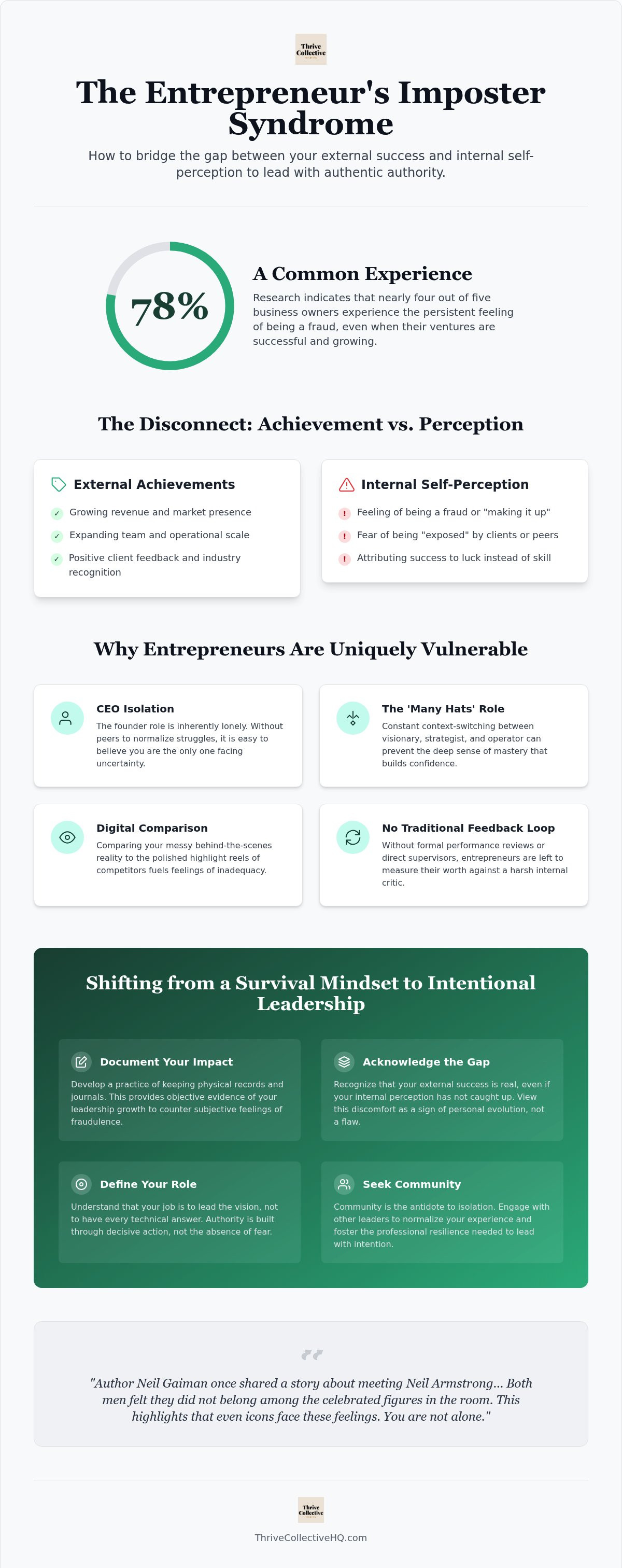
Research indicates that nearly 78 percent of business owners experience the persistent feeling that they are a fraud, a phenomenon commonly known as imposter syndrome for entrepreneurs. This feeling often stems from a lack of alignment between your external achievements and your internal self-perception as you scale your impact. Even when the revenue is growing and the team is expanding, you might find yourself waiting for the moment a client or investor realizes you are just making it up as you go. At Thrive Collective Publishing, we understand the weight of this isolation. It is a heavy burden to carry the title of CEO while comparing your messy behind-the-scenes reality to the polished highlight reels of your peers. You are not alone in this experience.
This article will show you how to bridge the gap between your external success and internal self-perception so you can lead with authentic authority. We will explore the psychological triggers unique to the visionary leader and provide practical tools to document your impact. Our goal is to help you move from a state of survival into a place of true alignment, where your professional persona and inner self finally speak the same language.
Key Takeaways
- Recognize why traditional success markers like revenue often fail to resolve internal doubt, requiring a more intentional approach to self-perception.
- Identify the specific triggers that fuel imposter syndrome for entrepreneurs, such as the isolation of the CEO role and the constant learning curves of scaling.
- Adopt a thrive versus survive dichotomy to move away from reactive anxiety and toward leading with authentic authority.
- Develop a practice of documenting your professional impact through physical records and journals to provide objective evidence of your leadership growth.
- Align your internal identity with your external success by engaging with leadership titles that focus on holistic growth and visionary intentionality.
Understanding the gap between achievement and self-perception
Impostor syndrome is a psychological pattern where individuals doubt their skills and accomplishments, fearing they will be exposed as a fraud. For the visionary leader, this often manifests in high-stakes environments where every decision feels like a test of legitimacy. You might find that traditional markers of success, such as hitting a specific revenue milestone or reaching a certain headcount, do little to quiet the internal critic. There is a fundamental difference between not knowing everything, which is a natural state of growth, and being a fraud. We encourage you to view this discomfort as a byproduct of your personal evolution rather than a character flaw. This perspective shift is central to managing imposter syndrome for entrepreneurs who are scaling their impact.
The high cost of the fraudulence myth
This persistent self-doubt often creates a cycle of overworking. You may feel you have to work twice as hard as your peers just to prove you belong at the table, which leads to exhaustion and clouds your ability to lead with clarity. When you are constantly second-guessing your intuition, decisive leadership becomes difficult. Waiting to feel 100 percent ready before making a move is a common barrier to growth. In reality, the feeling of readiness rarely arrives; authority is built through action, not through the absence of fear. Research from a 2025 NerdWallet survey showed that 52 percent of business owners felt these feelings hindered their ability to lead their teams effectively. This highlights the importance of addressing these internal gaps before they impact your legacy.
Normalizing the struggle through the Collective
Isolation is the fuel that keeps imposter syndrome for entrepreneurs alive. When you are alone in the CEO seat, it is easy to believe you are the only one struggling. The story of the "Two Neils" provides a helpful perspective. Author Neil Gaiman once shared a story about meeting Neil Armstrong at an event for high achievers. Both men felt they did not belong among the celebrated figures in the room, despite their massive contributions to culture and science. This shared experience highlights that even icons face these feelings. At Thrive Collective Publishing, we believe that community is the antidote to this isolation. By sharing these experiences within the Collective, we foster the professional resilience needed to lead with intentionality. We aim to help you move from a state of trying to survive the day to a state of thriving in your role as a visionary guide.
- Acknowledge the gap: Recognize that your external success is real, even if your internal perception has not caught up yet.
- Define your role: Understand that your job is to lead the vision, not to have every technical answer.
- Seek community: Engage with other leaders who have walked this path to normalize your experience.
Why do entrepreneurs feel uniquely vulnerable to feelings of fraudulence?
Entrepreneurial imposter syndrome is the persistent feeling of being a fraud despite having tangible evidence of success and professional growth. This occurs because founders often work in isolation (without a peer group to normalize their struggles) and frequently operate at the edge of their existing knowledge while scaling their impact.
This vulnerability often stems from the "wearing many hats" phenomenon. Unlike a specialist in a corporate role, you are required to be a visionary leader, a financial strategist, and a marketing expert simultaneously. This constant context switching can prevent the deep sense of mastery that usually builds confidence. Research from NerdWallet indicates that 78 percent of business owners have experienced this internal doubt, often because they lack the traditional feedback loops found in a standard management structure. Without performance reviews or a direct supervisor, you are left to measure your worth against an internal critic that rarely gives credit where it is due. Digital comparison culture further complicates this, as you compare your behind-the-scenes reality to the polished highlight reels of your competitors.
Operating at the edge of your expertise
Growth requires you to inhabit the role of a beginner repeatedly. Every time you reach a new level of revenue or enter a new market, you are forced to learn skills you did not possess the day before. This creates a natural tension where innovation feels like fraudulence. If you feel like you are faking it, consider that you are actually learning in real time. This discomfort is not a sign of failure; it is a sign that you are moving beyond your comfort zone to create a lasting legacy. Managing imposter syndrome for entrepreneurs involves recognizing that being at the edge of your knowledge is exactly where growth happens.
The isolation of the solo founder
The lack of a traditional management structure removes the external validation most professionals rely on to feel secure. This isolation can make every minor setback feel like a personal indictment of your ability. Building a support system is essential for maintaining your mental clarity and alignment. Engaging with leadership coaching can help you find the perspective needed to see your growth objectively. Finding a collective of peers who understand these specific pressures allows you to normalize the struggle and focus on intentionality. To support this personal evolution, we recommend exploring our curated titles for visionary leaders which provide the frameworks needed to lead with authentic authority.
Shifting from a survival mindset to intentional leadership
Moving from a state of reactive anxiety to one of proactive impact requires a fundamental shift in how you view your daily operations. The thrive versus survive dichotomy is a central theme in our work at Thrive Collective Publishing. When you are in survival mode, your energy is spent defending your position and hiding perceived weaknesses. This reactive state is where imposter syndrome for entrepreneurs thrives, as it feeds on the fear of the unknown. Intentionality serves as the primary antidote to this cycle. By choosing to lead with purpose, you replace the question of "Am I enough?" with "How can I best serve the vision?" This transition allows you to cultivate a company culture where parallel phrasing and inclusive language make every contributor feel valued and seen.
Cultivating your leadership core values
Your core values provide a steady compass when the winds of self-doubt begin to blow. When you have a clear understanding of your non-negotiables, the internal critic loses its power to disrupt your progress. In our title Game Changers, the narrative emphasizes how successful leaders use their personal mission as a filter for every business decision. This alignment creates a sense of professional integrity that is deeply grounding. A value-led business is much harder to shake with internal doubt because your actions are rooted in something larger than your individual ego. You aren't just building a company; you are cultivating a legacy that reflects your highest aspirations and your commitment to the collective good.
Practicing self-compassion as a professional skill
The relentless pace of modern entrepreneurship often suggests that rest is a sign of weakness, yet this mindset only deepens the feeling of being a fraud. We believe that self-compassion is a vital professional skill for any visionary leader. It involves a rhythmic alternation between the high-level dreaming required to set a course and the practical doing required to reach the destination. Moving away from the "hustle" culture that feeds inadequacy allows you to lead with more ease and alignment. Treat yourself with the same mentorship and encouragement you would offer a trusted team member. By acknowledging that you are a work in progress, you bridge the gap between who you are and who you are becoming, allowing your professional persona to remain authentic and heart-centered.
How can entrepreneurs document their professional impact?
Entrepreneurs can document their professional impact by maintaining a consistent record of client testimonials, project milestones, and personal reflections on leadership growth. Creating a tangible catalog of these wins serves as objective evidence to counter self-doubt and helps align daily actions with long-term visionary goals.
In a digital world where data is often ephemeral, there is a strong cognitive case for returning to paper. Physical writing engages the brain differently than typing, allowing for deeper reflection and a more permanent sense of achievement. When you see your progress recorded in your own handwriting, it becomes much harder for the internal critic to dismiss your success as luck or timing. This practice acts as a bridge between your daily tasks and the legacy you are building. By setting up a dedicated record of progress, you create a sanctuary of facts that you can return to during periods of high stress or transition. These records remind you that your authority is earned through consistent action and intentionality.
The power of the guided journal
Blank pages can sometimes feel intimidating when you are already feeling the weight of the CEO role. This is why prompts are often more effective for gaining clarity than an empty notebook. Using curated journals and keepsakes allows you to track your evolution as a leader with structure and purpose. These tools help you bypass the "I haven't done enough" filter by asking specific questions about your impact and growth. Over time, these entries become a historical catalog of your professional evolution. You are building a legacy that your future self can reference, providing a clear map of how you moved from a survival mindset to one of thriving. This documentation is a vital part of managing imposter syndrome for entrepreneurs who want to lead with authentic authority.
Collecting evidence of leadership legacy
To create a truly effective record, we suggest categorizing your wins into three specific areas: financial milestones, cultural shifts within your team, and personal breakthroughs in leadership. Financial wins are the easiest to track, but cultural and personal impacts are often what solidify your sense of worth. When a client shares how your service changed their life, or a team member expresses gratitude for your mentorship, these are the facts that dismantle the fraud narrative. Documenting this history prevents self-doubt from taking root because it replaces vague feelings of inadequacy with concrete evidence of impact. By reviewing these categories regularly, you maintain alignment between your inner self and your professional persona, ensuring that your leadership remains grounded in truth.
Browse our catalog of leadership titles
Cultivating growth through the Thrive Collective Publishing catalog
Thrive Collective Publishing serves as a sanctuary for the visionary leader who seeks deep alignment in every area of life. Our curated imprints are designed to provide the intellectual and emotional scaffolding required to scale your business while keeping your sense of self intact. Continuous learning is one of the most effective ways of managing imposter syndrome for entrepreneurs because it replaces the anxiety of the unknown with the confidence of the prepared. When you engage with our catalog, you are not just reading a book; you are entering a collective of thinkers and doers who value lasting impact over the sensationalism often found in traditional corporate media. This commitment to truth helps you build a legacy that is both ambitious and grounded.
Educational tools for scaling with ease
Our business and leadership books offer the practical management skills required to move from a hands-on founder to a strategic visionary. This transition is often where the internal critic is loudest, as it requires you to delegate the tasks you once mastered. Structured resources provide the clarity needed to lead with authentic authority during these periods of rapid change. As an independent press based in New Mexico, we are deeply rooted in Southwest literary culture, which prizes authenticity and the power of the individual voice. We believe that every business challenge is an opportunity for personal evolution. By providing titles that focus on intentionality and community, we help you cultivate a professional persona that feels as genuine as your daily reality.
The next steps in your leadership path
Choosing to commit to a practice of intentional growth is the final step in bridging the gap between your external success and your internal self-perception. In the title Turning Chaos into Gold, readers find a roadmap for moving through the inherent messiness of growth while staying true to their core values. This alignment is what allows you to invite your team and your investors into your collective vision with total confidence. Your unique voice is a vital contribution to the entrepreneurial landscape, and your specific perspective is something that no one else can replicate. By documenting your impact and seeking out resources that support your whole self, you ensure that your leadership is built on a foundation of integrity. This process is not about becoming someone else; it is about finally becoming the leader you already are.
To manage the feelings of fraudulence that often accompany success, begin by documenting your daily wins in a physical journal to create a tangible record of your impact. Seek out a community of peers who can normalize your experiences and provide the external perspective needed to see your growth objectively.
We recommend reading Turning Chaos into Gold for its practical approach to maintaining leadership alignment during high-pressure transitions. This title offers the frameworks necessary to transform the stress of scaling into a sustainable legacy of purpose.
If you would like to stay connected with our community, please join our newsletter or contact us at info@thrivecollectivehq.com for more information. Cordova Consulting LLC, dba Thrive Collective Publishing, New Mexico, USA.
Stepping into your authentic leadership legacy
Managing imposter syndrome for entrepreneurs is not about waiting for the fear to disappear; it is about choosing to lead with intentionality while the fear is still present. By documenting your professional impact and shifting from a survival mindset to one of thriving, you bridge the gap between your external success and your internal self-perception. We believe that your unique voice is a vital contribution to the entrepreneurial landscape. As a New Mexico based independent press and a member of the Independent Book Publishers Association (IBPA), our mission is to support soulful ambition and professional impact through curated resources.
You have already built something remarkable. Now is the time to align your inner world with the authority you have earned in the outer world. We are here to support you in every step of this personal evolution as you cultivate a legacy that reflects your highest purpose.
Frequently Asked Questions
What is the most effective way to handle imposter syndrome as a new founder?
Focus on documenting small wins immediately to build a foundation of evidence for your progress. New founders often feel overwhelmed by the unknown, which makes it easy to dismiss early successes as mere luck. By keeping a record from your first day, you create an objective history of your growth as a visionary leader. This practice helps bridge the gap between your previous identity and your new professional role.
How does imposter syndrome differ from actual lack of experience?
Imposter syndrome is characterized by a persistent fear of being exposed as a fraud despite clear evidence of success. In contrast, a lack of experience is a neutral state of needing more skill development in a specific area. If you have happy clients and growing revenue, yet still feel like a fraud, you are likely experiencing imposter syndrome for entrepreneurs. This is managed by internal alignment rather than just learning.
Can imposter syndrome ever be a positive sign for my business?
These feelings often signal that you are operating at the edge of your comfort zone, which is where true innovation happens. If you never felt like a fraud, you might not be pushing your boundaries or scaling your impact. Viewing this discomfort as a byproduct of personal evolution allows you to move from survival to thriving. It indicates that you are stepping into a bigger version of yourself.
How do I talk to my team about my feelings of self-doubt without losing authority?
Focus on vulnerable transparency regarding the challenges of growth rather than questioning your own technical competence. You can acknowledge that a specific project is pushing the boundaries of the company's current expertise. This invites your team into the collective vision and fosters a culture of shared intentionality. Authority is built on honesty and the ability to lead through uncertainty, not on having every answer at all times.
What are some practical daily habits to reduce feelings of being a fraud?
Incorporate a five minute reflection period at the end of each day to record one specific impact you made. This habit shifts your focus from what you did not do to the legacy you are building. Additionally, practicing rhythmic alternation between high-level dreaming and practical doing keeps your daily tasks grounded in purpose. Consistent physical writing in a guided journal helps solidify these wins in your long-term memory.
Is it common for successful entrepreneurs to feel like frauds years into their business?
Yes, research indicates that these feelings often persist or even intensify as the stakes get higher and the team grows. As you scale, you are constantly entering new tiers of leadership that you have not mastered yet. This recurring cycle is a standard part of the entrepreneurial path. Recognizing that even established icons face these doubts helps normalize your experience and reduces the sense of isolation felt in the CEO role.
How can reading leadership development books help manage imposter syndrome?
Titles focused on professional growth provide the frameworks and vocabulary needed to understand your internal experiences. Reading about how others have managed similar challenges helps align your inner self with your professional persona. Our catalog at Thrive Collective Publishing offers resources that emphasize intentionality and soulful ambition. These structured tools replace reactive anxiety with a clear roadmap for scaling your impact with ease and integrity.
What role does community play in overcoming entrepreneurial self-doubt?
Community provides the external perspective needed to see your achievements objectively when your internal critic is too loud. Engaging with a collective of peers allows you to share challenges and realize that your struggles are not unique. This connection breaks the cycle of isolation that fuels imposter syndrome for entrepreneurs. By joining a movement of visionary leaders, you move toward a state of thriving through shared support and collective wisdom.

Article by
Kimberly Cordova
Kimberly Burk Cordova is the founder of Thrive Collective Publishing, an independent multi-imprint publishing house based in Santa Fe, New Mexico. She is the author of books on leadership, business growth, AI and automation, emotional intelligence, and personal development, written for readers who want clear thinking, useful frameworks, and books they actually finish.
Before turning her full attention to publishing, Kimberly spent more than two decades in strategy, operations, and program leadership, working with public agencies and private organizations on transformation, technology, and large-scale change. That operator's lens shows up in everything she writes and publishes: real frameworks, real numbers, no fluff.
As publisher, she leads a catalog of more than 80 titles from six authors across multiple imprints, spanning literary suspense, true crime, children's biography, relationships, travel, guided journals, and coloring books. The house publishes regularly across its core series, including The Casita Series, Shadows of the Past, the Young Legends Collection, The Growth Leader Collection, the AI and Automation Blueprint, The Heirloom Series, The Art of Manifestation, the Just Write Collection, and Travel: Destination Guides.
She lives in Santa Fe with her husband Greg, a self-taught silversmith and lapidary artist. When she is not writing or publishing, she is building Wildflower Artisans, their Turquoise jewelry brand, or curating the next round of Just Write journals.
Connect with Kimberly and Thrive Collective Publishing at thrivecollectivehq.com.