

Your book proposal is not a simple summary of your writing (it is a visionary business plan for your intellectual legacy). At Thrive Collective Publishing, we believe your leadership expertise deserves a platform that reflects your true impact and soulful ambition. You might feel the pressure to finish every chapter before seeking a partner, or perhaps you worry that your social media reach is too small to interest a traditional press. We understand the specific tension of trying to distill years of complex concepts into a single pitch. Learning how to write a book proposal is the first step toward moving from a state of dreaming to a state of doing.
We are here to offer a clear roadmap that replaces confusion with intentionality and alignment. This article outlines how to position your title in a crowded market and helps you decide if traditional or independent publishing fits your long-term vision. We will explore the structural elements required for a professional pitch and how to demonstrate your reach to editors. By following this blueprint, you will gain the clarity needed to invite readers into your work and secure your place in our growing literary collective.
Key Takeaways
- Learn how to write a book proposal that functions as a strategic business plan, positioning your expertise for success before you finish the manuscript.
- Master the art of the overview to create a high-level hook that captures the vision and purpose of your work for potential editors.
- Gain clarity on your market position by identifying recently published titles that serve as your neighbors on the shelf.
- Evaluate your author platform by documenting your reach through professional credentials, speaking engagements, and community connections.
- Understand the submission standards at Thrive Collective Publishing to move your leadership title from a concept to a published reality.
What is a book proposal and why does a non-fiction author need one?
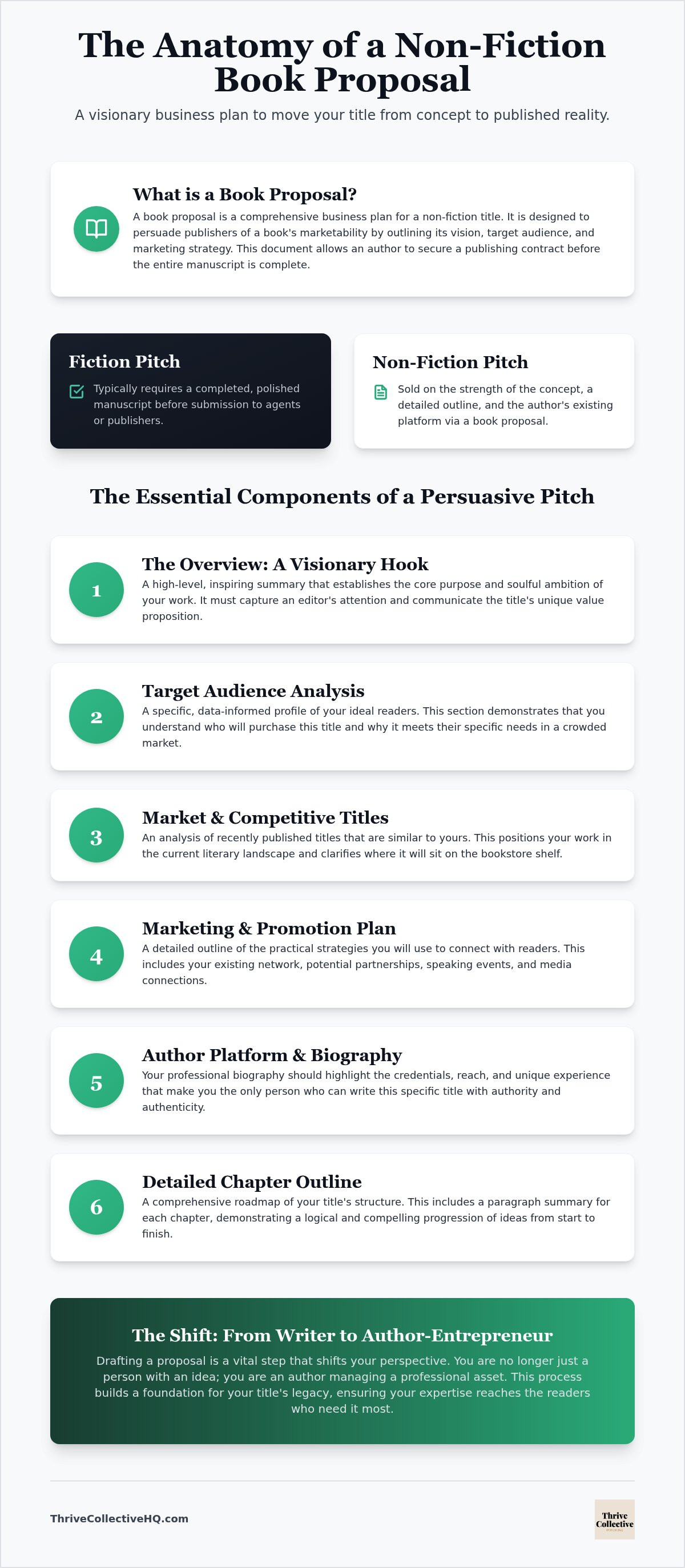
A book proposal is a comprehensive business plan for a non-fiction title that serves as a persuasive document to convince publishers of a book's marketability. It outlines your vision, target audience, and marketing strategy, allowing you to secure a contract before the entire manuscript is even written.
For a leader, this document is a tool for personal and professional evolution. It forces you to clarify your message, define your impact, and refine your voice before committing to a 50,000 word draft. At Thrive Collective Publishing, we view the proposal as a bridge between your expertise and the readers who need your guidance. Our editorial team uses this document to assess financial risk, evaluate market potential, and ensure alignment with our current catalog of leadership and growth titles. This structured approach helps us cultivate a community of authors who are as invested in their readers' success as they are in their own. By presenting a clear roadmap, you demonstrate that your work is built on a foundation of intentionality and purpose.
The difference between fiction and non-fiction pitches
In the world of fiction, a writer must typically finish the entire manuscript before seeking representation or a contract. Non-fiction is unique because it is often sold on the strength of the concept, the outline, and your existing author platform. Understanding the publishing process helps you see why the proposal is your most valuable asset. Entrepreneurs who learn how to write a book proposal save significant time by validating their ideas before the heavy lifting of writing begins. This approach ensures market fit and allows you to build a community around your message while the title is still in development. Whether you are looking at traditional imprints or our own submission guidelines, the proposal remains the industry standard for non-fiction excellence.
The psychological shift from writer to author-entrepreneur
Drafting a proposal requires you to step into the role of a visionary guide. You are no longer just a person with an idea; you are an author-entrepreneur managing a professional asset. This shift in perspective is vital for creating a legacy that extends beyond the pages of your title. The process builds a foundation for your future marketing efforts by identifying exactly who your readers are and how your work solves their specific challenges. When you view your book as a tool for community growth, the work of writing becomes an act of service and alignment. Learning how to write a book proposal helps you move from a state of dreaming to a state of doing, ensuring your leadership expertise reaches the people who need it most.
The essential components of a persuasive non-fiction pitch
Your proposal is a visionary blueprint for your impact. To understand how to write a book proposal that stands out, you must treat every section as a building block for your legacy. The essential components of a persuasive non-fiction pitch include an overview, target audience data, a marketing plan, and a detailed chapter outline. These elements work together to prove that your title is both necessary and commercially viable in today's literary landscape.
The overview functions as a high-level, inspiring hook. It establishes the purpose of the work and signals your soulful ambition. Following this, the target audience section requires specific data. You must identify exactly who will read this title and why it meets their needs in a crowded market. Your marketing plan then details the practical strategies you will use to move copies once the book is published, such as specific newsletter partnerships or community events. Finally, the chapter outline provides a roadmap of your leadership framework, showing a logical progression from one concept to the next. Learning how to write a book proposal involves more than just filling out a template; it's about crafting a narrative of professional evolution.
Crafting an irresistible author biography
Your biography should highlight professional management skills and strategic growth achievements. We look for authors who can explain why their unique experience makes them the only person to write this specific story. If your background is in leadership coaching, use those years of mentorship as a foundation for your authority. It demonstrates that your ideas have already helped others thrive in real-world scenarios. This personal connection bridges the gap between your expertise and the individual reader, making your pitch feel like a one-on-one conversation.
Sample chapters: Proving your editorial voice
Proving your editorial voice requires selecting the most impactful 20 to 30 pages of your work. These chapters should showcase a rhythmic alternation between short, punchy declarations and longer, descriptive passages that paint a picture of a desired future. It's vital to include at least one concrete example or number in every section to maintain a grounded, editorial feel. By reviewing our curated leadership titles, you can see how successful authors balance visionary theory with practical application. This balance keeps the reader engaged by providing quick insights alongside deeper, more reflective thoughts.
Analyzing the market: Competitive titles and target readers
Understanding where your title sits on a physical or digital shelf is a vital part of the editorial process. When you research how to write a book proposal, you will find that comparative title analysis is not about finding books to replace yours. Instead, it is about identifying your neighbors. These are the works that your ideal reader already owns and appreciates. We look for authors who can identify at least five titles published within the last three to five years by major publishers or serious independent imprints. This timeframe ensures your market data is current and reflects the present interests of the literary community.
Analyzing these titles requires a sophisticated touch. You should observe what these books did effectively and where they left a gap for your specific perspective. A successful proposal uses these comparisons to highlight a unique contribution to the field. For example, Artificial Intelligence Unleashed: An Entrepreneur’s Guide to Innovation serves as an excellent model for niche positioning. It addresses a specific technological evolution while remaining grounded in practical management skills, showing exactly how a new title can complement existing literature without repeating it.
Finding your competitive titles
To find these neighbors, you can use professional resources like Publishers Weekly or the Authors Guild to track recent releases in your genre. Look beyond the temporary popular lists to find titles with sustained impact and active communities. When you draft the section on how your work differs, avoid disparaging other authors. Frame your title as a complementary piece that expands on a specific theme or offers a fresh framework for a familiar challenge. This approach demonstrates professional maturity and an understanding of the collective nature of the publishing world.
Defining the reader avatar
A persuasive pitch moves beyond broad demographics like age or location. You must define the emotional state of your reader and the specific problems they face as modern business owners. Are they feeling overwhelmed by rapid change, or are they seeking a sense of alignment in their daily operations? By focusing on these soulful needs, you can position your work as a necessary guide for their personal evolution. Aligning your title with the leadership and growth needs of your community ensures that your message resonates deeply and creates a lasting legacy. This clarity is the hallmark of a visionary author who understands how to write a book proposal that commands the attention of the entire industry.
How do you demonstrate an author platform for a book proposal?
An author platform is the existing reach and influence a writer possesses within their specific niche or community, demonstrated through email subscriber lists, speaking engagements, professional credentials, and social media presence to prove to a publisher that a built-in audience is ready to purchase the title.
Trust and connection define the essence of a platform more than raw follower counts. At Thrive Collective Publishing, we look for authors who have cultivated a community of readers who value their specific leadership expertise. For entrepreneurs, your existing business networks are a powerful foundation. You don't need millions of followers to succeed. You need a dedicated collective of people who view you as a visionary guide. When you understand how to write a book proposal, you realize that your platform is the evidence that your message already has impact.
Measuring your digital and physical reach
Quantifying your reach requires an honest look at your data. List your email subscribers, podcast appearances, and keynote history with precision. If you've spoken at three major industry conferences in the last year, include those numbers. Professional certifications and management skills also establish authority. They prove you've done the work. We value the quality of your engagement over the quantity of your followers. A list of 500 highly engaged professionals is often more valuable to a publisher than 50,000 passive scrollers.
Building platform while you write
You don't have to wait for a finished manuscript to start growing your impact. Cultivating a community happens in the quiet moments of the drafting process. Many of our authors use journals and keepsakes to test their frameworks with their audience. This allows you to see which concepts resonate most deeply before the book enters our catalog. Intentionality is the key here. Every newsletter you send and every conversation you have is a brick in the foundation of your platform. Learning how to write a book proposal helps you see that every interaction is an opportunity for personal evolution.
The path from proposal to published title with Thrive Collective Publishing
Thrive Collective Publishing operates as a serious independent press, prioritizing soulful ambition alongside practical management skills. We aren't a content factory. We are a boutique partner for leaders who want to create work that lasts. Our process is designed to ensure that every title we publish represents a deep alignment between the author's expertise and our editorial standards. Understanding how to write a book proposal is essential because it is the first formal interaction we have with your work. It serves as the foundation for a partnership built on integrity and mutual belief in your potential.
The submission process begins with a formal review of your proposal and sample chapters. We look for clarity, market awareness, and a voice that speaks directly to the individual entrepreneur. Accepted authors receive a professional publishing agreement and full editorial support from our team in New Mexico. This partnership ensures that your intellectual legacy is handled with the care it deserves. You can review our submission guidelines to understand our current editorial focus and specific genre interests.
What we look for in a new author
We seek authors who act as visionary guides for their communities. These are individuals committed to holistic success rather than just financial gain. When we evaluate a pitch, we look for titles that fit naturally within our established imprints and series, such as business growth or personal evolution. Your work should reflect a commitment to scaling with ease and an understanding that success is a collective endeavor. We prioritize manuscripts that offer practical solutions while maintaining an aspirational atmosphere that encourages readers to step into a bigger version of themselves.
The editorial and production flow
Once an agreement is signed, we move into a structured editorial and production flow. This includes deep manuscript development to ensure your message is as punchy and impactful as possible. Our design team creates covers inspired by a Red Dot award-winning aesthetic, ensuring your title stands out in any setting. A key part of our indie publishing strategy involves using KDP and IngramSpark to reach a global audience of readers. We are dedicated to moving our community from a state of dreaming to a state of doing through our curated catalog of professional titles. By the time your book is published by our press, it will be a professional asset ready to command attention in a crowded market.
Step into your author legacy
Thrive Collective Publishing is a New Mexico independent press focusing on leadership and legacy. We provide accepted authors with professional agreements and expertise in Amazon KDP and global distribution. You now have the roadmap for how to write a book proposal that captures your soulful ambition. If you're ready to share your vision, review our submission guidelines or contact our editorial team at info@thrivecollectivehq.com for more information.
Your expertise is a professional asset that deserves a platform for growth and intentional impact.
Start by outlining your framework and identifying five competitive titles to ground your work. This clarity ensures your message is aligned with the needs of your community and ready for professional review.
We recommend Artificial Intelligence Unleashed: An Entrepreneur’s Guide to Innovation. This title models how to position complex leadership concepts for a modern audience while maintaining a visionary tone.
Contact info@thrivecollectivehq.com to learn more about our community. Cordova Consulting LLC, dba Thrive Collective Publishing, New Mexico, USA.
Frequently Asked Questions
Do I need a literary agent to submit a book proposal to Thrive Collective Publishing?
You don't need a literary agent to submit your work to our press. We accept direct submissions from authors who align with our visionary guide model and demonstrate high level professional authority. While many large imprints require agency representation, we prefer to cultivate a direct relationship with our community. This allows for a more personal and heart centered partnership throughout the entire publishing process.
How long should a standard non-fiction book proposal be?
A standard proposal typically ranges from 30 to 50 pages. This includes your overview, market analysis, marketing plan, and approximately two sample chapters. Quality matters more than page count. You should focus on distilling your complex leadership concepts into a clear pitch that demonstrates your professional impact. Every page should serve a specific purpose in proving the commercial viability and soulful ambition of your title.
Can I submit a proposal if I have already self-published the book?
We generally prioritize new, unpublished works to maintain the integrity of our catalog. However, we may consider previously self-published titles if you can demonstrate significant audience growth or a need for a fresh editorial perspective. If you've sold over 5,000 copies independently, your platform might make a compelling case for a new edition. In most cases, we encourage authors to focus on their next project to build their legacy.
What is the most common reason a book proposal gets rejected?
The most common reason for rejection is a lack of a clear author platform. Publishers need to see that you have an existing reach within your specific niche or community. If you don't have a built in audience ready to purchase the title, the financial risk becomes too high. Another frequent issue is failing to explain how your work differs from existing neighbors on the shelf. Learning how to write a book proposal requires proving both your expertise and your market fit.
How much of the book should be written before I send the proposal?
You should have a detailed chapter outline and one to two polished sample chapters ready before submitting. Non-fiction titles are often sold on the strength of the proposal rather than a finished manuscript. This allows you to refine your message based on editorial feedback before committing to 50,000 words. Writing the proposal first ensures your work is in total alignment with market needs and your own professional evolution goals.
Is it possible to write a book proposal for a memoir?
Yes, it is possible to write a proposal for a memoir, though it functions slightly differently than a standard business title. A memoir relies heavily on your editorial voice and the narrative arc of your personal evolution. You must still demonstrate why your story matters to a wider community and how it fits into current literary trends. Memoirs often require more sample pages to prove that you can sustain a reader's interest through a descriptive narrative.
Does Thrive Collective Publishing charge authors for publishing services?
We do not charge authors for our publishing services. As a serious independent press, we operate under professional publishing agreements where we invest in the production, design, and distribution of accepted titles. We are not a hybrid or vanity press. Our success is tied to yours, creating a collective endeavor where we both thrive. We prioritize titles that demonstrate expertise and the potential for a lasting legacy.
How do I handle competitive titles if I think my book is truly unique?
Even the most unique work has neighbors on the shelf. You should look for titles that your ideal readers already enjoy and appreciate. If your book covers a niche within leadership coaching, find other titles that serve business owners or entrepreneurs. Use these comparisons to highlight the specific gap your work fills. Learning how to write a book proposal involves showing that a market already exists for your ideas, even if your specific framework is entirely new.

Article by
Kimberly Cordova
Kimberly Burk Cordova is the founder of Thrive Collective Publishing, an independent multi-imprint publishing house based in Santa Fe, New Mexico. She is the author of books on leadership, business growth, AI and automation, emotional intelligence, and personal development, written for readers who want clear thinking, useful frameworks, and books they actually finish.
Before turning her full attention to publishing, Kimberly spent more than two decades in strategy, operations, and program leadership, working with public agencies and private organizations on transformation, technology, and large-scale change. That operator's lens shows up in everything she writes and publishes: real frameworks, real numbers, no fluff.
As publisher, she leads a catalog of more than 80 titles from six authors across multiple imprints, spanning literary suspense, true crime, children's biography, relationships, travel, guided journals, and coloring books. The house publishes regularly across its core series, including The Casita Series, Shadows of the Past, the Young Legends Collection, The Growth Leader Collection, the AI and Automation Blueprint, The Heirloom Series, The Art of Manifestation, the Just Write Collection, and Travel: Destination Guides.
She lives in Santa Fe with her husband Greg, a self-taught silversmith and lapidary artist. When she is not writing or publishing, she is building Wildflower Artisans, their Turquoise jewelry brand, or curating the next round of Just Write journals.
Connect with Kimberly and Thrive Collective Publishing at thrivecollectivehq.com.