

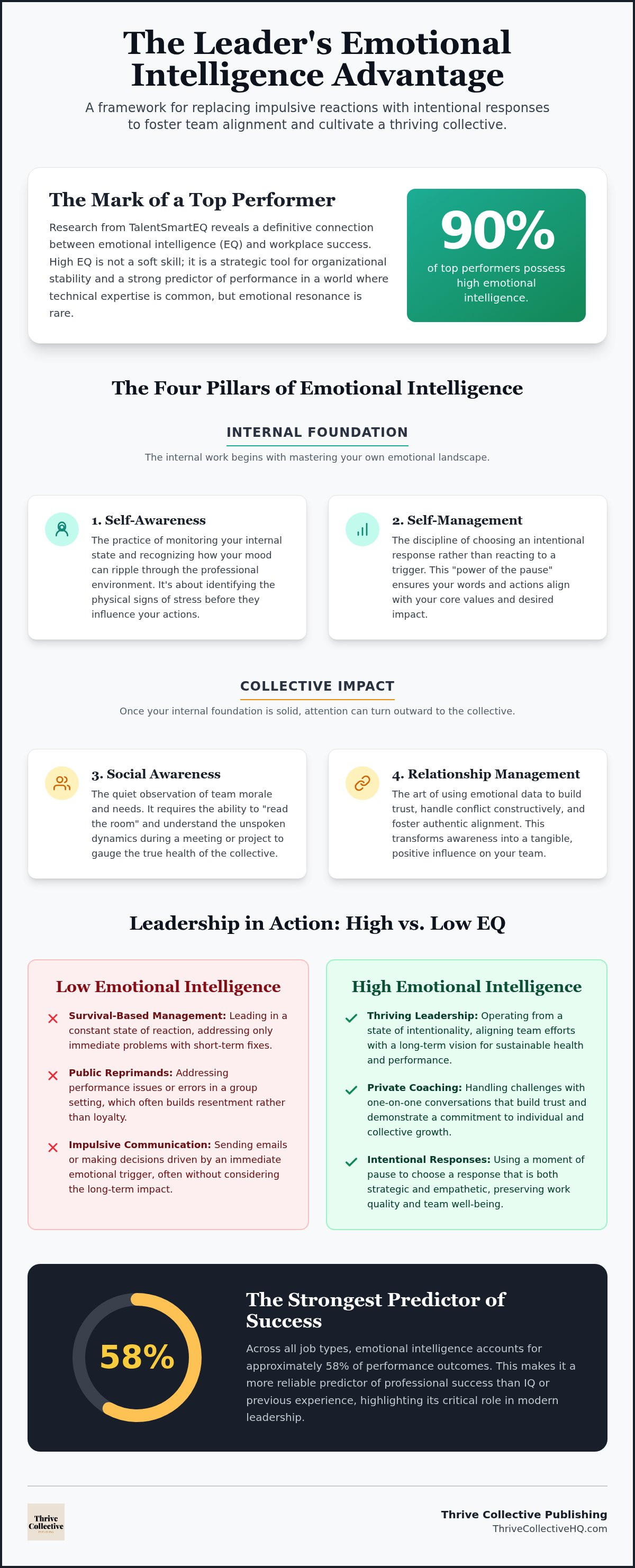
Research from TalentSmartEQ indicates that 90% of top performers in the workplace possess high emotional intelligence, yet many leaders still struggle to bridge the gap between authority and connection. Applying emotional intelligence at work real examples involves replacing impulsive reactions with intentional responses through self-awareness and social management to foster team alignment. You might recognize the heavy silence after a difficult conversation or the frustration of a team that feels misaligned with your vision. Thrive Collective Publishing: Books, Journals, and Guides views these human skills as the strongest predictor of performance in an AI-driven world, where technical expertise is common but emotional resonance is rare.
We understand that leading a collective requires more than just strategic oversight; it demands a deep commitment to personal evolution and social awareness. This article explores how you can use emotional intelligence as a practical tool to manage stress, handle conflict, and foster authentic alignment within your organization. We will examine concrete scenarios that illustrate these principles in action, drawing on the leadership insights of authors like Kimberly Burk Cordova. By the end of this piece, you will have a clear framework for applying these insights to your own leadership legacy.
Key Takeaways
- Learn to distinguish between reacting to immediate stress and choosing an intentional response that maintains the stability of your professional environment.
- Study emotional intelligence at work real examples to understand how private coaching builds more loyalty than public reprimands.
- Discover how a daily practice of reflection using a digital detox journal helps you identify and manage your internal state before interacting with your team.
- Understand the connection between self-management and team alignment to create a sustainable collective impact that goes beyond financial performance.
What does emotional intelligence look like in a professional setting?
Professional emotional intelligence is the practiced ability to identify and govern your own emotional state while recognizing and influencing the feelings of those around you. This skill serves as a foundation for team alignment, allowing leaders to replace impulsive reactions with intentional choices that support the health of the entire collective.
Thrive Collective Publishing recognizes that leadership is a craft of human connection rather than just technical oversight. When we look at emotional intelligence, we aren't discussing a soft sentiment; we're describing a strategic tool for organizational stability. Leaders who lack this skill often find themselves in a cycle of survival based management, reacting to every fire with high cortisol and short term fixes. In contrast, those who cultivate these skills move into a state of thriving leadership.
The difference between empathy and emotional intelligence
While empathy is the capacity to feel what another person is experiencing, it is only one component of a broader skill set. True leadership requires balancing that emotional resonance with professional boundaries and strategic management. For instance, consider emotional intelligence at work real examples like a project manager noticing a lead designer's fatigue during a high stakes launch. Instead of simply feeling bad for the employee, the leader strategically extends a deadline by 48 hours. This choice isn't just kind; it's a calculated move to preserve the quality of the work and the long term health of the team.
Why entrepreneurs prioritize these skills today
Scaling a business is a collective effort that requires more than just a high IQ or a solid business plan. Research shows that emotional intelligence accounts for approximately 58 percent of performance outcomes across all job types, making it the single strongest predictor of success in the workplace. In our catalog, author Kimberly Burk Cordova emphasizes that intentionality is the bridge between a visionary's dream and a team's execution. By moving away from the cold, traditional corporate structures of the past, modern leaders are adopting a mentor like authority that fosters deep loyalty. You can find more about these strategies in The Emotional Intelligence Advantage, which serves as a guide for those ready to evolve their leadership style.
The four pillars of the emotional intelligence advantage
Building a leadership legacy requires a structured approach to your internal and external world. These pillars help you identify emotional intelligence at work real examples in your own daily interactions. The framework for this development rests on four distinct areas: self-awareness, self-management, social awareness, and relationship management. These aren't just abstract concepts; they're the mechanics of how you show up for your team every day. In the seminal article What Makes a Leader?, it's noted that emotional intelligence is the sine qua non of leadership. Without it, a person can have the most rigorous training, an incisive mind, and an endless supply of smart ideas, but they still won't make a great leader.
Mastering self-awareness and self-management
The internal work begins with self-awareness. This is the practice of monitoring your internal state and recognizing how your mood ripples through the office. If you enter a meeting feeling frazzled, your team will likely mirror that anxiety. You can use our guided journals from Cordova Creations to track these patterns over a 30 day period. By identifying the physical signs of stress, such as a tight chest or a sharp tone, you can intervene before you send an impulsive email. Self-management is the discipline of choosing your response rather than reacting to a trigger. It's the power of the pause. This moment of silence ensures your words align with your core values and the impact you want to leave behind.
Social awareness and the power of the collective
Once you understand your own landscape, you can turn your attention outward. Social awareness is the quiet observation of team morale and needs. It requires you to read the room and understand the unspoken dynamics during a meeting. Are people hesitant to speak? Is there a hidden tension between departments? Relationship management then becomes the art of using this emotional data to build trust. You can see emotional intelligence at work real examples when a leader uses active listening to hear what isn't being said, then addresses the root cause of a conflict with ease. Cultivating a community within your business means recognizing the individual contributions that make the collective whole. When you align these pillars, you move from managing tasks to leading people with intentionality. If you're looking to deepen this practice, exploring our curated leadership titles can provide the tactical steps needed for your growth.
Real examples of high versus low emotional intelligence at work
Understanding the theory is only the first step. To truly evolve, you must be able to recognize emotional intelligence at work real examples in the high stakes environment of your daily operations. The difference between a leader who fosters a thriving culture and one who merely manages tasks often comes down to their response to pressure. Research indicates that individuals with high emotional intelligence earn approximately $29,000 more annually than those with lower scores. This financial gap reflects the tangible value of being able to align a team toward a shared legacy without the friction of unresolved conflict.
Consider the contrast in how leaders handle a missed deadline. A leader with low emotional intelligence might ignore the lapse to avoid discomfort, or conversely, send a sharp, public message demanding immediate results. This creates a culture of fear or apathy. A high EQ leader chooses a different path. They initiate a private conversation to identify the obstacle causing the delay. By asking if the team member has the necessary resources, the leader reinforces the idea that the business is a collective endeavor. This approach builds loyalty and ensures that the project remains aligned with the original vision.
Scenario one: Handling a difficult feedback loop
When reviewing a team member's work, a low EQ approach involves delivering a cold list of errors without context. This often leaves the individual feeling defensive and disconnected from the project's goals. In contrast, a high EQ leader starts by asking about the creator's intent for the specific title or task. This simple shift in perspective allows the team member to feel heard and empowered. They become a partner in the solution rather than a recipient of criticism. You can find more strategies for these conversations in our leadership and growth collection.
Scenario two: Managing team conflict during a pivot
Business pivots are inherently stressful. A leader operating from a survival mindset might demand strict compliance with new rules without acknowledging the transition stress. This often results in resistance and reduced morale. A visionary leader validates the difficulty of the change first. They paint a clear picture of the desired future while providing the emotional support needed to reach it. This moves the team from a state of survival into a state of alignment, ensuring the pivot is a success for the entire collective. The cost of low EQ in these moments is high, often resulting in the loss of talented authors and a diminished reputation within your professional community.
How can a leader improve their emotional intelligence?
Emotional intelligence improvement requires a commitment to daily self-reflection, intentional habit formation, and the active pursuit of feedback from a professional collective. By engaging with leadership titles and utilizing guided journals, a leader develops the self-awareness necessary to replace impulsive reactions with thoughtful, strategic responses that foster team alignment.
Growth in this area begins with clearing the mental clutter that accumulates during a typical workday. Thrive Collective Publishing suggests that you begin by setting aside time for quiet reflection. When you review emotional intelligence at work real examples from your own history, you can identify where your reactions served the collective and where they fell short. This awareness allows you to address blind spots in your management style before they impact team morale. Seeking feedback from a trusted mentor or a peer group provides an external perspective that is often difficult to see from the center of the action. You might also practice active listening by summarizing what a team member has said before you offer a solution. This simple step ensures that your team feels heard and valued, which is essential for long term retention.
The role of intentionality in daily habits
Your morning routine sets the tone for your entire organization. By setting a specific intention for how you want to show up for your team, you move from a state of reacting to a state of leading. We recommend using the heirloom series of journals to document your thoughts and track your progress as you build your leadership legacy. Reading titles from authors like Kimberly Burk Cordova can help you deepen your understanding of visionary leadership and the human element of business. These practices help you recognize the physical signs of stress, allowing you to pause before making decisions that require a calm, clear mind.
Building a supportive professional community
No visionary succeeds in a vacuum, and your growth is often mirrored by the growth of those around you. You can join or create a book club at work to discuss growth oriented titles and share insights with your peers. This focus on collective growth rather than individual competition creates a culture of integrity and support. Professional development is a continuous process of personal evolution. As you commit to this practice, you will find that your ability to manage difficult conversations and complex dynamics improves. Research shows that 42 percent of companies now offer emotional intelligence training to their senior managers, acknowledging that these human skills are the strongest predictor of organizational performance.
Cultivating a collective culture through intentional leadership
Emotional intelligence at work real examples show that a leader's ability to govern their own emotional state determines the stability and health of the entire organization. By aligning personal values with business goals, a visionary leader creates a ripple effect that reduces conflict and fosters deep team loyalty. This practice involves moving from the survival mindset of a founder to the intentional focus of a leader who prioritizes the collective energy of the office over mere task completion.
The transition from founder to leader requires a shift in focus from technical mechanics to human dynamics. While a founder might be obsessed with the logistics of a launch, a leader observes the emotional readiness of the team. In high performing organizations, research shows that 90 percent of top performers possess high emotional intelligence, proving that these human skills are the strongest predictor of long term success. Thrive Collective Publishing provides the resources for this evolution, offering a catalog of titles designed for those who believe that success is a collective endeavor rather than a solo pursuit. When you lead with intentionality, you aren't just managing a business; you're cultivating a community where every individual feels empowered to contribute to a shared legacy.
Choosing the right titles for your growth
As you refine your management style, explore our catalog for titles that resonate with your current leadership challenges. You might consider The Emotional Intelligence Advantage as a starting point for your team. This title provides a framework for moving from reactive behavior to strategic resonance. We believe in focusing on quality over quantity when selecting your professional development goals. A single, well chosen book that aligns with your values will have a more profound impact on your organization than a dozen surface level resources. This intentional approach ensures that your growth is both authentic and sustainable.
Next steps for the visionary entrepreneur
Growth is a continuous process of personal evolution that requires both study and practice. Identify one specific skill to practice this week, such as active listening or monitoring your physical response to stress. Small, consistent changes lead to the most significant progress in team alignment. Visit the books collection to find your next mentor on the shelf and discover titles that support your vision. For inquiries regarding professional development titles or to learn more about our authors, please contact info@thrivecollectivehq.com. We are here to support you as you move from a state of dreaming to a state of doing, building a business that allows both you and your team to thrive.
Step into your visionary leadership legacy
Emotional intelligence is not a passive trait; it's a strategic practice that requires deep intentionality and a commitment to personal evolution. By identifying emotional intelligence at work real examples in your own leadership, you move from a state of survival to one of alignment. We've explored how self-awareness and social management function as the pillars of a thriving collective culture. The shift from managing tasks to leading people is the hallmark of a true visionary. It requires a dedicated focus on the individual contributions that make your collective whole.
As an independent publisher, Thrive Collective Publishing maintains a serious editorial voice that trusts you, the reader. We offer a curated selection of professional development books that focus on the visionary leader's growth and the long-term impact of your work. We believe that success is a collective endeavor, and we are honored to be part of your professional evolution.
You have the capacity to lead with both authority and heart. We believe in your potential to create a lasting legacy through every intentional interaction you have with your team.
Frequently Asked Questions
What are some practical examples of emotional intelligence in the workplace?
Practical examples include a manager pausing a meeting to address a palpable tension in the room or a CEO choosing to deliver disappointing news in person rather than via email. These emotional intelligence at work real examples demonstrate that EQ is about choosing the response that serves the collective. It involves recognizing a team member's non-verbal cues and adjusting your communication style to ensure clarity and support.
Can emotional intelligence be learned or is it an innate trait?
Emotional intelligence is a skill set that you can develop through intentionality and consistent practice. While some individuals may have a natural aptitude for social awareness, the capacity to regulate your own emotions and influence others is not fixed. Engaging with leadership development titles and practicing daily reflection allows you to strengthen these human skills over time. It is a process of personal evolution that requires patience and commitment.
How does emotional intelligence impact team productivity and retention?
Leaders with high EQ create environments where employees feel safe to take risks and share honest feedback. This psychological safety directly impacts productivity by reducing the mental energy spent on office politics or conflict management. Research from TalentSmartEQ shows that 90 percent of top performers have high emotional intelligence. When you lead with alignment and empathy, you reduce turnover and build a loyal community that is invested in your legacy.
What is the first step for a leader to improve their EQ?
The first step toward improvement is cultivating deep self-awareness through a daily practice of reflection. You might start by using a digital detox journal to identify the physical and mental triggers that cause you to react impulsively under stress. By documenting these patterns, you can develop the discipline to pause before responding. This allows your actions to align with your core values rather than your immediate emotional state.
Is there a difference between emotional intelligence and being nice?
Emotional intelligence is a strategic management tool, whereas being nice is often a surface level behavior aimed at avoiding discomfort. High EQ leaders are capable of delivering difficult feedback and enforcing professional boundaries because they understand the long term impact of those decisions. It is about being effective and authentic rather than simply pleasant. True EQ involves having the courage to navigate difficult conversations while maintaining a deep respect for the individual.
How can I measure the emotional intelligence of my team?
You can assess your team's emotional intelligence by observing how they handle setbacks and resolve internal disagreements. Teams with high EQ tend to recover quickly from failure and engage in constructive conflict rather than passive aggressive behavior. You might also look at the quality of their collaboration and their ability to provide supportive feedback to one another. Measuring these human skills requires consistent observation of the collective energy and interpersonal dynamics.
Why is self-awareness considered the foundation of leadership EQ?
Self-awareness is the foundation because you cannot influence the emotions of others if you are unaware of your own internal landscape. It acts as a mirror that allows you to see how your mood and behavior affect the office environment. Without this clarity, a leader is likely to react to stress in ways that create disconnection. Recognizing your own triggers is the prerequisite for the self-management needed to lead with intentionality.
What happens to a business culture when a leader lacks emotional intelligence?
A lack of emotional intelligence often results in a culture of survival where employees are afraid to speak up or make mistakes. This environment stifles innovation and leads to high levels of burnout and turnover. When a leader is reactive rather than intentional, the resulting friction creates a disconnect between personal values and business goals. The business may achieve short term financial gains, but it will struggle to build a sustainable, thriving legacy.

Article by
Kimberly Cordova
Kimberly Burk Cordova is the founder of Thrive Collective Publishing, an independent multi-imprint publishing house based in Santa Fe, New Mexico. She is the author of books on leadership, business growth, AI and automation, emotional intelligence, and personal development, written for readers who want clear thinking, useful frameworks, and books they actually finish.
Before turning her full attention to publishing, Kimberly spent more than two decades in strategy, operations, and program leadership, working with public agencies and private organizations on transformation, technology, and large-scale change. That operator's lens shows up in everything she writes and publishes: real frameworks, real numbers, no fluff.
As publisher, she leads a catalog of more than 80 titles from six authors across multiple imprints, spanning literary suspense, true crime, children's biography, relationships, travel, guided journals, and coloring books. The house publishes regularly across its core series, including The Casita Series, Shadows of the Past, the Young Legends Collection, The Growth Leader Collection, the AI and Automation Blueprint, The Heirloom Series, The Art of Manifestation, the Just Write Collection, and Travel: Destination Guides.
She lives in Santa Fe with her husband Greg, a self-taught silversmith and lapidary artist. When she is not writing or publishing, she is building Wildflower Artisans, their Turquoise jewelry brand, or curating the next round of Just Write journals.
Connect with Kimberly and Thrive Collective Publishing at thrivecollectivehq.com.