

Why do you reach for a chilling narrative when you are seeking a moment of quiet at the end of the day? It's a question we often contemplate at Thrive Collective Publishing: Books, Journals, and Guides as we curate titles that explore the shadows of the human experience. The choice between psychological thrillers vs true crime usually comes down to the source of the tension. Psychological thrillers are fictional explorations of the internal "what if" of the mind, focusing on unreliable narrators and suspenseful plots. True crime examines the "what was" through the lens of historical reality, requiring a careful ethical approach to real-world events.
You likely recognize the pull of a story that makes you double-check the locks, even as it offers a sense of safety through the distance of the page. We believe that understanding the distinct psychological mechanisms, ethical boundaries, and narrative structures of these genres helps you choose stories that align with your current state of mind. This article provides a framework for selecting your next title, explains the deep research required for titles like "The Mother I Did Not Know" by K.B. Cordova, and offers curated recommendations from our catalog. You will find clarity in how fictional suspense differs from factual accounts, ensuring your reading remains intentional, impactful, and deeply resonant.
Key Takeaways
- Learn to identify the structural differences between internal psychological conflict in fiction and the documented historical events found in true crime.
- Understand the specific psychological appeal of psychological thrillers vs true crime and how each genre provides a unique form of emotional catharsis.
- Explore the ethical considerations and depth of research required to honor real human experiences while maintaining narrative integrity.
- Utilize a clear framework to select your next title based on whether you seek intellectual escape or a deeper understanding of historical events.
- Review how authors like K.B. Cordova and Eliza Hawthorne utilize distinct narrative techniques to explore the more complex aspects of our nature.
What is the difference between psychological thrillers and true crime?
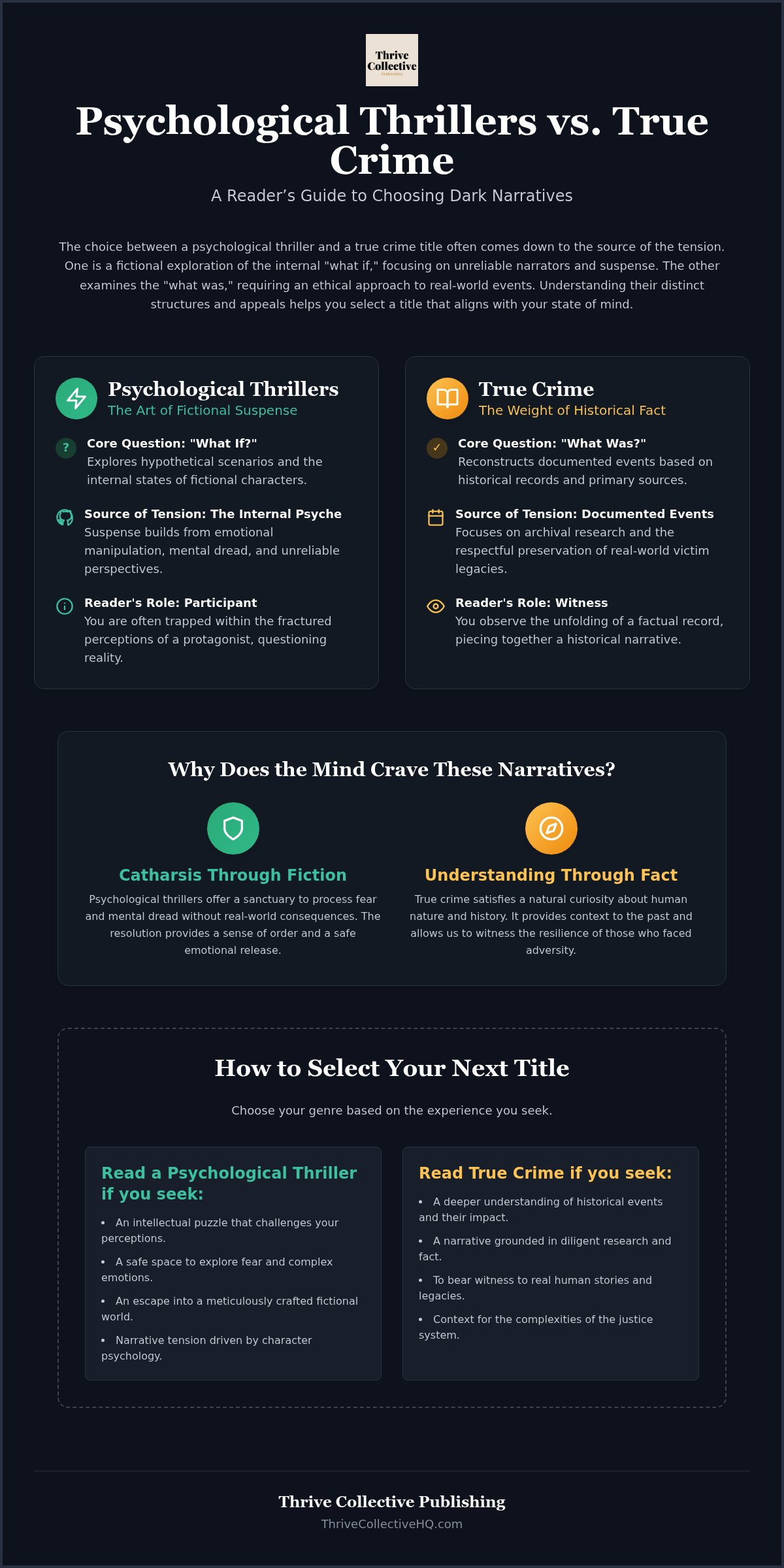
Psychological thrillers are fictional narratives focusing on the internal mental state of characters to create suspense through emotional manipulation and unreliable perspectives. True crime refers to non-fiction accounts of documented criminal events prioritizing historical accuracy, archival research, and the respectful preservation of real-world victim legacies through narrative structure.
The distinction between psychological thrillers vs true crime is found in the source of the suspense. While both genres invite you into the darker corners of human nature, they operate under different sets of rules. At Thrive Collective Publishing, we curate titles that respect these boundaries while providing deep narrative engagement. A psychological thriller functions as a fictional exploration of the internal state, using mental conflict rather than physical action to drive the narrative. In contrast, true crime titles focus on documented events, requiring authors to balance historical accuracy with a narrative structure that honors real human experiences. You are choosing between the "what if" of a novelist's imagination and the "what was" of a historian's archive.
When you open a title in our true crime and suspense collection, your role as a reader shifts. In a thriller, you often become a participant, trapped within the unreliable perceptions of a protagonist. In true crime, you are a witness, observing the unfolding of a factual record. This distinction is vital for maintaining an ethical relationship with the stories you consume.
The internal tension of psychological thrillers
Suspense in fiction is often a slow build of mental dread. Authors like K.B. Cordova specialize in this quiet, literary approach to suspense. Her work in The Casita Series emphasizes the character's psyche and the subtle emotional manipulation that occurs when reality is filtered through a fractured lens. Pacing is used to heighten the sense of unease, making the reader question the protagonist’s every move. This internal tension creates a safe space to explore fear without the weight of real-world consequences.
The historical weight of true crime
True crime demands a different level of responsibility from both the author and the reader. Titles in the Shadows of the Past series rely heavily on primary sources and archival research to build their narrative. Eliza Hawthorne approaches her subjects with a historically careful and respectful eye, ensuring that the focus remains on the victims rather than the sensationalism of the crime. This genre uses non-fiction narrative structures to provide context to the past, reminding us that these stories belong to real people and real legacies.
Why does the mind crave suspense and true accounts?
Why do you find yourself drawn to stories that explore the darker edges of the human experience? It is a natural curiosity. We believe that engaging with these themes is a form of personal evolution. It allows you to confront the complexities of the world from a place of security. Whether you are choosing between psychological thrillers vs true crime, you are seeking a specific type of emotional catharsis. This process is not about dwelling on the dark, but rather about finding alignment and understanding within it. By witnessing how characters or real individuals face adversity, you build a stronger sense of your own resilience.
The safety of the fictional lens
Fiction provides a unique sanctuary for the psyche. When you read a psychological thriller, you are maintaining a safe distance from the events on the page. This allows you to process fear, betrayal, and mental dread without real-world consequences. The resolution at the end of a title provides a sense of order that is often missing from daily life. To balance the intensity of these narratives, we often suggest using a journal from the Just Write Collection for a short digital detox after a long reading session. Putting pen to paper helps you ground your thoughts and transition from the character's mental state back to your own reality.
The empathy and justice of true accounts
True crime appeals to your innate desire for justice and historical truth. You aren't just consuming a story; you are seeking to understand the "why" behind real events. This genre often fosters deep empathy for victims and a commitment to honoring their legacies. Researchers at the University of Colorado Anschutz Medical Campus have explored this phenomenon, asking Why Do We Love True Crime? to understand the neurochemical and psychological drivers behind our fascination. The intellectual satisfaction of piecing together a mystery provides a sense of agency. It reminds you that seeking the truth is a powerful act of community and integrity. As you explore our catalog of curated titles, you will find stories that challenge your perspective and encourage you to thrive through deeper understanding.
Ethical considerations and the depth of research in dark narratives
Thrive Collective Publishing approaches the darker genres with a deep sense of integrity and a commitment to narrative excellence. We believe that the distinction between psychological thrillers vs true crime is not just a matter of narrative structure but one of moral alignment and intentionality. While a novelist seeks to capture an emotional truth through imagination, a true crime author carries the heavy responsibility of preserving a historical record for future generations. This is why we prioritize research over sensationalism in every title we publish. You deserve titles that offer depth, historical context, and substance rather than just a fleeting shock or a surface-level thrill.
Respecting the reality of victims in true crime
In the Shadows of the Past series, the research process is exhaustive and disciplined. Eliza Hawthorne refuses to lean into the glorified killer trope, opting instead to focus on the societal and historical context of each case, such as the Gilded Age elite in "Architect of Desire." Her work involves analyzing primary sources and archival documents to ensure every detail is historically careful and respectful. This approach honors the memory of the victims by treating their stories as more than just plot points for entertainment. It requires a commitment to the truth that naturally limits creative license, ensuring the narrative remains grounded in the reality of what actually occurred.
The creative license of the literary thriller
A literary thriller relies on a different kind of research that is equally rigorous. K.B. Cordova uses the landscape of the Southwest to ground her fictional suspense in a tangible and evocative reality. In titles like "The Mother I Did Not Know," the setting becomes a character itself, enhancing the psychological tension through atmosphere, isolation, and local culture. While Cordova has the freedom to invent her protagonists and their dilemmas, her work remains effective because it maintains a strict sense of psychological plausibility. The creative license of the novelist is balanced by the need for accuracy in human behavior and environmental detail. You are not just reading a story; you are experiencing a carefully constructed world where the "what if" feels entirely possible and deeply unsettling.
By curating titles that respect these ethical boundaries, we help you connect with narratives that offer both intellectual stimulation and a sense of collective purpose. Whether you are listening to a true crime account or reading a suspenseful novel, the intentionality behind the research ensures that the experience is both respectful and impactful. We believe that choosing a book should be an act of alignment with your values, allowing you to thrive through stories that matter.
How do you choose between psychological thrillers and true crime?
Choosing between psychological thrillers vs true crime depends on whether you seek the intellectual escape of fictional suspense or the educational weight of historical reality. Psychological thrillers offer emotional catharsis through character-driven tension, while true crime titles provide a grounded, research-heavy analysis of documented real-world events.
Your intent as a reader should guide your journey through our catalog. Sometimes you want to lose yourself in the intricate, quiet tension of a literary landscape. Other times, you want to ground yourself in the facts of the past to better understand the present. Identifying this intent before you choose a title ensures that your reading time remains intentional and rewarding. We believe that every book you pick up is an opportunity for personal evolution and deeper alignment with your own values.
Reading for escape vs reading for education
If you find yourself craving a mental puzzle where the stakes are high but the consequences are safely contained within the imagination, reach for a title like The Mother I Did Not Know by K.B. Cordova. This literary suspense title focuses on the internal state of the protagonist, offering a safe distance to explore complex emotional themes through quiet, evocative prose. Conversely, if you are in a season of seeking education and historical perspective, a title from the Shadows of the Past series by Eliza Hawthorne is the better choice. These works provide an intellectual satisfaction that comes from piecing together real mysteries and honoring real legacies. Many thoughtful readers keep a mix of both genres in their library, alternating between the "what if" of fiction and the "what was" of history depending on their current need for growth.
Identifying the hallmarks of quality suspense
High-quality suspense is defined by rhythmic prose and varied sentence structures that mirror the character's internal state. You should look for titles that avoid formulaic twists or predictable narrative beats. A well-crafted thriller trusts you to follow the subtleties of the plot without relying on sensationalism. At Thrive Collective Publishing, we prioritize these editorial standards in every title we sign. We also believe that the physical experience of reading matters, which is why our titles are produced in paperback and hardcover as well as Kindle, with audiobooks on Audible. Reading a small house that selects for craft rather than trend adds a layer of connection to the author’s vision. That editorial care, combined with rigorous research and narrative integrity, distinguishes a curated catalog from a content factory. When you read our authors, you are supporting a community of writers who value substance over volume.
Exploring the Thrive Collective Publishing catalog
Thrive Collective Publishing operates as a sanctuary for readers who seek more than just a quick thrill. When you browse our catalog of six authors, you are engaging with a curated selection of titles that prioritize narrative integrity and deep research. The choice between psychological thrillers vs true crime often reflects your own season of growth, and we provide the tools to help you engage with both genres meaningfully. Our independent house focuses on high-quality production and editorial excellence. You can find our books on Amazon in paperback, hardcover and Kindle, and our audiobooks on Audible, while the reader goods we make ourselves are sold direct at for readers.
The literary suspense of K.B. Cordova
The Casita Series stands as our flagship for literary suspense, offering a quiet and contemplative approach to the genre. K.B. Cordova explores themes of memory, family secrets, and unique cultural landscapes. Her title, "The Mother I Did Not Know," exemplifies this literary tone by focusing on the internal state of the protagonist rather than external action. It invites you to dwell in psychological nuances without the distraction of sensationalist tropes. You can explore her work in The Casita Series collection, where every page is designed to challenge your perspective and encourage personal evolution.
The historical true crime of Eliza Hawthorne
For those who prefer the grounded reality of the past, the Shadows of the Past collection offers a different kind of immersion. Eliza Hawthorne provides carefully researched accounts of unsolved mysteries and historical scandals, treating every case with a historian’s discipline. These titles are particularly effective as audiobooks, allowing you to witness the facts through a compelling and respectful narrative structure. You can find these titles in our True Crime Collection. Hawthorne’s commitment to historical accuracy ensures that the dignity of real-life victims remains at the center of every account, avoiding the common pitfalls of the genre.
We also offer reader companions and book club guides to help you foster community around the titles you love. These resources provide a framework for deeper discussion, allowing you to move from simply dreaming to actively doing. Whether you are looking for a hardcover for your library or a Kindle edition for your next trip, our catalog reflects a belief that reading is a collective endeavor. We invite you to step into these stories and see how they help you thrive.
Step into your next narrative with intentionality
Understanding the nuance of psychological thrillers vs true crime allows you to approach your reading with a sense of purpose and alignment. Whether you are exploring the quiet, literary suspense of the Southwest or examining the historical weight of a real-world case, your choice reflects a desire for growth and legacy. We believe that stories have the power to shift your perspective when they are built on a foundation of integrity and deep research. Choosing a title should feel like an act of self-discovery, moving you from simply surviving to truly thriving.
Thrive Collective Publishing operates as a boutique house where quality always precedes quantity. Our authors are published under professional agreements that prioritize their vision and your experience as a reader. By choosing titles from our catalog, you are supporting a Collective that values substance over sensationalism. We take pride in publishing the careful, atmospheric work that larger houses tend to pass over. Your literary life is an opportunity for personal evolution, and we are here to provide the curated titles that support your impact on the world.
We believe in your potential to find meaning in every story you choose. Your next great read is waiting to help you thrive.
Frequently Asked Questions
What is the primary difference between a psychological thriller and true crime?
The primary difference between psychological thrillers vs true crime is the source of the narrative tension. Psychological thrillers are fictional explorations of the mind's internal "what if" scenarios, while true crime titles provide non-fiction accounts of documented events. We believe that recognizing this boundary helps you choose a title that aligns with your current need for either intellectual escape or historically grounded education.
Are psychological thrillers always based on true stories?
Psychological thrillers are not always based on true stories, as they primarily rely on the creative imagination of the author to build suspense. While a title like "The Mother I Did Not Know" by K.B. Cordova uses a realistic Southwest setting, the plot remains a fictional exploration of internal mental states. This allows you to process complex themes of identity and memory within a safe, imaginative framework.
Why is true crime often released as an audiobook?
True crime is frequently released as an audiobook because the format provides an immersive, witness-like experience for the reader. Statistics from 2026 show that true crime is the second most popular podcast genre, accounting for 19 percent of global listening hours. This auditory transition to books allows authors like Eliza Hawthorne to guide you through complex historical evidence with a rhythmic, narrative flow that feels personal.
How does K.B. Cordova differ from other suspense authors?
K.B. Cordova differs from other suspense authors through her literary and quiet approach to the genre. Instead of relying on physical action or formulaic twists, she focuses on the character's psyche and the atmospheric isolation of the Southwest. Her work in The Casita Series prioritizes emotional truth and the subtle manipulation of memory, making every title feel like a one-on-one conversation with the protagonist’s internal world.
What makes Eliza Hawthorne titles historically careful?
Eliza Hawthorne titles are considered historically careful because they rely on rigorous archival research and primary sources rather than sensationalist speculation. She prioritizes the legacy of the victims and the societal context of the Gilded Age elite, as seen in "Architect of Desire." This intentionality ensures that every account remains respectful and grounded in the documented reality of the past, avoiding common tropes.
Can I find book club guides for these genres at Thrive Collective Publishing?
You can find reader companions and book club guides for our titles directly through the Thrive Collective Publishing website. We believe that reading is a collective endeavor, and these resources are designed to help you foster community and deeper discussion. These guides provide a structured framework for exploring the ethical boundaries and narrative complexities found in both literary suspense and true crime accounts.
Where can I buy titles from Thrive Collective Publishing?
Our books are available on Amazon in paperback, hardcover and Kindle, and our audiobooks are on Audible. The reading glasses, bookmarks and book totes we make are sold direct at for readers, which is another way to support the house behind the author’s vision. Either route supports our mission as an independent boutique house, ensuring that we can continue curating high-quality narratives that help our community of readers thrive.

Article by
Kimberly Cordova
Kimberly Burk Cordova is the founder of Thrive Collective Publishing, an independent multi-imprint publishing house based in Santa Fe, New Mexico. She is the author of books on leadership, business growth, AI and automation, emotional intelligence, and personal development, written for readers who want clear thinking, useful frameworks, and books they actually finish.
Before turning her full attention to publishing, Kimberly spent more than two decades in strategy, operations, and program leadership, working with public agencies and private organizations on transformation, technology, and large-scale change. That operator's lens shows up in everything she writes and publishes: real frameworks, real numbers, no fluff.
As publisher, she leads a catalog of more than 80 titles from six authors across multiple imprints, spanning literary suspense, true crime, children's biography, relationships, travel, guided journals, and coloring books. The house publishes regularly across its core series, including The Casita Series, Shadows of the Past, the Young Legends Collection, The Growth Leader Collection, the AI and Automation Blueprint, The Heirloom Series, The Art of Manifestation, the Just Write Collection, and Travel: Destination Guides.
She lives in Santa Fe with her husband Greg, a self-taught silversmith and lapidary artist. When she is not writing or publishing, she is building Wildflower Artisans, their Turquoise jewelry brand, or curating the next round of Just Write journals.
Connect with Kimberly and Thrive Collective Publishing at thrivecollectivehq.com.