

What if the persistent fatigue you feel isn't a sign of overwork, but a symptom of holding onto a version of your professional life that no longer exists? Thrive Collective Publishing: Books, Journals, and Guides recognizes that for the visionary entrepreneur, the hardest part of growth is often the act of subtraction. Using journaling prompts for letting go provides a structured way to discern which commitments serve your future legacy and which belong in your past. This practice is a form of mental hygiene that helps you overcome the sunk cost fallacy and clear the clutter preventing strategic clarity.
We understand the drain of feeling tethered to outdated goals. This intentionality is exactly what's required to align your daily actions with your purpose. You'll learn how to use actionable prompts from our Just Write Collection to audit your current commitments and find immediate relief from energetic drain. We provide a clear mental framework to help you decide what stays and what goes, ensuring your energy is preserved for the work that truly matters.
Key Takeaways
- Adopt the philosophy of what stays and what goes to organize your mental and physical environments with clear intention.
- Identify the psychological barriers, such as the sunk cost fallacy, that cause leaders to cling to outdated professional identities.
- Use specific journaling prompts for letting go to discern which current commitments align with your future legacy and which belong in your past.
- Explore the benefits of a digital detox by using physical journals to externalize thoughts and achieve strategic clarity.
- Select curated titles from Thrive Collective Publishing to help you capture meaningful insights and sustain a practice of intentional growth.
What is the philosophy of what stays and what goes by Faith Roberson?
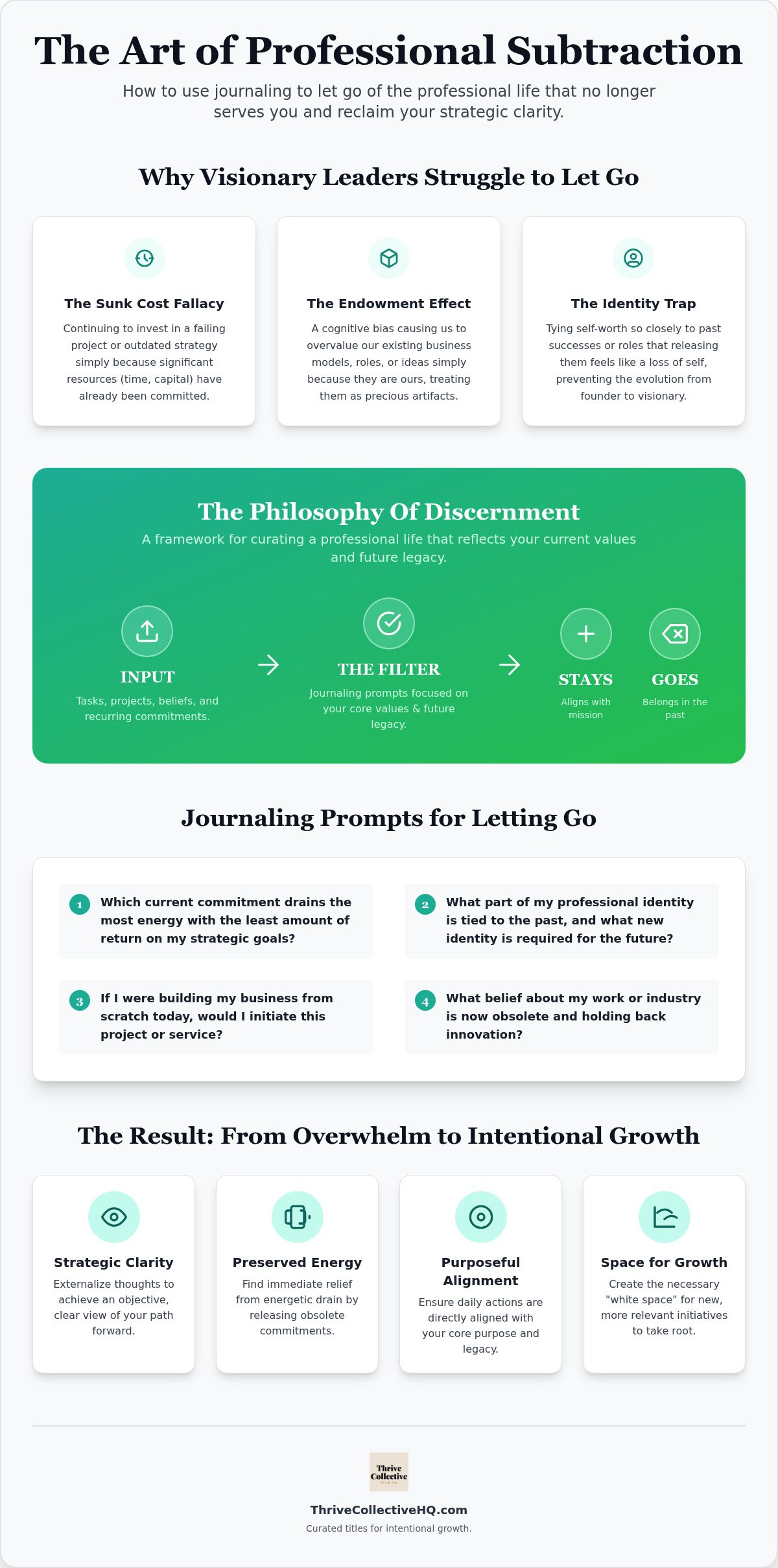
Faith Roberson's philosophy of what stays and what goes is a holistic framework that treats your mental and physical environments as a single, interconnected ecosystem. It posits that everything in your life, from the books on your shelf to the recurring meetings on your calendar, must have a clear purpose or a designated place. For those seeking journaling prompts for letting go, this method serves as a primary tool for discernment. It's not just about discarding items; it's about curating a life that reflects your current values and future legacy.
Entrepreneurs often find themselves hoarding outdated tasks or business models that served them in the past but now act as anchors. Roberson’s method encourages a rigorous audit of these mental assets. A central tenet of the methodology is that intentionality is the bridge between surviving and thriving. If you cannot define the specific value an item or a commitment adds to your mission today, it's likely a candidate for release. This approach moves beyond simple organization and enters the realm of professional evolution, helping you move from a state of dreaming to a state of doing with a lighter load.
The intersection of physical and mental decluttering
Physical clutter is rarely just about the objects; it's often a physical manifestation of internal indecision. When your desk is buried in papers, your mind is often buried in unresolved choices. Organizing your thoughts requires the same level of curation as organizing a home. Consider a founder who spent years developing a legacy service that no longer aligns with their company's new direction. By applying Roberson’s principles, they can acknowledge the project's past value while making the difficult decision to archive it. This release creates the necessary white space for new initiatives to take root, much like the direct and warm leadership style advocated by Kimberly Burk Cordova.
Discernment over disposal
The goal of this philosophy is not to reach a state of empty minimalism, but to achieve a state of high-utility alignment. It's about having the right things, not nothing. Your values act as the filter for this discernment process. We often view our experiences as a vast, unorganized pile, but Thrive Collective Publishing views your life as a catalog you are actively curating. This process is deeply rooted in Journal therapy, where externalizing these choices onto paper allows for an objective analysis of what truly belongs in your future. Using physical tools from the Just Write Collection provides the tactile structure needed to facilitate this mental work, ensuring that every entry brings you closer to your most authentic professional self.
Why do leaders struggle with the act of letting go?
Leaders often view tenacity as their greatest asset, but this same trait can become a liability when it prevents necessary evolution. The sunk cost fallacy is a primary barrier for entrepreneurs; it's the tendency to continue investing in a failing project or outdated service simply because we've already poured time and capital into it. This is often compounded by the endowment effect, a cognitive bias where we overvalue our existing business models or professional roles just because they are ours. We treat these legacies as precious artifacts rather than tools that may have outlived their utility.
Holding onto these obsolete elements prevents you from scaling with ease. When your mental bandwidth is occupied by what was, there is no room for what could be. Using specific journaling prompts for letting go allows you to audit these attachments objectively. It's not a sign of failure to release a project; it's a strategic curation of your future impact. Thrive Collective Publishing believes that true leadership requires the courage to subtract as much as the drive to add.
The identity trap for founders
For many, the business isn't just work; it's an extension of the self. Leaders often tie their self-worth to past successes, creating a fear that releasing a specific role or belief equals a loss of identity. Kimberly Burk Cordova emphasizes the importance of direct leadership growth, which requires shifting from a hands-on founder to a visionary leader. This transition demands a willingness to let go of the tasks that once defined your day but now limit your reach. Finding the right journaling prompts for letting go can help you facilitate this shift by identifying which parts of your identity are tied to the past and which are pulling you toward your legacy.
The cost of maintaining the obsolete
The mental energy required to sustain outdated systems or strained professional relationships is staggering. Research suggests that regular journaling can lead to a 42 percent higher goal achievement rate by helping you focus on what matters. Conversely, over-commitment leads to professional burnout, as the weight of the obsolete drains the energy needed for high-impact work. Intentionality is the only cure for this stagnation. By exploring our titles on leadership and growth, you can find the frameworks necessary to begin this essential work of subtraction and create the space required for your next level of professional evolution.
How can journaling facilitate the release of outdated beliefs?
Journaling acts as a mirror for the mind, allowing you to externalize internal conflicts and examine them with the objectivity of a curator. When you move thoughts from your head onto the page, you reduce the cognitive load of holding onto unresolved decisions. This process of externalization is a cornerstone of effective journaling prompts for letting go, as it transforms abstract anxieties into concrete observations. By writing, you move from the raw emotion of being overwhelmed to a state of structured discernment, where you can clearly see which beliefs no longer align with your current professional trajectory.
We believe that this practice is most effective when it mirrors the calm and quiet nature of a literary reflection. Unlike the frantic pace of digital communication, the act of writing by hand encourages a slower, more intentional processing of information. This mental hygiene is essential for leaders who need to clear the clutter of past expectations to make room for future innovations. It is through this quiet inquiry that you can identify the subtle differences between a commitment that requires perseverance and one that simply belongs in your past.
The power of the physical page
There is a significant cognitive case for choosing paper over digital interfaces. Digital notes are often frantic, fleeting, and easily buried under a mountain of notifications. In contrast, the slow pace of handwriting forces your brain to engage more deeply with the material, which is a primary benefit of a digital detox journal. Our Just Write Collection is designed specifically to support this type of deep reflection. These physical titles provide a tactile boundary that protects your thoughts from the distractions of the online world, allowing you to find the clarity needed to release what no longer serves your growth.
Creating a ritual for reflection
To gain the full benefits of journaling prompts for letting go, we suggest establishing a consistent ritual for your mental work. Choose a specific time and a quiet environment where you feel supported and uninterrupted. As you write, pay attention to the rhythm of your prose. Use a mix of short, punchy declarations to state your truths and longer, descriptive passages to explore the desired future you are building. This rhythmic alternation keeps your mind engaged and prevents the process from becoming stagnant. View your journal as a private mentor, a safe space where you can be both the boss-like expert and the best-friend-like confidante as you curate the catalog of your life.
Practical journaling prompts for letting go of professional and personal weight
To move from a state of dreaming to a state of doing, you must first clear the path of outdated attachments. These journaling prompts for letting go are designed to help you audit the catalog of your professional and personal life with the precision of a curator. We recommend using a physical title from the Just Write Collection to capture these reflections, as the act of handwriting slows the mind and allows for deeper inquiry. Be specific in your responses; avoid vague adjectives and instead use concrete examples of how these weights manifest in your daily work.
Effective discernment requires a willingness to look at your current commitments without the fog of past effort. When you answer these questions, consider the energetic drain of holding onto what no longer fits. Research suggests that regular journaling can lead to a 42 percent higher goal achievement rate, but this only happens when you focus your energy on the right targets. By releasing the obsolete, you create the alignment necessary for true professional evolution.
Prompts for professional discernment
Which professional role am I still performing that I have actually outgrown? Think of the founder who still manages minute scheduling tasks or social media comments despite having a capable team in place. What is the specific cost of keeping this project on the catalog of my business? Calculate the actual hours spent on support or maintenance for a legacy service compared to its actual contribution to your future legacy. If I were starting my company today, which current service or business model would I choose not to include? This question helps you bypass the sunk cost fallacy by focusing on current alignment rather than past investment.
Browse our leadership and growth titles
Prompts for personal and internal release
What old story about my capability am I still reciting to myself? You might still believe you are not good with financial strategy because of a mistake made years ago, even though you have since gained significant expertise. Which habit is currently out of alignment with the leader I am becoming? This might be the tendency to over-explain every decision, a habit Kimberly Burk Cordova suggests replacing with the direct and warm authority of a visionary leader. What would stay in my life if I only kept things that contributed to my legacy? Using this filter helps you distinguish between the noise of daily demands and the work that creates lasting impact.
Selecting the right titles to support your growth
Thrive Collective Publishing: Books, Journals, and Guides curates titles that move beyond abstract concepts into the realm of daily practice. Choosing the correct medium depends on whether you prefer the structured guidance of a guided journal or the open space of a blank page. While we have explored using journaling prompts for letting go, the physical tool you select is a significant part of the curation process. For readers who find a blank page intimidating, our guided journals provide the necessary structure to facilitate deep inquiry without the friction of a starting point. Our titles are crafted for the modern visionary who understands that intentionality is a skill that requires a dedicated physical space.
We invite you to view your professional and personal development not as a solitary struggle, but as a collective endeavor. When you engage with our catalog, you're joining a movement of creative entrepreneurs who prioritize alignment and impact over mere financial gain. This shared commitment to growth ensures that your efforts toward subtraction and curation are supported by a community of like-minded individuals. By choosing tools that mirror your ambition, you make the process of letting go a deliberate step toward your future legacy. We believe that no visionary succeeds in a vacuum, which is why our publishing house focuses on creating resources that foster both individual clarity and community connection.
The Heirloom Series and the art of keeping
Discernment is not just about what is discarded; it is also about honoring what remains. The Heirloom Series is designed to help you capture the stories, values, and insights that form your foundation. For an entrepreneur, legacy is a primary metric of success, and documenting the "what stays" in a keepsake format creates a permanent record of the principles that drive your career. This practice complements your work with journaling prompts for letting go by ensuring that your focus remains on the substance you are actively preserving. You can explore these tools in our journals and keepsakes collection to begin capturing the history of your growth.
Resources for the visionary leader
Scaling with ease requires a library of curated wisdom that supports your mental hygiene. Our catalog includes leadership development titles specifically for entrepreneurs, such as the grounded perspectives of Noelle Varden or the accessible insights of Liam Cruz. We believe that growth is a collective process, and being part of a community of readers helps solidify the changes you make during your private reflections. You can learn more about our mission and the authors who support your path by visiting our about page. Whether you are reading a literary suspense title by K.B. Cordova for quiet reflection or a business guide to refine your strategy, your professional evolution is our primary focus. We are committed to providing the intellectual and emotional tools required for you to thrive.
Curate your future with intentional subtraction
You've explored how discernment serves as the foundation for a visionary legacy. By applying the philosophy of what stays and what goes, you can identify the outdated roles and beliefs that drain your professional energy. Using structured journaling prompts for letting go allows you to externalize these conflicts and find the clarity needed to scale with ease. We understand that the act of subtraction is often more difficult than addition, yet it's essential for those who wish to lead with intentionality.
Thrive Collective Publishing curates titles for the intentional reader. As an independent press based in New Mexico, we're committed to supporting visionary authors like Noelle Varden through high-quality paperback and hardcover editions. Our catalog, including the imprints of Cordova Creations, provides the physical tools necessary for deep, literary reflection.
We believe your potential is defined by what you choose to carry into your future. Step into the next version of yourself with a lighter load and a clearer mission.
Frequently Asked Questions
What are the best journaling prompts for letting go of a relationship?
The most effective prompts for releasing a relationship focus on identifying the specific values that were served in the past but are no longer present. You might ask yourself what specific lessons this connection provided and how those lessons contribute to your current strength. Another useful inquiry is to define what professional or personal space opens up once you stop trying to maintain a dynamic that has outlived its season.
How often should I use journaling prompts for letting go?
Regular use of journaling prompts for letting go is most effective when practiced daily or weekly to maintain consistent mental hygiene. Research from Gitnux in July 2026 suggests that journaling can reduce symptoms of anxiety by 20 percent after only four weeks of consistent practice. By making this a recurring ritual, you prevent the accumulation of mental clutter and ensure your daily actions remain in alignment with your long term legacy.
Can journaling really help with professional burnout?
Journaling serves as an essential tool for mitigating professional burnout by providing a space for cognitive decluttering and externalizing stress. When you are energetically drained by outdated commitments, writing allows you to identify the specific tasks that no longer serve your mission. This process of discernment helps you reclaim the mental bandwidth required for high impact work, moving you from a state of surviving to a state of thriving.
What is the difference between prompted journaling and blank notebooks?
Prompted journaling offers a structured framework for those who struggle with the blank page, while blank notebooks facilitate unrestricted literary reflection. Titles in our Just Write Collection provide specific inquiries that guide you through the process of discernment and release. Conversely, a blank notebook, favored by authors like K.B. Cordova, allows for a more fluid and quiet exploration of your internal landscape without the boundaries of pre-set questions.
How do I start journaling if I have never done it before?
Starting a journaling practice requires only a physical notebook and a commitment to five minutes of honest reflection each day. Begin by answering one simple question about your current state of alignment or your goals for the future. We recommend choosing a quiet environment and using a physical title to avoid the distractions of digital notifications. Don't worry about perfect prose; focus instead on the clarity that comes from putting thoughts onto paper.
What stays and what goes according to the Faith Roberson method?
Everything in your life should have a clear purpose or place according to the holistic philosophy of Faith Roberson. This method requires you to audit both your physical environment and your mental commitments to see if they reflect your personal truth. If an item or a belief does not contribute to your current values or support your future growth, it is categorized as something that goes to make room for grace.
Are there specific journals recommended for leaders?
We recommend the Just Write Collection for leaders who require practical journaling prompts for letting go of professional weight and achieving strategic clarity. These titles are designed for the modern visionary who needs to balance ambitious goals with intentionality. Additionally, the Heirloom Series is an excellent resource for leaders who wish to document the principles and stories that define their legacy, ensuring that what stays is captured for future generations.
How can I tell if a belief is outdated or still useful?
A belief is outdated if it no longer aligns with the visionary leader you are becoming or the legacy you intend to build. You can test a belief by asking if it encourages growth or if it is merely a story you recite out of habit. If the belief creates a sense of stagnation or prevents you from scaling with ease, it is likely a candidate for release through intentional reflection and journaling.

Article by
Kimberly Cordova
Kimberly Burk Cordova is the founder of Thrive Collective Publishing, an independent multi-imprint publishing house based in Santa Fe, New Mexico. She is the author of books on leadership, business growth, AI and automation, emotional intelligence, and personal development, written for readers who want clear thinking, useful frameworks, and books they actually finish.
Before turning her full attention to publishing, Kimberly spent more than two decades in strategy, operations, and program leadership, working with public agencies and private organizations on transformation, technology, and large-scale change. That operator's lens shows up in everything she writes and publishes: real frameworks, real numbers, no fluff.
As publisher, she leads a catalog of more than 80 titles from six authors across multiple imprints, spanning literary suspense, true crime, children's biography, relationships, travel, guided journals, and coloring books. The house publishes regularly across its core series, including The Casita Series, Shadows of the Past, the Young Legends Collection, The Growth Leader Collection, the AI and Automation Blueprint, The Heirloom Series, The Art of Manifestation, the Just Write Collection, and Travel: Destination Guides.
She lives in Santa Fe with her husband Greg, a self-taught silversmith and lapidary artist. When she is not writing or publishing, she is building Wildflower Artisans, their Turquoise jewelry brand, or curating the next round of Just Write journals.
Connect with Kimberly and Thrive Collective Publishing at thrivecollectivehq.com.