

What if the persistent fear that you are unqualified is actually a symptom of your expansion rather than a reflection of your ability? Research suggests that up to 70 percent of high achievers experience these feelings of inadequacy at some point, often at the exact moment they are ready to scale. You might find yourself crediting a successful launch to luck or hesitating to delegate tasks because you worry others will see through the facade. It is a common friction point as you transition from a hands-on operator to a visionary leader.
We understand that this internal noise can cloud your decision making and slow your progress. By using specific journal prompts for imposter syndrome, you can begin to separate fleeting emotions from the objective facts of your success. You will acquire a structured set of prompts designed to dismantle self-doubt and help you document the evidence of your professional competence. We will examine how the Just Write Collection from Thrive Collective Publishing: Books, Journals, and Guides provides a space for this reflection, moving you from a state of questioning your worth to one of leading with clarity and intentionality.
Key Takeaways
- Identify why the transition from a specialist operator to a visionary leader often triggers a sense of being unqualified.
- Access a structured set of journal prompts for imposter syndrome that help you compile a concrete record of professional wins and intuitive successes.
- Discover how anchoring your leadership in documented core values can effectively silence the inner critic and align your daily actions with your long term legacy.
- Understand the strategic advantage of maintaining a physical catalog of your growth to maintain mental clarity while scaling your business.
What is imposter syndrome for the modern entrepreneur?
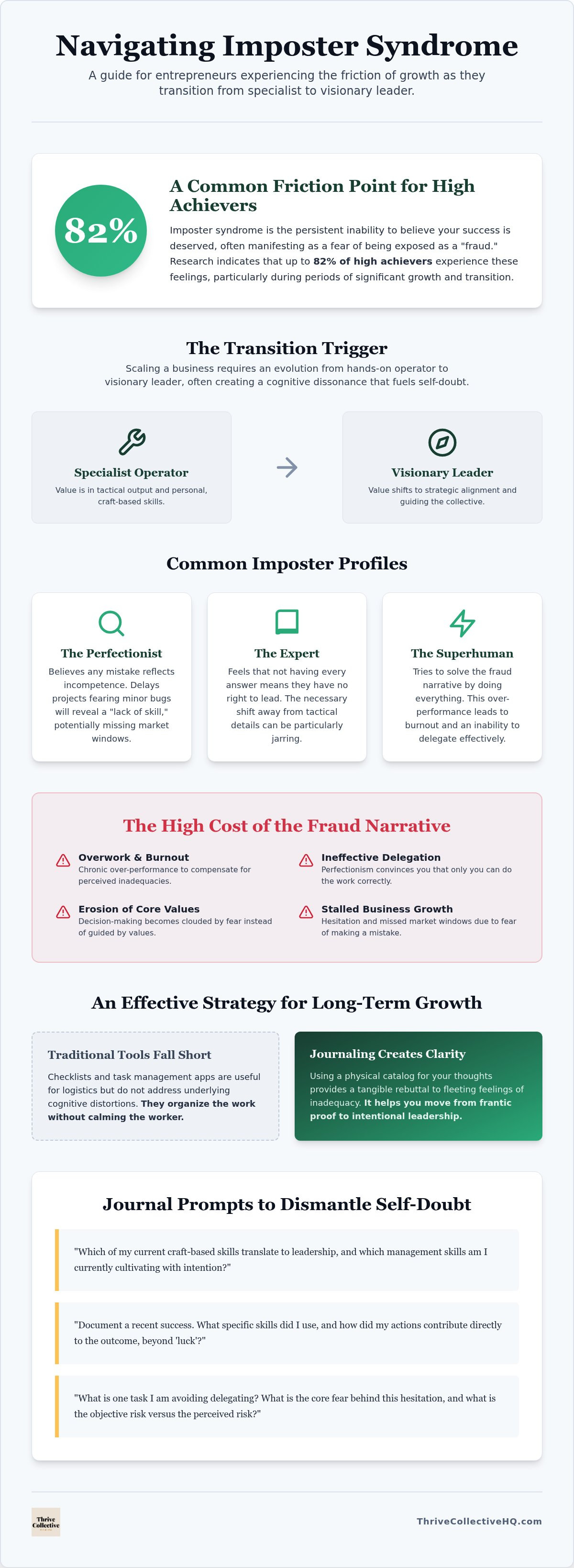
Imposter syndrome in leadership is the persistent inability to believe your success is deserved or legitimately achieved through your own skills. It manifests as a fear of being exposed as a fraud despite consistent evidence of professional competence. This Impostor syndrome is a professional phenomenon affecting up to 82 percent of high achievers at some point in their careers.
At Thrive Collective Publishing, we recognize the distinct line between healthy humility and the paralyzing fraud narrative that stalls business growth. Humility allows you to acknowledge your team and your luck while still owning your talent. In contrast, the fraud narrative tells you that every win was a fluke. This internal friction often peaks during significant milestones. Hiring your first employee or securing significant funding can feel like a trap rather than a triumph. You worry that the new team member or the investor will eventually see that you are just making it up as you go. You aren't alone in this feeling, but leaving it unaddressed can be costly.
The high cost of the fraud narrative
When you operate from a place of self-doubt, you tend to overwork to compensate for perceived inadequacies. This chronic over-performance eventually leads to the erosion of your leadership core values. You might find that you can no longer delegate effectively because your perfectionism convinces you that any mistake is a reflection of your own incompetence. We recently observed a founder who delayed a critical software update for four months because she fit the "Perfectionist" imposter profile. She was so afraid of a minor bug revealing her "lack of skill" that she nearly missed her market window entirely and exhausted her development team in the process.
Why traditional productivity tools fail to help
Checklists and task management apps are useful for logistics, but they do not address underlying cognitive distortions. They organize the work without calming the worker. This is why using specific journal prompts for imposter syndrome is a more effective strategy for long term growth. Instead of chasing more tasks, you need to pursue aligned action. By stepping away from the screen and using a physical catalog for your thoughts, you create a space for mental clarity. This practice helps you move past the frantic need to prove yourself and into a state of intentional leadership. Documenting your evolution on paper provides a tangible rebuttal to the fleeting feelings of inadequacy that digital tools simply cannot provide.
Why does the transition to visionary leadership trigger self-doubt?
Entrepreneurs often experience imposter syndrome because the path of scaling a business requires constant evolution into new, unfamiliar roles. When you move from a specialist to a visionary leader, the lack of a familiar roadmap can create a cognitive dissonance between your external achievements and your internal confidence.
This transition is often the primary catalyst for feeling unqualified. You are no longer the one executing every task; you are the one guiding the people who do. For the "Expert" imposter type, this shift is particularly jarring. You might feel that if you do not have every answer immediately available, you have no right to lead the team. This pressure is widespread. While 70 percent of high achievers report these feelings, first-time leaders are especially vulnerable to the dissonance between their past tactical success and their current strategic responsibilities. The internal narrative often ignores the fact that your value has shifted from tactical output to strategic alignment.
The specialist to visionary gap
If you were a "natural genius" in your original craft, management can feel like a foreign language. The skills that made you a great designer, writer, or developer are not the same skills required to inspire a collective. Understanding the founder to visionary evolution is essential for your peace of mind. You aren't losing your edge; you are expanding your impact. To help process this, consider using specific journal prompts for imposter syndrome to bridge the gap. Try writing on this: Which of my current craft-based skills translate to leadership, and which management skills am I currently cultivating with intention?
Scaling with ease versus scaling with anxiety
The "Superhuman" imposter type tries to solve the fraud narrative by doing everything. They believe that if they work harder than everyone else, no one will notice they feel like a fraud. This leads to burnout rather than legacy. At Thrive Collective Publishing, we advocate for scaling through intentionality and community rather than cutthroat competition. We believe that success is a collective endeavor. When you stop trying to prove your worth through volume, you can start leading with purpose. Use this prompt to reflect: In what ways am I trying to prove my worth through volume rather than value? To support your growth during this phase, you might explore our titles on leadership development for more structured guidance.
Which journal prompts effectively challenge the fraud narrative?
Journaling serves as a tactical tool for externalizing internal anxieties and subjecting them to logical scrutiny. By creating a written record of your decisions, outcomes, and feedback, you build a concrete evidence base. This record counters the distorted self-perception often found in high-achieving leaders who struggle with self-doubt. It moves you from a state of reacting to feelings to a state of reviewing facts.
To dismantle the fraud narrative, we suggest a structured approach using specific journal prompts for imposter syndrome. These are divided into evidence collection and skill attribution to help you reclaim your narrative and lead with intentionality.
Evidence Collection Prompts:
- List three times your intuition was correct in the last quarter.
- What feedback have I received from a peer or reader that I initially dismissed?
- Identify a specific project that succeeded because of my unique perspective.
- List three difficult decisions I made this month that moved the business forward.
- What evidence exists today that I am capable of handling the next level of growth?
Skill Attribution Prompts:
- What specific action did I take that led to our most recent win?
- How did my preparation contribute to the success of my last meeting or presentation?
- Which of my core values guided my most recent hire or partnership?
- What technical or soft skill did I use to solve the last major bottleneck?
- In what ways did my leadership facilitate the team's latest accomplishment?
For those who identify as the "Soloist" imposter type, it is vital to document the value of the team. Ask yourself: How has delegating this specific task improved the quality of the final result? Recognizing that you don't succeed in a vacuum is a sign of leadership strength, not a lack of individual talent. These journal prompts for imposter syndrome help you see that your role is to cultivate a collective, not to carry the entire weight alone.
Prompts for documenting professional wins
When you document your wins, do so without using the words "luck" or "accident." Own the intentionality of your success. If you find this difficult, try this prompt: If a colleague achieved what I did today, how would I describe their talent? This shift in perspective allows you to see your achievements with the same grace you extend to others. You can find more titles focused on growth and alignment in our catalog to support this shift in mindset.
Prompts for reframing mistakes
For the "Perfectionist" type, mistakes often feel like proof of fraudulence. We must reframe them as data gained from a recent failure. Try this prompt: What did this specific challenge teach me about our current business systems? Mistakes are data points, not character flaws. They highlight where your systems need refinement, not where your value as a leader is lacking.
Using Journaling to Document Leadership Core Values
Establishing a written record of your core values provides a moral and strategic compass that silences the inner critic. When your actions are in alignment with your stated values, the feeling of being a fraud diminishes. Your success becomes rooted in integrity rather than just performance. By using journal prompts for imposter syndrome to define your legacy, you move from a state of performance to a state of purpose. Ask yourself: How do I want my team to describe my leadership in five years? This shift is essential for those caught in the "Natural Genius" trap. This imposter type believes that if they have to work hard at leadership, they must be a fraud. By focusing on value-based leadership, you learn to reward persistence over innate talent. We created the Heirloom Series specifically to help you document these values, creating a legacy that guides both your current team and future generations.
Aligning daily actions with visionary goals
Small, daily choices are the building blocks of your leadership legacy. To stay on track, use journal prompts for imposter syndrome that focus on your immediate impact. Ask yourself: Which of my actions today directly supported my primary leadership goal? If you find it difficult to define these goals, seeking leadership coaching can provide the external perspective needed to identify your true north. For the "Superhuman" type who tries to do it all, try this prompt: What did I say no to today to protect my energy for visionary work? Saying no is often the most courageous act of a leader who is scaling with purpose.
Creating a catalog of professional impact
Your competence isn't just about your individual output; it's about the growth of those you lead. Tracking the evolution of your team members provides undeniable evidence of your leadership ability. Consider this prompt: Who on my team has grown because of a resource or opportunity I provided? This "Collective" approach is a core philosophy at Thrive Collective Publishing. It shifts the focus from your internal anxieties to the external impact you are creating. When you see your success as a shared endeavor, the individual pressure of imposter syndrome begins to lift. You aren't just a founder; you are an architect of growth.
Why is a physical catalog of your thoughts essential for growth?
Using a physical journal creates a tactile boundary between your work and your reflection. Digital tools often feel like an extension of the same screen where you fight your daily business battles; paper offers a sanctuary. A paper catalog of your leadership evolution becomes a permanent record of your growth. It provides a tangible rebuttal to the fleeting feelings of inadequacy that often strike during high pressure seasons. When you use journal prompts for imposter syndrome on a physical page, the act of writing slows your heart rate and focuses your mind. We designed the Just Write Collection at Thrive Collective Publishing as a purposeful tool for this exact practice, ensuring that your reflections have a home as sophisticated as your vision.
Physical journaling allows for a deeper level of intentionality that digital apps cannot replicate. While an app might manage a task, a journal manages the mind. Our Art of Manifestation journals help you move beyond the "fraud narrative" by helping you visualize your visionary role with clarity. This practice turns abstract dreams into concrete plans, providing a sense of alignment that silences the inner critic. We invite you to view the full catalog of journals and keepsakes to find the title that best supports your current stage of growth.
The science of handwriting for leaders
The cognitive case for paper is well documented; handwriting engages the reticular activating system, helping you unearth deeper insights that typing often misses. By stepping away from notifications, you engage in a necessary digital detox that allows your visionary ideas to surface. Founders in the Thrive Collective community frequently use the Just Write series to process complex transitions. They find that the physical weight of the journal serves as a grounding force when their business feels like it's scaling faster than their confidence. It's about creating a space where you can thrive rather than just survive, using journal prompts for imposter syndrome to separate your identity from your output.
Building your leadership library
We encourage you to see your completed journals as part of your professional library. These aren't just notebooks; they're the primary sources of your business's origin story. The Heirloom Series is particularly effective for this, allowing you to document the intentionality behind your growth for those who will follow in your footsteps. Your journals become a legacy of resilience and wisdom. If you've found clarity through this practice, we invite you to email info@thrivecollectivehq.com with your own journaling success stories. We'd love to hear how these prompts have supported your personal evolution as a leader.
Step Into Your Visionary Power
Transitioning from a founder who manages every detail to a leader who guides a collective requires a shift in how you view your own competence. We've explored how identifying the specific triggers of self-doubt and using journal prompts for imposter syndrome can help you build a concrete record of your professional wins. By moving from digital noise to the tactile clarity of paper, you create a sanctuary for alignment and intentionality. This practice ensures your success is rooted in your core values rather than a fleeting need for external validation.
As an independent press, Thrive Collective Publishing: Books, Journals, and Guides is dedicated to providing the tools you need for this personal evolution. Our guided journals are designed for intentional growth, helping you document a legacy that reflects your true impact. We believe that your success is not a fluke; it is the result of your integrity and your willingness to grow. You've already done the hard work of building your business. Now, it's time to trust the leader you've become.
Frequently Asked Questions
Is it normal for successful entrepreneurs to have imposter syndrome?
Yes, experiencing these feelings is a standard part of the entrepreneurial path, particularly as you scale your impact. High achievers often encounter this "fraud narrative" because they are constantly stepping into unfamiliar territories of leadership. We see this frequently in our community; it is a sign that you are evolving from an operator into a true visionary leader. Embracing this discomfort is part of your evolution toward holistic success.
Can journaling actually reduce the feelings of being a fraud?
Journaling effectively dismantles the fraud narrative by externalizing your anxieties and subjecting them to logical scrutiny. By creating a physical record of your successes, you build a concrete evidence base that your mind can no longer ignore. This practice helps you move out of a survival mindset and into a state of alignment where you can lead your collective with genuine confidence and clarity.
How often should I use these journal prompts for imposter syndrome?
You should use journal prompts for imposter syndrome whenever you notice self doubt interfering with your decision making or delegation. While a weekly check-in is a powerful way to document your wins, these prompts are especially useful during high pressure transitions like scaling your team. Consistency allows you to cultivate a deep sense of intentionality and provides a permanent rebuttal to fleeting feelings of inadequacy.
What is the best type of journal for a busy business owner?
A high quality physical journal that offers both structure and space is ideal for a busy leader. We recommend selecting a title from the Just Write Collection by Thrive Collective Publishing because it provides a tactile boundary between your business tasks and your personal growth. This separation is vital for mental clarity; it allows you to step away from digital distractions and focus entirely on your leadership evolution and legacy.
How do I distinguish between imposter syndrome and actual lack of skill?
The primary difference lies in the evidence; imposter syndrome is a feeling of being unqualified despite a consistent track record of success. If you have achieved significant milestones but still feel like a fluke, you are likely experiencing this psychological friction. A real skill gap is a specific, identifiable area where you lack knowledge; imposter syndrome is a vague, persistent fear of being "exposed" as a fraud.
Can imposter syndrome ever be a positive thing for a leader?
It can serve as a powerful indicator that you are pushing the boundaries of your current capabilities and are ready for expansion. These feelings often arise when you are stepping into a bigger version of yourself and refusing to settle for the status quo. By reframing this friction as a sign of growth, you can use it as fuel to deepen your alignment and increase your impact.
What should I do if my journal entries are consistently negative?
If your writing leans toward the negative, intentionally shift your practice toward "evidence collection" rather than emotional venting. Focus your journal prompts for imposter syndrome on objective data, such as reader feedback or team growth statistics, to ground your thoughts in reality. This helps you move away from frantic over-performance and toward a state of calm authority where you can thrive alongside your community and your team.
How do I start a journaling practice if I have never done it before?
Begin by setting aside ten minutes each morning for quiet reflection before the demands of your business take over. Use a single, focused prompt to guide your pen and prevent the paralysis of a blank page. Starting small allows you to build a sustainable habit that will eventually become a cherished catalog of your professional wins and your personal evolution as a conscious entrepreneur.

Article by
Kimberly Cordova
Kimberly Burk Cordova is the founder of Thrive Collective Publishing, an independent multi-imprint publishing house based in Santa Fe, New Mexico. She is the author of books on leadership, business growth, AI and automation, emotional intelligence, and personal development, written for readers who want clear thinking, useful frameworks, and books they actually finish.
Before turning her full attention to publishing, Kimberly spent more than two decades in strategy, operations, and program leadership, working with public agencies and private organizations on transformation, technology, and large-scale change. That operator's lens shows up in everything she writes and publishes: real frameworks, real numbers, no fluff.
As publisher, she leads a catalog of more than 80 titles from six authors across multiple imprints, spanning literary suspense, true crime, children's biography, relationships, travel, guided journals, and coloring books. The house publishes regularly across its core series, including The Casita Series, Shadows of the Past, the Young Legends Collection, The Growth Leader Collection, the AI and Automation Blueprint, The Heirloom Series, The Art of Manifestation, the Just Write Collection, and Travel: Destination Guides.
She lives in Santa Fe with her husband Greg, a self-taught silversmith and lapidary artist. When she is not writing or publishing, she is building Wildflower Artisans, their Turquoise jewelry brand, or curating the next round of Just Write journals.
Connect with Kimberly and Thrive Collective Publishing at thrivecollectivehq.com.