

Your family legacy is not a collection of digital files or a box of unsorted photographs. It is a strategic document of intentional leadership and shared values. To learn how to write a family legacy journal, you must select a high-quality physical journal, use structured prompts to document your core values and history, and commit to a regular rhythm of reflection. Many readers at Thrive Collective Publishing share the concern that digital memories are fragile and that finding the time to sit and reflect feels like a luxury you cannot afford.
We believe you don't have to be a professional author to create something beautiful and permanent. This guide provides the structured process you need to turn your memories into a physical heirloom that ensures your family thrives for generations to come. We will cover everything from selecting the right physical title from The Heirloom Series in our catalog to using specific prompts that spark deep connection with your current family members during the writing process.
Key Takeaways
- Understand that a legacy journal is a curated record of principles and wisdom designed to guide future generations, moving beyond the simple chronology of a daily diary.
- Learn the structured process of how to write a family legacy journal by selecting a thematic focus and choosing a permanent title from The Heirloom Series catalog.
- Focus on documenting hard-won lessons and personal growth to provide your readers with a realistic and helpful roadmap for their own challenges.
- Overcome the pressure of perfect writing by adopting the epistolary method, framing each entry as a personal letter to a specific family member.
- Prioritize physical formats to ensure your records remain discoverable and tactile, serving as a lasting artifact of your presence for decades to come.
What defines a family legacy journal?
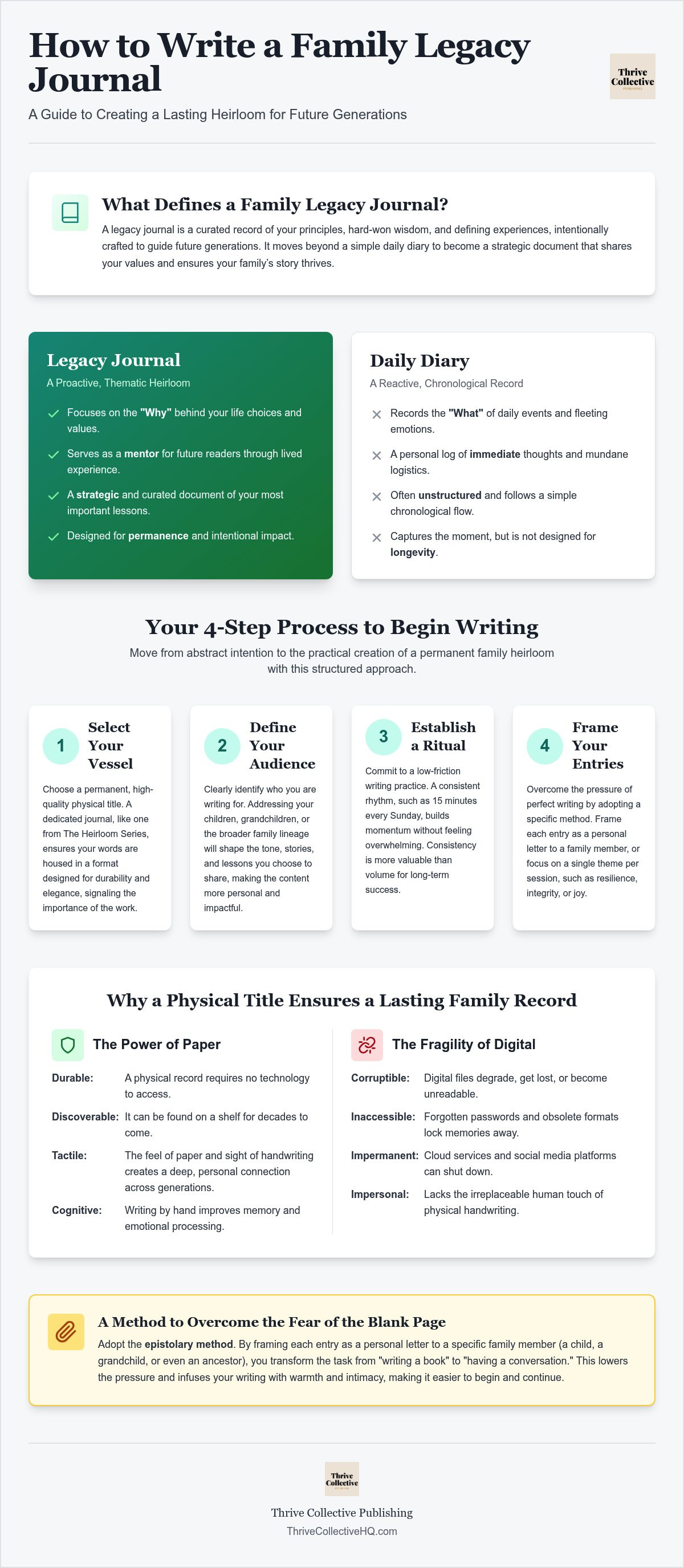
A family legacy journal is a curated record of values, experiences, and wisdom intended for future generations. Unlike a daily diary that captures mundane details, this title focuses on the long-term arc of a family’s history. It provides a permanent connection through intentional storytelling and shared principles that define your unique family culture.
Thrive Collective Publishing views these journals as much more than simple notebooks; they're vessels for intentional impact. When you learn how to write a family legacy journal, you're not just documenting the past. You're actively shaping the future by providing a roadmap for those who will carry your name. This practice shares deep roots with the historical ethical will, a document designed to pass on spiritual values and life lessons rather than just material wealth.
To better understand the power of documenting your story, watch this helpful video:
The genealogy market, valued at USD 6.40 billion in 2022, proves that the global desire for ancestral connection is growing rapidly. While a standard journal might record what you did on a Tuesday, a legacy title explains why you made certain choices. It moves from the "what" to the "why," serving as a bridge between your current leadership and the future success of your descendants. Choosing a professional title from a curated catalog ensures that your words are preserved in a format designed for durability and elegance.
The difference between diaries and legacy titles
Diaries are often reactive, capturing the fleeting emotions and mundane logistics of a single day. In contrast, legacy titles are proactive and thematic. You're writing as a Visionary Guide, offering mentorship to children or grandchildren who may face challenges similar to your own. Instead of a chronological list of events, you're documenting the principles that helped you thrive. This shift in perspective transforms a simple notebook into a strategic heirloom that mentors future readers through your lived experience.
Why paper remains the gold standard for legacy
Digital storage is remarkably fragile; files become corrupted, passwords are forgotten, and cloud services eventually close. A physical title from The Heirloom Series provides a tactile, discoverable record that requires no technology to access. Research discussed in The Cognitive Case for Paper highlights how writing by hand improves memory retention and emotional processing. There's also an irreplaceable connection in seeing the slant of a loved one's handwriting on the page. It makes your presence felt long after the ink has dried, creating a sense of professional intimacy across generations.
How do you begin the process of writing a legacy?
Starting a legacy journal involves selecting a specific thematic focus and a dedicated physical vessel from The Heirloom Series. By defining your audience and establishing a 15-minute weekly ritual, you shift from abstract intentions to the practical creation of a permanent family heirloom.
Learning how to write a family legacy journal requires you to move past the idea of a perfect, chronological autobiography. Instead, view this as a series of intentional conversations with the future. We find that the most successful authors in our community prioritize consistency over volume, treating their writing time as a sacred appointment with their values. This practice is an act of leadership that bridges the gap between your current life and your future impact.
You can break this process down into four manageable steps. First, select your vessel from The Heirloom Series to ensure your words are housed in a permanent, high-quality format. Second, define your audience clearly; knowing whether you are addressing your children, grandchildren, or a broader community changes how you tell your stories. Third, establish a low-friction writing ritual, such as 15 minutes every Sunday morning, to build momentum without feeling overwhelmed. Finally, start with anchor memories that represent your core values rather than attempting to write a dry, chronological history of every year you've lived.
Setting the scene for reflection
Choosing your first entry point
Do not feel obligated to start at the beginning of your life. Chronology is often the enemy of momentum. Instead, identify a core value and write about a specific time it was tested. This provides immediate value to your reader by showing them how you navigated a challenge. On the very first page, write a short sentence defining the specific goal of this journal. It acts as a compass for the rest of your entries. If you're looking for more inspiration, you can browse our full catalog of curated titles to find the right fit for your voice.
Which themes offer the most value for future readers?
The most valuable themes for a family legacy journal include hard-won lessons from failures, the underlying meaning behind family traditions, and a visionary outlook for the future. By focusing on these areas, you provide future generations with a strategic roadmap for living rather than a simple list of historical dates.
When you consider how to write a family legacy journal, you must move beyond surface-level facts that can be found in a public record. Your readers don't just want to know that you lived; they want to know how you thrived. The "Hard-Won Lessons" theme is perhaps the most vital. By documenting your failures and the resulting growth, you offer a blueprint for resilience. It's an act of deep support to show a grandchild that even their most respected ancestor faced moments of doubt and survived them through intentionality and grit.
We also encourage you to explore the "Family Traditions" theme by explaining the origin and meaning of unique rituals. Why does your family gather in a specific way every December? What was the original intention behind that shared meal? This turns the title into a vessel for family culture. Finally, include a "Visionary Future" section. Write down your hopes and prayers for the next hundred years. This perspective bridges the gap between your current impact and the collective success of those who will carry your name long after you are gone.
Documenting leadership and business wisdom
Entrepreneurs and leaders often overlook the ancestral value of their professional struggles. Share the story of your first business venture or a significant professional challenge. Explain your philosophy on community and why you believe success is a collective endeavor. If you navigated a specific crisis, such as a market downturn or a difficult pivot, provide concrete examples of the values that kept you in alignment. This creates a manual for conscious entrepreneurship that your descendants can reference when they face their own crossroads.
Capturing the "unspoken" family history
Sometimes the most powerful legacy lies in the quiet details that history books ignore. We recommend using structured questions to interview older relatives before their stories are lost. Don't just ask for names and dates. Record the small details, such as the smell of a specific New Mexico kitchen or the rhythmic sound of a tool used in a family trade. Focus on these literary and quiet details to bring the story to life. This craft-forward approach ensures that your family history feels like a one-on-one conversation between the past and the present.
How can you overcome the fear of the blank page?
Perfection is the enemy of preservation. When you are learning how to write a family legacy journal, the most significant barrier is often the weight of your own expectations. You might feel you aren't a "good" writer or that your life isn't interesting enough to fill a book. At Thrive Collective Publishing, we encourage you to adopt a "Just Write" mentality. This means accepting that your journal is a work in progress rather than a polished manuscript destined for a library shelf. Your family doesn't need a literary masterpiece; they need your authentic voice and your hard-won truths.
One of the most effective ways to bypass the internal critic is the epistolary method. Instead of writing for an abstract future audience, write as if you are talking to a specific person, such as a grandchild or a close friend. This shift transforms the act of writing into a conversation. You can also use existing artifacts to spark your memory. Lay out a few old letters or a specific photograph on your desk. These physical items act as anchors, grounding your thoughts and making it easier to begin. Remember that the goal is to thrive through expression, not to survive a writing chore.
The power of prompted journaling
If you find yourself staring at a white page, prompts can act as a catalyst for your story. This is a practical solution for those wondering how to write a family legacy journal without feeling overwhelmed by the scope of a whole life. The Just Write Collection is designed specifically to help you bypass the hesitation of starting from scratch. A powerful recurring prompt we recommend is "What I know for sure." This allows you to speak from a place of authority and alignment. Try writing just one sentence today describing a recent moment where your actions matched your values. These small, intentional entries build the momentum necessary to complete a full heirloom title.
Varying your sentence rhythm for easier writing
Writing should feel like a natural extension of your speech. We suggest mixing short, punchy declarations with longer, more descriptive passages to create a rhythmic flow. You shouldn't worry about formal grammar or rigid structures; your authentic voice is what will resonate with your readers (use parentheses for side notes or quick reflections to keep the main narrative moving). This varied rhythm keeps the reader engaged and makes the writing process feel less like a corporate task and more like a soulful ambition. By focusing on the meaning behind your stories, you ensure your impact is documented with clarity and warmth.
Why does a physical title ensure a lasting family record?
A physical title ensures a lasting family record by removing the barriers of digital gatekeeping and technological obsolescence. It provides a tangible, discoverable artifact that future generations can hold, read, and cherish without needing passwords or specific software, making your intentionality a permanent part of the family home. Unlike digital files that are easily deleted or lost in the cloud, a physical journal remains a constant presence.
Digital memories are fragile. We often assume that our social media posts or cloud-based notes will last forever, but platforms change and hardware fails. A physical journal is discoverable in a way that a password-protected drive can never be. It sits on a shelf or in a family chest, waiting for a curious descendant to find it. This tactile nature turns your wisdom into a physical presence. Thrive Collective Publishing uses high-quality materials to ensure that your ink and paper survive for decades, transforming a simple book into a vessel for your soul's ambition.
Archival quality and preservation
Longevity requires more than just good intentions; it requires archival materials. We prioritize acid-free paper in our catalog to prevent the yellowing and brittleness that often affects cheaper notebooks over time. This chemical stability is essential if you want your handwriting to remain legible for the next hundred years. To ensure the best results, we advise storing your journal in a cool, dry place away from direct sunlight. Titles such as The Mother I Did Not Know by K.B. Cordova illustrate how the search for family truth can span generations. High-quality paper supports this search by maintaining the clarity of your story.
The journal as a family heirloom
When you learn how to write a family legacy journal, you are preparing a gift of mentorship for people you may never meet. It is a bridge between your current leadership and their future success. We encourage you to sign and date the inside cover to establish provenance and historical context for those who follow you. Passing down a physical book is more than a hand-off; it is a ceremony that reinforces your family community and collective identity. This practice ensures your values stay in alignment with the future you are helping to build. We invite you to join our collective of intentional authors and begin documenting the principles that will help your family thrive for years to come.
To begin your project, you can browse The Heirloom Series to find the right format for your family history. If you have questions about our titles, please email info@thrivecollectivehq.com.
Documenting your intentional impact
Your legacy is a form of intentional impact that bridges the gap between your lived experience and the future success of your descendants. By understanding how to write a family legacy journal, you've moved from the abstract desire to preserve your history to a practical commitment to your family's collective growth. Our guided journals are used by entrepreneurs to scale their personal impact, ensuring the leadership that built your business also sustains your family culture.
Thrive Collective Publishing titles are designed for archival longevity, protecting your handwriting and wisdom from the fragility of digital storage. We believe in the power of the written word to build community across generations. Your entries are not just stories; they're a roadmap for those who will carry your name. Step into your role as a visionary guide and begin the process of documenting your truth today.
Your future readers are waiting to hear your voice. We're honored to support you as you create a lasting heirloom that ensures your family continues to thrive.
Frequently Asked Questions
What is the difference between a memoir and a legacy journal?
A memoir is a narrative work focusing on a specific period of your life, while a legacy journal is a curated vessel for values and wisdom intended to guide future generations. While a memoir is often written for a general audience, a legacy title is a personal mentorship tool. It focuses on the "why" behind your choices rather than just the "what" of your history, serving as a permanent bridge for your unique family culture.
How often should I write in my family journal to be effective?
Consistency is more important than the volume of words you produce. We recommend a low-friction ritual, such as fifteen minutes every Sunday morning, to maintain momentum without feeling overwhelmed. When you are learning how to write a family legacy journal, setting a regular cadence helps you move from the abstract desire of preservation to the practical act of creating a meaningful heirloom for your readers.
What if I am not a confident writer or have poor handwriting?
Your authentic voice is more valuable to your family than perfect grammar or calligraphic handwriting. Future readers will cherish the tactile connection of seeing your unique script on the page because it serves as a physical artifact of your presence. If you feel stuck, focus on the "Just Write" mentality where perfection is the enemy of preservation. Your lived experience and alignment are what matter most to those who love you.
Should I include photos and physical mementos in my journal?
Including physical mementos can act as powerful "anchor memories" that bring your written stories to life. We suggest using archival-safe adhesives to secure photographs or letters within your journal pages. These items provide a visual context that complements your narrative, helping future generations feel a deeper connection to the specific era and environment you are describing in your legacy title. Concrete details make the history feel tangible and real.
What are the best prompts to use for interviewing grandparents?
The most effective prompts move beyond surface-level facts to capture leadership and business wisdom. Instead of asking about childhood pets, ask about a core value and a specific time it was tested. You might ask what they believe is the secret to collective success or what hard-won lessons they wish they had known at thirty. These thematic questions provide a roadmap for living that offers genuine value to future readers across the collective.
How do I protect the physical journal from aging and damage?
Ensuring archival longevity starts with choosing a title from our catalog that uses acid-free paper to prevent yellowing or brittleness. You should store your journal in a cool, dry place away from direct sunlight and humidity. These simple steps protect the integrity of the ink and paper, allowing your family history to survive for many decades as a permanent record of your intentionality and impact. Proper storage is an act of preservation.
Can I write a legacy journal if I do not have children?
You can certainly write a legacy journal even if you don't have children. These titles serve as a gift of mentorship to your broader community, nieces, nephews, or the readers who follow your work. Your impact is not limited by biological lineage; your values and professional philosophy offer significant guidance to anyone who might look to your life as an example of thriving and alignment. Your wisdom belongs to the future.
Is it better to use a blank notebook or a prompted journal?
A prompted journal is often better for bypassing the fear of the blank page and the inner critic. Titles in our catalog provide a structured format that helps you organize your thoughts into meaningful themes. While a blank notebook offers total freedom, a prompted title acts as a visionary guide, ensuring you document the specific principles and history that will most benefit your future readers. Structure helps your intentionality flourish.

Article by
Kimberly Cordova
Kimberly Burk Cordova is the founder of Thrive Collective Publishing, an independent multi-imprint publishing house based in Santa Fe, New Mexico. She is the author of books on leadership, business growth, AI and automation, emotional intelligence, and personal development, written for readers who want clear thinking, useful frameworks, and books they actually finish.
Before turning her full attention to publishing, Kimberly spent more than two decades in strategy, operations, and program leadership, working with public agencies and private organizations on transformation, technology, and large-scale change. That operator's lens shows up in everything she writes and publishes: real frameworks, real numbers, no fluff.
As publisher, she leads a catalog of more than 80 titles from six authors across multiple imprints, spanning literary suspense, true crime, children's biography, relationships, travel, guided journals, and coloring books. The house publishes regularly across its core series, including The Casita Series, Shadows of the Past, the Young Legends Collection, The Growth Leader Collection, the AI and Automation Blueprint, The Heirloom Series, The Art of Manifestation, the Just Write Collection, and Travel: Destination Guides.
She lives in Santa Fe with her husband Greg, a self-taught silversmith and lapidary artist. When she is not writing or publishing, she is building Wildflower Artisans, their Turquoise jewelry brand, or curating the next round of Just Write journals.
Connect with Kimberly and Thrive Collective Publishing at thrivecollectivehq.com.