

Procrastination is rarely a symptom of poor time management or a lack of discipline. It is usually an emotional defense mechanism against the weight of the legacy you are trying to build. You likely recognize the heavy feeling of a to-do list that remains untouched while the hours slip away into mindless busy work. It is exhausting to face the guilt of another day where your vision for growth remained secondary to the safety of minor tasks. We understand that this stalling often stems from decision fatigue, a fear of failure, or a quiet anxiety about what happens when you actually succeed. At Thrive Collective Publishing, we believe that learning how to finally stop procrastinating requires moving beyond surface-level productivity hacks and addressing the underlying emotional roots of avoidance. This guide provides a practical framework to help you move from a state of survival into one of intentional momentum. You will learn to align your daily execution with your long-term professional goals (ensuring that your actions today support the titles and impact you wish to leave behind). By shifting your focus toward purpose-driven alignment, you can reduce stress, regain your focus, and reclaim the energy needed to lead with confidence.
Key Takeaways
- Recognize that procrastination for leaders is often an emotional response to the weight of responsibility rather than a lack of discipline.
- Discover how to finally stop procrastinating by identifying the specific fears and decision fatigue that create resistance to your visionary goals.
- Replace traditional time management tactics with intentionality to bridge the gap between your daily actions and your professional legacy.
- Utilize tools like guided journaling to transition from a reactive state of survival into a rhythm of focused, soulful ambition.
- Frame your business challenges as opportunities for personal evolution while exploring titles from our catalog that support your growth as an author and leader.
What is the true cause of procrastination for entrepreneurs?
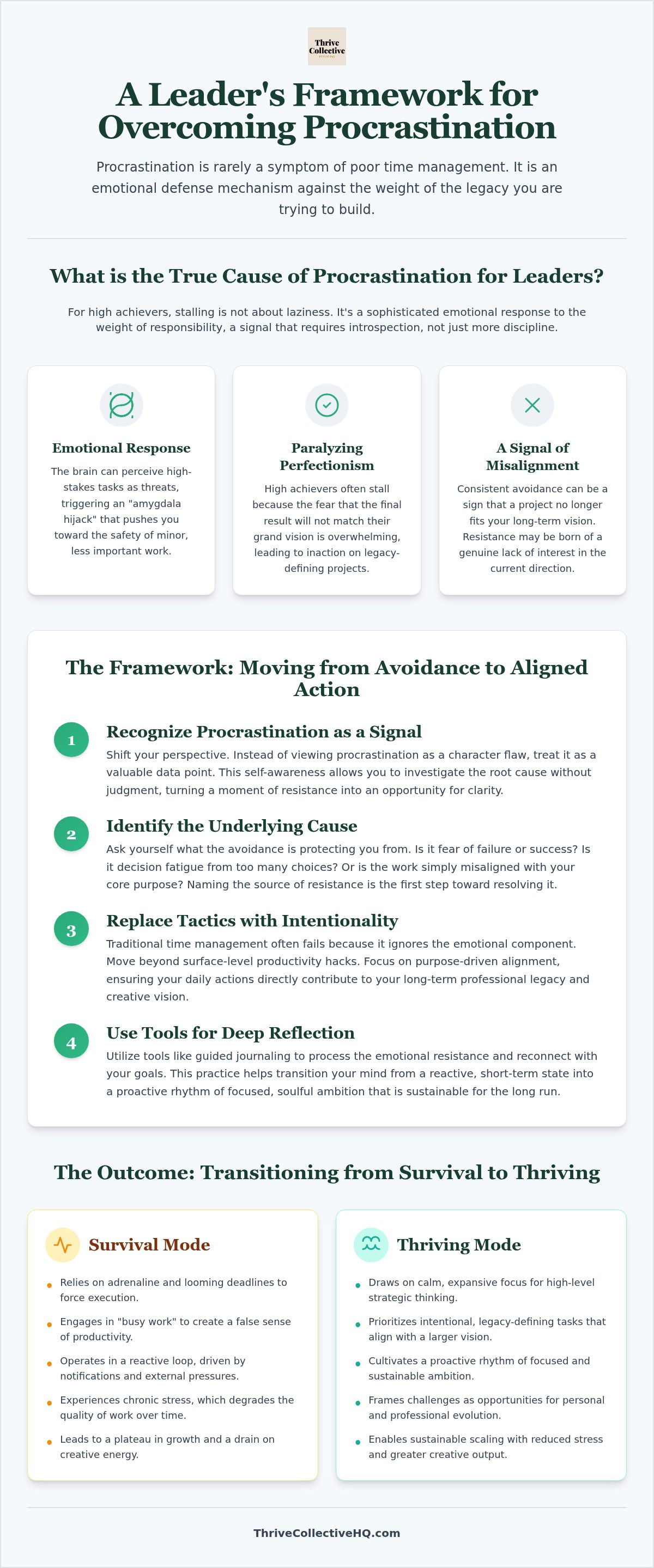
Procrastination for leaders is rarely about laziness or a lack of discipline. It is a sophisticated emotional response to the weight of responsibility and the fear of making a choice that impacts one's legacy. It represents a temporary misalignment between your current tasks and your visionary goals.
Thrive Collective Publishing recognizes that for leaders, stalling is often a protective mechanism against the vulnerability of growth. When you face a high-stakes decision, your brain may experience an amygdala hijack. This occurs when the limbic system perceives a complex business task, such as finalizing a manuscript or restructuring a team, as a physical threat. Instead of engaging with the work, your biology pushes you toward safety. Understanding this biological root is the first step in learning how to finally stop procrastinating; it allows you to treat avoidance as a data point rather than a character flaw.
It is also vital to distinguish between healthy incubation and destructive avoidance. Healthy incubation is a period where you step back to let ideas settle; it is active and intentional. Avoidance, however, is a refusal to look at the work because the emotional cost feels too high. For example, an author working on a complex title like The Mother I Did Not Know by K.B. Cordova may stall not because they lack ideas, but because the emotional depth of the work requires a higher level of intentionality. By recognizing this distinction, you can begin to move from a state of survival into one where you can truly thrive.
The myth of the lazy entrepreneur
High achievers are often the most prone to chronic procrastination because they care deeply about the outcome. Perfectionism frequently stalls high-stakes projects; the fear that the result will not match the vision is paralyzing. You might find yourself caught in the busy work trap, where you answer non-essential emails or organize files to create a false sense of productivity. This creates an illusion of progress while the tasks that define your professional legacy remain untouched. It is a common pattern among those who are scaling their impact but haven't yet mastered the emotional regulation required for the next level of leadership.
Procrastination as a signal for misalignment
Sometimes, avoidance is a signal that a project no longer fits your long-term vision. If you are consistently stalling, it may be time for a period of reflection to see if your actions are still in alignment with your purpose. Staying in a state of survival is costly; it drains your energy and prevents you from scaling with ease. Use self-awareness to determine if your resistance is born of fear or a genuine lack of interest in the current direction. This clarity is essential for anyone seeking how to finally stop procrastinating and reclaim their creative momentum.
Why traditional time management fails to solve procrastination
Standard time management systems often assume that your productivity is a linear equation. They suggest that if you simply break a task into smaller pieces, the resistance will vanish. However, for an entrepreneur building a professional legacy, the resistance isn't about the size of the task; it's about the emotional weight of the outcome. When you're stuck in a cycle of avoidance, a calendar notification can feel like an intrusion rather than a helpful reminder. Understanding how to finally stop procrastinating involves recognizing that your hours are not just slots to be filled, but opportunities for focused impact. You're not a machine; you are a curator of ideas and a leader of people.
The belief that you work best under pressure is one of the most common fallacies in business. While a looming deadline can trigger a spike in adrenaline that forces execution, this is a survival state. It isn't the state from which visionary leadership or creative excellence flows. High-level strategic thinking requires the calm, expansive focus found in intentional leadership. Relying on the rush causes the quality of your work to suffer, and your health pays the price through chronic stress. This biological tax reduces your capacity to scale with ease and eventually leads to a plateau in your growth.
The limitations of digital productivity apps
Digital tools often contribute to the very overwhelm they're intended to solve. Constant pings and notification-heavy interfaces keep your brain in a reactive loop, making it difficult to access deep work. Research from the American Psychological Association suggests that the cognitive cost of shifting between tasks can reduce productive time by up to 40 percent. Removing this digital friction is essential for cognitive clarity. Many readers find that returning to analog tools, such as those in the journals and keepsakes collection, allows for a more grounded strategic planning session. The act of writing forces a slower, more deliberate pace of thought, helping you process complex business challenges with more ease.
The hidden cost of the rush
How to use intentionality and journaling to regain momentum
Guided journaling serves as a mirror for your professional evolution, allowing you to externalize the anxieties that lead to avoidance. By documenting your thought patterns on paper, you transition from a reactive state of survival to a proactive state of intentional leadership and focused impact. This process is about more than just clearing a to-do list; it's about reclaiming your visionary space. Understanding how to finally stop procrastinating is often a matter of externalizing the internal noise that keeps you stagnant. We recommend a structured approach to bridge the gap between your current resistance and your future legacy.
- Step 1: Identify the resistance by writing down the specific fear associated with the task. Be honest about whether you fear the work itself or the visibility that comes with completing it.
- Step 2: Connect the task to a core leadership value or a long-term legacy goal. Remind yourself why this specific action matters for the community you are building.
- Step 3: Commit to a five-minute entry in a guided journal to clear mental clutter. Focus on the feeling of completion rather than the weight of the process.
- Step 4: Execute the smallest possible version of the task to build immediate momentum. If the task is writing a chapter, start with a single paragraph.
This framework creates a path for those wondering how to finally stop procrastinating through the power of intentionality. It replaces the harshness of self-criticism with the clarity of a curator's eye, allowing you to view your progress as a series of deliberate choices.
The power of the written word for leaders
The Just Write Collection facilitates cognitive offloading, a process where you move heavy thoughts from your mind to the page. Tactile feedback is essential for grounding a visionary mind; the physical act of writing slows your heart rate and forces focus. Using journals to track patterns of avoidance over weeks and months provides invaluable data. You might notice that you stall every time a project reaches the final editing stage, signaling a specific area for personal evolution.
Building a ritual of aligned action
Consistency is more valuable than intensity in professional development. Create a calm environment for strategic thinking by removing digital interruptions for at least twenty minutes each morning. During this time, practice a sisterly, supportive internal dialogue. Instead of asking why you haven't started, ask what you need to feel safe enough to begin. This shift from pressure to presence is how you move from merely surviving your schedule to truly thriving within it.
How does aligned action facilitate the transition from survival to thriving?
Aligned action bridges the gap between your visionary goals and your daily execution. By viewing business challenges as opportunities for personal evolution, you move from a reactive survival state to a proactive state of growth. This intentionality ensures that every task contributes directly to the professional legacy you are building.
Success is a collective endeavor that begins with individual clarity and integrity. When you operate in a state of survival, your focus remains narrow, limited to the immediate fires you must extinguish. To move beyond this, you must learn how to finally stop procrastinating by aligning your daily execution with your professional legacy. Framing business challenges as opportunities for personal evolution rather than chores allows you to approach your work with a curator's eye. This shift is what separates a weary task-master from a visionary leader who scales with ease. It's about moving from a reactive state of doing to a soulful state of leading.
A study by the American Society of Training and Development found that people are 65 percent more likely to meet a goal after committing to another person. This highlights why we prioritize community and shared purpose over mere productivity. When your actions are rooted in deep intentionality, the friction of avoidance begins to dissolve. We believe that when you lead from a place of alignment, you don't just finish tasks; you create work that carries lasting weight in your industry.
Cultivating a community of intentional leaders
Shared accountability within a collective reduces the isolation often felt at the top. When you realize that other leaders face the same emotional hurdles, the shame of procrastination loses its power. Transparency allows you to own your stalls and move through them with the support of a movement that values deep work and thoughtful growth. At Thrive Collective Publishing, we see business challenges as a mirror for your own development. By joining a movement of readers who prioritize intentionality, you create a safety net for your own professional evolution. This community-oriented approach ensures that you aren't building your legacy in a vacuum.
Scaling your impact with purpose
Every daily action should contribute to the legacy you wish to leave behind. This requires a high level of self-regulation and a commitment to your long-term vision rather than short-term relief. There is a direct relationship between emotional intelligence and professional momentum; the better you understand your own triggers, the faster you can return to a state of flow. We suggest using The Emotional Intelligence Advantage as a tool to help you recognize the signals of avoidance before they become habits. This awareness is the foundation of learning how to finally stop procrastinating while building a business that reflects your true impact.
Explore our leadership and growth titles
Selecting titles from our catalog to support your growth
Thrive Collective Publishing provides a curated selection of titles designed for the modern entrepreneur who is ready to scale with ease and intentionality. We understand that the path to leadership is often cluttered with the emotional friction of avoidance. Learning how to finally stop procrastinating is a process of curation (selecting the right intellectual and emotional tools to support your specific visionary needs). Our catalog serves as a hub for connection and growth, offering resources that ground your professional ambition in soulful intentionality and help you move from a state of survival to one of thriving.
Our collection includes specific resources tailored to the challenges discussed in this guide. The Procrastination Cure is a foundational title for mastering momentum and ensuring your daily execution remains in alignment with your purpose. For those seeking to explore the depth of complex narratives and personal history, The Mother I Did Not Know by K.B. Cordova provides an elegant study in how we frame our own stories. Additionally, The Heirloom Series offers keepsake journals for documenting a legacy that extends far beyond the boardroom, ensuring your impact is felt for generations.
Why buying direct matters for the modern reader
Supporting an independent press like Thrive Collective Publishing allows for a more personal and heart-centered connection between the author and the reader. We believe that success is a collective endeavor, and buying direct ensures that the resources stay within the community of conscious entrepreneurs. You can explore our why buy direct page for more information on our philosophy and the benefits of skipping traditional corporate intermediaries. It also means we can put the money into editing and design rather than into a distribution chain that takes its cut before the author sees any of it. By choosing to buy direct, you are supporting a thoughtful, serious independent press based in New Mexico that prioritizes the curator’s voice over the marketer’s hype.
Your next step toward intentionality
Growth requires a commitment to the doing as much as the dreaming. We suggest you choose one title from the leadership and growth collection to serve as your guide for the coming month. Pair this with a daily journaling practice to maintain the clarity and integrity needed to thrive. If you find yourself facing decision fatigue or are unsure which title best suits your current professional evolution, we invite you to email info@thrivecollectivehq.com for personalized recommendations. We are equally invested in your success and look forward to supporting your path toward focused impact and a lasting professional legacy.
Stepping Into Your Professional Legacy
You now understand that avoidance is often a signal of emotional misalignment rather than a lack of willpower. By shifting your focus from tactical efficiency to purposeful intentionality, you can reclaim your visionary momentum. We've explored how tactile tools like guided journaling and a calm, editorial approach help you move from survival into a state where you truly thrive. This framework is the foundation for learning how to finally stop procrastinating while building a business that reflects your deepest values.
Thrive Collective Publishing is a serious independent press dedicated to the visionary leader. Our catalog is carefully curated for entrepreneurs who prioritize legacy and impact over surface-level metrics. Titles like The Procrastination Cure provide the practical management skills needed to sustain your professional evolution. We invite you to treat your business challenges as opportunities for personal growth and lean into the support of our Collective.
Your vision deserves the space to grow and the energy to reach its full potential. We're here to support you as you align your daily actions with the lasting impact you're meant to make. It's time to lead with clarity and purpose.
Frequently Asked Questions
Why do I procrastinate on tasks that I actually enjoy?
Procrastination on enjoyable tasks often stems from the high emotional stakes you've placed on the outcome. When you care deeply about a project, the pressure to produce something exceptional can trigger a protective avoidance response. You aren't avoiding the work itself; you are avoiding the vulnerability of potentially failing at something that defines your professional identity or your legacy as a visionary leader.
Is procrastination always a sign of burnout for business owners?
Procrastination is frequently a sign of emotional misalignment or decision fatigue rather than full-scale burnout. While burnout is a state of total depletion, stalling is often a temporary defense mechanism against the weight of a specific choice. Recognizing this distinction is vital for those learning how to finally stop procrastinating, as it allows you to address the specific friction point rather than assuming you need to stop working entirely.
How can a guided journal help me stop stalling on big projects?
A guided journal serves as a mirror for your professional evolution, helping you move heavy thoughts from your mind to the page. This tactile process facilitates cognitive offloading, which reduces the mental clutter that leads to avoidance. By identifying the specific fears associated with a big project, you can use intentionality to bridge the gap between your current resistance and your future impact.
What is the difference between procrastination and needing a break?
A break is a conscious, restorative choice that leaves you feeling energized, whereas procrastination is an avoidant behavior that results in guilt and increased stress. True rest is a strategic tool for the modern entrepreneur, allowing for healthy incubation of ideas. Procrastination, by contrast, keeps you in a state of survival where you are reacting to deadlines rather than leading with calm authority.
Can emotional intelligence training improve my productivity?
Improving your emotional intelligence is a direct path to better productivity because it helps you regulate the feelings that trigger avoidance. When you can identify when your brain is perceiving a task as a threat, you can use self-regulation techniques to stay focused. This is a core component of learning how to finally stop procrastinating and ensures your daily actions remain aligned with your long-term visionary goals.
Why does my brain prioritize small tasks over high-level strategy?
Your brain prioritizes small tasks because they offer immediate gratification and a false sense of safety. Completing minor chores provides a dopamine hit that masks the anxiety of high-level strategy, which often feels more vulnerable. This busy work trap keeps you occupied without moving the needle on the titles or projects that will actually define your professional legacy and long-term impact.
How do I get back on track after a long period of avoidance?
Getting back on track requires you to forgive the past stall and commit to the smallest possible version of a meaningful task. Consistency is more valuable than intensity during this transition. You might begin by choosing a strategic title from our catalog or spending ten minutes in a guided journal to reconnect with your purpose. This small act of alignment helps you move from survival back into a state of thriving.

Article by
Kimberly Cordova
Kimberly Burk Cordova is the founder of Thrive Collective Publishing, an independent multi-imprint publishing house based in Santa Fe, New Mexico. She is the author of books on leadership, business growth, AI and automation, emotional intelligence, and personal development, written for readers who want clear thinking, useful frameworks, and books they actually finish.
Before turning her full attention to publishing, Kimberly spent more than two decades in strategy, operations, and program leadership, working with public agencies and private organizations on transformation, technology, and large-scale change. That operator's lens shows up in everything she writes and publishes: real frameworks, real numbers, no fluff.
As publisher, she leads a catalog of more than 80 titles from six authors across multiple imprints, spanning literary suspense, true crime, children's biography, relationships, travel, guided journals, and coloring books. The house publishes regularly across its core series, including The Casita Series, Shadows of the Past, the Young Legends Collection, The Growth Leader Collection, the AI and Automation Blueprint, The Heirloom Series, The Art of Manifestation, the Just Write Collection, and Travel: Destination Guides.
She lives in Santa Fe with her husband Greg, a self-taught silversmith and lapidary artist. When she is not writing or publishing, she is building Wildflower Artisans, their Turquoise jewelry brand, or curating the next round of Just Write journals.
Connect with Kimberly and Thrive Collective Publishing at thrivecollectivehq.com.