

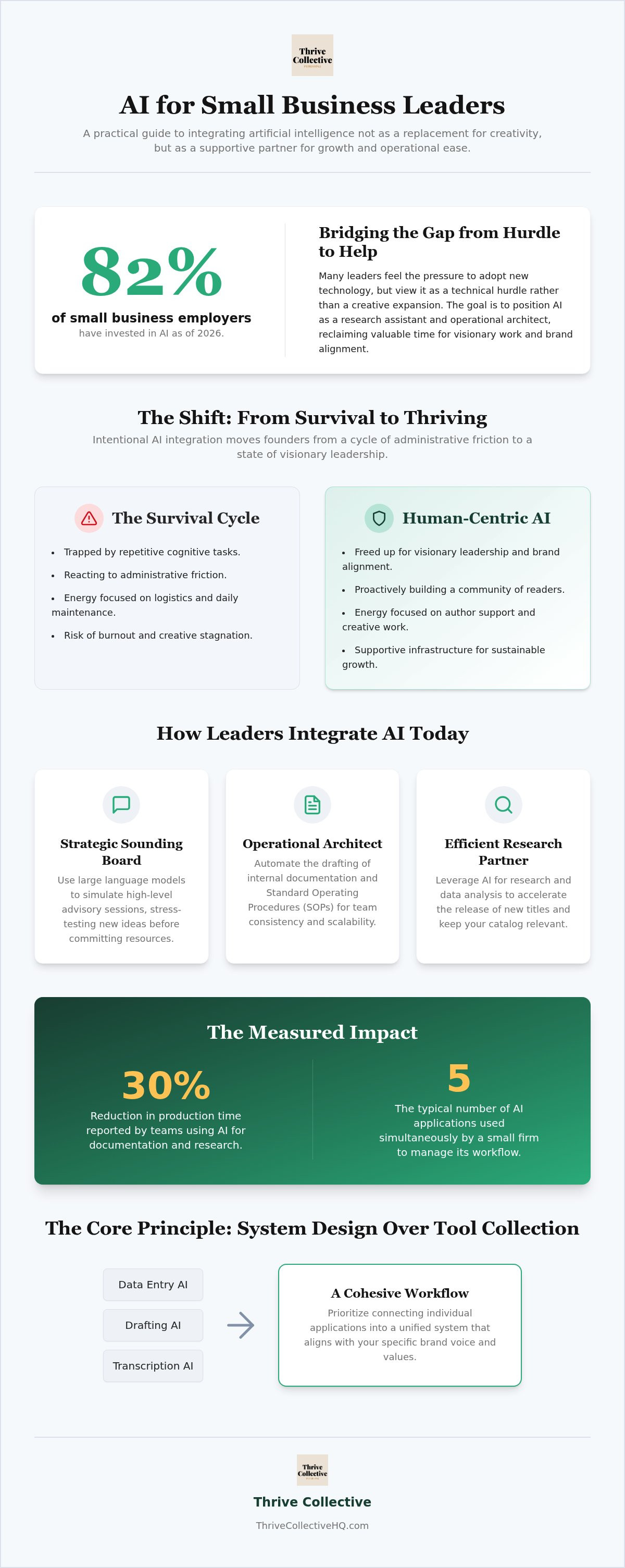
Recent data shows that 82% of small business employers have invested in artificial intelligence as of 2026, yet the transition often feels more like a technical hurdle than a creative expansion. You might feel the pressure to adopt every new release, from GPT-5.6 to Gemini 3.6 Flash, while simultaneously fearing that these tools will strip away the personal connection you've spent years building with your readers. Understanding how small businesses actually use AI is about positioning technology as a research assistant and operational architect. By automating data and meeting transcription, leaders can reclaim time for visionary work and brand alignment.
At Thrive Collective Publishing, we understand the hesitation that comes with integrating generative content, especially when your catalog represents your legacy and your values. This article provides a clear roadmap for intentional integration. We will explore practical examples of how small teams are currently scaling their impact, reclaiming time for deep creative work, and managing their titles with a refined sense of ease. You will discover how to build a supportive digital infrastructure that honors your brand soul while positioning you as a leader in the modern literary landscape.
Key Takeaways
- Effective integration involves using machine learning for repetitive cognitive tasks to bridge the gap between your current capacity and your long-term vision.
- Discover how small businesses actually use AI as a sophisticated sounding board for strategic planning and for drafting internal operational manuals.
- Prioritize system design over tool collection by connecting individual applications into a cohesive workflow that aligns with your specific brand voice.
- Identify the most impactful areas for automation by auditing your weekly energy drains and launching a focused 30-day pilot program.
- Learn to scale with ease using the foundational frameworks for founder education found in the title Artificial Intelligence Unleashed within our catalog.
What does it mean for a small business to use AI effectively?
Effective AI use is the intentional integration of machine learning to handle repetitive cognitive tasks, allowing you to bridge the gap between your current daily capacity and your long-term vision. When considering how small businesses actually use AI, the focus remains on reclaimed time and improved reader experiences rather than just technical features. By prioritizing results over software novelties, you ensure that every tool in your stack serves your legacy. This approach transforms technology from a source of overwhelm into a supportive foundation for your creative ambition.
Human-Centric AI is the intentional practice of using machine learning to handle the cognitive heavy lifting of a business while preserving the founder's unique voice and creative vision. It serves as a supportive infrastructure that prioritizes meaningful reader connections and long-term legacy over mere speed or technical performance.
The shift from survival to thriving with automation
Using intelligent automation allows a founder to move from a state of constant operation to one of visionary leadership. Many entrepreneurs find themselves trapped in a survival cycle, reacting to administrative friction instead of building their community. Aligned intelligence reduces this burden by managing the workflows that don't require your specific creative spark. This is the difference between generic automation, which can feel cold and detached, and a system that reflects your values. At Thrive Collective Publishing, we manage our catalog of titles using these efficient, small-team systems. This ensures that our energy remains focused on deep support for our authors and readers, rather than getting lost in the logistics of daily maintenance.
Why 2026 is the year of the specialized small business agent
The landscape has shifted away from one-size-fits-all chatbots toward specialized agents that understand the nuances of your specific industry. In 2026, 82% of US small business employers have invested in these tools, with the typical firm using five applications simultaneously to manage their workflow. Newer firms are adopting these technologies even faster, recognizing that a custom-trained model can handle complex metadata and distribution across platforms like KDP or IngramSpark with high precision. Our title Artificial Intelligence Unleashed provides the foundational framework for this shift. It helps you move away from basic prompts toward sophisticated, system-wide integration that respects the integrity of your brand. By utilizing agents designed for your niche, you can scale your impact without losing the personal touch that defines your business.
Practical applications: How leaders integrate AI today
Small business leaders are moving past the novelty of generative text to find deeper integration strategies. One primary way is using large language models as a sophisticated sounding board for strategic planning. You can simulate a high-level advisory session to stress-test your next big idea without the cost of a full consulting team. This is how small businesses actually use AI to refine their vision before committing resources to a new project. It isn't about replacing your intuition. It's about providing a digital mirror for your most ambitious thoughts.
The U.S. Small Business Administration provides guidance on utilizing these tools to manage daily complexities with greater precision. For example, automating the first draft of operational manuals and internal documentation allows a small team to function with the clarity of a much larger organization. Small teams using these systems for research and documentation report cutting production time by 30 percent, which accelerates the release of new titles and keeps your catalog fresh and relevant for your readers.
Operational architecture and system design
System design is where your brand soul meets efficiency. Creating Standard Operating Procedures (SOPs) with AI assistance ensures that your team maintains consistency as you scale. For independent presses, this includes managing distribution logistics across platforms like IngramSpark or KDP. You can use these systems to monitor inventory levels and predict when a popular title might need a new print run. This level of intentionality prevents the burnout often associated with manual tracking and allows you to focus on the high-level impact of your work.
Content curation and reader engagement
Tool selection vs. system design: Making the right choice
Success in the digital landscape isn't found in the sheer number of applications you download. It's found in the intentionality of your design. A tool is merely a single application, but a system is the architecture that connects those tools to your daily workflow. Understanding how small businesses actually use AI requires a shift from chasing features to cultivating alignment. You must resist the pull of shiny object syndrome, where the latest model version distracts you from your core mission. Instead, evaluate every piece of software based on its ability to uphold your brand voice and protect your community. This ensures that technology serves your legacy rather than complicating it.
When selecting systems, you must prioritize three core criteria to respect reader privacy and maintain trust. First, ensure the software offers end-to-end data encryption for all reader interactions. Second, look for explicit no-training clauses that prevent your unique catalog content from being used to train general models. Third, verify that the tool provides transparent data usage policies that comply with evolving state-level regulations. The U.S. Small Business Administration guide on AI serves as a helpful reference for navigating these choices while protecting your boutique operation.
Criteria for the modern entrepreneur
For a boutique press, the cost-to-value ratio is a critical factor in every decision. Entry-level tools often cost between $20 and $30 per month, while a typical small business stack of five tools might reach $500 per month. You need to balance the ease of use with the depth of customization required for your specific publishing workflow. Integration capabilities are essential; your AI systems should talk to your existing platforms without creating manual data entry tasks. This allows you to scale with ease while keeping your overhead manageable and your focus on impact.
The "Human-in-the-loop" requirement
Every output generated by machine learning requires a human soul to reach its full potential. Maintaining the unique, warm, and professional voice of authors like Kimberly Burk Cordova is non-negotiable for our collective. AI can help with the structural drafting of metadata or operational manuals, but it cannot replicate the deep support and professional intimacy our readers expect. We set clear boundaries for where technology ends and creativity begins. By keeping a human in the loop, you ensure that every title in your catalog remains authentic, resonant, and deeply connected to your visionary goals.
How to implement AI as a leadership companion
Implementing these systems requires a structured approach rather than a reactive one. You shouldn't simply adopt every new tool and hope for the best. Instead, start by auditing your current weekly tasks to identify specific energy drains. This is how small businesses actually use AI to create the space necessary for high-level leadership. By isolating one high-impact area, such as metadata drafting or distribution logistics, you can run a 30-day pilot program to measure the actual return on your time. This method ensures that your technology stack remains in alignment with your creative purpose.
The audit: Identifying alignment opportunities
Differentiating between your deep creative work and administrative friction is the first step toward scaling with ease. We recommend using a digital detox journal from our catalog to track where technology helps you stay in flow and where it creates distractions. Focus on tasks that feel heavy or repetitive. If managing distribution for a series like The Casita Series consumes hours of your week, that is a prime candidate for your first pilot. By automating these cognitive burdens, you reclaim the mental energy needed to cultivate your community and focus on your legacy.
Training for brand voice and integrity
Your brand voice is your most valuable asset, and it must remain intact as you integrate new systems. To keep your Visionary Guide persona consistent, you can feed previous titles like The Mother I Did Not Know by K.B. Cordova into a private model. This ensures style consistency without risking your data in public training sets. Training the system on your historical catalog helps you avoid the uncanny valley of overly polished, robotic prose. It allows the machine to learn your specific rhythmic alternation and vocabulary patterns, ensuring that every piece of content feels like a one-on-one conversation with your readers.
Once the pilot concludes, review the results with your team and gather reader feedback. Does the new metadata resonate? Are the operational manuals clear? Refining the system based on these insights ensures that your AI companion remains a supportive partner in your personal evolution. Our title Artificial Intelligence Unleashed provides the specific frameworks needed to manage this training process with integrity and professional authority.
Scaling with ease: The Thrive Collective approach
At Thrive Collective Publishing, we believe that true scaling happens through alignment rather than just activity. Our approach to how small businesses actually use AI is rooted in the belief that technology should serve as a bridge to deeper community connection. We don't select titles for our catalog based on trends alone; we curate resources that empower you to build a legacy with intentionality. By integrating machine learning into our small-team systems, we maintain the professional authority of a large house while preserving the personal touch of a boutique press. This balance ensures that your visionary goals remain the focus of your daily operations.
Education as the foundation for growth
Education serves as the essential foundation for any business evolution. While many focus on the technical mechanics of a new tool, we encourage our authors and readers to first understand the purpose behind their integration. Our title Artificial Intelligence Unleashed was developed to provide this specific framework for founders. It helps you move beyond the survival dichotomy and into a state where you can thrive by design. Using guided journals from our collection allows you to reflect on your progress and ensure your tech stack remains in alignment with your creative purpose, making the transition into automation a soulful experience rather than a cold, corporate requirement.
Building a legacy in the digital age
Building a legacy in the digital age requires a focus on impact and purpose over simple efficiency. As of 2026, 82% of US small business employers have invested in AI tools, signaling a massive shift in how boutique operations compete in the marketplace. These systems allow independent authors and small presses to manage complex metadata and distribution logistics with the same precision as the "Big Five" publishers. By automating the administrative friction that often stalls growth, you reclaim the time necessary for mentorship and deep creative work.
We invite you to explore the Leadership and Growth collection for more strategy on building a sustainable, heart-centered business. For inquiries regarding leadership development or our submission guidelines, please contact us at info@thrivecollectivehq.com.
Cultivating Your Legacy with Intentional Technology
Building a sustainable business requires more than just efficient tools; it requires a commitment to alignment and purpose. We've explored how small businesses actually use AI to bridge the gap between their current capacity and their visionary goals. By focusing on system design and maintaining a human in the loop, you can reclaim your time for the creative work, the deep mentorship, and the legacy-building that define your impact. Technology serves its highest purpose when it acts as a supportive infrastructure for your unique voice and professional authority.
Our title Artificial Intelligence Unleashed provides the specific frameworks you need to navigate this evolution with confidence. This resource reflects our deep independent publishing expertise and our commitment to strategic leadership development for visionary founders. You don't have to navigate these technical shifts alone. By choosing tools that respect reader privacy and brand integrity, you ensure that your business thrives while your brand soul remains intact.
Your potential for growth is limitless when your operations are in harmony with your mission. We're here to support you as you step into this bigger version of your leadership. Continue to lead with intentionality, purpose, and grace.
Frequently Asked Questions
Is AI safe for a small business to use with sensitive data?
Safety depends on selecting tools with explicit no-training clauses and enterprise-grade encryption. Under the Transparency in Frontier AI Act in California, developers must provide more clarity on data handling as of January 2026. You should opt for paid versions of models like GPT-5.6 or Claude Opus 5 to ensure your proprietary catalog data isn't used for general training. This protects your intellectual property and maintains the integrity of your brand.
How much does it cost to implement AI in a solo entrepreneur business?
A typical entry-level stack for a solo entrepreneur costs between $100 and $500 per month as of July 2026. This usually includes a general large language model for approximately $20 per month and specialized tools for CRM or distribution. Many founders start with a single flat-fee tool for $20 to $30 per month to manage repetitive cognitive tasks before expanding their digital infrastructure further.
Will using AI for content make my brand sound robotic?
AI only sounds robotic if you use generic prompts without a human-in-the-loop strategy. Maintaining your unique voice requires feeding your previous titles into private models to ensure rhythmic consistency. This is how small businesses actually use AI to scale their impact without losing the professional intimacy and soulful ambition their readers expect from a thoughtful independent press. Your creative spark remains the essential element.
What is the best AI tool for a small business starting out in 2026?
There is no single best tool, but most small businesses begin with a versatile model like GPT-5.6 or Claude Opus 5 for general strategic support. As of May 2026, the average AI-adopting small business uses five different tools simultaneously to handle specific workflows. You should select tools that integrate with your existing platforms, such as KDP or IngramSpark, to ensure your operations remain in alignment.
Can AI help with small business strategic planning?
AI serves as a sophisticated sounding board that allows you to stress-test your vision and simulate advisory sessions. By analyzing market data and reader feedback, these systems help you identify gaps in your catalog or leadership development titles. This strategic support helps a founder move from a state of survival into a state where they can thrive and scale with ease. It provides a digital mirror for your most ambitious thoughts.
How do I tell my readers that I am using AI in my process?
Transparency is best achieved through a clear AI disclosure policy on your about page or your why buy direct page. You can explain that machine learning helps with operational architecture, such as metadata or distribution, while the creative soul of your titles remains human-led. This honesty builds trust and reinforces your commitment to integrity within your collective. Readers appreciate knowing that technology is being used to improve their experience.
What are the ethical considerations for small businesses using generative AI?
Ethical use focuses on respecting intellectual property and ensuring consumer transparency as required by new laws like Colorado's AI Act. It's essential to understand how small businesses actually use AI to support rather than replace human creators. Always verify that your tools comply with the EU AI Act and state-level regulations to maintain your brand's integrity. Focusing on legacy and impact ensures your use of technology remains grounded in purpose.

Article by
Kimberly Cordova
Kimberly Burk Cordova is the founder of Thrive Collective Publishing, an independent multi-imprint publishing house based in Santa Fe, New Mexico. She is the author of books on leadership, business growth, AI and automation, emotional intelligence, and personal development, written for readers who want clear thinking, useful frameworks, and books they actually finish.
Before turning her full attention to publishing, Kimberly spent more than two decades in strategy, operations, and program leadership, working with public agencies and private organizations on transformation, technology, and large-scale change. That operator's lens shows up in everything she writes and publishes: real frameworks, real numbers, no fluff.
As publisher, she leads a catalog of more than 80 titles from six authors across multiple imprints, spanning literary suspense, true crime, children's biography, relationships, travel, guided journals, and coloring books. The house publishes regularly across its core series, including The Casita Series, Shadows of the Past, the Young Legends Collection, The Growth Leader Collection, the AI and Automation Blueprint, The Heirloom Series, The Art of Manifestation, the Just Write Collection, and Travel: Destination Guides.
She lives in Santa Fe with her husband Greg, a self-taught silversmith and lapidary artist. When she is not writing or publishing, she is building Wildflower Artisans, their Turquoise jewelry brand, or curating the next round of Just Write journals.
Connect with Kimberly and Thrive Collective Publishing at thrivecollectivehq.com.