

A digital file is a fragile ghost that may vanish with a single software update, but a hand-bound book is a physical witness that endures for centuries. You likely feel the weight of your family's stories and the quiet pressure to capture them before they fade. It's natural to feel overwhelmed by the decades of memories waiting to be organized or the fear that your handwriting isn't perfect enough for the task.
Thrive Collective Publishing understands that preserving a legacy requires more than just a blank notebook (it requires an editorial eye). To start a family heirloom journal that your children will actually want to keep, you should focus on curated prompts and high-quality materials that prioritize longevity over volume. By selecting specific themes and using archival-grade paper, you ensure your stories remain legible and relevant for future generations. This article offers practical family heirloom journal ideas and editorial-led methods to help you document your history with intention. We will explore how to select the right physical format, which stories carry the most weight, and how to maintain a consistent writing practice that feels like a gift rather than a chore.
Key Takeaways
- Learn to curate a physical record of family identity that serves as a collective history for future generations.
- Evaluate whether a structured prompt-based title or a blank volume best suits your creative style and long-term documentation goals.
- Explore meaningful themes that go beyond basic genealogy to capture the unique culture and traditions of your household.
- Implement practical family heirloom journal ideas to begin documenting significant memories with consistency and intentionality.
- Understand the essential principles of archival care to ensure your written legacy survives the passage of time without degradation.
Defining the purpose of a family heirloom journal
Thrive Collective Publishing views a family heirloom journal as a curated record of a family’s collective identity and values. At its core, a family heirloom journal is a physical volume designed to house stories, genealogy, and wisdom for future generations. These titles serve as a bridge between the past and the future, providing a tangible connection that digital files cannot replicate. While digital records are convenient, they are often scattered across clouds and hard drives. A physical book exists in space and time. Creating a legacy record requires intentionality, moving beyond simple lists of dates to capture the soul of a family’s character. When you begin looking for family heirloom journal ideas, you are starting a process of curation that turns raw history into a meaningful narrative of growth and alignment.
The shift from survival to thriving through documentation
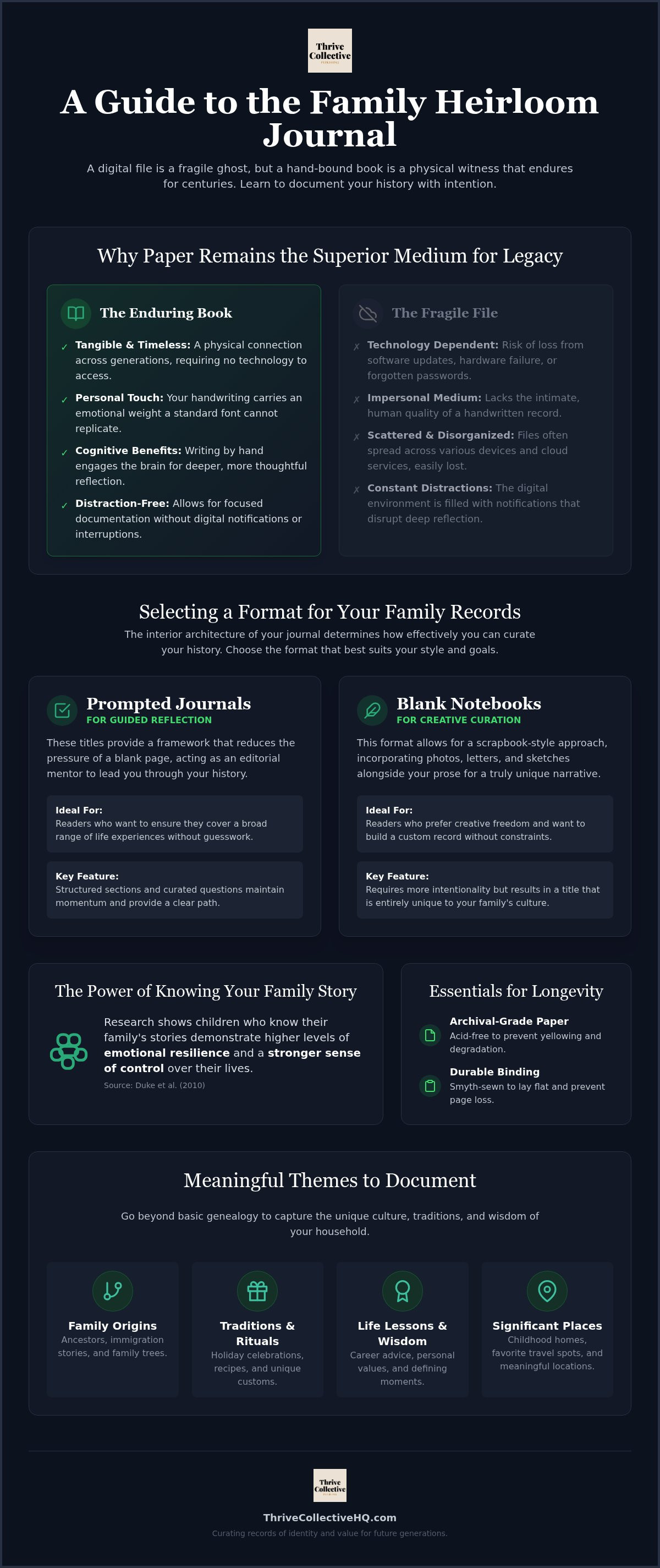
Documenting family history helps you move from a state of surviving day-to-day to thriving within a larger historical context. This process fosters a sense of alignment with your ancestors and their shared purpose. Research indicates that this connection has measurable benefits for the next generation. One study conducted by Duke et al. (2010) suggests that children who know their family stories show higher levels of emotional resilience and a stronger sense of control over their lives. By recording these narratives, you provide a foundation for your descendants to understand their roots and their potential. It transforms the family story from a collection of facts into a living legacy of impact.
Why paper remains the superior medium for legacy
Physical journals offer a digital detox, allowing for deeper reflection without the distraction of screens or notifications. Paper does not require a password, a specific software version, or a charging cable to be read in fifty years. The tactile nature of a physical title adds a layer of intimacy to the stories recorded within. Your specific handwriting carries an emotional weight that a standard font cannot convey. Within The Heirloom Series by Cordova Creations, we focus on the cognitive benefits of paper. Writing by hand engages the brain differently than typing, encouraging a more thoughtful and grounded approach to your legacy. A physical journal is a durable, elegant choice that honors the importance of the words inside.
Selecting a format for your family records
Selecting a format is the first step in moving from a state of dreaming to a state of doing. Choosing the right format depends on your comfort level with writing and the specific goals you hold for the title. You should consider whether you prefer the structure of prompts or the freedom of a blank page. While some competitors focus solely on the aesthetics of a cover, the interior architecture of your journal determines how effectively you can curate your history. Quality matters when selecting a title that must survive multiple generations of handling. Thrive Collective Publishing recommends looking for archival-quality paper and durable binding (such as smyth-sewn) to ensure longevity. This specific construction allows the book to lay flat while you write and prevents pages from falling out after decades of use.
Prompted journals for guided reflection
Prompted titles provide a framework that reduces the pressure of the blank page. These titles often include 5 to 10 specific categories, ranging from early childhood memories to career advice. Guided journals are ideal for readers who want to ensure they cover a broad range of life experiences. Within The Heirloom Series, the editorial structure acts as a mentor, gently leading you through the curation of your history. This approach helps you maintain momentum by removing the guesswork from each writing session and ensuring no vital chapter of your life is left unrecorded.
Blank notebooks for creative curation
A blank notebook allows for a more scrapbook-style approach, incorporating photos, letters, and sketches alongside your prose. This format suits the reader who wants to curate a unique narrative without the constraints of pre-set questions. Combining blank pages with your own family heirloom journal ideas can offer the ideal balance for a custom record. This approach requires more intentionality, but it results in a title that is entirely unique to your family's culture. You might explore the journals and keepsakes in our catalog to find a format that resonates with your vision for the future.
The choice between structure and freedom is a personal one, but it should always be made with the future reader in mind. Whether you choose a guided path or a blank canvas, the goal remains the same: to create a physical legacy that speaks with your voice. By focusing on quality and intentionality, you ensure that your stories don't just survive but thrive in the hands of your descendants. Your chosen format is the vessel for your wisdom, so select one that invites you to write with honesty and purpose.
Specific themes for family documentation
Legacy is not merely a list of names and dates. It is a pulse. You want your descendants to feel the life behind the ink and the heart behind the history. Moving beyond basic biography makes a journal more engaging for future readers. Focus on specific themes that reflect the unique culture of your household. For example, you might include a 12-month gratitude log to show your perspective on abundance or a collection of 5 signature recipes that define your family gatherings. This intentionality ensures the title reflects what your family values most. When you explore family heirloom journal ideas, look for themes that resonate with your personal evolution. These themes act as pillars for your narrative, providing a structure that supports both your memories and your vision for the future.
The wisdom and values ledger
Record the core values that guide your decisions. Integrity, community, and resilience are common starting points, but you should choose the ones that define your specific character. Include 3 specific stories of how these values were tested or demonstrated in your life. Perhaps it was a business decision that required courage or a community project that fostered connection. This creates a manual for living that your descendants can reference during their own challenges. It moves the title from a history book to a visionary guide. By documenting these moments, you create alignment between your current actions and the future success of your family line.
Documenting the intangible heritage
Capture the small details of daily life that often slip through the cracks of memory. These are the sensory markers of your existence (the specific scent of a grandmother’s kitchen or a recurring family joke that only your siblings understand). To deepen this record, interview older relatives using 10 focused questions to record oral histories before they are lost. Ask about their first impressions of a historical event or the most difficult choice they ever made. You should also include a section for letters to the future. Address your descendants directly with your hopes for them. This creates a sense of professional intimacy across generations, ensuring your voice remains a clear and steady presence in their lives. You can find inspiration for these entries in The Heirloom Series by Cordova Creations. Curating these intangible elements and family heirloom journal ideas ensures that your family’s essence is preserved with the same care as your genealogy.
How do you start a family heirloom journal?
A family heirloom journal is a curated physical record of genealogy, personal stories, and ancestral wisdom intended for future generations. To begin the process, a reader should select an archival-quality title and commit to recording one significant memory or value each week to ensure the project remains manageable.
Starting a family heirloom journal involves selecting a high-quality physical title, choosing a consistent time for reflection, and beginning with the most significant stories first to build momentum. Thrive Collective Publishing recommends beginning by listing 3 major life events that shaped your perspective as a leader or parent. These events serve as the foundation for your narrative. You might consider:
- A specific career transition that tested your integrity.
- A moment of profound personal growth during a season of change.
- The realization of the weight and responsibility of your family line.
Avoid the urge to be perfect. Authenticity is more valuable to future readers than polished prose. Your descendants will want to feel your presence in the ink (the pauses and the raw honesty of your experiences). When you integrate your family heirloom journal ideas into a physical title, you are building a legacy that digital files simply cannot sustain. It is an act of intentionality that aligns your past with the future you are helping to build for your community.
Setting an editorial schedule
Dedicate 20 minutes a week to your journal to prevent the task from becoming a burden. Use a specific trigger, such as a Sunday morning coffee or a quiet evening reflection, to signal your time for legacy work. This habit creates a sanctuary for reflection where you can focus on what truly matters. Consistency over intensity is the key to completing a multi-year project. It is better to write one meaningful paragraph each week than to attempt a complete biography in a single weekend and then lose interest. This rhythmic approach ensures your family heirloom journal ideas continue to thrive alongside your daily responsibilities.
Gathering source material
Collect 5 to 10 key photographs, letters, or documents that you wish to include or reference. These items act as anchors for your narrative, providing a visual context for the stories you share. Reach out to family members to verify dates or details of shared stories, which strengthens the accuracy and depth of your record. Organizing your materials beforehand makes the actual writing process much smoother and more enjoyable. This preparation ensures that when you sit down to write, you are in a state of creative flow rather than searching through old boxes or digital folders.
Ensuring the longevity of your family records
A legacy title is only valuable if it survives the passage of time. You have invested time and soul into curating your family heirloom journal ideas, and Thrive Collective Publishing believes that protecting that effort is a vital part of the editorial process. Take pride in the fact that you are creating the original record of your own family story. This is not just a notebook; it is a historical document that requires a curator’s attention to detail. By choosing the right materials and storage methods, you ensure that your voice remains clear for those who will read your words in fifty or one hundred years.
Archival standards for paper and ink
To prevent yellowing and brittleness over decades, look for acid-free paper with a pH of 7 or higher. Standard wood-pulp paper contains lignin, which produces acid as it breaks down and eventually destroys the fibers. You should also be selective about your writing tools. Use pigment-based inks rather than dye-based inks, as pigments are more resistant to fading and water damage. Within The Heirloom Series by Cordova Creations, we prioritize these archival materials to ensure your legacy remains intact. Once the title is complete, store it in a cool, dry place away from direct sunlight. UV rays can break down paper fibers and bleach ink in as little as a few months of direct exposure. Archival storage boxes or slipcases provide an extra layer of defense against dust and environmental fluctuations, keeping the pages pristine for the future.
Passing the torch to the next generation
Preservation is as much about community as it is about chemistry. You must discuss the journal with your family so they understand its significance and where it is kept. This transparency prevents the title from being overlooked or discarded during future household transitions. Consider including a "custodian page" at the beginning or end of the book. This page should list who is responsible for the care of the book in the future, creating a clear line of succession. This act of leadership ensures that the collective family story continues to grow and remain in alignment with your original vision. The page serves as a formal invitation for the next generation to step into their role as a guide for the family. It bridges the gap between your individual effort and the collective future of your descendants, ensuring the narrative you started continues to thrive.
Building a bridge to the future
Your legacy is a living testament to the choices you've made, the values you hold, and the community you've built. By selecting a durable physical format and focusing on the intangible heritage of your daily life, you transform a simple notebook into a visionary guide for those who follow. We believe that curating these stories is an act of profound intentionality that helps your family move from simply surviving history to thriving within it.
Implementing these family heirloom journal ideas requires a commitment to quality and a consistent editorial rhythm. Cordova Creations titles are designed specifically for lasting legacy, providing the structural support you need to document your most significant stories. Thrive Collective Publishing supports readers in curating their narratives, ensuring your most important life lessons are preserved with the dignity they deserve.
The first page is an invitation to step into a bigger version of yourself. We are honored to walk beside you as you build this bridge to the future.
Frequently Asked Questions
What should I include in a family heirloom journal?
You should include a mix of factual genealogy, personal anecdotes, and core values that define your family culture. Aim for a balance between major milestones and the small, daily habits that make your household unique. For example, recording your 5 signature recipes or the 3 most difficult decisions you faced provides a richer legacy than a simple list of birth dates. These family heirloom journal ideas ensure the title feels like a living narrative rather than a dry record.
How do I start a journal if I do not like my handwriting?
You should view your handwriting as a unique signature that carries emotional weight for future generations. While you might feel self-conscious about legibility, your descendants will value the physical connection of your script more than polished typography. If you are concerned, try using a fine-liner pen with pigment-based ink to improve clarity. Writing slowly and focusing on intentionality can help you feel more confident as you curate your history in a physical title.
What is the difference between a family heirloom journal and a scrapbook?
A family heirloom journal focuses primarily on the written narrative and ancestral wisdom, while a scrapbook is a visual collection of ephemera like ticket stubs and photos. While you can certainly combine the two, a journal serves as an editorial record of your values and life lessons. It prioritizes the "why" behind the events of your life. This distinction ensures the title acts as a visionary guide for descendants who seek to understand your perspective.
How many pages should an heirloom journal have?
An heirloom journal should ideally have between 100 and 200 pages to remain manageable for the writer and accessible for the reader. A title that is too large can feel overwhelming to complete, while one that is too small may not capture the breadth of your legacy. Focusing on 12 key themes or recording one significant memory per month ensures you create a dense, high-value record without the pressure of filling a massive volume.
Can I use a digital journal and print it later?
You can use digital tools, but Thrive Collective Publishing recommends starting with a physical title for superior longevity and cognitive benefits. Digital files are susceptible to bit rot and obsolete software versions that may make them unreadable in twenty years. Writing by hand encourages a slower, more reflective state of mind that is essential for legacy work. A hand-bound volume is a durable witness that doesn't require a password or a charging cable to endure.
What are the best interview questions for a family journal?
The best interview questions are open-ended and focus on emotional experiences rather than simple facts. You might ask:
- What was the most courageous choice you ever made?
- How did you define success when you were in your thirties?
- Which family tradition do you hope we never lose?
These family heirloom journal ideas help you capture the soul of your relatives' stories and provide a roadmap for the next generation to follow.
How do I protect a family heirloom journal from damage?
You should protect your journal by storing it in a cool, dry place away from direct sunlight and fluctuating humidity. Using an archival-quality storage box or a slipcase adds a layer of defense against dust and accidental spills. It is also wise to use pigment-based ink that resists fading and water damage. Discussing the location of the title with your family ensures that it is handled with care and passed down correctly through the generations.

Article by
Kimberly Cordova
Kimberly Burk Cordova is the founder of Thrive Collective Publishing, an independent multi-imprint publishing house based in Santa Fe, New Mexico. She is the author of books on leadership, business growth, AI and automation, emotional intelligence, and personal development, written for readers who want clear thinking, useful frameworks, and books they actually finish.
Before turning her full attention to publishing, Kimberly spent more than two decades in strategy, operations, and program leadership, working with public agencies and private organizations on transformation, technology, and large-scale change. That operator's lens shows up in everything she writes and publishes: real frameworks, real numbers, no fluff.
As publisher, she leads a catalog of more than 80 titles from six authors across multiple imprints, spanning literary suspense, true crime, children's biography, relationships, travel, guided journals, and coloring books. The house publishes regularly across its core series, including The Casita Series, Shadows of the Past, the Young Legends Collection, The Growth Leader Collection, the AI and Automation Blueprint, The Heirloom Series, The Art of Manifestation, the Just Write Collection, and Travel: Destination Guides.
She lives in Santa Fe with her husband Greg, a self-taught silversmith and lapidary artist. When she is not writing or publishing, she is building Wildflower Artisans, their Turquoise jewelry brand, or curating the next round of Just Write journals.
Connect with Kimberly and Thrive Collective Publishing at thrivecollectivehq.com.