

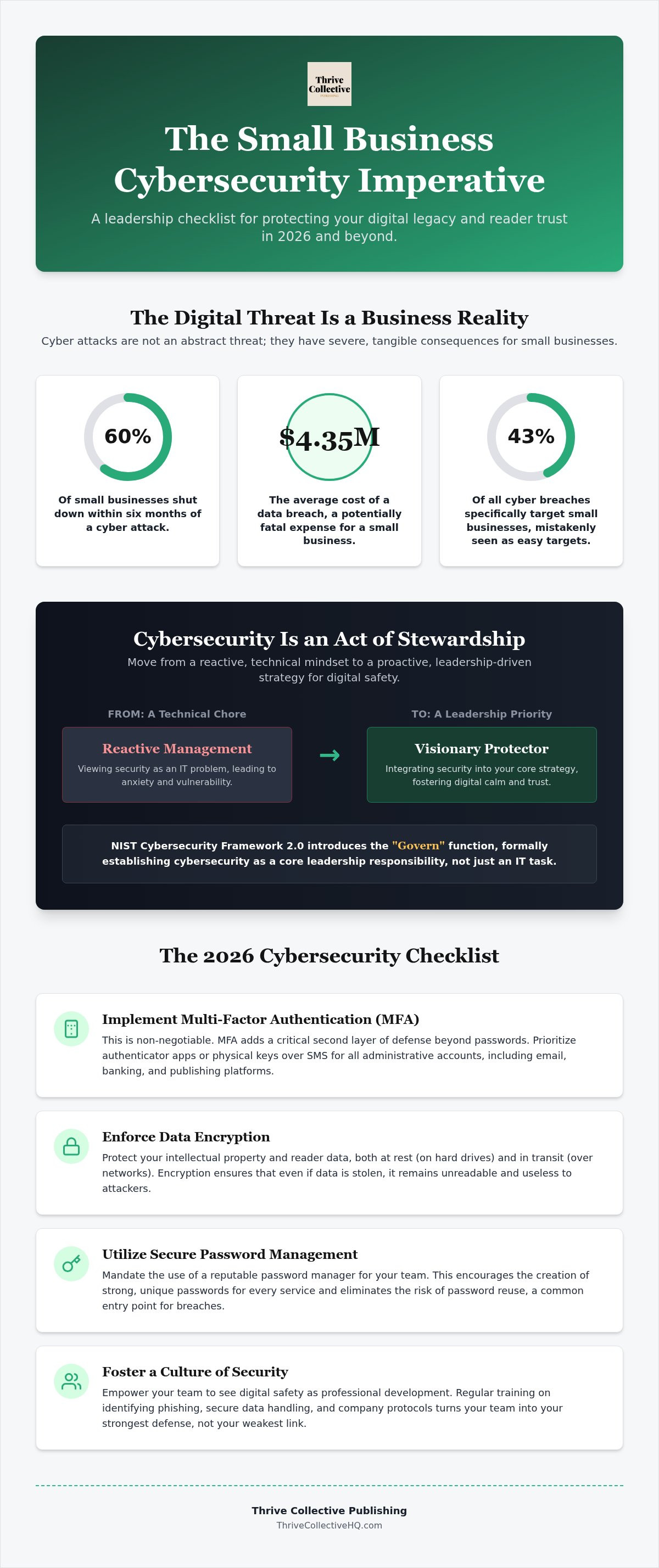
Approximately 60% of small businesses that fall victim to a cyber attack shut down within six months of the breach. This reality underscores that protecting your digital legacy is an essential act of leadership stewardship rather than just a technical chore. At Thrive Collective Publishing, we know you've worked hard to build a catalog of titles, such as the flagship title The Mother I Did Not Know by K.B. Cordova, and a community of readers who trust your voice. To secure your assets, you must implement a cybersecurity checklist for small business owners that prioritizes governance, multi-factor authentication, and data encryption. These steps create a secure foundation that allows you to scale with ease and maintain the professional intimacy you've cultivated with your audience.
We understand that the complexity of digital safety can feel like a barrier to your creative flow. You want to focus on alignment and impact, not firewalls and encryption protocols. This guide offers a clear framework to help you move from a state of anxiety to a state of digital calm. You'll learn how to apply the latest NIST CSF 2.0 standards to your small team and establish protocols that protect your work and your reputation. By the end of this article, you'll have a practical roadmap to ensure your business remains a safe haven for your readers. No one succeeds in a vacuum, and our Collective is here to ensure you have the tools to thrive.
Key Takeaways
- View cybersecurity as an essential act of stewardship that protects your professional integrity and the deep trust shared with your readers.
- Implement the 2026 technical essentials, such as multi-factor authentication and encrypted password management, to create a secure digital perimeter.
- Foster a culture of security by empowering your team to see digital safety as a form of professional development and alignment with your collective mission.
- Follow a structured cybersecurity checklist for small business owners to audit software titles and transition from a state of overwhelm to one of digital calm.
- Integrate safety protocols into your broader leadership strategy to ensure you are prepared to scale with ease while protecting your brand legacy.
Why is cybersecurity a leadership priority for entrepreneurs?
Cybersecurity is the digital foundation of professional integrity and business continuity. It ensures that the trust you have built with your community remains intact while protecting the intellectual property that defines your brand’s unique impact in the marketplace. It is an act of stewardship for your vision and legacy.
To better understand how these protocols fit into your operational workflow, watch this helpful overview:
Proactive security is an investment in your future scaling. Waiting until a breach occurs is a reactive management style that often costs four times as much as prevention. In 2026, the average cost of a data breach has reached $4.35 million, a figure that can instantly dismantle years of hard work. Approximately 60% of small businesses that suffer a breach shut down within six months. By following a cybersecurity checklist for small business owners, you transition from surviving threats to thriving in a secure environment. This shift allows you to focus on high-level strategy and creative alignment. The 2024 update to the NIST Cybersecurity Framework, version 2.0, introduced the Govern function specifically to highlight that digital safety is a leadership responsibility. Applying foundational Cybersecurity principles signals to your team and your readers that you value their safety. It is a core component of modern leadership that we emphasize in our leadership and growth resources.
The shift from founder to visionary protector
Understanding that your digital footprint is your legacy is the first step toward true security. Small businesses are often viewed as accessible targets for data mining because they lack the complex defenses of larger corporations. You must move beyond the myth that small scale equals safety. 43% of breaches target small businesses, making your role as a visionary protector essential for long-term business continuity and the protection of your catalog.
Stewardship of intellectual property and reader data
You have a deep responsibility to protect the sensitive information provided by your community. This stewardship extends to your creative assets and unique titles, such as The Mother I Did Not Know, ensuring they are safe from unauthorized access. These security protocols are a direct reflection of your leadership core values and your commitment to integrity. By prioritizing safety, you align your technical operations with your heart-centered mission to serve your readers.
Securing the digital perimeter: Technical essentials for 2026
A secure business is built on intentionality. You cannot protect what you do not control. While we often think of security as a wall, it is actually a series of protocols that allow you to scale with ease. Implementing a cybersecurity checklist for small business owners starts with the technical perimeter. This involves moving beyond the basics of antivirus software and into the modern requirements of 2026. In an environment where AI-powered phishing is common, a single set of credentials is a vulnerability that your Collective cannot afford.
The non-negotiable role of multi-factor authentication
Passwords alone are insufficient. Multi-factor authentication (MFA) adds a necessary layer of protection by requiring a second form of verification. While SMS codes are better than nothing, authenticator apps or physical security keys are the preferred standard for high-level security. You should apply MFA to every administrative account, including your professional email, business banking, and publishing platforms where your catalog is managed. The Federal Trade Commission now requires small businesses to implement these measures as part of reasonable security standards.
Password hygiene and team access protocols
Sharing logins among team members creates significant risk. It obscures accountability and leaves your intellectual property exposed to unnecessary threats. Instead, use a central encrypted vault to manage access. This allows your small team to use necessary tools without ever seeing the master password. When a team member transitions out of your Collective, you can revoke access immediately through the central system. Following these FCC cybersecurity tips ensures that your internal operations remain as professional as the work you produce.
Beyond passwords, establishing a regular schedule for off-site data backups is vital. If your primary system fails, a secure backup allows you to restore your business without losing your creative history or your readers' data. For distributed teams and independent contractors, secure remote access is the standard. This means requiring the use of Virtual Private Networks (VPNs) and denying access from public Wi-Fi networks. These steps protect the integrity of your brand and the privacy of your community. They are simple acts of stewardship that yield long-term peace of mind.
As you refine these technical layers, you might find that intentionality in business leads to growth in other areas. Exploring our catalog of leadership titles can help you align your operational safety with your long-term visionary goals.
Creating a culture of security within your small team
Building a secure business is a collective effort. It requires a shift from technical isolation to shared responsibility. While the technical perimeter is vital, your team is your most significant asset and your most frequent point of vulnerability. Establishing a culture of security means moving beyond fear-based management and toward intentional stewardship. When every person in your organization understands their role in protecting your vision, you create a resilient foundation for growth. This alignment ensures that the trust you have built with your readers remains a priority at every level of operation.
Training as an act of professional empowerment
At Thrive Collective Publishing, we view security training as a form of professional development rather than a compliance chore. By providing your team with the skills to identify social engineering tactics, you empower them to navigate the digital world with confidence. Regular workshops can help team members spot sophisticated phishing attempts that often mimic the tone of a trusted partner. This practice builds a deep sense of integrity within the team. You can find resources to support this type of organizational trust in our collection of leadership development books for entrepreneurs. Encouraging a "no-blame" culture is equally essential. If a team member clicks a suspicious link, they should feel safe reporting it immediately without fear of retribution. This transparency allows for rapid containment and reflects a leadership style rooted in support rather than control.
Clear protocols for data handling and communication
Defining clear expectations for how information moves through your business is a practical necessity. Your team should know exactly what data can be shared over public channels and what requires encrypted storage. With the rise of remote work, guidelines for using personal devices for business tasks must be explicit. This includes denying access from public Wi-Fi and requiring the use of secure communication platforms for sensitive creative assets. Citing the FTC's guide to cybersecurity for small businesses can provide a neutral, authoritative standard for these internal policies. These protocols are not meant to restrict your team; they are designed to protect the legacy you are building together. By integrating these habits into your daily workflow, you ensure that every cybersecurity checklist for small business owners becomes a lived reality rather than a forgotten document. This level of intentionality allows your business to thrive while maintaining the professional intimacy that defines your brand.
What are the essential steps in a 2026 cybersecurity checklist?
A comprehensive security strategy involves a systematic review of access points, data storage methods, and employee protocols. By following a structured checklist, you move from a reactive state of anxiety to a proactive state of calm, ensuring your business remains resilient against evolving digital threats.
Integrating these steps into your leadership rhythm transforms security from an abstract worry into a manageable routine. You should begin by auditing all active software and subscription titles for necessary security updates. Outdated software is a common entry point for intrusions. Next, verify the encryption status of sensitive reader and author records to ensure that even if data is intercepted, it remains unreadable. Reviewing and updating your incident response plan is equally critical. This document should outline exactly how your team will communicate and respond if a breach occurs. Finally, assess the security practices of your third-party vendors and platforms. Your safety is only as strong as the weakest link in your digital ecosystem. A thorough cybersecurity checklist for small business owners serves as your roadmap for this intentionality.
Immediate technical safeguards for your catalog
Maintaining the physical and digital integrity of your office environment requires attention to detail. You must update firmware on all office hardware and network routers to patch vulnerabilities that manufacturers have identified. In March 2026, NIST released new quick-start guides to help with these implementations, underscoring the need for a documented approach. Your website must also have an active and valid SSL certificate to protect reader data during transactions. Additionally, limit administrative privileges to only essential personnel. Many breaches occur through accounts with unnecessary levels of access.
Ongoing administrative maintenance and review
Consistency is the heartbeat of a secure business. Conduct a quarterly review of your Business and Entrepreneurship catalog access to ensure only current team members have entry. Testing your backup restoration process is also vital. A backup is only useful if the data is viable when you need it most. Finally, schedule a yearly security audit with a professional consultant to identify blind spots in your protocols. This level of intentionality protects your legacy and the community you serve. Adhering to a cybersecurity checklist for small business owners ensures your foundation remains firm as you scale.
Integrating security into your broader leadership strategy
True leadership requires a holistic view of business health. You cannot separate the growth of your catalog from the safety of the systems that hold it. When you integrate security into your broader strategy, you create the space necessary to thrive. This is not about fear. It is about the quiet confidence that comes from knowing your foundation is solid. By following your cybersecurity checklist for small business owners, you demonstrate a commitment to excellence that inspires your authors and your readers alike. You are setting a standard for other leaders in your community, showing that conscious entrepreneurship includes the intentional stewardship of digital assets.
Scaling with purpose and protection
A secure foundation is a prerequisite for sustainable growth. As you expand your reach, your vulnerabilities naturally increase, making proactive protection a necessity rather than an option. You can use your high security standards as a differentiator when building new author relationships, proving that you value their creative intellectual property as much as they do. This approach aligns with the core principles of leadership coaching, where scaling with purpose involves protecting the impact you have already made. When your team sees you prioritizing these measures, they are invited to take ownership of the business’s digital health, creating a collective shield for your vision.
Resources for the intentional visionary
Securing your business is an ongoing act of integrity that protects the legacy you are building. By moving through this cybersecurity checklist for small business owners, you have established a leadership-focused framework that safeguards your digital assets and honors the trust of your community. You are now prepared to scale with ease, supported by a secure foundation and a team that shares your commitment to professional excellence. To discuss how these leadership principles can further support your publishing goals, please email us at info@thrivecollectivehq.com.
Cultivating a Legacy of Digital Integrity
Protecting your business is an act of alignment between your vision and your daily operations. By implementing a cybersecurity checklist for small business owners, you ensure that the trust you have built with your readers remains undisturbed. You have the power to move from technical overwhelm to digital calm by establishing clear protocols for your team and auditing your software titles with intentionality. This secure foundation allows you to focus on the impact of your creative work while joining a collective of leaders dedicated to secure scaling.
Integrating these professional skills with the insights found in our Business and Entrepreneurship titles will help you cultivate a community that thrives on integrity. Your legacy is safe when your leadership is proactive. We believe in your potential to lead with both heart and precision.
Frequently Asked Questions
Do I really need a cybersecurity plan if I am a solo entrepreneur?
Every solo entrepreneur needs a documented security plan to protect their intellectual property and reader data. Even if you work alone, your catalog of titles represents a significant asset that requires intentional stewardship. A plan ensures you have clear protocols for backups and access management, preventing your business from becoming an accessible target for data mining. It provides the digital calm necessary to focus on your creative vision.
What is the most common cyber threat facing small businesses in 2026?
AI-powered phishing is the most prevalent threat in 2026, as cybercriminals use sophisticated models to mimic the tone of trusted partners. These attacks are far more convincing than traditional spam and often target sensitive credentials. Staying vigilant and following a cybersecurity checklist for small business owners helps you recognize these subtle social engineering tactics before they compromise your Collective. Integrity in communication starts with secure systems.
How often should I update my cybersecurity checklist?
You should review your technical controls quarterly and conduct a comprehensive audit of your security posture annually. Digital threats evolve quickly, and your business requirements change as you scale with ease. Regular updates ensure your protocols remain in alignment with your growth and the latest NIST CSF 2.0 standards. This consistency is a hallmark of professional excellence and proactive leadership.
Is multi-factor authentication really necessary for every account?
Multi-factor authentication is a non-negotiable requirement for any account that holds sensitive data or administrative access. It provides a critical layer of defense that passwords alone cannot offer in the modern landscape. By requiring a second form of verification, you significantly reduce the risk of unauthorized entry into your banking, email, and publishing platforms. It is a simple but powerful act of protection.
What should I do first if I suspect my business data has been compromised?
Isolate the affected devices from your network and change all administrative passwords immediately upon suspecting a compromise. Your incident response plan should then guide you through the process of containment and assessment. If reader data is involved, acting with transparency and integrity is essential to preserve the trust you have cultivated. Prompt action prevents a minor incident from becoming a threat to your legacy.
How can I train my team on security without making them feel anxious?
Frame security training as an act of professional empowerment and a way to protect the Collective’s shared mission. When you present safety as a leadership skill rather than a technical burden, your team can approach it with intentionality. Using a cybersecurity checklist for small business owners as a collaborative tool reduces anxiety and fosters a culture of shared responsibility. Support your team as they grow into visionary protectors.
Are cloud-based storage systems safer than local hard drives?
Cloud-based storage systems are generally safer than local hard drives because they offer enterprise-level encryption and automated redundancy. Local drives remain vulnerable to physical theft, fire, or simple hardware failure. However, the safety of the cloud depends entirely on your use of strong access controls and multi-factor authentication. Protecting your catalog in the cloud allows for greater flexibility as you scale.
How does cybersecurity impact my brand reputation with readers?
Cybersecurity is the digital foundation of your brand reputation because it honors the privacy and safety of your readers. A single data breach can dismantle years of community building and break the professional intimacy you have established. Prioritizing security signals that you are a visionary leader who values the loyalty of those you serve. It is an essential component of your long-term impact and legacy.

Article by
Kimberly Cordova
Kimberly Burk Cordova is the founder of Thrive Collective Publishing, an independent multi-imprint publishing house based in Santa Fe, New Mexico. She is the author of books on leadership, business growth, AI and automation, emotional intelligence, and personal development, written for readers who want clear thinking, useful frameworks, and books they actually finish.
Before turning her full attention to publishing, Kimberly spent more than two decades in strategy, operations, and program leadership, working with public agencies and private organizations on transformation, technology, and large-scale change. That operator's lens shows up in everything she writes and publishes: real frameworks, real numbers, no fluff.
As publisher, she leads a catalog of more than 80 titles from six authors across multiple imprints, spanning literary suspense, true crime, children's biography, relationships, travel, guided journals, and coloring books. The house publishes regularly across its core series, including The Casita Series, Shadows of the Past, the Young Legends Collection, The Growth Leader Collection, the AI and Automation Blueprint, The Heirloom Series, The Art of Manifestation, the Just Write Collection, and Travel: Destination Guides.
She lives in Santa Fe with her husband Greg, a self-taught silversmith and lapidary artist. When she is not writing or publishing, she is building Wildflower Artisans, their Turquoise jewelry brand, or curating the next round of Just Write journals.
Connect with Kimberly and Thrive Collective Publishing at thrivecollectivehq.com.