

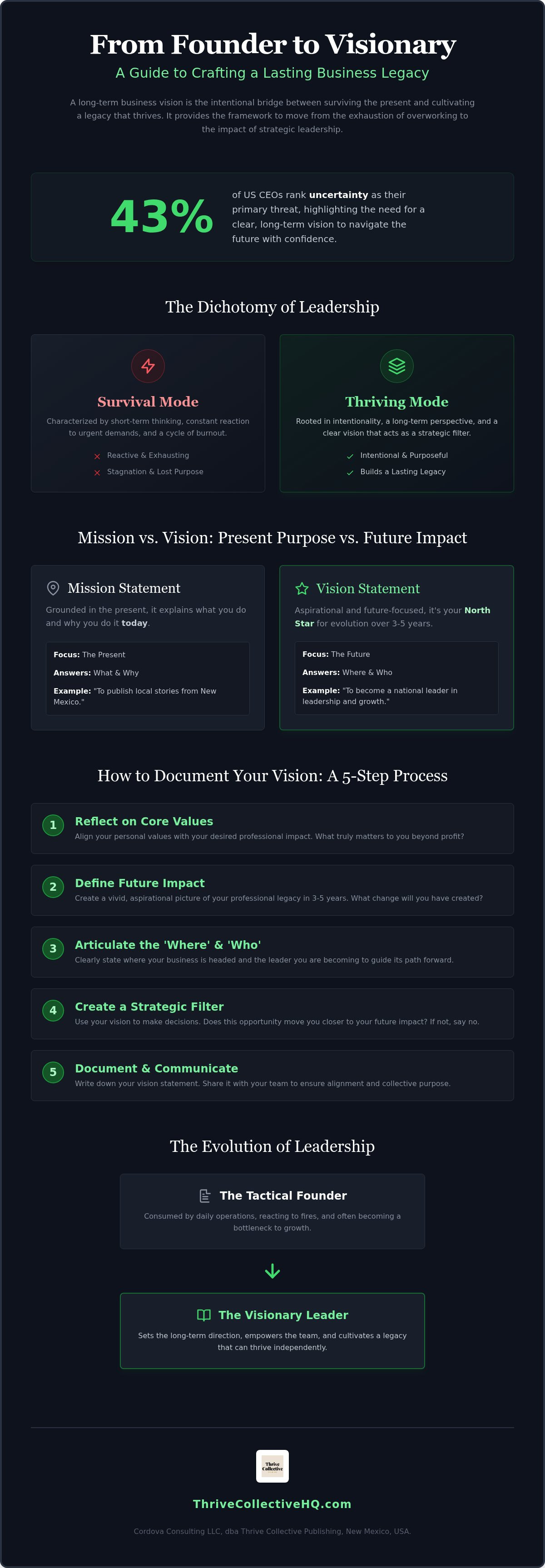
43 percent of US CEOs rank uncertainty as their primary threat for 2026, a statistic that reflects the pressure many founders feel today. A long-term business vision is the intentional bridge between surviving the present and cultivating a legacy that thrives without your constant presence. At Thrive Collective Publishing | Santa Fe Indie Publisher, we see many leaders caught in the cycle of daily survival, reacting to every urgent demand while their deeper purpose begins to fade under the weight of burnout. It is difficult to scale with ease when you lack clarity on the next stage of business growth.
We believe that defining this future state provides the framework needed to move from the exhaustion of constant overworking to the impact of a lasting professional legacy. By articulating where you are going over the next three to five years, you create a strategic filter for making easier business decisions. This article explores the evolution from tactical founder to visionary leader, providing a five-step process to document your vision without losing your soul. We preview how to align your personal values with professional impact through intentional reading and community support.
Key Takeaways
- Define a long-term business vision that moves you beyond the limitations of a mission statement and toward a lasting professional legacy.
- Create a decision-making framework that allows you to scale with ease by filtering out opportunities that do not align with your core purpose.
- Transition from a tactical founder to a visionary leader by identifying the internal shifts required to step back from daily operations.
- Apply a practical five-step method to document your future goals while maintaining a deep connection to your personal values and soulful ambition.
- Understand how a curated catalog of titles and diverse reading habits can foster the creative thinking necessary for sustained business growth.
Defining the long-term business vision beyond the mission statement
A long-term business vision is a vivid, aspirational picture of what your professional legacy will look like in three to five years. It is more than a simple objective; it is a clear articulation of the impact you intend to make and the leader you desire to become. While a mission statement describes your current purpose, a vision statement serves as the North Star for your evolution. It defines who you are becoming and where your business is headed, moving you from a state of reactive survival to a place where you can truly thrive. At Thrive Collective Publishing | Santa Fe Indie Publisher, we believe this clarity is the first step toward scaling with ease.
We see the thrive versus survive dichotomy play out daily in the lives of founders. Survival mode is exhausting. It is characterized by short-term thinking, where success is measured by making it through the week. Thriving, however, is a choice rooted in intentionality. Your vision acts as a strategic filter. When a new opportunity arises, you don't ask if it is profitable; you ask if it aligns with your future impact. This clarity simplifies decision-making, allowing you to say no to distractions that do not serve your ultimate goals. By focusing on where you want to be in the future, you stop reacting to every fire and start building a foundation for growth.
The difference between present purpose and future impact
A mission statement is grounded in the present. It explains what you do and why you do it today. In contrast, a vision is aspirational. It is the where and the who. For example, a small press in New Mexico might have a mission to publish local stories, but their long-term business vision could be to become a national leader in the leadership and growth space. This shift in perspective changes every hire, every title acquired, and every marketing strategy. A well-crafted vision resonates emotionally, providing the soulful ambition needed to sustain you during difficult seasons.
Why survival mode is the enemy of a long-term perspective
Reactive leadership is a quiet thief. When you are constantly responding to the loudest demand, you lose the ability to lead with purpose. This short-term focus often leads to burnout and stagnation because you are running a race without a finish line. Stepping out of survival mode requires the courage to pause and document your intentions. We believe that professional growth is inseparable from personal evolution. By choosing a long-term perspective, you stop being a bottleneck in your own business and start cultivating a legacy that can eventually stand on its own. This intentionality is what separates a busy entrepreneur from a visionary leader.
Why is a long-term business vision essential for scaling with ease?
A long-term business vision acts as a compass, aligning your daily decisions with your soulful ambition. It transforms your business from a series of reactive tasks into a purposeful movement, allowing you to scale with ease by providing a clear filter that distinguishes impactful growth from mere busywork.
Scaling with ease is about more than just adding resources; it is about subtracting the noise. When you have a defined vision, you have a framework for saying no to opportunities that look good on paper but do not lead to your desired legacy. This intentionality prevents the burnout often associated with rapid growth. Strategic innovation also plays a role. By looking ahead, you can identify trends like AI adoption before they become emergencies. You can explore these concepts further in our collection of leadership and growth titles.
Simplifying complex decisions through a strategic filter
Planning for a three-year horizon clarifies your weekly and monthly priorities. It ensures that your daily tasks aren't just checked boxes but are steps toward your future impact. For those looking to integrate modern tools into their strategy, Artificial Intelligence Unleashed: An Entrepreneur’s Guide to Innovation provides a practical framework for strategic planning in a rapidly changing market. Following practical steps for writing a business vision can help you ground these high-level ideas in concrete reality. To start building this framework today, browse our catalog of leadership titles.
Attracting the right community and team
A shared vision brings together a collective of like-minded people. It serves as a beacon for ideal team members and authors who believe in the same future you do. When your vision is clear, company culture shifts from a set of rules to a shared ambition. This alignment makes management simpler because everyone is moving toward the same North Star. It is about building a community, not just a staff, ensuring that everyone involved is invested in the collective success of our press.
The evolution from tactical founder to visionary leader
Your evolution from a tactical founder to a visionary leader requires more than just a change in your daily schedule; it demands a psychological shift. Many entrepreneurs find themselves trapped in the role of the primary doer. They mistakenly believe that their constant presence in every task is the only way to maintain quality. In reality, this hands-on approach often makes you the bottleneck to your own success. To scale with purpose, you must embrace the role of the Visionary Guide. Focus your energy on the long-term business vision rather than the immediate fire.
This transition is a core theme in our work on leadership coaching. It is about moving from the person who executes to the person who inspires and directs the collective effort. When you stop managing tasks and start leading people, you create space for your business to grow beyond your personal capacity.
Letting go of the day-to-day to focus on impact
Stepping back from daily operations is rarely easy. It requires developing management skills that prioritize delegation and trust over control. You can tell you are working in the business when your calendar is filled with technical tasks that someone else could handle. You are working on the business when you are refining strategy or building community. For instance, one founder we worked with spent 40 hours a week on administrative tasks. By hiring a dedicated operations lead, she reclaimed that time to focus on strategic partnerships, which doubled her catalog size in 12 months.
Developing a long-term mindset through continuous learning
A visionary leader never stops growing. Reading is one of the most effective ways to expand your capacity for strategic thought. Biographies of historical figures and deep-dive strategy titles provide the mental models needed to see the path ahead. If you are looking for how to create a business vision that accounts for modern technology, The Entrepreneur’s Edge: Mastering AI, Cybersecurity, and AR/VR for Small Business Success is an excellent resource. These works help you understand that your current challenges are often opportunities for personal evolution, allowing you to lead with a perspective that stretches far beyond the current quarter.
How do you document a long-term business vision without losing your soul?
Documenting your vision is a sacred act of intentionality that requires stepping away from the digital noise. To preserve your soul, you must ground your professional goals in your personal values, ensuring that your business serves your life rather than consuming it through constant, reactive overworking and eventual burnout.
The process of drafting a long-term business vision should be an analog experience. We encourage our authors to put down their phones and pick up a pen. Physical writing slows the mind, allowing for a deeper connection to your purpose. This practice helps you move beyond the mechanical templates often found in corporate environments and toward a vision that feels alive. With 60 percent of CEOs prioritizing business model changes in 2026, according to recent industry research, the ability to anchor these changes in your personal truth is essential for sustained growth.
Follow these five steps to draft a soulful vision:
- Disconnect from all digital devices for at least two hours to clear mental clutter.
- Identify the core values that define your personal integrity and professional impact.
- Describe the specific legacy you want your work to leave for your community and family.
- Write a detailed narrative of your business three years from today, using the present tense.
- Identify the primary milestones required to reach that future state without sacrificing your well-being.
Reflective writing as a tool for professional clarity
Physical tools are vital for this evolution. Using our journals and keepsakes allows you to document your thoughts in a format that honors your history. For example, the Dear Mom and Dad Share Your Story Guided Keepsake Journal demonstrates how documenting a personal legacy can provide a blueprint for future generations. When you sit down for a visioning session, try these three prompts: What does a typical Tuesday look like in three years? Whose lives have been changed by our work? What decisions am I no longer making personally?
Balancing data-driven goals with aspirational values
A vision must be both ambitious and achievable. While you need milestones to measure progress, these should be balanced with your personal well-being. A business that thrives financially but leaves the founder exhausted is not a successful business. We suggest reviewing your vision annually to ensure it still resonates with your evolving values. This practice ensures your professional impact remains in alignment with the life you want to lead, allowing you to scale with ease and intentionality.
Building a professional legacy through intentional reading
A curated catalog of titles serves as the intellectual foundation for your evolution as a leader. While internal data provides the mechanics of your operations, external inspiration provides the purpose and the future direction. At Thrive Collective Publishing, we believe that a long-term business vision is not built in a vacuum. It is cultivated through a disciplined habit of reading that stretches your perspective and challenges your assumptions. By engaging with diverse genres, you build the creative resilience necessary to lead a collective that thrives.
Diverse reading habits are essential for the modern entrepreneur. Immersing yourself in literary suspense or true crime might seem disconnected from strategy, but these genres sharpen your ability to recognize patterns and understand human motivation. Biographies of leaders who faced significant uncertainty provide the mental models needed to maintain a long-term perspective. This varied intake ensures your mind remains flexible, allowing you to see opportunities where others see only chaos. We see Thrive Collective Publishing as a hub where these resources meet to support your professional growth.
The intersection of personal growth and business strategy
Personal development is the engine of business strategy. Titles within our Just Write Collection are designed to foster the clarity required to document your future impact. There is a direct connection between your emotional intelligence and your capacity for visionary leadership. For example, a founder in our community recently shifted her entire business model from high-volume consulting to a boutique publishing approach after reading a series of biographies on small press owners. This pivot was not driven by a spreadsheet but by a deep alignment with her personal values and the legacy she wanted to leave.
Joining a collective of visionary leaders
Sustaining a long-term business vision is difficult to do alone. The power of community provides the accountability and support needed to stay the course when daily pressures mount. We invite you to participate in our book clubs, where readers and authors gather for shared growth and deep conversation. As an independent press, our role is to cultivate new ideas and provide a platform for voices that challenge the status quo. By joining this collective, you ensure that your progress is not just a solitary effort but part of a movement toward more intentional and heart-centered entrepreneurship.
Cultivating your professional legacy
Moving beyond a simple mission statement requires the courage to step into the role of a visionary guide. You've seen how a defined long-term business vision acts as a filter for strategic decisions, allowing you to scale with ease while protecting your personal well-being. By stepping back from daily operations and documenting your future impact through analog tools, you move from the stress of survival to the impact of a lasting legacy.
Thrive Collective Publishing, the publishing arm of Cordova Consulting LLC, operates as a boutique independent press in New Mexico. We offer 47 verified titles on Amazon and Audible, focusing on leadership and growth. Our catalog provides the strategic and soulful insights required for your evolution as a leader. We believe every author and reader in our community contributes to a larger movement of heart-centered leadership.
Your professional future is a collective endeavor, and we're honored to walk this path with you. It's time to stop reacting to the demands of the day and start leading with soulful ambition. We're here to help you turn your dreams into a documented reality that supports your life and community.
Frequently Asked Questions
What is the primary difference between a mission and a vision?
A mission statement describes your current purpose and daily operations, while a long-term business vision focuses on your aspirational future state. Think of the mission as the why behind your work today, while the vision is the where and who of tomorrow. While your mission keeps you grounded in your current impact, your vision provides the North Star that guides your professional evolution and legacy over several years.
How often should an entrepreneur review their long-term business vision?
We recommend reviewing your vision at least once a year during a dedicated strategy session. This annual check-in ensures your goals remain in alignment with your personal values and the changing market landscape. Since 60 percent of US CEOs are prioritizing business model changes in 2026, staying flexible is vital for success. Use these moments to adjust your milestones while keeping your ultimate professional legacy intact and inspiring for your collective.
Can a business vision change as the company grows?
Your vision should evolve as you gain more clarity and experience in your field. While the core impact you wish to make often remains steady, the specific methods and scale of that impact can expand. As you transition from a tactical founder to a visionary leader, you might find that your earlier goals were too small. Embracing this growth allows you to refine your future goals to match your increasing capacity for professional impact.
How does a long-term vision help prevent entrepreneur burnout?
A vision prevents burnout by providing a framework to say no to non-aligned opportunities. When you aren't constantly reacting to every urgent demand, you move from a state of survival to a state of thriving. This strategic clarity reduces the mental load of decision-making. It ensures your energy is spent on high-impact work that fulfills your soulful ambition rather than exhausting you with tasks that don't serve your professional legacy.
What role does personal growth play in a business vision?
Personal growth is the engine that drives your professional evolution. At Thrive Collective Publishing, we believe a business cannot outgrow the mindset of its leader. Your vision must include the skills and emotional intelligence you need to cultivate. By prioritizing continuous learning through intentional reading and reflective writing, you expand your capacity to lead a larger collective and handle the complexities of scaling your impact with ease and intentionality.
How do you communicate a vision to a small team effectively?
Communicate your vision by sharing it as a vivid narrative that includes the entire collective. Instead of just stating a goal, describe the future impact your team will create together. Use regular meetings to link daily tasks to the long-term business vision, showing every team member how their work contributes to the professional legacy you are building. This shared purpose turns a group of employees into a community of invested, visionary partners.
Why is it important to document a vision in writing?
Documenting your vision in writing transforms abstract dreams into a concrete commitment. The act of physical writing using analog tools helps you slow down and find clarity away from digital distractions. It provides a permanent reference point that holds you accountable during challenging seasons. A written vision serves as a historical record of your intentions, allowing you to track your evolution and celebrate the milestones you achieve as your creative business grows.
How long should a long-term business vision be?
A comprehensive vision is typically a few paragraphs to a full page rather than a single sentence. It should be descriptive enough to paint a clear picture of your business in three to five years. While a mission statement is punchy, a vision needs depth to cover your future impact, company culture, and personal well-being. This detailed narrative provides the necessary clarity to guide your strategic planning and daily decision-making for years to come.

Article by
Kimberly Cordova
Kimberly Burk Cordova is the founder of Thrive Collective Publishing, an independent multi-imprint publishing house based in Santa Fe, New Mexico. She is the author of books on leadership, business growth, AI and automation, emotional intelligence, and personal development, written for readers who want clear thinking, useful frameworks, and books they actually finish.
Before turning her full attention to publishing, Kimberly spent more than two decades in strategy, operations, and program leadership, working with public agencies and private organizations on transformation, technology, and large-scale change. That operator's lens shows up in everything she writes and publishes: real frameworks, real numbers, no fluff.
As publisher, she leads a catalog of more than 80 titles from six authors across multiple imprints, spanning literary suspense, true crime, children's biography, relationships, travel, guided journals, and coloring books. The house publishes regularly across its core series, including The Casita Series, Shadows of the Past, the Young Legends Collection, The Growth Leader Collection, the AI and Automation Blueprint, The Heirloom Series, The Art of Manifestation, the Just Write Collection, and Travel: Destination Guides.
She lives in Santa Fe with her husband Greg, a self-taught silversmith and lapidary artist. When she is not writing or publishing, she is building Wildflower Artisans, their Turquoise jewelry brand, or curating the next round of Just Write journals.
Connect with Kimberly and Thrive Collective Publishing at thrivecollectivehq.com.