

An adult makes thousands of small conscious decisions every single day. For an entrepreneur, these choices are rarely simple, and the cumulative weight often leads to a state known as decision fatigue debt. Decision making frameworks for business owners are structured editorial tools that allow you to filter complex choices through your long term vision, ensuring every move serves a specific purpose. At Thrive Collective Publishing, we view the role of a leader as that of a master editor, someone who carefully curates every action to maintain the integrity of the whole.
You likely know the feeling of late night overthinking or the friction that arises when a small team lacks clear authority. It is exhausting to fear that one high stakes mistake might halt your progress. This article provides the clarity you need to move from a state of surviving to one where you truly thrive. You will learn how to apply structured editorial thinking to your most complex business choices to ensure every action aligns with your vision. We will explore the specific rubrics used by successful leaders and how the leadership titles in our catalog, such as those by Kimberly Burk Cordova, offer a path toward intentional growth.
Key Takeaways
- Identify how decision making frameworks for business owners alleviate decision fatigue by providing a clear rubric for alignment.
- Differentiate between irreversible one-way door choices and experimental two-way doors to maintain a healthy pace of growth.
- Use the RAPID model to assign specific roles within your team, replacing the delay of consensus with the clarity of defined authority.
- Cultivate the discernment of a visionary leader by engaging with leadership titles and reflective journaling practices.
- Prioritize high-impact tasks using the Eisenhower Matrix to ensure your daily energy supports your broader legacy.
Understanding the burden of decision fatigue in leadership
Your day begins with a barrage of choices. From the tone of a morning email to the allocation of a marketing budget, the volume of decisions is staggering. The sheer number is the problem, not the difficulty of any single choice. In a notable study, the rate of favorable rulings by judges fell from 65% at the beginning of a session to nearly 0% just before a break. This illustrates how cognitive depletion affects even the most experienced professionals. Decision making frameworks for business owners are structured editorial tools that filter complex choices through your long term vision to ensure every move aligns with your goals. Without them, you risk falling into decision fatigue debt, a state of mental depletion that often leads to procrastination and lost revenue.
Moving from a survival mindset to a thriving, visionary state requires more than just willpower. It requires a shift in how you view your role as a leader. At Thrive Collective Publishing, we provide leadership and growth titles that serve as a blueprint for this evolution. We believe that professional growth is an editorial process where you learn to cut the noise and focus on the narrative that truly matters for your legacy.
The cost of reactive management
Reactive management is a silent thief of time. If you find yourself responding to every notification or weighing in on every minor team dispute, your focus becomes fragmented. Consider a founder who spends 10 hours each week debating low-impact choices, such as routine office supplies or the exact wording of a minor internal memo. This is not leadership; it is busywork. Intentional leadership demands that you protect your cognitive energy for the choices that actually define your company's impact. By refusing to let the urgent crowd out the important, you create space for the deep work required to scale with ease.
Why intuition requires a structured partner
Your gut feeling is a powerful tool, but it is not infallible. Stress, lack of sleep, and temporary market fluctuations can cloud your judgment. A framework acts as a rigorous editor for your intuition, forcing you to look at the data before you commit. The decision-making process is inherently cognitive, and without a partner in logic, your feelings may lead you astray. By setting clear professional development goals and studying authors like Kimberly Burk Cordova, you ensure your choices are grounded in reality rather than fleeting anxiety. Using decision making frameworks for business owners ensures that your gut feelings are always supported by a logical, repeatable rubric.
What are the most reliable decision making frameworks for business owners?
Decision making frameworks for business owners are structured mental models that clarify complex choices by separating variables like urgency, impact, and available data. These frameworks allow leaders to move past emotional reactions and toward intentional actions that align with the long term goals of the organization. By adopting a repeatable system, you create an editorial catalog of successful choices that can be studied and refined over time.
The Eisenhower Matrix for daily clarity
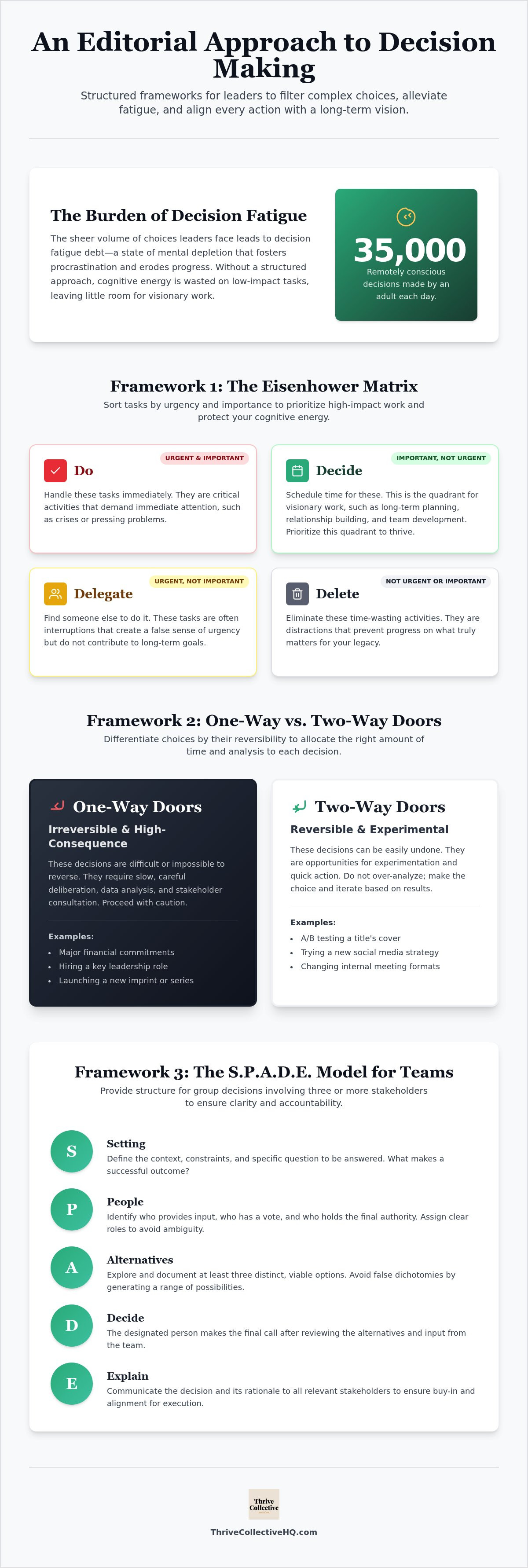
Daily prioritization often feels like a battle against the clock. The Eisenhower Matrix helps you sort tasks into four distinct quadrants: urgent and important, important but not urgent, urgent but not important, and neither. To truly scale with intention, you must prioritize the second quadrant. This includes activities like long term planning or team development. For instance, moving a task like drafting a five year vision statement from a dusty to-do list to your morning focus can change the trajectory of your week. This level of discipline is a core tenet of leadership coaching for entrepreneurs, where the focus is on purpose rather than just pace. It is about choosing to thrive rather than simply surviving the day.
Applying the S.P.A.D.E framework to big choices
When a decision involves three or more stakeholders, the S.P.A.D.E. framework provides a necessary structure. It begins with the Setting, where you define the context and constraints. Next, you identify the People who provide input or hold the final vote. You then list Alternatives, exploring at least three distinct paths to avoid the trap of binary thinking. The Decide phase is the actual commitment, followed by the crucial Explain phase. In this final step, you articulate the "why" behind your choice to your readers and team. This transparency builds deep trust and ensures everyone is moving in the same direction. Utilizing such decision making frameworks for business owners ensures that your most significant commitments are never made in a vacuum. If you find yourself needing more guidance on refined judgment, we invite you to browse the titles in our business catalog for deeper insights into the visionary mind.
Choosing between one-way and two-way door decisions
Not all choices carry the same weight. Some are like heavy oak doors that lock behind you, while others are screen doors that swing both ways. Decision making frameworks for business owners often start with this simple distinction. One-way doors represent irreversible, high stakes commitments that require careful deliberation. Two-way doors are reversible choices that allow for experimentation and learning. Understanding the difference is essential for maintaining the momentum of your organization.
Leaders often fall into the trap of treating every choice like a one-way door. This perfectionist tendency creates a bottleneck in growth and leads to unnecessary stress. For example, signing a 12 month lease for a new storefront in Santa Fe is a one-way door with significant financial and legal implications. Conversely, signing up for a 3 month software trial to test a new project management tool is a two-way door. If the tool fails to meet your needs, you simply walk back through the door and try something else. Recognizing this allows you to move with a sense of calm and intentionality.
Identifying high stakes commitments
A true one-way door decision typically meets three specific criteria: it involves a significant outlay of capital, it is structurally difficult to undo, and it has a long term impact on your brand legacy. Because the cost of failure is high, these decisions require approximately 70 percent more data and reflection than minor choices. When you face these heavy doors, the internal pressure can be overwhelming. Reading The Emotional Intelligence Advantage can help you manage the anxiety that naturally accompanies these high stakes commitments. It provides the mental clarity needed to act with intention rather than fear, ensuring your legacy remains secure.
The power of the reversible choice
The vast majority of your daily choices are actually reversible. Some industry estimates suggest that 80 percent of business choices are two-way doors. For these, speed is more valuable than perfect certainty. Rapid testing allows you to gather real world data rather than getting stuck in a procrastination habit. If a new marketing campaign or a minor title change in your catalog does not resonate with your readers, you can pivot. Embracing the reversible nature of these choices allows you to maintain an energetic flow. It moves you away from the paralysis of overthinking and toward the proactive state of a visionary leader.
How do you implement a decision framework with a small team?
Implementing a decision framework with a small team involves assigning specific roles to ensure clarity and speed. By using decision making frameworks for business owners like the RAPID model, a leader defines who recommends, agrees, performs, provides input, and ultimately decides, which eliminates the friction of consensus seeking and allows the team to move with intentionality.
Friction often arises when lines of authority are blurred. Without a clear structure, groups fall into the trap of seeking consensus for every minor choice, which inevitably leads to delays and frustration. By assigning specific roles at the start of a project, you eliminate the ambiguity that stalls progress and drains your energy. This creates a sense of calm in the office, allowing your collective efforts to focus on high impact goals rather than administrative friction.
Implementing this model can reduce meeting times by 30 percent. When each person knows exactly what is expected of them, the work flows naturally from a state of dreaming to a state of doing. You no longer need every team member to weigh in on every detail, which protects the cognitive capacity of the entire group.
Defining the decider and the contributors
As a business owner, you may feel the urge to be the final word on every choice. However, true leadership involves empowering your team to own specific titles or projects. You are not always the ideal individual to be the decider. For example, your marketing lead should have the authority to decide on the social media budget for a new release in the catalog. In this scenario, you might provide input, but the final choice rests with the lead. This level of trust allows you to step back and focus on the broader vision of the company.
Building a culture of transparency
Clarity is a gift you give to your team. Documenting the why behind a choice is just as important as the choice itself. We recommend maintaining a simple shared log for major company decisions to serve as a reference point for future growth. This practice ensures that the reasoning behind a choice is not lost in the daily rush. It fosters a culture of transparency where every team member understands how their work aligns with the long term legacy of the brand. This clarity is essential during the transition from founder to visionary leader, where your role shifts from doing the work to guiding the movement.
Cultivating the discernment of a visionary leader
A framework is a skeletal structure, but your discernment is the lifeblood that makes it function. While decision making frameworks for business owners provide the necessary rubrics for alignment, they're only as effective as the clarity of the mind employing them. True leadership requires a commitment to personal evolution, ensuring that your internal compass remains steady even when external data is conflicting. By investing in your own growth, you move beyond the mechanics of management and step into the role of a visionary guide for your collective. This process of self-refinement ensures that every choice serves a larger purpose.
The role of literature in leadership
Expanding your mental models is a continuous editorial process. The Leadership and Growth Collection at Thrive Collective Publishing offers a curated selection of perspectives designed to refine your judgment. Titles by Kimberly Burk Cordova provide a direct and warm approach to business challenges, helping you see obstacles as opportunities for refinement. Reading diverse viewpoints allows you to stress-test your assumptions and prepare for complex scenarios before they arrive. For those looking to integrate modern technology with human wisdom, Artificial Intelligence Unleashed provides essential context for making choices in an automated age. This is particularly relevant considering that a 2025 McKinsey report found 95 percent of companies using AI had not yet seen a measurable return on their investment, highlighting the vital need for human oversight and strategic discernment.
Journaling for post-decision reflection
Refining your intuition requires a feedback loop that digital tools often fail to provide. We advocate for the "Decision Journal" technique, where you record your expectations and reasoning before committing to a choice. Using a paper journal from the Just Write Collection facilitates a necessary digital detox, allowing your thoughts to settle without the distraction of notifications. By reviewing these entries six months later, you can track the accuracy of your logic and identify recurring biases in your thinking. This practice is supported by the cognitive case for paper, which suggests that the tactile act of writing improves information retention and emotional processing. This quiet reflection ensures that every choice you make is an intentional step toward the legacy you wish to build.
Step into your role as a visionary leader
Mastering decision making frameworks for business owners is an editorial act that transforms the way you lead your collective. By distinguishing between irreversible commitments and experimental tests, you protect your cognitive energy for the choices that define your legacy. Implementing clear roles like the RAPID model ensures your team moves with the same intentionality that you bring to your vision. We believe that scaling with ease is possible when you replace reactive management with structured discernment. Lead with intention.
Thrive Collective Publishing features titles by Kimberly Burk Cordova and other visionary authors who prioritize intentionality over hype. Our catalog provides the quiet wisdom needed to refine your judgment in an increasingly noisy market. These resources are crafted for entrepreneurs who value depth and purpose in every chapter of their growth.
You have the potential to move beyond the daily rush and lead with a sense of profound calm. Trust in your ability to curate a business that reflects your highest values and deepest ambitions.
Frequently Asked Questions
What is the most effective decision making framework for a solo entrepreneur?
The Eisenhower Matrix is often the most practical choice for a solo entrepreneur because it addresses the immediate need for prioritization without requiring external input. By sorting your tasks into four quadrants based on urgency and importance, you can protect your time for high impact work. This framework ensures that your daily efforts contribute to your long term legacy rather than just reacting to the noise of an overflowing inbox.
How can I tell if a business decision is a one-way or two-way door?
A one-way door decision is marked by high costs and irreversibility, such as signing a long term commercial lease or making a significant capital investment. If the choice is difficult to undo and carries high stakes for your brand, it is a one-way door. Conversely, a two-way door is an experimental choice that allows you to pivot if the outcome is not favorable. Most business choices are reversible.
Should I use a framework for every small choice in my business?
Using complex decision making frameworks for business owners for every micro-choice can actually increase decision fatigue. You should save structured models for choices that involve significant risk or multiple stakeholders. For routine tasks, trust your established systems or delegate the choice to your team. The goal of a framework is to provide clarity for the complex, not to create a bottleneck for the mundane aspects of your daily operations.
How do I explain a new decision making framework to my team?
Transparency is the most effective tool when introducing a new framework to your team. Explain that the goal is to improve alignment and speed rather than to add a layer of bureaucracy. By clearly defining roles through models like RAPID, you empower your team to take ownership of specific projects. This clarity reduces friction and ensures that everyone understands how their individual contributions support the collective goals of the organization.
Can decision making frameworks help with burnout and overworking?
Decision making frameworks for business owners are essential for preventing the cognitive depletion that leads to burnout. By providing a repeatable rubric, these tools reduce the mental energy required to evaluate every new opportunity. This structured approach allows you to say no to distractions with confidence, protecting your capacity for deep work. When you operate with intentionality, you move from a state of survival to one where you can truly thrive.
What are the best leadership development books for making better choices?
Our catalog features several titles designed to refine your judgment and leadership skills. We recommend exploring the works of Kimberly Burk Cordova for direct and warm insights into intentional growth. Additionally, titles like The Emotional Intelligence Advantage provide the psychological tools needed to manage the stress of high stakes choices. These resources serve as an editorial guide, helping you expand your mental models and lead your company with purpose.

Article by
Kimberly Cordova
Kimberly Burk Cordova is the founder of Thrive Collective Publishing, an independent multi-imprint publishing house based in Santa Fe, New Mexico. She is the author of books on leadership, business growth, AI and automation, emotional intelligence, and personal development, written for readers who want clear thinking, useful frameworks, and books they actually finish.
Before turning her full attention to publishing, Kimberly spent more than two decades in strategy, operations, and program leadership, working with public agencies and private organizations on transformation, technology, and large-scale change. That operator's lens shows up in everything she writes and publishes: real frameworks, real numbers, no fluff.
As publisher, she leads a catalog of more than 80 titles from six authors across multiple imprints, spanning literary suspense, true crime, children's biography, relationships, travel, guided journals, and coloring books. The house publishes regularly across its core series, including The Casita Series, Shadows of the Past, the Young Legends Collection, The Growth Leader Collection, the AI and Automation Blueprint, The Heirloom Series, The Art of Manifestation, the Just Write Collection, and Travel: Destination Guides.
She lives in Santa Fe with her husband Greg, a self-taught silversmith and lapidary artist. When she is not writing or publishing, she is building Wildflower Artisans, their Turquoise jewelry brand, or curating the next round of Just Write journals.
Connect with Kimberly and Thrive Collective Publishing at thrivecollectivehq.com.