

A leader who spends every hour reacting to the immediate needs of their business isn't leading; they're merely surviving. You likely started your business to create something meaningful, yet the daily friction of operations often leaves little room for the visionary thinking required to scale with ease. Thrive Collective Publishing suggests that the best books on strategic thinking for leaders are those that move beyond simple manuals to provide frameworks for long-term alignment and legacy. We believe that your library should be more than a collection of instructions; it should be a source of intentionality and growth. Finding the right titles is the first step toward reclaiming your time and your purpose.
We've curated a selection of titles designed to shift your focus from the tactical to the visionary. You'll discover how specific literature can help you align your personal values with your business growth while providing practical frameworks to apply these insights immediately. This overview provides a clear reading list that delivers a real return on your time, helping you move from a state of dreaming to a state of decisive doing.
Key Takeaways
- Understand how to cultivate the mental discipline required to identify long-term patterns and consequences before making critical business decisions.
- Review a curated list of books on strategic thinking for leaders that bridges the gap between classic strategy and the human-centric leadership needs of 2026.
- Learn to implement a weekly Strategic Hour to translate theoretical insights from your reading into concrete operational improvements.
- Determine the specific titles that match your leadership stage, ensuring your reading list supports your current goals for alignment and intentionality.
- Explore how shifting your focus from daily fires to visionary impact helps you cultivate a lasting legacy within your professional community.
Why do leaders prioritize books on strategic thinking?
Visionary leaders prioritize these titles to move beyond immediate reactions and cultivate the mental discipline required for long-term impact. By studying patterns and consequences through curated literature, you escape industry echo chambers and gain the clarity needed to align your daily actions with your future legacy and business growth.
Strategic thinking is not an innate talent; it is a discipline refined through intentional study. Thrive Collective Publishing recognizes that the most effective leaders seek out books on strategic thinking for leaders to gain a perspective that transcends their specific industry. When you engage with diverse viewpoints, you develop the ability to see the broader landscape of your business. Understanding what is strategic thinking allows you to move beyond the friction of daily operations toward a more sustainable and purposeful future. We believe that a disciplined reading habit serves as a high-impact form of professional coaching, offering insights that traditional manuals often overlook.
The distinction between tactical and strategic reading
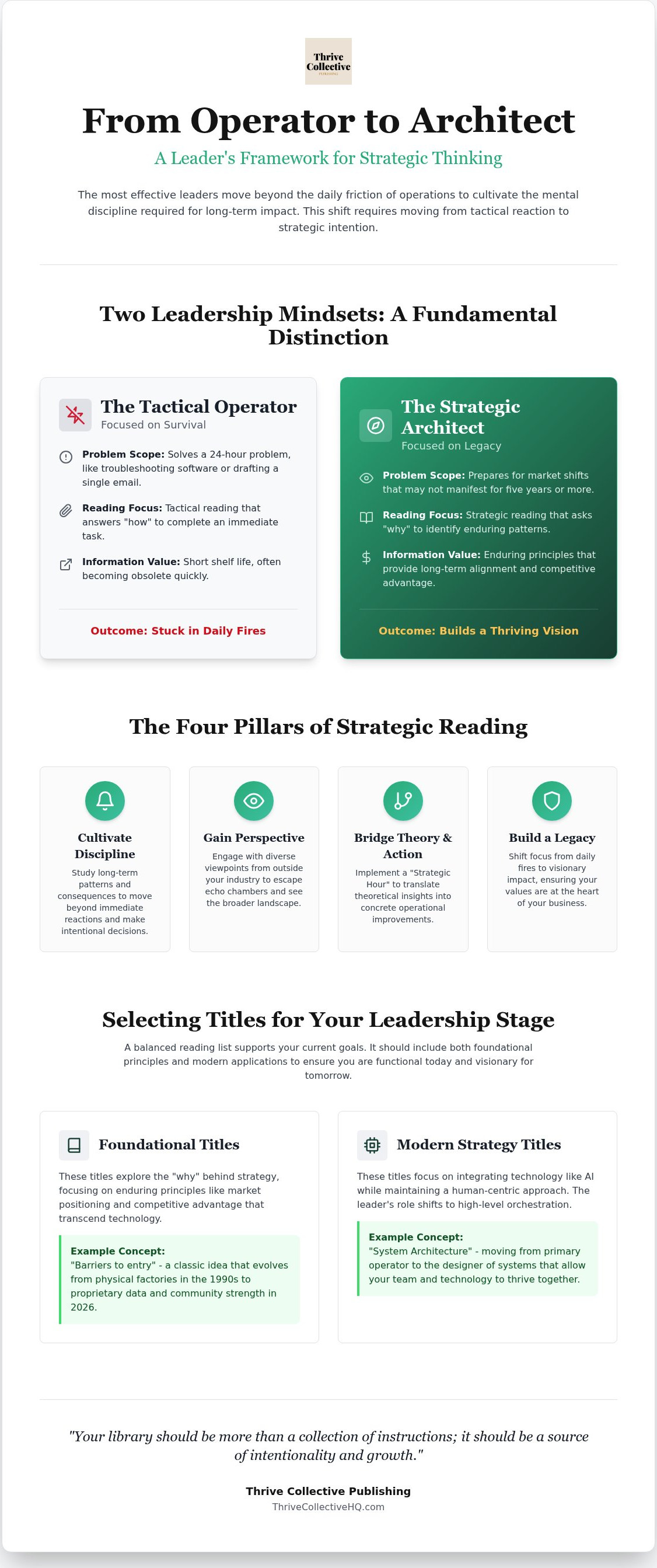
Tactical reading is designed to solve a 24-hour problem. It tells you how to troubleshoot a software error, draft a single marketing email, or run a specific social media ad. While these skills are necessary for daily survival, the information often has a short shelf life. Strategic reading, however, prepares you for shifts in the market that may not manifest for five years. In 2026, the ability to anticipate these shifts is the difference between a business that barely survives and one that truly thrives. Balancing both types of reading ensures you are functional today while remaining visionary for tomorrow.
Cultivating the visionary leader mindset
Transitioning from an operator to an architect requires a fundamental shift in how you value your time. The operator is often stuck in the daily fires of the business, while the architect focuses on the intentionality and alignment of the entire structure. Our leadership and growth collection is curated to support this evolution. By practicing reflection, you turn raw information into strategic wisdom. This process allows you to build a community-oriented business that scales with ease, ensuring your personal values remain at the heart of your professional impact. When you lead with this level of clarity, your business becomes a vehicle for collective progress rather than just financial gain.
Essential titles for mastering long-term vision in 2026
The landscape of leadership has changed, requiring a sophisticated blend of timeless principles and modern adaptability. Thrive Collective Publishing curates titles that help you move beyond the noise of generic business advice to find clarity in your long-term direction. Developing a framework for strategic thinking for leaders requires a blend of historical wisdom and forward-looking adaptability. When you diversify your catalog to include cognitive science and human-centric strategy, you build a foundation that supports both personal growth and business impact.
Foundational texts for strategic foundations
While the tools of business evolve, the core principles of market positioning and competitive advantage remain constant. Understanding the "why" behind a strategy is far more valuable than simply following a "what" or a checklist. For example, a concept from the 1990s like "barriers to entry" still applies to a 2026 digital business, though the application has shifted. In the past, a barrier might have been a physical factory or a massive distribution network. Today, that barrier is often your proprietary data or the strength of the community you have cultivated. By studying foundational titles, you learn to identify these enduring patterns regardless of the current technology.
Modern strategy in the age of AI and automation
As we move further into 2026, scaling with ease depends on how well you integrate technology without losing your human-centric focus. Strategy in this era is less about manual execution and more about high-level orchestration and alignment. You must move from being the primary operator to being the architect of systems that allow your team to thrive. Titles like The Emotional Intelligence Advantage provide the necessary tools for navigating internal leadership dynamics in a world that often feels dominated by algorithms. This human-centric approach ensures that your business remains a place of connection and purpose, even as automation handles the tactical daily tasks.
True visionary impact also requires an understanding of the cognitive biases that cloud our judgment. We often fall into the trap of confirmation bias or the sunk cost fallacy, especially when we feel stuck in daily fires. Reading outside of traditional business genres, such as exploring literary suspense or historical biographies, can sharpen your critical thinking and help you see your business from a fresh perspective. If you are looking to expand your perspective, consider exploring our curated leadership catalog to find your next essential read.
How can readers apply theoretical strategy to daily operations?
Reading is a powerful tool for growth, but knowledge without application is merely a distraction for a busy leader. You don't need more information; you need more alignment. When you invest your limited time in books on strategic thinking for leaders, the goal isn't just to finish the title or clear your nightstand. It's to find the specific insight that will move the needle for your business. We recommend creating a "Strategic Hour" once a week. This is a dedicated, non-negotiable block of time to step away from the daily fires and reflect on what you've recently read. Use this sanctuary to bridge the gap between abstract concepts and your immediate business reality.
The 3-Step Integration Framework
To ensure your reading delivers a tangible return on your investment of time, we suggest a rhythmic framework. First, identify one core thesis from your current title that directly challenges your status quo or your current way of operating. Second, map that thesis against your specific 90-day goals to see if it offers a more efficient path to your desired outcome. Third, execute one "strategic experiment" based on that insight within the next seven days. For instance, if you are reading about decentralized leadership, your experiment might be delegating one recurring decision to a team member this week. This process turns a theoretical idea into a practical data point, allowing you to scale with ease rather than guessing your way forward.
Using guided journals for business clarity
Processing complex strategic thoughts often requires getting away from a screen to avoid the noise of digital notifications. Digital fatigue is a real barrier to visionary thinking in 2026, often leading to information overload rather than clarity. Using physical tools like our Just Write Collection allows you to slow down and let your thoughts breathe. There is a strong cognitive case for paper when it comes to planning your legacy and business strategy. Handwriting your strategic plans helps you internalize the material and find clarity that a keyboard often obscures. When you write by hand, you engage different parts of your brain, leading to deeper intentionality and better alignment with your personal values. It’s a soulful way to ensure your business growth remains rooted in your heart-centered mission.
Finally, remember that leadership is a collective effort. When you share insights from books on strategic thinking for leaders with your small team or your community, you foster a culture of shared growth. Vocalizing these concepts clarifies them for yourself and invites others into your vision. This turns your personal evolution into a catalyst for the entire business to thrive, moving everyone from a state of survival into a state of intentional impact.
Selecting the right titles for your leadership stage
Every leader stands at a different point on the path toward their legacy. A founder launching their first venture faces different frictions than a seasoned CEO managing a team of fifty. Because your time is your most precious asset, you must select books on strategic thinking for leaders that address your specific phase of growth. We believe that intentionality in your reading choices prevents the distraction of generic advice and ensures every page contributes to your personal evolution and business alignment. Choosing the wrong title for your current stage often leads to information overload rather than the clarity you need to move forward.
Strategy for the new business owner
In the early days, your primary challenge is often the transition from being the doer to the thinker. It's easy to fall into the trap of overworking, believing that more hours equal more success. However, building strategic foundations early allows you to scale with ease later. You should look for titles that help you define your leadership core values from day one. This clarity ensures that every decision you make is rooted in your purpose. For those seeking a deeper exploration of this transition, our guide on leadership coaching for entrepreneurs offers a visionary perspective on scaling with purpose.
Advanced strategy for scaling visionaries
As your business grows, the complexity of managing teams and maintaining culture becomes paramount. You are no longer just an operator; you are the architect of a collective effort. At this stage, advanced books on strategic thinking for leaders focus on high-level alignment and the psychology of leadership. Maintaining a literary mindset, one that values deep reflection and nuanced understanding, helps you handle high-growth pressures without losing your soul. We recommend exploring The Growth Leader Collection, which features titles specifically curated for those navigating these intricate dynamics.
Cultivating a strategic legacy
The final stage of leadership involves looking beyond your own tenure toward long-term community impact and succession. Strategy here is about ensuring the business can thrive without your daily presence. This requires a shift in focus toward mentorship and the preservation of values. By selecting titles that explore legacy and long-term impact, you prepare yourself and your organization for a future that honors your original vision. This stage is less about competitive advantage and more about the enduring contribution you leave behind for your community and the next generation of authors and leaders.
Cultivating a strategic legacy with Thrive Collective Publishing
Thrive Collective Publishing helps leaders cultivate a strategic legacy by providing literature that aligns business growth with personal values. We believe that books on strategic thinking for leaders should go beyond tactical advice to foster deep intentionality and visionary impact. By curating a catalog that balances professional development with literary depth, we empower you to move from a state of survival to one where your business and community truly thrive. Our mission is to serve as a hub for connection and growth for entrepreneurs who view their work as a vehicle for collective progress.
We see ourselves as more than an independent press; we are a movement for intentional leaders who refuse to settle for generic business advice. While many publishers focus on high-volume, transactional titles, our focus remains on curated works that encourage you to think like an architect rather than an operator. Success is a collective endeavor, and the titles you choose to house in your library should reflect that belief. By engaging with literature that challenges your fundamental perspective, you aren't just building a profitable company; you are cultivating a lasting legacy that supports your community and your purpose.
Beyond business books: Why the whole leader matters
A visionary leader understands that strategy isn't limited to spreadsheets or market analysis. It requires a deep well of empathy and a sharp analytical mind that can identify patterns in human behavior. Integrating diverse genres like literary suspense or true crime into your reading habit sharpens these skills in ways a traditional manual cannot. For example, reading a title like The Mother I Did Not Know by K.B. Cordova builds the emotional intelligence needed to navigate complex human dynamics within your team. Fiction allows you to exercise your strategic imagination, helping you visualize future scenarios with greater clarity. We take pride in supporting authors who write specifically for the thoughtful, serious leader who values depth over hype.
Your next step toward visionary leadership
Your evolution as a leader is a continuous process of alignment and intentionality. We invite you to join our collective of readers who prioritize deep work and visionary impact over superficial metrics. Finding the right literature to support your current growth phase is the first step toward reclaiming your time and your mission. To begin this next phase of your development, we invite you to explore our Leadership and Growth collection. If you are looking for a more personalized approach to your professional development, please email info@thrivecollectivehq.com for a curated reading recommendation tailored to your specific leadership stage. We are here to support your purpose, your impact, and your legacy as you step into a bigger version of yourself.
Stepping into your visionary impact
Cultivating a strategic mindset is a discipline that requires intentionality to move from survival to a state of thriving. By integrating specific books on strategic thinking for leaders into your routine, you shift from being a reactive operator to the architect of your business legacy. We've explored how a weekly Strategic Hour and a curated library from Thrive Collective Publishing, including flagship fiction like The Mother I Did Not Know by K.B. Cordova, build the emotional intelligence needed for long-term impact. Our independent press, rooted in the rich literary culture of New Mexico, remains dedicated to providing the tools you need for this personal evolution. We believe that when one leader grows, the entire community rises with them.
You're capable of building a business that scales with ease while remaining deeply aligned with your personal values. You don't have to navigate this path alone; success is a collective endeavor. We're here to support your purpose and your growth as you lead with clarity, heart, and a vision for the future.
Frequently Asked Questions
What are the best strategic thinking books for new business owners in 2026?
The best books on strategic thinking for leaders starting a new venture are those that prioritize market positioning and the establishment of core values. In 2026, you should look for titles that address the intersection of human-centric leadership and AI-driven efficiency. These foundations prevent the common trap of overworking by ensuring your early decisions are rooted in long-term alignment rather than immediate survival. This approach helps you build an architect's mindset from day one.
How many leadership development books should I read per year?
We recommend focusing on four to six high-impact titles per year rather than attempting to consume a high volume of generic advice. Deep reading requires time for reflection and application, which is difficult to achieve if you are rushing through a new book every week. A curated approach ensures you have the mental space to integrate strategic insights into your daily operations and personal evolution. Quality of insight always outweighs the quantity of pages turned.
Can fiction titles help with strategic thinking for leaders?
Fiction titles are essential for developing the strategic imagination and empathy required for visionary leadership. Engaging with complex narratives, such as the flagship title The Mother I Did Not Know by K.B. Cordova, sharpens your ability to identify patterns in human behavior and anticipate future scenarios. This literary approach helps you see your business challenges through a more nuanced, analytical lens that traditional business manuals often lack. It builds the emotional intelligence needed for high-level strategy.
What is the difference between a leadership book and a strategy book?
A leadership book typically focuses on the who and how of managing people, culture, and team dynamics. In contrast, a strategy book addresses the where and why of your business direction and competitive advantage. Visionary leaders must engage with both to ensure their collective effort is aligned with a clear, long-term vision. This balance supports sustainable growth and ensures your business serves as a vehicle for both personal and community impact.
How do I find time to read for professional development while running a business?
You find time for professional development by treating your reading as a non-negotiable business appointment. Scheduling a Strategic Hour once a week allows you to step away from the daily fires and focus on high-level thinking. By prioritizing these books on strategic thinking for leaders during your most productive hours, you ensure that your business growth is guided by intentionality. This practice moves you from a state of reacting to a state of decisive, visionary doing.
Should I buy business books direct from the publisher or through a large retailer?
Buying direct from an independent press like Thrive Collective Publishing ensures that more of your investment supports authors and the creation of thoughtful, curated content. While large retailers offer convenience, buying direct allows you to join a community of readers who value intentionality and independent literary culture. This choice strengthens the publishing ecosystem and ensures we can continue to produce high-quality titles for visionary entrepreneurs who want to thrive rather than just survive.
How do I know if a leadership book is actually worth my time?
A leadership book is worth your time if it offers concrete frameworks and challenges your current status quo rather than relying on breathless, hype-driven language. Look for titles that provide specific examples and analytical depth. If a book promises an immediate solution or relies heavily on industry buzzwords, it likely lacks the substance required to deliver a meaningful return on your investment. Trust your intuition and seek out curated recommendations from trusted sources.
What is the "Thrive versus Survive" dichotomy in leadership literature?
The thrive versus survive dichotomy describes the difference between reactive, tactical management and intentional, visionary leadership. Survival is characterized by a focus on 24-hour problems and industry echo chambers. Thriving occurs when you use strategic thinking to align your personal values with your business impact, allowing you to scale with ease and cultivate a lasting legacy. This distinction is a recurring theme across our catalog, encouraging you to step into a bigger version of yourself.

Article by
Kimberly Cordova
Kimberly Burk Cordova is the founder of Thrive Collective Publishing, an independent multi-imprint publishing house based in Santa Fe, New Mexico. She is the author of books on leadership, business growth, AI and automation, emotional intelligence, and personal development, written for readers who want clear thinking, useful frameworks, and books they actually finish.
Before turning her full attention to publishing, Kimberly spent more than two decades in strategy, operations, and program leadership, working with public agencies and private organizations on transformation, technology, and large-scale change. That operator's lens shows up in everything she writes and publishes: real frameworks, real numbers, no fluff.
As publisher, she leads a catalog of more than 80 titles from six authors across multiple imprints, spanning literary suspense, true crime, children's biography, relationships, travel, guided journals, and coloring books. The house publishes regularly across its core series, including The Casita Series, Shadows of the Past, the Young Legends Collection, The Growth Leader Collection, the AI and Automation Blueprint, The Heirloom Series, The Art of Manifestation, the Just Write Collection, and Travel: Destination Guides.
She lives in Santa Fe with her husband Greg, a self-taught silversmith and lapidary artist. When she is not writing or publishing, she is building Wildflower Artisans, their Turquoise jewelry brand, or curating the next round of Just Write journals.
Connect with Kimberly and Thrive Collective Publishing at thrivecollectivehq.com.