

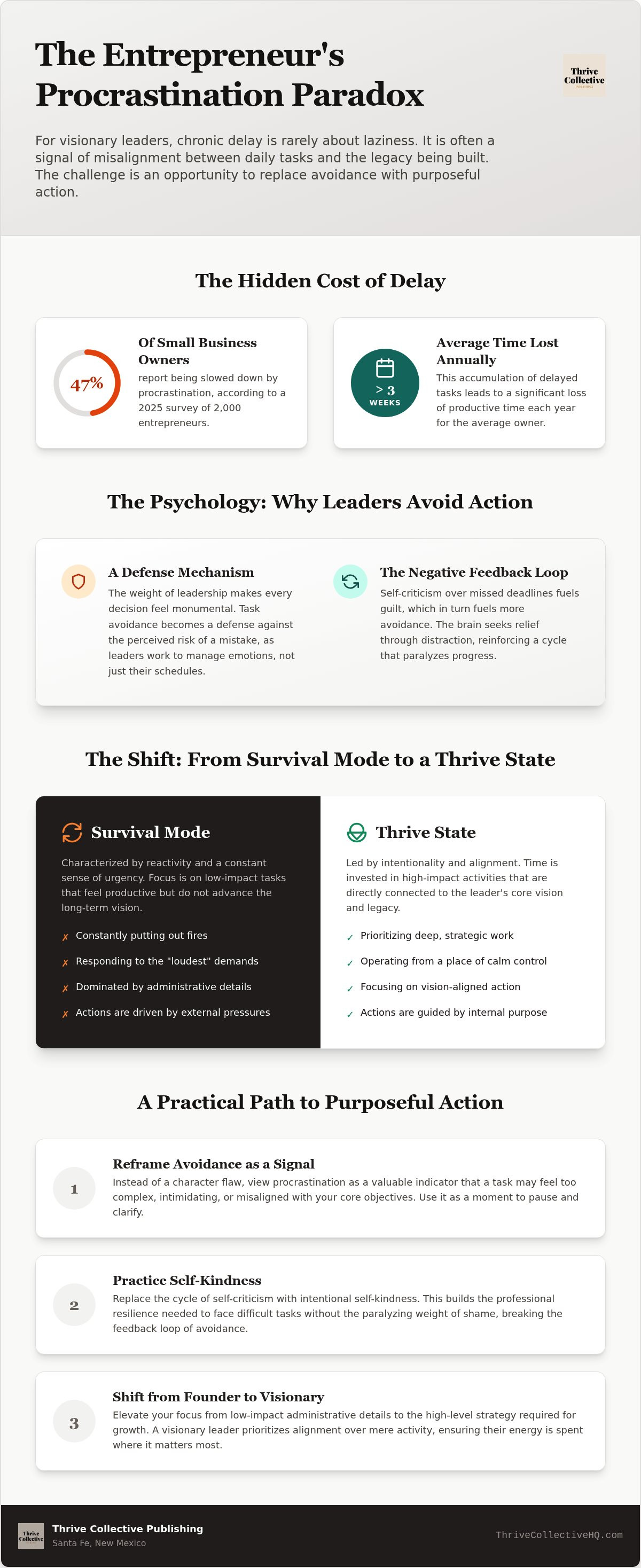
A 2025 survey of 2,000 small business owners found that 47 percent are slowed down by procrastination, which often leads to an average loss of over three work weeks every year. For a visionary leader, this delay is rarely about laziness or a lack of ambition. It's often a signal of misalignment between your daily tasks and the legacy you're building. At Thrive Collective Publishing | Santa Fe Indie Publisher, we view effective time management for entrepreneurs as more than just a productivity hack (it's a foundational practice for those who wish to scale with ease).
We understand the weight of the last minute rush and the quiet guilt that follows unfulfilled potential. You might worry that these habits mean you're not cut out for the scale of your dreams, but we believe this challenge is an opportunity for personal evolution. You'll discover how to replace the cycle of avoidance with a rhythm of purposeful action that supports your growth as a leader. We'll look at how to move from a state of surviving the daily grind to thriving in a space of calm, control, and long term impact.
Key Takeaways
- Learn how to replace the cycle of self-criticism with self-kindness to build professional resilience and stop the feedback loop of avoidance.
- Understand the true physiological cost of relying on last-minute adrenaline and why working under pressure is a survival tactic rather than a sustainable strategy.
- Master a five-step process for effective time management for entrepreneurs that prioritizes your hardest tasks to build momentum and regain control of your schedule.
- Discover how curated leadership titles and guided reflection can help you identify deep-seated patterns of avoidance and realign your daily actions with your long-term legacy.
Why do entrepreneurs struggle with the habit of procrastination?
Entrepreneurs often find themselves trapped in the cycle of procrastination because the sheer weight of their leadership responsibilities creates a psychological burden where every decision feels monumental, causing a natural instinct to delay action in an attempt to protect the business from the perceived risk of a potential mistake.
Being a small business owner means every choice carries the potential to impact your team, your family, and your long term legacy. This heavy sense of responsibility often results in a fear of making the wrong move. When the stakes feel this high, task avoidance becomes a defense mechanism. The psychology of procrastination suggests that we aren't just managing time; we're managing emotions. If a task feels like it could lead to failure, your mind might steer you toward safer, more comfortable activities, like checking emails or organizing files, instead of tackling the high level strategy you actually need to grow.
At Thrive Collective Publishing | Santa Fe Indie Publisher, we see this pattern frequently among the authors we work with. Managing these internal and external pressures is a core theme in the title Turning Chaos into Gold, which offers a roadmap for leaders who feel overwhelmed by the daily demands of their business. Effective time management for entrepreneurs starts with recognizing that avoidance is a signal, not a character flaw. Mastering time management for entrepreneurs is about moving beyond the clock and into a space of intentional leadership.
The shift from founder to visionary leader
Many business owners remain stuck in the founder stage for too long. In this phase, you might find yourself bogged down in administrative details or low impact tasks that feel productive but don't move the needle. A visionary leader, however, understands that their primary role is to prioritize alignment over mere activity. This shift requires a new perspective on how you value your time. We explore this transition further in our leadership coaching resources, which emphasize the need for scaling with purpose and clarity.
Identifying the survival versus thrive dichotomy
The survival state is characterized by reactivity. In this mode, you're constantly putting out fires and responding to the loudest demands of the moment. This is the opposite of the thrive state, where intentionality and planning lead the way. For example, an entrepreneur might procrastinate on writing their annual impact report because it requires deep thought and reflection. By choosing to answer minor customer inquiries instead, they stay in survival mode, missing the chance to align their daily work with their bigger vision for the business.
The psychology of avoidance and the power of self-kindness
Self-criticism acts as a quiet thief in the life of a founder. It creates a negative feedback loop where the guilt of a missed deadline or a delayed project fuels even more avoidance. When you tell yourself that you are failing, your brain naturally seeks relief through distraction. This cycle is a significant barrier to effective time management for entrepreneurs. Choosing self-kindness instead acts as a buffer. It builds the professional resilience needed to face difficult tasks without the paralyzing weight of shame. A leader who practices emotional awareness can pivot quickly, turning a moment of hesitation into a moment of alignment.
Managing a daily workflow requires a high level of emotional intelligence. You must be able to name the feeling of resistance as soon as it arises. Once you recognize that you are avoiding a task because it feels intimidating or complex, you can address the emotion directly. This mindset shift leads to better business outcomes because it allows you to stay present and focused. You move from reacting to your fears to leading with intentionality and grace. By treating your work as an opportunity for personal evolution, you change your relationship with the clock.
Moving beyond the laziness myth
Procrastination is an emotional response to stress rather than a lack of character or work ethic. High-achievers are often the most prone to this habit because they care deeply about the quality of their work and the impact of their legacy. When your standards are exceptionally high, the pressure to perform can feel overwhelming. Avoidance is often a sign of high standards rather than low effort. It is an attempt to protect your identity as a capable leader from the possibility of falling short of your own expectations. Recognizing this allows you to lower the stakes and simply begin.
Cultivating a community of support
No one succeeds in a vacuum, and we believe in the power of the Collective to help leaders thrive. Sharing your challenges with other authors or fellow business owners reduces the isolation that often leads to shame-based procrastination. When you see that others face similar hurdles, the weight of your own struggles begins to lift. This shared experience fosters a sense of integrity and reminds us that success is a collective endeavor rather than a solitary race. You can visit our about page to see how we prioritize growth and community in our work. For those seeking fresh perspectives on leadership, our catalog of titles offers resources designed to support your leadership path.
Is it true that some leaders work better under pressure?
While many leaders believe the adrenaline of a last minute rush sharpens their focus, relying on pressure is actually a survival mechanism that trades long term health and creative depth for short term completion, ultimately preventing the intentional scaling required to build a lasting and meaningful legacy.
Thrive Collective Publishing recognizes that many visionary leaders have a complicated relationship with the clock. You might feel that you only truly "turn on" when a deadline is looming. This reliance on the "pressure cook" method is a common hurdle in time management for entrepreneurs. The physiological cost is steep. When you rely on adrenaline to cross the finish line, your body stays in a state of high alert. This chronic stress response floods your system with cortisol, which can cloud your judgment and limit your ability to think strategically. Research from 2026 indicates that 72 percent of entrepreneurs have experienced burnout symptoms in the past year, with 70 percent citing long hours as the primary trigger. This cycle prevents the deep work necessary for innovation. Instead of dreaming about the future of your business, you're merely surviving the present.
The hidden cost of the adrenaline rush
When your brain is in a state of high alert, the quality of your decision making inevitably suffers. Last minute work often leads to overlooked details and small errors that can damage your professional reputation. Relying on the rush means you're never working at your full potential. We believe that sustainable success requires a different approach. Building sustainable habits is a central theme in our leadership development books, which offer strategies to move away from these frantic patterns and toward a more rhythmic, intentional way of working.
Replacing panic with purpose
Effective time management for entrepreneurs isn't about doing more in less time (it's about doing what matters with more presence). You can find excitement in the process of building your legacy without needing the threat of a deadline to motivate you. Start your day by identifying the one task that will have the greatest impact on your business three years from now. By tackling this legacy task first, you build momentum based on purpose rather than panic. This shift allows you to lead with a sense of calm and authority that inspires your entire Collective and supports your long term growth.
Practical frameworks for moving from survival to aligned action
Regaining control of your professional schedule requires a shift from reactive habits to a structured rhythm of intentionality. We recommend a five step process to help you move out of survival mode and into a space of clarity. First, perform a complete audit of your current tasks to see where your energy actually goes. Second, filter these tasks through the lens of your long term legacy. Third, use intentionality to either delegate or delete anything that does not require your specific visionary input. Fourth, identify the hardest, most intimidating task on your list and commit to starting it first. Finally, use physical tools like those in our journals and keepsakes collection to track your progress and celebrate small wins. This tangible record helps you see how far you have come in mastering time management for entrepreneurs.
Starting with the most challenging task builds immediate momentum. When you tackle the thing you have been avoiding, you remove the psychological weight that usually drags down the rest of your day. This approach is not about working harder (it is about working with a sense of alignment). By choosing which tasks to own and which to pass to your team, you create space for the high level thinking that your business needs to thrive. This is how you move from being a founder who does everything to a leader who directs the vision.
The power of three in daily planning
Overwhelm often stems from a list that is simply too long. We suggest a framework where you choose only three critical tasks to complete each day. This focus reduces the mental noise and increases your sense of impact. For example, a leader might categorize their three tasks as one Legacy task (strategic planning for next year), one Leadership task (a team check in), and one Operational task (reviewing a high level contract). When you finish these three, you can end your day with a sense of peace instead of feeling like you are always behind.
Creating a digital detox for deep work
The average entrepreneur uses four or more digital tools daily, which often leads to fragmented attention and constant context switching. Removing digital distractions during specific work blocks is essential for deep work. We encourage you to use paper journals to map out your strategic goals away from the glow of a screen. There is a strong cognitive case for paper that suggests writing by hand helps with memory and complex problem solving. Stepping away from the digital noise allows you to reconnect with your purpose and find the quiet needed for true innovation.
Browse our catalog of leadership titles
Cultivating intentionality through curated resources and reflection
True leadership is an internal practice that requires constant nurturing and a commitment to personal evolution. At Thrive Collective Publishing, we believe that the resources you choose to consume are the seeds of your future impact. Curating a personal catalog of knowledge is not about collecting data; it is about finding fresh perspectives that challenge your old habits of avoidance. This intentional approach to learning is a vital component of effective time management for entrepreneurs. When you see your growth as a collective endeavor, you realize that your individual success contributes to the strength of your entire community. Building a personal catalog of knowledge supports your long term success by ensuring that you are always operating from a place of depth. It allows you to draw on the wisdom of those who have walked the path before you, making your own path feel less solitary and more supported.
Using journals for personal evolution
Writing down your goals and reflections creates a tangible sense of accountability that digital tools often lack. While a blank notebook offers freedom, a guided journal provides the structure needed to move from a state of dreaming to a state of doing. This distinction is crucial for those who feel overwhelmed by the vastness of their own vision. This is the essence of a Collective (the belief that we are all invested in one another's ability to thrive). If you are currently facing a hurdle, try this prompt in your next session: "What is the one task I am avoiding that, if completed, would most support my long term legacy?" This simple act of reflection helps you identify patterns of avoidance and realign your daily actions with your purpose.
The role of the visionary guide
Thrive Collective Publishing acts as a visionary guide, reaching back to help you find the path toward a more aligned professional life. We believe in the power of integrity and the importance of choosing resources that mirror your deepest values. A mentor does not just give answers; they provide the tools for you to find your own. We recommend that leaders looking for a structured way to shift their mindset read Turning Chaos into Gold. This title provides a framework for leaders to move from reactive survival to purposeful impact, helping you cultivate a rhythm of work that feels both sustainable and soulful. By investing in your own development, you are not just improving your business; you are honoring the impact you were meant to make. Mastering time management for entrepreneurs is a continuous process of learning and unlearning.
Stepping Into Your Leadership Legacy
Moving from a cycle of avoidance to a rhythm of intentionality is a practice of personal evolution. It's about replacing the frantic adrenaline of last minute rushes with a calm sense of control. This shift in time management for entrepreneurs ensures your daily actions align with the long term impact you wish to leave on your community.
To begin this shift, identify your legacy task first thing each morning and commit to the power of three in your daily planning. Protecting your focus from digital noise allows you to lead from a place of quiet authority rather than reactive panic.
We recommend Turning Chaos Into Gold because it offers a grounded roadmap for those ready to move beyond survival mode. Join our newsletter for more reflections on leadership or contact us at info@thrivecollectivehq.com. Thrive Collective Publishing is an entity of Cordova Consulting LLC, dba Thrive Collective Publishing, New Mexico, USA.
Frequently Asked Questions
Is procrastination always a sign of poor time management?
Procrastination is frequently an emotional response to stress or fear rather than a simple failure of scheduling. While many people believe they lack discipline, the reality is that your brain is attempting to protect you from the discomfort of a high stakes task. Effective time management for entrepreneurs involves recognizing these feelings as signals to realign your work with your purpose rather than just buying a new planner or setting more alarms.
How can self-compassion help me get more work done?
Self-compassion breaks the negative feedback loop that keeps you stuck in avoidance. When you criticize yourself for being (lazy), you create more stress, which leads to further procrastination. By treating yourself with the same encouragement you'd offer a colleague, you lower your cortisol levels and make it easier to start. This mental shift creates the resilience needed to face complex business challenges with a clear and focused mind.
What is the difference between being a founder and a visionary leader?
A founder often operates in survival mode, handling every operational detail and reacting to urgent fires as they arise. In contrast, a visionary leader focuses on alignment and long term legacy. This shift requires you to move away from low impact tasks and prioritize strategic growth. We believe that true leadership involves stepping back to see the bigger picture, ensuring that your daily actions contribute to a collective vision rather than just a task list.
Why do I feel more productive when I am under a tight deadline?
Deadlines trigger a physiological adrenaline rush that forces a narrow focus, making you feel briefly more productive. However, this is a survival state that often results in errors and prevents deep, creative work. Relying on the last minute rush is a common hurdle in time management for entrepreneurs that leads to chronic burnout. Building a rhythm of work based on intentionality rather than panic allows for more sustainable and high quality business outcomes.
Can journaling really help me stop procrastinating on my business goals?
Journaling provides a private space for guided reflection, allowing you to identify the specific fears or patterns that trigger avoidance. By writing down your goals, you move them from a vague idea in your mind to a concrete commitment on paper. This practice fosters a sense of accountability and helps you track your professional evolution. Using structured prompts can turn a moment of overwhelm into a clear path toward your next impactful action.
How do I choose the right leadership development books for my needs?
We suggest selecting titles that address your specific current hurdles, whether you are struggling with delegation, strategic planning, or emotional resilience. Look for resources that align with your core values and the legacy you wish to build. At Thrive Collective Publishing, we curate our catalog to provide diverse perspectives on conscious entrepreneurship. Choosing books that challenge your existing habits will provide the fresh insights necessary to move your business forward with integrity.
What are the first steps to take when I feel completely overwhelmed?
When overwhelm strikes, the first step is to pause and perform a quick audit of your current mental load. Identify the single most impactful task that aligns with your long term vision and commit to spending thirty minutes on it without distractions. Breaking the cycle of (survival) requires you to choose alignment over volume. By focusing on just one high level priority, you build the momentum needed to regain control of your professional schedule.
Does everyone in entrepreneurship struggle with avoidance at some point?
Avoidance is a nearly universal experience for small business owners because the weight of responsibility can be immense. Many of the authors we work with report facing these same challenges as they transition into bigger versions of their leadership roles. Recognizing that you aren't alone in this struggle helps remove the shame that often fuels further procrastination. We view these moments as opportunities for personal evolution and a natural part of the collective path toward success.

Article by
Kimberly Cordova
Kimberly Burk Cordova is the founder of Thrive Collective Publishing, an independent multi-imprint publishing house based in Santa Fe, New Mexico. She is the author of books on leadership, business growth, AI and automation, emotional intelligence, and personal development, written for readers who want clear thinking, useful frameworks, and books they actually finish.
Before turning her full attention to publishing, Kimberly spent more than two decades in strategy, operations, and program leadership, working with public agencies and private organizations on transformation, technology, and large-scale change. That operator's lens shows up in everything she writes and publishes: real frameworks, real numbers, no fluff.
As publisher, she leads a catalog of more than 80 titles from six authors across multiple imprints, spanning literary suspense, true crime, children's biography, relationships, travel, guided journals, and coloring books. The house publishes regularly across its core series, including The Casita Series, Shadows of the Past, the Young Legends Collection, The Growth Leader Collection, the AI and Automation Blueprint, The Heirloom Series, The Art of Manifestation, the Just Write Collection, and Travel: Destination Guides.
She lives in Santa Fe with her husband Greg, a self-taught silversmith and lapidary artist. When she is not writing or publishing, she is building Wildflower Artisans, their Turquoise jewelry brand, or curating the next round of Just Write journals.
Connect with Kimberly and Thrive Collective Publishing at thrivecollectivehq.com.