

Preserving a parent's life story often feels like a race against time, yet the process of starting that conversation can feel heavy or even intrusive. We have curated 50 memory journal questions to ask your parents to transform those quiet moments into a structured, beautiful record of your family legacy. The most effective way to capture a parent's history is through specific, sensory-based inquiries that move beyond basic facts into emotional truths. By using these prompts, you can document everything from their childhood adventures to the hard-won wisdom of their later years, eventually compiling these stories into a physical volume like those found in the Heirloom Series from Thrive Collective Publishing.
You likely feel the quiet pressure of stories left untold and the fear that your family history might fade without a dedicated home. It is common to feel overwhelmed by the sheer volume of a person's life, but intentionality allows us to move from surviving the loss of memory to helping a legacy thrive. This guide offers a curated path through that hesitation, providing a clear list of evocative questions that foster deep connection rather than awkward silence. We will walk through the best ways to approach these conversations and how to transform spoken words into a lasting physical record (a true family heirloom) that honors the complexity of the people who raised you.
Key Takeaways
- Understand the role of intentional oral history in building a bridge between generations, offering a depth that digital records often fail to capture.
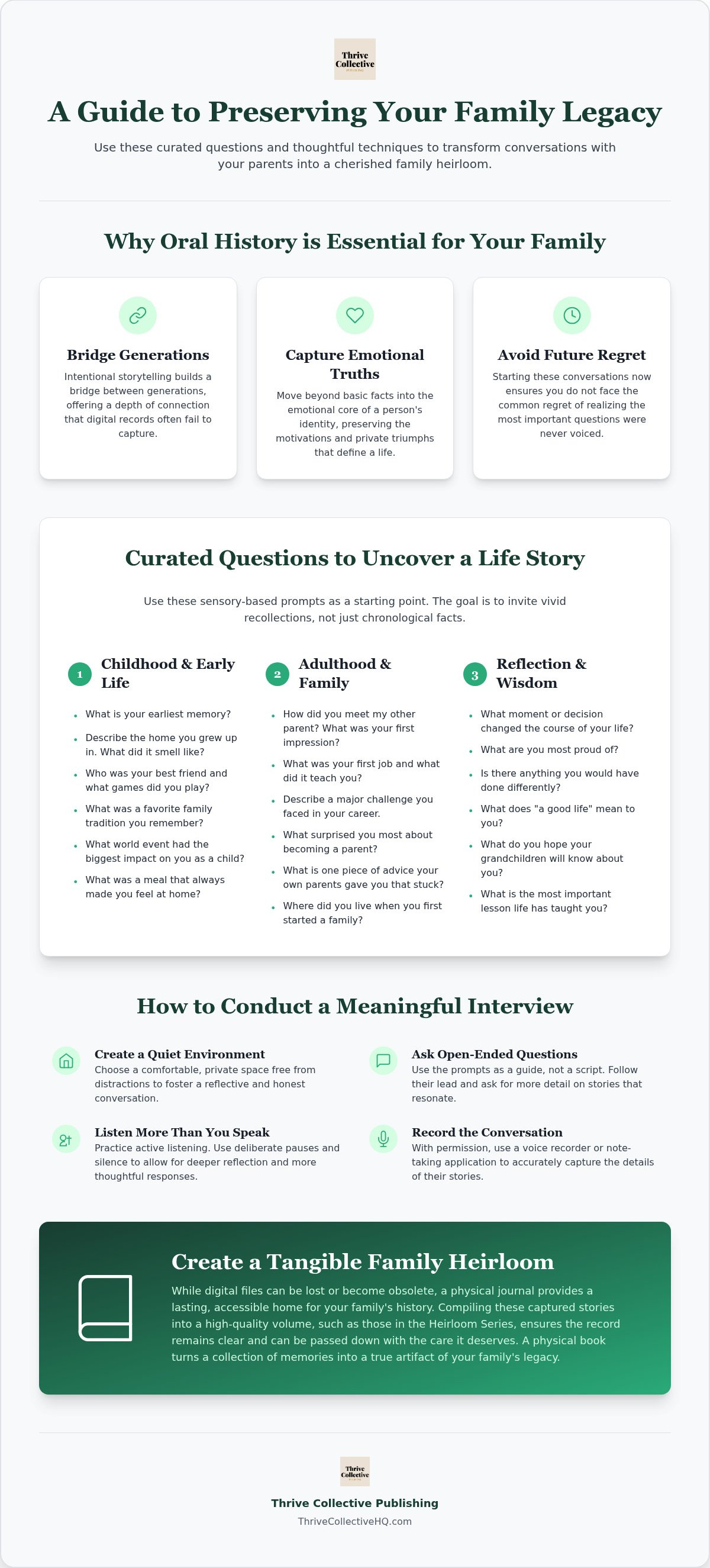
- Access 50 specific memory journal questions to ask your parents that utilize sensory details to draw out vivid memories of their early lives and formative influences.
- Document the transition into adulthood and parenthood through questions that highlight resilience, leadership, and the development of personal purpose.
- Master the art of the family interview by creating a quiet environment and using deliberate pauses to allow for more reflective and honest responses.
- Create a tangible family heirloom by preserving these captured stories in a physical journal (such as those in the Heirloom Series) to ensure the record remains accessible and clear.
Why are memory journal questions to ask your parents essential for legacy?
Legacy is not a passive inheritance but an active choice to curate the narratives that define our existence. It is the intentional act of passing down values, hard-won lessons, and lived experiences to the people who will carry your name forward. While we live in an era of digital abundance, many families find that their cloud storage and social media feeds lack the emotional depth required to truly understand a person's character. Using specific memory journal questions to ask your parents allows you to move past the surface of their lives and into the core of their identity. This process prevents the genealogical void, a common phenomenon where the specific motivations and private triumphs of a person are lost within just two generations.
At Thrive Collective Publishing, we view our titles as tools for facilitating this deep human connection. By engaging with these prompts, you are participating in a tradition of Oral history that bridges the gap between the past and the present. It turns a parent's life from a series of dates into a living narrative that can be touched and revisited. This is particularly evident in works like The Mother I Did Not Know by K.B. Cordova, where the search for maternal history reveals how much of a parent's internal world remains hidden until we ask the right questions.
To better understand the weight of these conversations, watch this helpful video:
The cognitive value of shared storytelling
Sharing narratives does more than just fill pages in a book; it strengthens family bonds by providing a sense of belonging for grandchildren and younger relatives. When a parent recounts their history, they are not just sharing facts but are offering a roadmap for resilience. Legacy is the rhythmic transfer of wisdom through generations. This storytelling acts as a vital form of reflection for parents as well, allowing them to see the full impact of their choices and the alignment of their purpose over time. It creates a collective identity that helps every family member feel more grounded in their own story.
Avoiding the regret of the unasked question
Many readers wait for a milestone, such as a major holiday or a specific anniversary, to begin asking these deep questions. Often, that milestone arrives too late or the clarity of memory has begun to fade. Intentionality requires setting aside specific, focused time for these exchanges rather than hoping they will happen naturally. There is a quiet authority in a parent's lived experience that deserves a dedicated, quiet space. Starting now ensures you don't face the common regret of realizing the most important questions were never voiced. To begin this process, many families utilize the The Heirloom Series to provide a structured home for these vital stories, ensuring the answers are preserved with the care they deserve.
Questions regarding childhood and early influences
Childhood memories act as the foundational blueprint for a parent's values, shaping their approach to leadership and community throughout their life. When you begin selecting memory journal questions to ask your parents, prioritize sensory details over simple chronologies. Ask about the specific weight of the winter blankets in their childhood bedroom or the exact sound of their father's car pulling into the driveway. These sensory anchors help bypass rehearsed stories and invite more authentic, vivid recollections. If you are just getting started with family history, beginning with the earliest years provides a logical entry point for the narrative. At Thrive Collective Publishing, we believe that understanding the atmosphere of a parent's childhood neighborhood, perhaps the scent of roasting piñon or the layout of a local park, reveals the cultural landscape that shaped their worldview.
Mentors play a quiet but powerful role in early development. Ask your parents about the specific individuals who guided them through their formative years. These early influences often explain the alignment between their childhood dreams and their eventual adult impact. Using these memory journal questions to ask your parents creates a bridge to a world that no longer exists, ensuring their early influences are never forgotten.
Foundational memories and traditions
Traditions are the rhythmic heartbeat of a family's history. These questions help uncover the intentionality behind the rituals you might still practice today:
- What was the most consistent tradition in your household during the holidays?
- Describe a meal from your childhood that immediately brings you back to your mother’s kitchen.
- How did your family spend Sunday afternoons or quiet evenings together?
Understanding these rituals provides a sense of continuity and belonging that anchors the family collective. It allows grandchildren to see their own lives as part of a longer, purposeful story.
Education and early ambitions
The dreams of a child often reveal the core essence of their character before the complexities of adult life intervene. These questions explore early mentors and intellectual guides:
- What did you dream of becoming before the realities of adulthood took hold?
- Was there a specific teacher or book that changed the way you viewed the world?
- Describe your first experience with a significant challenge or failure.
Exploring these early years often reveals the seeds of the stories found in our curated catalog of titles, where themes of resilience and self-discovery frequently appear. These early ambitions, even if they were never fully realized, provide deep insight into what your parents valued most when they were young. This section of your inquiry is often the most evocative, as it touches on the pure potential of their early lives, a theme often explored by imprints like Cordova Creations.
Questions about adulthood, career, and parenthood
Adulthood serves as the primary era where personal character is forged through the dual responsibilities of professional contribution and family stewardship. It is during these middle decades that your parents transitioned from being children themselves to becoming providers, leaders, and anchors for a new generation. When selecting memory journal questions to ask your parents, it is essential to explore the internal shifts they experienced as they balanced professional ambition with the quiet demands of home life. These stories often reveal the leadership core values that have guided their most difficult decisions and shaped the way they moved through the world.
In the catalog of Thrive Collective Publishing, we often see themes of professional evolution and personal sacrifice explored by authors like K.B. Cordova. Her title, The Mother I Did Not Know, serves as a poignant example of how much of a parent's adult struggle remains invisible to their children. Asking these questions creates a space for that invisible labor to be recognized and honored as part of your family’s collective history. It allows you to see your parents not just as caregivers, but as individuals who had to cultivate alignment between their work and their personal purpose.
Career paths and professional evolution
A person's career is often the primary laboratory for testing their integrity and resilience. These questions help you understand the professional landscape your parents managed and the lessons they brought home from the workplace:
- What was your first job, and what did it teach you about the value of a dollar?
- Describe a moment in your career when you had to stand up for your integrity, even if it was difficult.
- How did you manage the balance between professional ambition and family life during your busiest years?
The first job is rarely about the title; it is almost always about the discipline of showing up and the early realization of what it means to contribute to a community. Understanding these hurdles helps you see your parent as a developing leader who had to make intentional choices about their path.
The experience of parenthood
The transition into parenthood is perhaps the most profound shift in a person's identity, requiring a move from self-focus to the intentional cultivation of another human's potential. Use these memory journal questions to ask your parents to uncover their private thoughts on the realities of raising a family:
- What was the most surprising thing you learned about yourself after I was born?
- How did your parenting style differ from the way you were raised by your own parents?
- What is one thing you hope I never forget about our family as you move forward in your own life?
Parenthood often highlights the thrive versus survive dichotomy in its most literal form. By asking how their style differed from their upbringing, you allow them to reflect on the intentional choices they made to break cycles or preserve traditions. This provides a clearer picture of the legacy they aimed to build within the walls of your home.
How to conduct a meaningful family history interview?
A successful family history interview requires a distraction-free environment and an intentional focus on the emotional subtext of your parent's stories. While having a list of memory journal questions to ask your parents is a vital starting point, the quality of the record depends on your ability to hold space for vulnerability. Thrive Collective Publishing approaches the preservation of narrative as an editorial act, one that values the quiet moments of reflection as much as the spoken words themselves. You should aim to listen more than you speak, allowing for the pauses and silences that often precede the most profound revelations. We believe that no one succeeds in a vacuum, and capturing these stories is a way to strengthen the family collective.
Setting the scene for vulnerability
The physical environment dictates the depth of the conversation. Choose a location where your parent feels most at ease, such as their favorite armchair or a quiet corner of the garden, to encourage a sense of safety. Bringing physical artifacts like old photographs, a worn recipe card, or a piece of jewelry can act as a bridge to the past, prompting deeper memories than a question alone. Ensure the space is free from digital distractions; turn off televisions and place phones in another room to signal that this time is sacred. If you choose to record the session, always obtain explicit permission first and position the device so it does not interfere with the natural rhythm of your exchange.
The art of the follow-up question
A curated list of memory journal questions to ask your parents should serve as a guide rather than a rigid script. Your most important role is that of an active listener who notices when a parent’s voice changes or when they become particularly reflective. These are the moments to lean in with follow-up questions that explore the internal landscape of the event. Instead of asking for more facts, ask questions like "How did that feel at the time?" or "What were you thinking as you made that decision?" By inviting them to describe the "why" behind their actions, you help them move from surviving a memory to helping their legacy thrive through shared wisdom. This approach mirrors the narrative depth found in the Heirloom Series by Cordova Creations, where the focus remains on the soul of the story rather than just the timeline.
Why is a physical heirloom journal essential for family stories?
A physical journal provides a permanent, tangible artifact that preserves the emotional resonance of handwriting and ensures the record remains accessible without the risks of digital obsolescence. While you have curated your memory journal questions to ask your parents, the medium in which they answer is just as vital as the questions themselves. Digital records are often lost to forgotten passwords or hardware failure, but a book published by a serious independent press like Thrive Collective Publishing is designed to last for generations. We suggest selecting titles from the Heirloom Series to ensure these responses have a dignified and permanent home.
The choice of paper over a screen is supported by the cognitive case for paper, which suggests that handwriting fosters a deeper level of focus and reflection. When a parent uses a pen to record their history, they are forced to slow down, allowing for more intentional and thoughtful responses. This rhythmic pace is essential for the transition from simply surviving a conversation to helping a legacy thrive. Authors like K.B. Cordova often explore the weight of family history in their work, and a physical journal honors that weight by giving it a physical presence in your home.
The tactile benefit of handwriting
Seeing a parent's handwriting provides an immediate emotional connection that a typed font simply cannot replicate. The unique loops of their letters and the pressure of the pen on the page act as a secondary narrative, revealing their personality and presence in a way that digital data cannot. Handwriting requires a specific alignment of mind and body, leading to more authentic storytelling that mirrors the editorial standards we maintain at Thrive Collective Publishing. A physical journal becomes a permanent record that does not require a battery or a login; it remains always accessible to your children and grandchildren without the need for technical support.
Choosing the right journal for your family
When selecting a home for these stories, look for high-quality paper and durable binding that can withstand being handled for decades. The Heirloom Series, published by Cordova Creations, is designed to be a quiet companion to these deep conversations rather than a distraction. We suggest inviting your parent to fill out just a few pages at a time, making it a rhythmic habit rather than an overwhelming chore. By documenting the answers to your memory journal questions to ask your parents in a physical volume, you are creating a bridge between the past and the future that your family can hold in their hands.
Cultivating a Lasting Family Narrative
Honoring a parent's life story requires more than just curiosity; it demands a dedicated space for reflection and a commitment to preservation. By utilizing these memory journal questions to ask your parents, you are initiating a rhythmic transfer of wisdom that strengthens your family collective. We have discussed the importance of sensory-based inquiries and the art of the active listener, both of which move a conversation from simple facts to deep emotional truths. Thrive Collective Publishing, based in the literary heart of New Mexico, curates titles specifically for readers who value legacy and intentionality. Our journals are designed for multi-generational durability, ensuring that the alignment of your family’s values is never lost to time.
You have the unique opportunity to bridge the gap between the past and the future. By starting this process today, you ensure that the quiet authority of your parents' lived experiences will continue to inspire and guide the generations that follow. We are here to support your efforts in creating a beautiful, tangible record of the people who shaped your world.
Frequently Asked Questions
How do I start a conversation about family history with my parents?
Start by sharing your personal "why" and explaining that you value their perspective as a foundational part of your own identity. You might begin by bringing out a physical artifact, such as an old photograph or a family recipe, to serve as a natural icebreaker. Framing the request as a desire to learn from their wisdom rather than an interrogation helps create a comfortable atmosphere for sharing.
What if my parents do not want to talk about their past?
Respect their boundaries by starting with lighter, sensory-based topics rather than deep emotional or potentially painful events. If they hesitate, focus on daily life details like the music they enjoyed or the layout of their childhood home. You can always return to more complex subjects later once a rhythmic habit of storytelling has been established and they feel more secure in the process.
Is it better to record the interview or write the answers down?
Both methods offer distinct advantages, but we recommend a combination that prioritizes a permanent physical record. Recording an interview captures the unique cadence of a parent's voice, while transcribing those answers into a title from the Heirloom Series ensures the story survives digital obsolescence. Writing by hand also provides an emotional connection that a digital file simply cannot replicate for future generations.
What are the best questions to ask to evoke specific memories?
Sensory questions that focus on smells, sounds, and textures are the most effective tools for triggering vivid recollections. Instead of asking for a general history, use specific memory journal questions to ask your parents like "What was the specific scent of your grandmother's kitchen?" or "What music was playing in the house on Saturday mornings?" These prompts bypass rehearsed stories and invite more authentic, detailed memories.
How often should we meet to work on a memory journal?
Consistency is more important than duration, so aim for a rhythmic schedule that suits your parent’s energy levels, such as an hour once a week. Keeping sessions short prevents fatigue and ensures the experience remains an enjoyable connection rather than a daunting chore. This steady approach allows the narrative to grow naturally over time, mirroring the intentionality we value at Thrive Collective Publishing.
Can I use these questions for grandparents or other relatives?
Yes, these prompts are fully adaptable for any elder relative whose life story contributes to your family collective. The core themes of childhood influences, professional evolution, and personal values are universal across generations. Adapting these questions for aunts, uncles, or grandparents helps prevent a genealogical void and ensures a more comprehensive understanding of your family’s impact and legacy.
What should I do with the journal once it is finished?
Store the completed journal in a safe, climate-controlled environment where it is protected from light and moisture. While you might choose to scan the pages for digital backup, the physical original should be treated as a primary family artifact. Share the finished work during family gatherings to reinforce a sense of belonging and to show your parents the tangible impact of their shared wisdom.
Why is a physical journal better than a digital document?
A physical journal provides a tactile connection and a permanent record that does not require a battery, a login, or a specific software version to access. Handwriting reveals a parent’s personality through the unique loops and pressure of their pen, creating a true heirloom. Titles from Cordova Creations are designed for this exact purpose, offering the durability needed to thrive across multiple generations without the risk of digital corruption.

Article by
Kimberly Cordova
Kimberly Burk Cordova is the founder of Thrive Collective Publishing, an independent multi-imprint publishing house based in Santa Fe, New Mexico. She is the author of books on leadership, business growth, AI and automation, emotional intelligence, and personal development, written for readers who want clear thinking, useful frameworks, and books they actually finish.
Before turning her full attention to publishing, Kimberly spent more than two decades in strategy, operations, and program leadership, working with public agencies and private organizations on transformation, technology, and large-scale change. That operator's lens shows up in everything she writes and publishes: real frameworks, real numbers, no fluff.
As publisher, she leads a catalog of more than 80 titles from six authors across multiple imprints, spanning literary suspense, true crime, children's biography, relationships, travel, guided journals, and coloring books. The house publishes regularly across its core series, including The Casita Series, Shadows of the Past, the Young Legends Collection, The Growth Leader Collection, the AI and Automation Blueprint, The Heirloom Series, The Art of Manifestation, the Just Write Collection, and Travel: Destination Guides.
She lives in Santa Fe with her husband Greg, a self-taught silversmith and lapidary artist. When she is not writing or publishing, she is building Wildflower Artisans, their Turquoise jewelry brand, or curating the next round of Just Write journals.
Connect with Kimberly and Thrive Collective Publishing at thrivecollectivehq.com.